What Is Search Engine Marketing? 5 Key Components in 2026
Learn the five essential components of search engine marketing, understand SEO versus SEM, and build campaigns that drive measurable business growth.

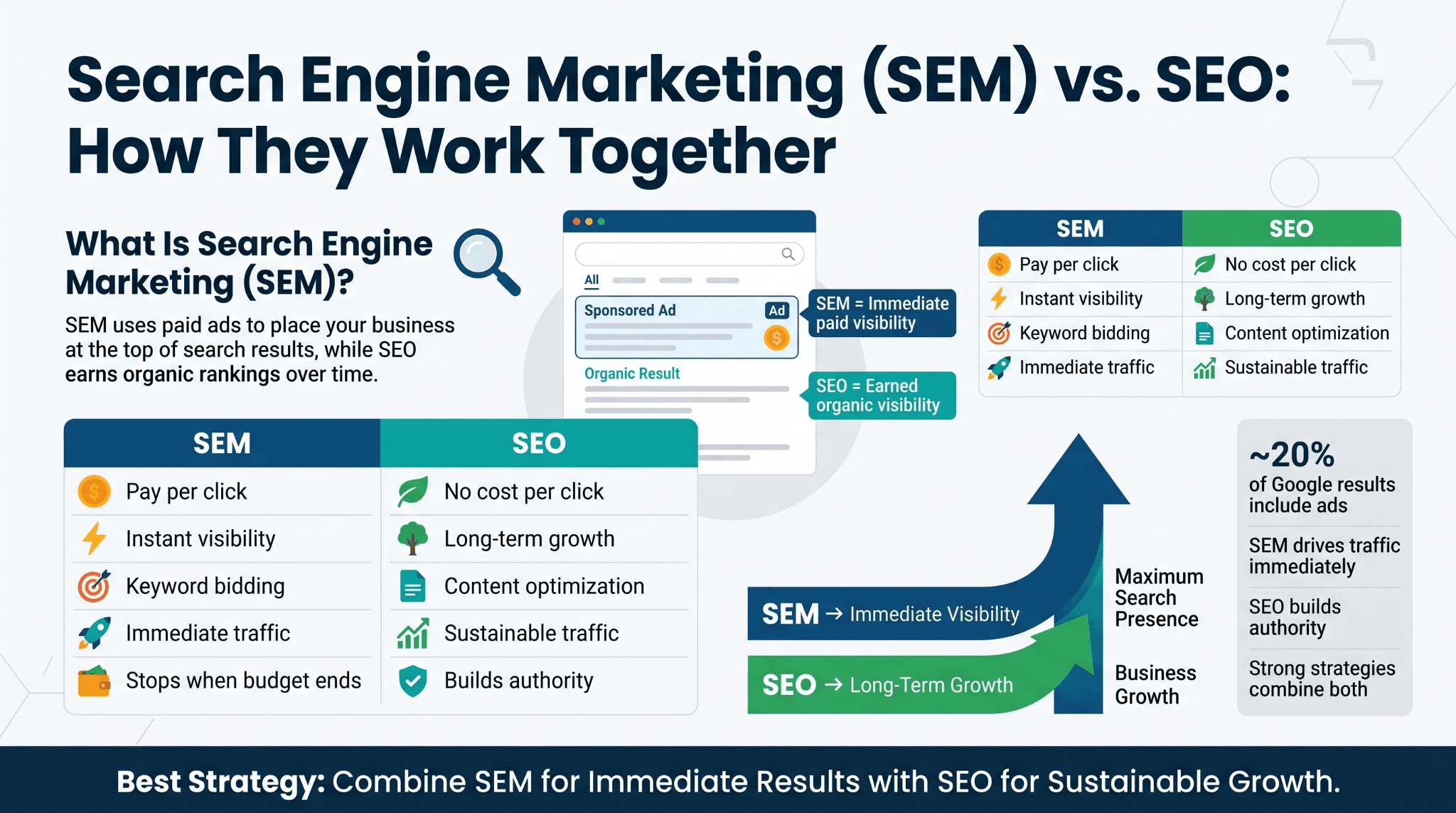
Search engine marketing is the practice of paying to appear in search engine results, primarily through pay-per-click advertising, to drive qualified traffic while organic rankings build over time. It works alongside SEO rather than replacing it. Together, they form a complete search visibility system rather than two competing channels.
For businesses trying to understand what search engine marketing actually involves, the confusion usually starts with terminology. SEO, SEM, and PPC are used interchangeably, even though each one plays a distinct operational role. This article breaks down the five components that make SEM function as a system, not a series of disconnected ad campaigns. Get a Proposal from WellsGroup's search and AI visibility team and see what a structured SEM system looks like for your business.
What Is Search Engine Marketing?
What is search engine marketing, in the simplest terms? It is paying a search engine, most often Google, to place your business at the top of results for specific search terms. Instead of waiting for organic ranking to improve, a business bids on keywords and pays each time someone clicks the ad.
SEM is the umbrella term. It includes paid search advertising, shopping ads, and, increasingly, visibility across AI-powered search surfaces. Organic SEO sits outside of SEM because it earns placement rather than paying for it.
Here is how SEM and SEO relate to each other in practice:
-
Google still displays ads on roughly 20 percent of all search results, according to WordStream's 2026 SEO statistics report, meaning the majority of the page remains organic
-
That is why businesses treat SEM as an accelerant, not a replacement for organic strategy
-
SEO builds compounding visibility over months, driven by content and technical optimization
-
SEM produces visibility the moment a campaign goes live, with no ramp-up period
-
The two are almost always run in parallel inside a mature marketing system, rather than treated as competing choices
Why Does Search Engine Marketing Matter for Businesses in 2026?
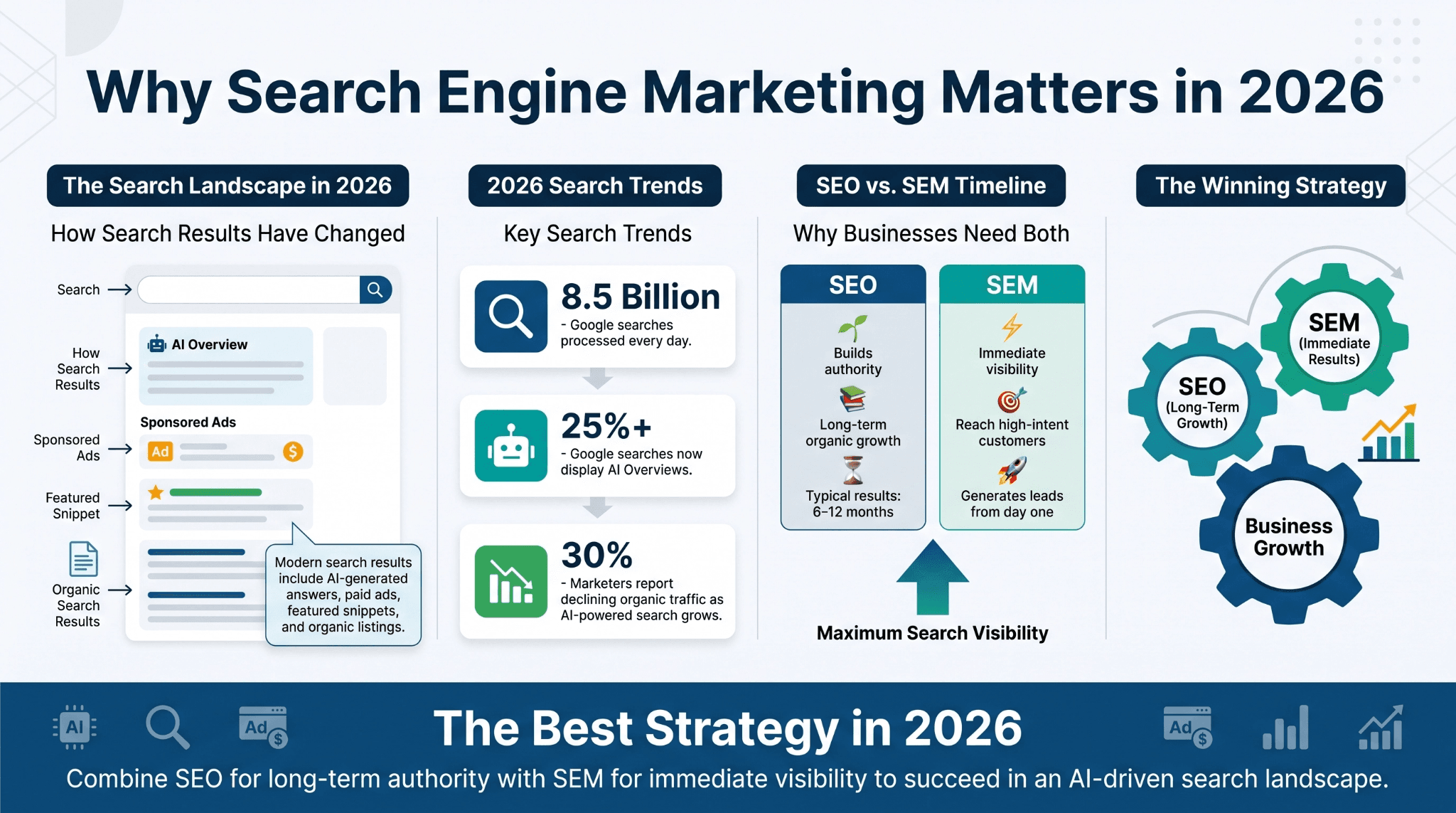
The search landscape in 2026 looks different from what it did even two years ago. Google now processes approximately 8.5 billion searches per day, and a significant share of those queries end without a single click, according to Colorlib's 2026 search engine statistics report. Zero-click behavior, driven by AI Overviews and featured snippets, has changed how businesses need to think about visibility.
Consider a new logistics company launching in a competitive metro market. Organic SEO could take six to twelve months to produce meaningful rankings for high-value keywords. That timeline does not match the reality of needing bookings this quarter. Search engine marketing closes that gap by putting the business in front of ready-to-convert searchers immediately.
A few forces are shaping SEM's role in 2026 specifically:
-
AI Overviews now appear on more than 25 percent of Google queries, compressing the organic click-through rate even for well-ranked pages, per Colorlib's 2026 data.
-
Over 75 percent of marketers plan to increase or maintain their investment in search and display ads this year, according to HubSpot's 2026 State of Marketing Report.
-
Nearly 30 percent of marketers report decreased organic search traffic as users shift toward AI tools, based on the same HubSpot report.
These shifts do not mean SEM has become more important than SEO. They mean businesses need both systems working together, with paid visibility filling the gaps that organic alone cannot cover in a zero-click search environment.
What Are the 5 Key Components of Search Engine Marketing?
Search engine marketing is not a single activity. It is a system made up of five interdependent components, and weakness in any one of them undermines the others. A well-built SEM operation treats these as connected parts of a pipeline, not isolated tasks assigned to different people.
Keyword Research and Search Intent
Every SEM campaign starts with understanding what people actually type into a search bar and why. A keyword like "auto transport quote" signals someone ready to buy, while "how does car shipping work" signals someone still researching. Matching the right ad to the right intent is what determines whether a click turns into a customer.
Paid Search Advertising (PPC)
Pay-per-click advertising is the operational engine behind search engine marketing. A business only pays when someone clicks the ad, and the ad's position is determined by a combination of bid amount and relevance. This is also the component most commonly outsourced to search engine marketing services, since managing bids, ad copy, and account structure at scale requires dedicated attention.
Landing Page Optimization
An ad that earns a click but sends the visitor to a slow or irrelevant page wastes the spend that went into winning that click. The landing page needs to match the exact promise made in the ad, load quickly, and make the next step obvious. Google also factors landing page experience into Quality Score, which directly affects cost per click.
Bid Management and Budget Strategy
Not every keyword deserves the same budget. Businesses need a system for deciding where to bid aggressively and where to hold back, based on how valuable each conversion is. A keyword with high commercial intent and low competition often delivers more return than an expensive, broad term with unclear buyer intent.
Performance Tracking and Search Engine Marketing Analysis
Search engine marketing analysis is the practice of continuously reviewing clicks, conversions, and cost per result to determine what is actually working. Without this component, the other four operate blindly. Analysis is what turns a campaign from a one-time expense into a system that improves over time.
What Is the Difference Between SEO and SEM?
The difference between SEO and SEM comes down to how visibility is earned versus purchased. SEO is the process of improving organic rankings through content, technical optimization, and backlinks. SEM includes SEO's paid counterpart, primarily PPC advertising, where placement is bought rather than earned.
The table below breaks down the practical differences businesses run into most often.
|
Factor |
SEO |
SEM |
|
Cost structure |
No direct cost per click |
Pay per click, ongoing spend |
|
Time to results |
Weeks to months |
Immediately upon launch |
|
Longevity |
Compounds over time |
Stops when the spend stops |
|
Control over placement |
Limited, algorithm-dependent |
Direct, based on bid and budget |
|
Best suited for |
Long-term authority building |
Immediate, measurable visibility |
Neither approach replaces the other. Organic search still drives more than 53 percent of overall website traffic on average, according to WordStream's 2026 statistics, which means SEO remains the larger long-term asset. SEM exists to cover the gap while that asset is being built and to capture high-intent searches that organic alone may not reach quickly enough.
How Do Search Engine Marketing Services Support Business Growth?
Most businesses do not have the internal bandwidth to manage keyword research, bid strategy, ad creative, and analysis simultaneously while also running the rest of their operations. This is where search engine marketing services come in, providing the structure and ongoing attention that SEM requires to stay effective.
A properly run SEM service typically includes:
-
Strategic keyword and competitor research tied to actual buyer intent
-
Campaign structuring across search, shopping, and display formats
-
Ongoing bid and budget management based on performance data
-
Continuous search engine marketing analysis to reallocate spend toward what converts
The value of search engine marketing services is not the ads themselves. It is the discipline of treating SEM as an operating system that gets reviewed and adjusted weekly, rather than a campaign that gets set up once and left alone.
How Should Businesses Approach Search Engine Marketing Analysis?
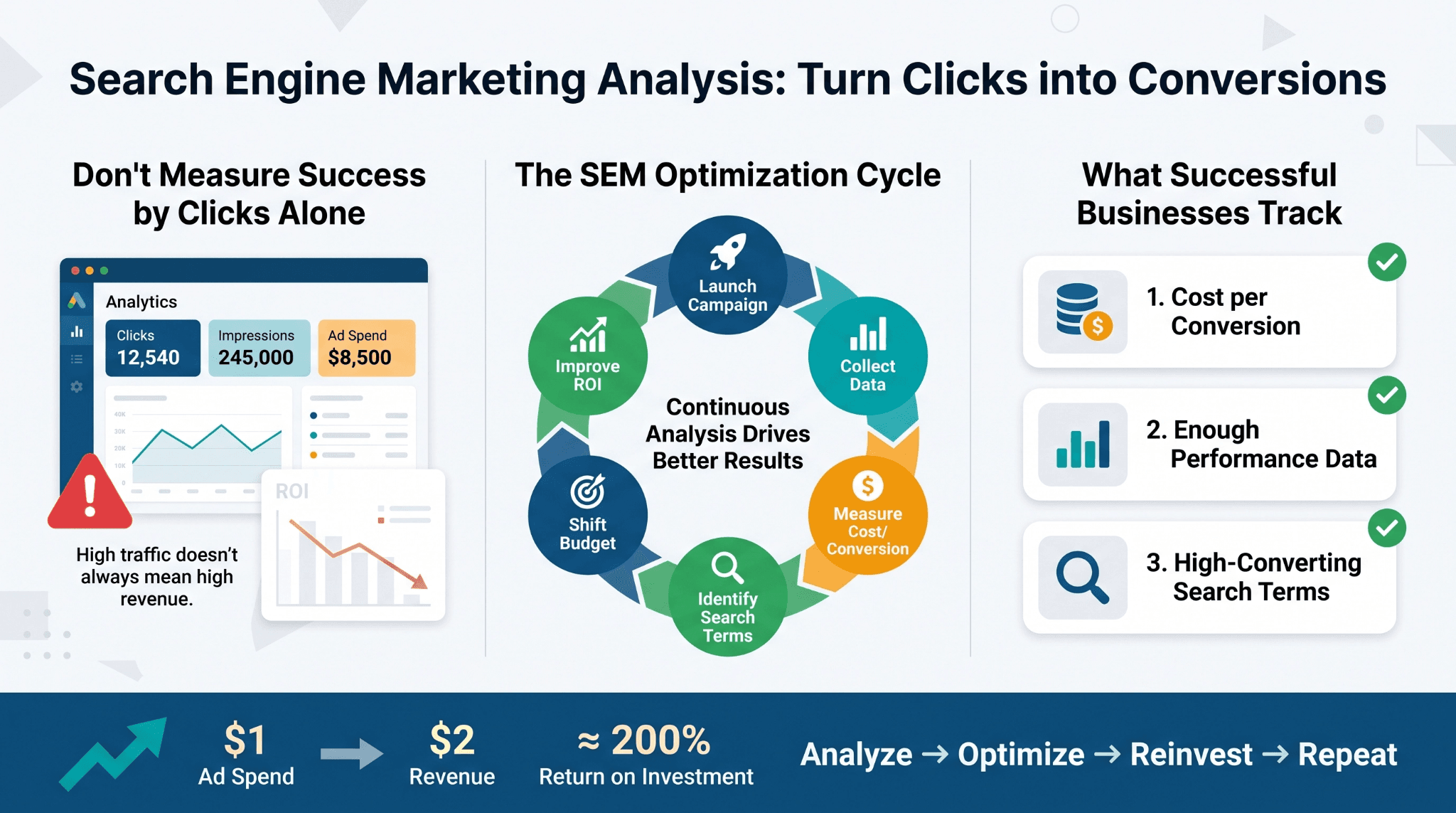
Search engine marketing analysis is where most businesses either compound their results or quietly waste their budget. The most common mistake is judging performance by clicks or impressions alone, which say nothing about whether those clicks turned into actual customers.
A few patterns consistently separate businesses that improve their SEM results from those that plateau:
-
Tracking cost per conversion instead of cost per click, since a cheap click that never converts is more expensive than an expensive one that does
-
Giving campaigns enough time to gather statistically meaningful data before making changes, rather than pausing keywords after a few days
-
Reviewing which specific search terms triggered conversions, not just which campaigns were active
Wordstream's 2026 data shows that well-optimized PPC campaigns can return roughly $2 for every $1 spent, a 200 percent return. That kind of return is not automatic. It comes from consistent analysis that reallocates budget away from underperforming terms and toward the ones producing real conversions.
What Businesses Usually Ask About Search Engine Marketing
A few questions come up consistently when businesses first evaluate whether SEM fits their growth plan. Here are direct answers to the most common ones.
Is search engine marketing the same as advertising?
SEM is a specific form of digital advertising focused on search engine results, typically through pay-per-click auctions. Broader digital advertising also includes social media ads, display banners, and video, which operate on different platforms with different bidding systems.
How much does search engine marketing cost?
Cost varies widely by industry and competition, with the average cost per click on Google Ads sitting around $1.16 across all industries, though competitive sectors can run significantly higher, according to Meetanshi's 2026 SEM statistics report. Most businesses set a monthly budget and let the bid strategy determine spend within that ceiling.
Can small businesses use search engine marketing effectively?
Yes, particularly because SEM allows precise budget control and geographic targeting. A small business can often compete effectively against larger competitors on specific, less contested keywords where intent is high and competition is lower.
Does search engine marketing help with visibility on AI search tools like ChatGPT and Gemini?
Indirectly, yes. The structured content and clear entity signals that improve PPC quality scores also make a business easier for AI systems to cite. WellsGroup builds SEM and AI search visibility together for exactly this reason.
How long does it take to see results from search engine marketing?
Most campaigns show measurable traffic within one to two weeks, with conversion data stabilizing around three to four weeks. Businesses that actively manage this ramp-up period, rather than checking in monthly, typically see stronger long-term returns.
Turn Search Engine Marketing Into a Growth System
Search engine marketing in 2026 is no longer just about winning a click on a traditional results page. With AI Overviews now appearing on more than a quarter of Google queries, and zero-click searches becoming the norm rather than the exception, visibility is shifting toward a broader set of surfaces, including AI-generated answers and conversational search tools like ChatGPT and Gemini.
The five components covered here, keyword research, PPC execution, landing page quality, bid strategy, and performance analysis, remain the foundation. What is changing is the environment they operate in. Businesses that treat SEM as a connected system, reviewed continuously and integrated with their broader SEO and content strategy, are the ones positioned to stay visible as search itself continues to evolve.
If you are ready to build a search engine marketing system that adapts to where search is actually heading, book a free consultation with WellsGroup's team.