Local SEO and AI Search Visibility Ranking Factors: Your 2026 Local SEO Checklist
Master the 2026 local SEO checklist: optimize Google Business Profiles, reviews, citations, location pages, and AI search visibility.

A home services company in Phoenix ranks in the top three on Google Maps. Their profile looks complete. Their reviews are solid. Yet a competitor with fewer reviews and a newer website is appearing in Google AI Overviews and getting cited by ChatGPT when someone asks "best HVAC company near me." That is not a coincidence. It is a signal that the rules of local search have shifted.
Local search in 2026 is no longer a single channel. It is a layered visibility system operating across Google Maps ranking, AI Overviews, ChatGPT, Perplexity, Gemini, and Apple Maps simultaneously. A practical local SEO checklist for 2026 must address all of these surfaces, not just the ones that were relevant two or three years ago. Get a proposal from WellsGroup and find out what a fully managed local SEO and AI visibility system can deliver for your business.
Google Business Profile Optimization: The Foundation of Every Local SEO Checklist
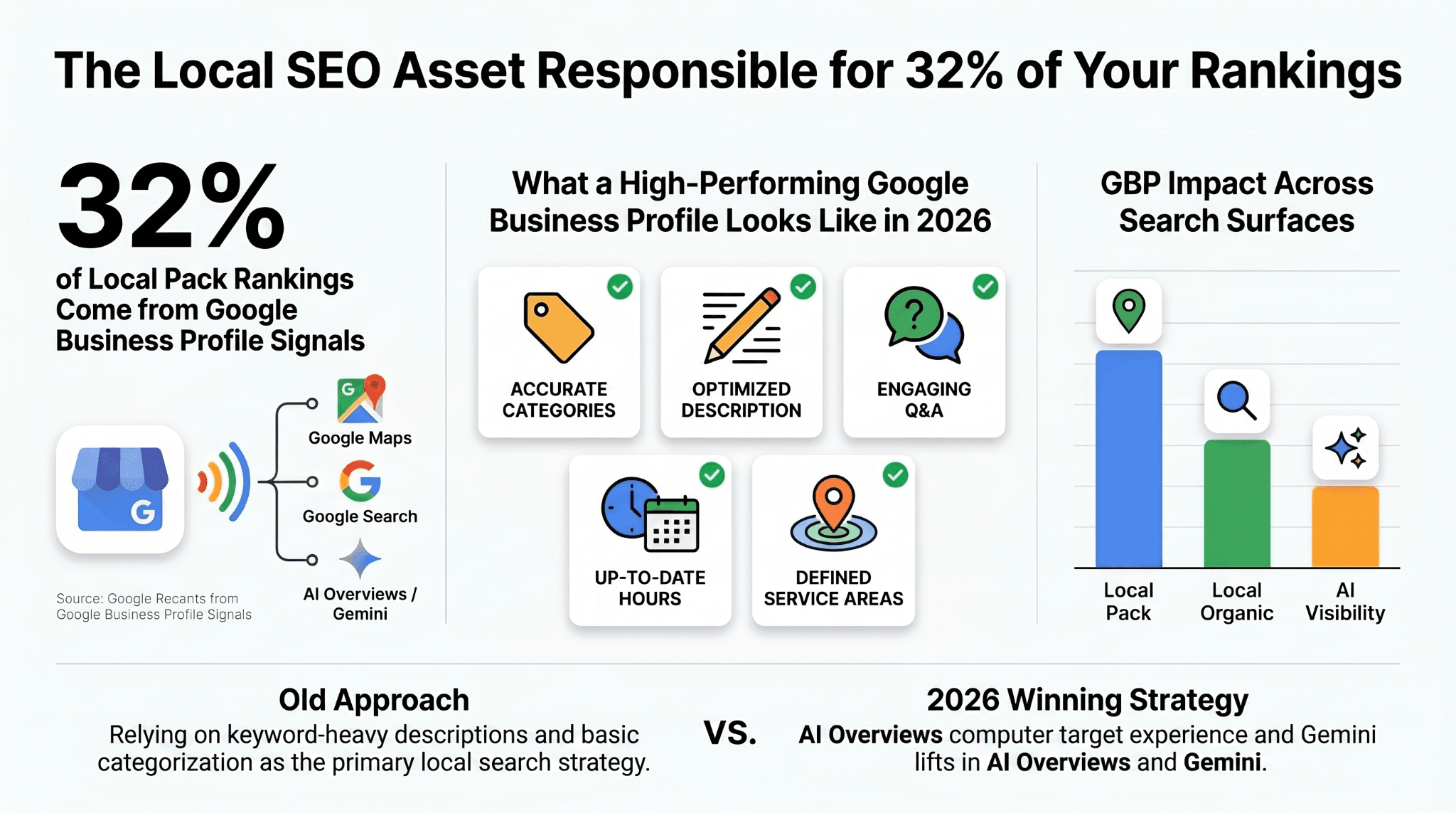
According to Whitespark's Local Search Ranking Factors survey, Google Business Profile signals account for 32% of what determines your local pack ranking, making it by far the single most impactful area to focus on.
Most businesses set up their GBP once and leave it. That approach worked in 2020. In 2026, it actively costs rankings. Google now treats GBP as a structured data source for both local pack rankings and AI-generated answers. The same profile that earns a map pack position is also the one cited in Google AI Overviews, Gemini responses, and localized ChatGPT results.
Google Business Profile optimization is no longer a setup task. It is an ongoing operational commitment.
What a 2026-Ready Google Business Profile Actually Looks Like
Most profiles are incomplete in ways that are not immediately obvious. A missing secondary category, an outdated service area, or an empty Q&A section can all suppress rankings without the business owner realizing it.
Every item on this part of the local SEO checklist directly affects how Google ranks and cites your profile. The elements that separate a high-performing GBP from an average one in 2026 are:
-
Primary and secondary categories that precisely match the core service, not the broadest available option
-
Keyword-aligned business description written for both human readers and AI systems
-
Q&A section seeded with 10 to 15 keyword-relevant answers that feed Google AI Overview responses directly
-
Business hours kept accurate and updated for holidays, since being open when a user is searching is among the most important local pack ranking signals in 2026
The table below shows how GBP signals compare across key ranking surfaces in 2026, based on Whitespark's 2026 Local Search Ranking Factors survey:
|
Ranking Surface |
GBP Signal Weight |
Primary Driver |
|
Local Pack / Maps |
32% |
Category, completeness, proximity |
|
Local Organic |
Lower than Pack |
On-page and GBP alignment |
|
AI Visibility |
High citation rate |
Structured data, Q&A, NAP match |
NAP Consistency and Local Citation Building Across Every Platform
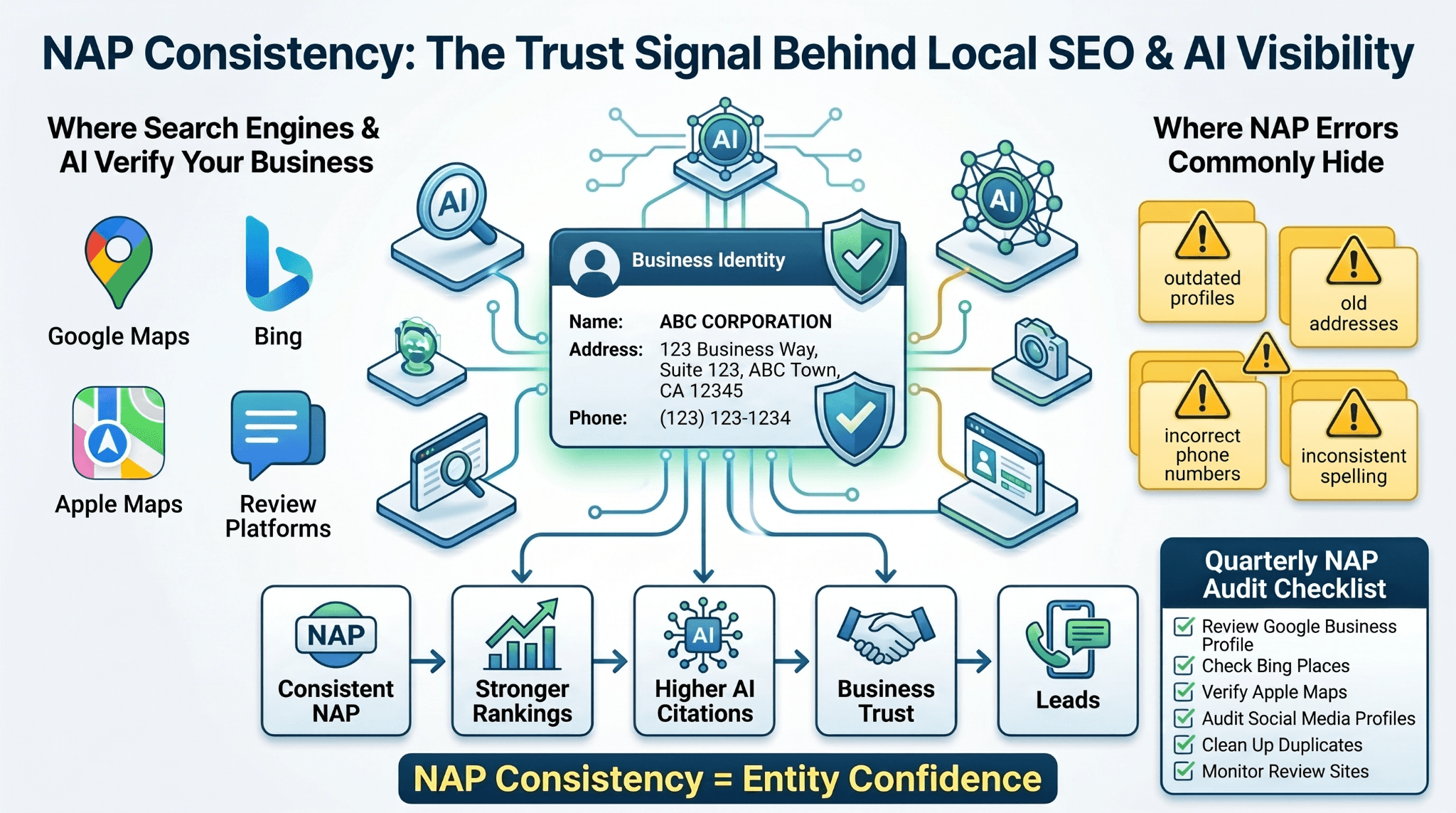
NAP stands for Name, Address, and Phone number. It is the foundational identity layer that search engines and AI systems use to verify a business is real, active, and located where it claims to be.
In earlier years, NAP consistency was primarily a Google concern. In 2026, the scope has expanded significantly. Answer engines and generative AI systems now pull local business details from a wider set of sources, including ChatGPT, Gemini, Perplexity, Apple Maps, Bing Places, Yelp, industry directories, and publisher sites. A discrepancy that doesn't cause a visible drop in Google rankings today can still prevent a business from being cited by AI systems tomorrow.
NAP consistency is not a one-time fix. It is an ongoing maintenance layer that requires quarterly auditing as the business evolves.
Where NAP Inconsistencies Hide and How to Find Them
NAP errors do not usually appear on primary platforms. They accumulate silently across secondary directories, aggregator sites, and old social profiles that were created and forgotten.
The most common sources of NAP inconsistencies are:
-
Data aggregators such as Neustar Localeze and Foursquare, which distribute business data to hundreds of downstream directories automatically
-
Old social media profiles carrying outdated addresses or phone numbers
-
Industry-specific directories listed once and never updated after a business change
-
Review platforms like Yelp, where business owners rarely log in after initial setup
Consistent NAP data across platforms measurably improves local rankings and builds the entity confidence that both Google and AI systems rely on to recommend a business. A quarterly audit using tools like BrightLocal or Whitespark is the operational standard for local SEO for small businesses that want to maintain accurate citation profiles at scale.
Online Reviews Are a Ranking Signal, Not Just a Trust Badge
Most businesses treat online reviews for local SEO as a reputation management issue. In 2026, that framing undersells their importance. Reviews are an active ranking signal, and what matters most is review velocity, response rate, and the relevance of keywords within review text.
A business with 200 reviews collected over four years being outranked by a competitor with 40 reviews from the last six months is not an anomaly. It is the algorithm functioning exactly as designed. Any serious local SEO checklist must treat review velocity as a non-negotiable ranking input, not an afterthought.
Building a Review Velocity System That Works Without Incentivizing
Review velocity refers to the consistent, ongoing accumulation of new reviews rather than a one-time surge followed by a long silence. A compliant, repeatable process looks like this:
-
Trigger the request at the right moment, after a completed service or resolved support interaction, not at the time of purchase
-
Use a direct link to the GBP review form rather than asking customers to find it themselves
-
Respond to every review within 48 hours, including negative ones, since businesses that maintain a high response rate see measurable ranking improvements
-
Vary the platforms where reviews are requested, covering Google, Bing, and industry-specific directories
For local SEO for service businesses, review keywords matter too. When customers organically mention service types or location names in their review text, it reinforces relevance signals for those specific queries.
Location Page SEO and Local Keyword Research for Service Areas
A service-based business operating across multiple cities cannot rank meaningfully using a single generic "Service Areas" page. In 2026, dedicated location pages are the infrastructure requirement for ranking in both local organic results and AI-driven search.
Each location page functions as a standalone signal: a structured, locally relevant document that tells both Google and AI systems what the business does, where it does it, and why it is trustworthy in that area.
How to Structure a Location Page That Ranks in 2026
A location page that ranks is not a city name dropped into a template. It answers the specific questions a local searcher is likely to ask, in language AI systems can extract and cite.
The core architecture includes:
-
City-specific H1 headline that includes the primary service and location naturally
-
Localized body content covering service specifics and real customer outcomes in that area
-
FAQs in plain language, structured for passage-level targeting so AI Overviews can pull direct answers
-
Embedded map and schema markup confirming NAP data in machine-readable format

Local Keyword Research for Service-Based Businesses
Near me, search optimization in 2026 is less about exact phrase matching and more about intent alignment. The queries AI systems pull from for local recommendations are often question-based rather than keyword-based.
The following framework helps prioritize content investment for location page SEO effectively:
|
Keyword Type |
Example |
Build a Page |
Add to Existing Content |
|
City plus service |
"Cloud IT support Chicago." |
Yes |
Yes |
|
Near me modifier |
"managed IT near me." |
No |
Yes |
|
Question-based query |
"Who manages CRM in Austin?" |
Yes (FAQ format) |
Yes |
|
Neighborhood modifier |
"IT services River North." |
Only if high volume |
Yes |
Local keyword research for service businesses should start with city-plus-service combinations, then layer in question-based modifiers that reflect how customers actually speak when asking AI tools for recommendations.
AI Search Visibility Is Now a Standalone Local SEO Checklist Item
For most of the past decade, ranking in local search meant ranking in Google. That is no longer a complete strategy. AI search visibility has emerged as a distinct ranking surface that operates alongside Google Maps and organic results.
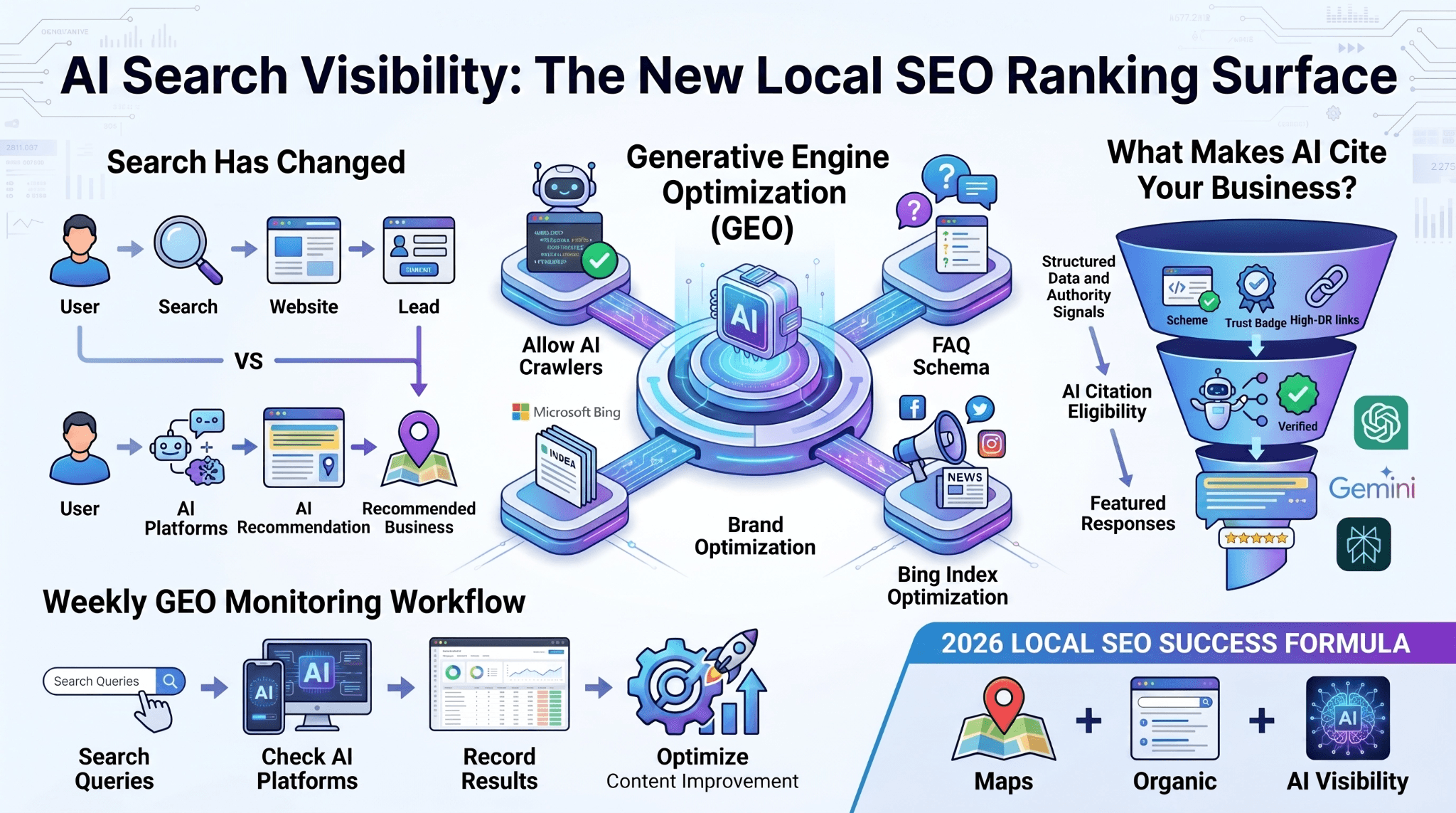
Generative Engine Optimization (GEO) is the practice of optimizing content to appear as sources and citations in AI-generated responses from platforms like ChatGPT, Perplexity, Google AI Overviews, and Claude. For local businesses, this means appearing when someone asks an AI tool for a service recommendation rather than typing it into a search bar.
What Generative Engine Optimization Means for Local Businesses
GEO is not a separate discipline that competes with traditional local SEO. It is an extension of it. Content that already ranks well in organic search tends to perform well in AI Overviews. Strong on-page SEO, structured data, and authoritative third-party mentions carry over from traditional rankings into AI citation eligibility.
The practical steps for local GEO implementation are:
-
Allow AI crawlers in robots.txt, so platforms like ChatGPT and Perplexity can access local pages
-
Implement FAQPage schema in JSON-LD format on all location and service pages to align content format with how AI engines search for conversational answers
-
Build brand mentions on authoritative third-party sources, including industry publications and local news
-
Submit your sitemap to Bing Webmaster Tools to improve ChatGPT Search visibility, since ChatGPT is retrieved through Bing's index
How to Track AI Search Visibility for Local Queries
Tracking GEO performance requires a different approach from traditional rank tracking. Run core service and location queries directly in ChatGPT, Perplexity, Google AI Mode, and Gemini. Record whether your business is cited, how it is described, and which competitors appear instead.
If a competitor consistently appears and you do not, the gap is usually one of three things: structured data, authoritative third-party mentions, or content clarity on location pages. For scaling businesses, GEO ensures your content gets cited when AI engines answer user questions, and monitoring that citation share is a weekly operational discipline, not a monthly review.
What Local Business Owners Are Asking About SEO and AI Visibility in 2026
The questions below reflect the most common decision points that service-based businesses encounter when taking local SEO seriously in 2026.
How long does local SEO take to show results?
GBP optimizations and NAP corrections can show ranking impact within 30 to 90 days for lower-competition queries. Review velocity improvements take two to three months. AI search visibility gains from GEO implementation typically appear in citation monitoring within 60 to 90 days of structured data deployment.
Does AI search require completely separate optimization from Google?
Not entirely. The same signals that strengthen Google rankings also improve AI citation eligibility. The additional layers required are FAQPage schema, third-party brand mentions, and AI crawler access. WellsGroup manages both as a unified system rather than separate workstreams.
What is the single most important action for a business starting local SEO from scratch?
Start with the Google Business Profile. GBP signals account for 32% of local pack ranking weight, making it the highest-leverage entry point for any local SEO checklist. Everything else builds on top of it.
How does local SEO for small businesses differ from larger brands?
For small businesses, depth beats breadth. One fully optimized location page, a clean GBP, and a consistent review velocity system will outperform a scattered multi-location setup with weak signals everywhere. WellsGroup applies enterprise-grade operational discipline to the focused scope of a growing business, which is where the performance gap closes fastest.
Local SEO in 2026 Is a System, Not a One-Time Setup
The businesses winning in local and AI search are not the ones who set up a profile years ago and moved on. They are treating local search as a continuous operational system: active GBP management, consistent NAP monitoring, a structured review process, dedicated location pages, and AI visibility tracking running in parallel.
Each factor in this local SEO checklist amplifies the others. A strong GBP feeds AI citation eligibility. Consistent NAP reinforces entity confidence across all platforms. Review velocity improves both local pack rankings and the trust signals AI systems rely on to recommend a business by name.
The technical work is manageable. The operational discipline is where most businesses fall short. Get a proposal from WellsGroup and find out what a fully managed local SEO and AI visibility system can deliver for your business.