Technical SEO Checklist Every Website Needs in 2026
Technical SEO in 2026 goes beyond rankings. Learn the essential checklist for crawlability, speed, schema, mobile compliance, and AI visibility.

A technical SEO checklist is a structured set of checks that ensures search engines can find, crawl, render, and rank your website correctly. In 2026, it will also determine whether AI systems like Google AI Overviews and ChatGPT Search can extract and cite your content. Without it, even well-written pages remain invisible.
Most websites have technical issues they are not aware of. Crawl blocks, slow load times, missing schema, and mobile indexing gaps quietly suppress rankings month after month. This technical SEO checklist covers every layer your site needs to pass in 2026, from foundational crawl health to AI search readiness, so nothing is left to chance.
WellsGroup conducts technical SEO audits that cover all five layers: crawl health, Core Web Vitals, schema, mobile compliance, and AI search readiness. Get a proposal or book a free consultation to find out exactly what is holding your site back.
What Is Technical SEO and Why Does It Still Matter in 2026?
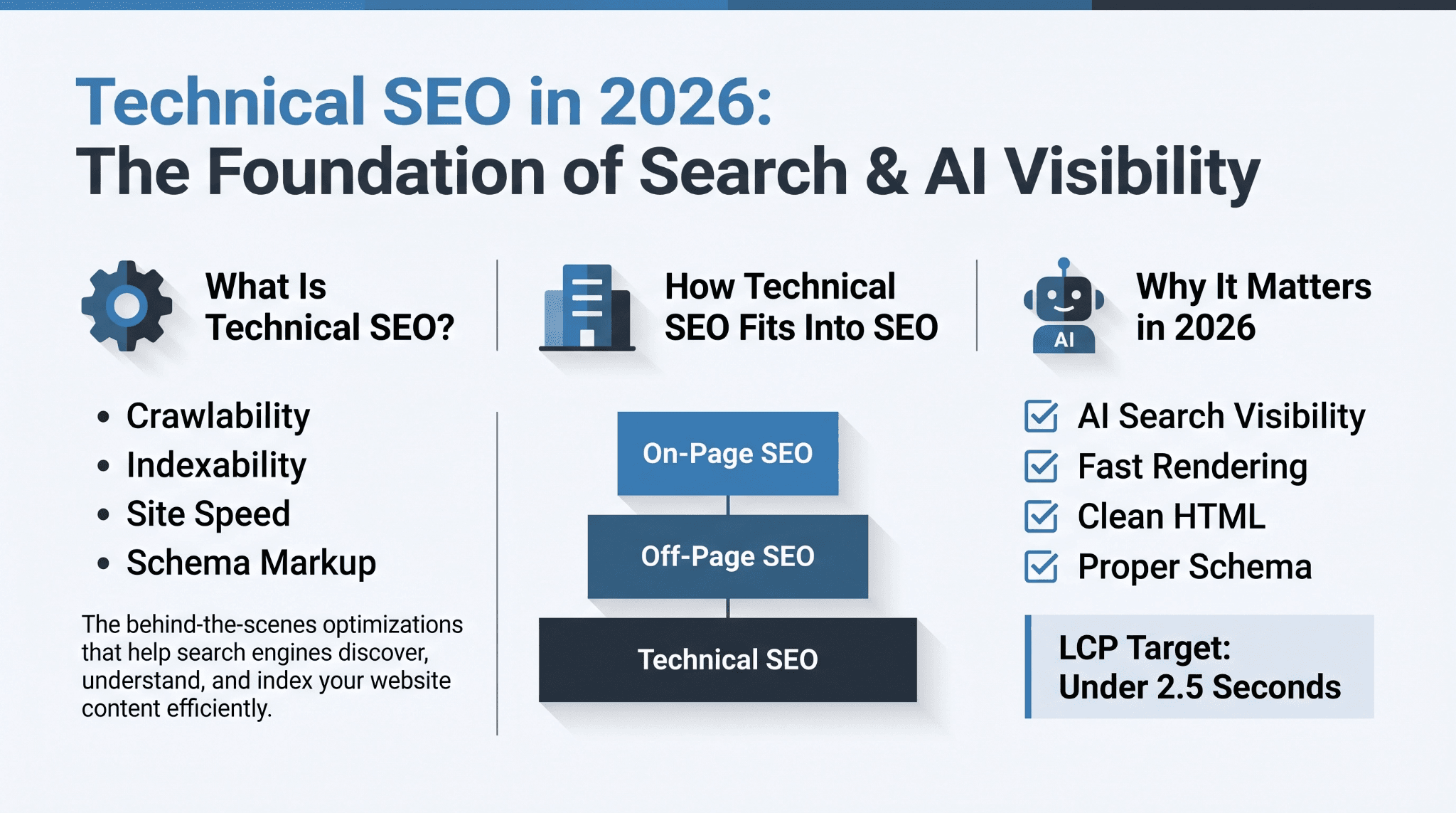
Technical SEO is the practice of optimizing the structural layer of a website so search engines can access it without friction. It has nothing to do with what you write and everything to do with how your site is built, delivered, and read by machines.
Understanding what is technical SEO means recognizing it sits underneath all other SEO work. On-page optimization and link building have limited impact if the crawl layer is broken.
How Is Technical SEO Different From On-Page and Off-Page SEO?
Think of your website as a building. On-page SEO is the interior, content, headings, and copy. Off-page SEO is the reputation, backlinks, and mentions. Technical SEO is the foundation and wiring. No matter how well-decorated a building is, if the structure is unsound, nothing else holds.
Why Is Technical SEO More Critical Now Than It Was Five Years Ago?
Between 2020 and 2024, technical SEO was largely about crawl checks and speed benchmarks. By 2026, it directly governs AI search visibility. Google AI Overviews, Gemini, and ChatGPT Search extract content from cleanly rendered, well-structured HTML. Pages with broken structure or missing schema are excluded from AI-generated answers regardless of content quality.
According to Google Search Central documentation, the qualifying threshold for a "good" Largest Contentful Paint score is under 2.5 seconds, measured at the 75th percentile of real user data. Pages that miss this benchmark are at a structural disadvantage in both mobile rankings and AI citation eligibility.
What Should a Technical SEO Checklist Cover in 2026?
A modern technical SEO checklist is not a single-pass task list. It is a recurring operational framework that a technical SEO specialist or consultant would run on a scheduled basis, quarterly at minimum, and after every significant site change.
The checklist spans five interconnected layers. Fixing one without addressing the others produces incomplete results.
The table below maps each layer to its function and primary audit tools:
|
Checklist Layer |
Primary Function |
Audit Tools |
|
Crawlability and Indexing |
Ensure pages are accessible to Googlebot |
Search Console, Screaming Frog |
|
Page Speed and Core Web Vitals |
Meet LCP, INP, and CLS thresholds |
PageSpeed Insights, GTmetrix |
|
Site Structure and Schema |
Support navigation and AI extraction |
Ahrefs, Rich Results Test |
|
Security and Mobile Standards |
HTTPS and mobile-first compliance |
Search Console, SSL Labs |
|
AI Search Readiness |
Structured content for AI citation |
Schema validators, HTML audit |
Is Your Website Crawlable and Indexable by Search Engines?
Crawlability is the entry point of any seo technical audit. Before Google ranks a page, Googlebot must find it, request it, and read it cleanly. A single misconfigured robots.txt file or an accidentally applied noindex tag can remove an entire section from search results with no visible frontend error.
Most businesses discover crawl issues only after a traffic drop, by which point months of damage have accumulated.
How Do You Check If Google Can Crawl Your Pages?
Start in Google Search Console. The Coverage report shows which pages are indexed, which are excluded, and why. Run these checks every audit cycle:
-
Review robots.txt at yourdomain.com/robots.txt, confirm no critical directories are blocked
-
Submit an updated XML sitemap containing only indexable, canonical URLs
-
Use the URL Inspection tool to test how Google renders individual pages
-
Check for redirect chains longer than two hops, which dilute crawl efficiency
What Is Crawl Budget and Does It Affect Smaller Websites?
Crawl budget is how many pages Googlebot will crawl in a given timeframe. For small sites, it rarely limits performance. The problem emerges when thin content, URL parameters, or auto-generated filter pages multiply crawlable URLs into the thousands, consuming budget before Googlebot reaches pages worth ranking.
The fix: noindex low-value pages and consolidate duplicates with canonical tags.
How Fast Does Your Website Need to Be to Rank in 2026?
Page speed is both a ranking signal and a citation signal. AI systems like Google AI Overviews pull from pages that render cleanly and quickly. A slow-loading page may be crawlable but still invisible in AI-driven environments.
What Tools Measure Core Web Vitals and Site Speed?
Every technical SEO audit should include these three tools:
-
Google PageSpeed Insights provides lab and field data from the Chrome User Experience Report (CrUX), the closest approximation to what Google uses for ranking
-
Search Console Core Web Vitals Report shows real-user data aggregated by URL cluster; use it to prioritize which page templates need the most work
-
GTmetrix diagnoses render-blocking resources, image issues, and server response times in waterfall format
Target scores: LCP under 2.5 seconds, INP under 200 milliseconds, CLS under 0.1, across at least 75% of real user sessions.
What Is INP and Why Did Google Replace FID With It?
Interaction to Next Paint (INP) replaced First Input Delay (FID) as a Core Web Vital in March 2024. FID measured only the delay before the browser began processing the first interaction. INP measures the full response time for every click, tap, and keypress throughout the session, a far more accurate signal of how responsive a page feels in practice.
To check INP: open the Core Web Vitals report in Search Console and filter by "Poor INP" URLs. Pages above 500 milliseconds need immediate attention.
Is Your Website Structured in a Way Search Engines Understand?
Site structure governs how pages relate to each other, how authority flows, and how both users and crawlers navigate the site. Poor structure is one of the most consistent findings in a professional seo technical audit, and one of the most overlooked by teams focused on content output.
The table below shows the most common structure issues and their SEO impact:
|
Structure Issue |
SEO Impact |
Fix |
|
Orphaned pages (no internal links) |
Pages not discovered or ranked |
Add contextual internal links |
|
Deep hierarchy (5+ clicks from home) |
Reduced crawl priority |
Flatten architecture, add hub pages |
|
Inconsistent URL structure |
Duplicate indexing risk |
Apply canonical tags consistently |
|
Missing or invalid schema |
Excluded from rich results and AI citations |
Implement and validate JSON-LD |
|
Broken internal links |
Wasted crawl budget, poor UX |
Audit with Screaming Frog, fix or redirect |
What Is Schema Markup and Do You Actually Need It in 2026?
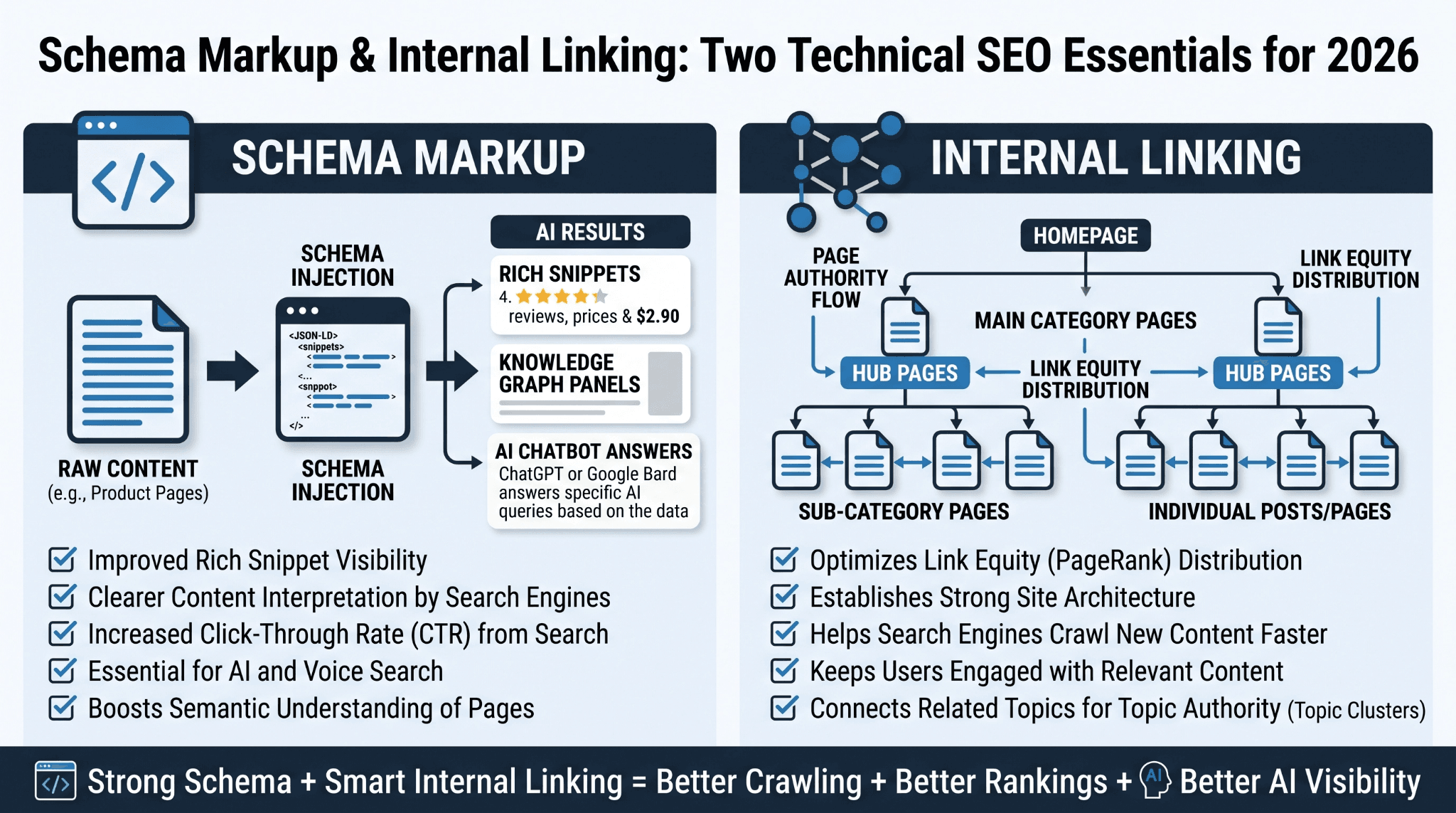
Schema markup is structured data in your HTML that tells search engines and AI systems exactly what type of content they are reading. Without it, search engines infer context from surrounding text. With it, the page explicitly declares its content type.
In 2026, schema is a functional requirement. Research presented by OtterlyAI at BrightonSEO in April 2026, based on a sitewide rollout across 2,000+ URLs, found that Google AI Overviews citations increased by 1,500% following schema implementation. The strongest-performing types across studies: FAQPage, Article, BreadcrumbList, and Organization.
Validate schema using Google's Rich Results Test at search.google.com/test/rich-results.
How Should Internal Links Be Structured for Maximum SEO Value?
Internal links distribute authority and tell Googlebot which pages are worth crawling repeatedly. Every important page should be reachable within three clicks from the homepage. Use descriptive anchor text, not "click here" or "read more," which carry no semantic signal.
Run Screaming Frog or Ahrefs Site Audit to find orphaned pages. Pages with zero internal links pointing to them are invisible to Googlebot regardless of their content quality.
Does Your Website Meet Google's Security and Mobile Standards?
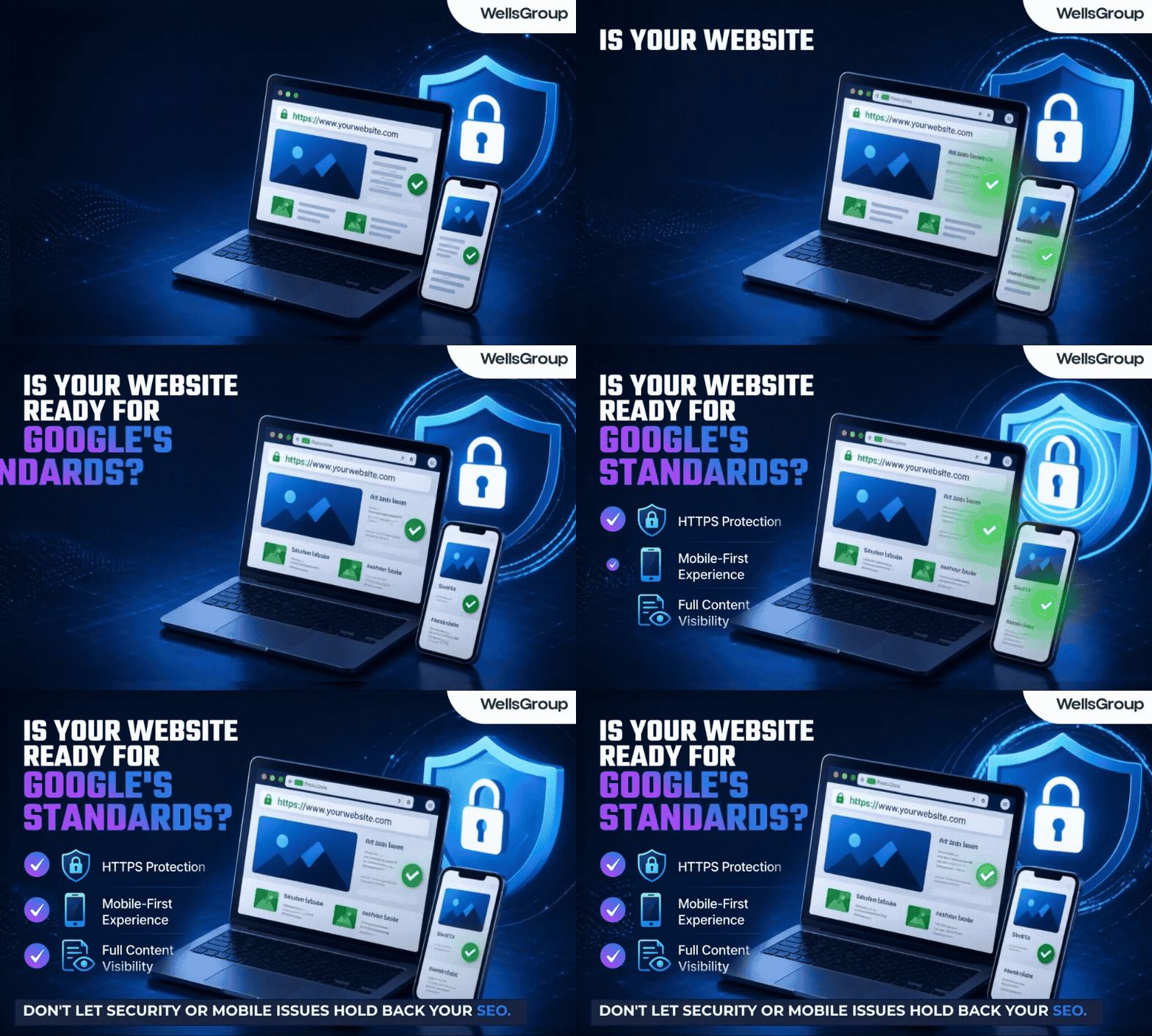
HTTPS is a baseline requirement, not a differentiator. Pages served over HTTP receive no trust signal from Google. Mixed content errors, where an HTTPS page loads resources over HTTP, produce the same result. Check SSL status using SSL Labs at ssllabs.com/ssltest.
What Does Mobile-First Indexing Actually Mean for Your Site?
Google indexes and ranks the mobile version of your site first, not the desktop version. If your mobile site hides content behind tabs, omits schema, or serves a stripped-down page, that content may not be indexed at all.
Practical check: open every key page template on a mobile device and confirm all headings, body content, schema, and CTAs are fully rendered. Verify results in Search Console's Mobile Usability report.
What Does AI Search Mean for Your Technical SEO Checklist?
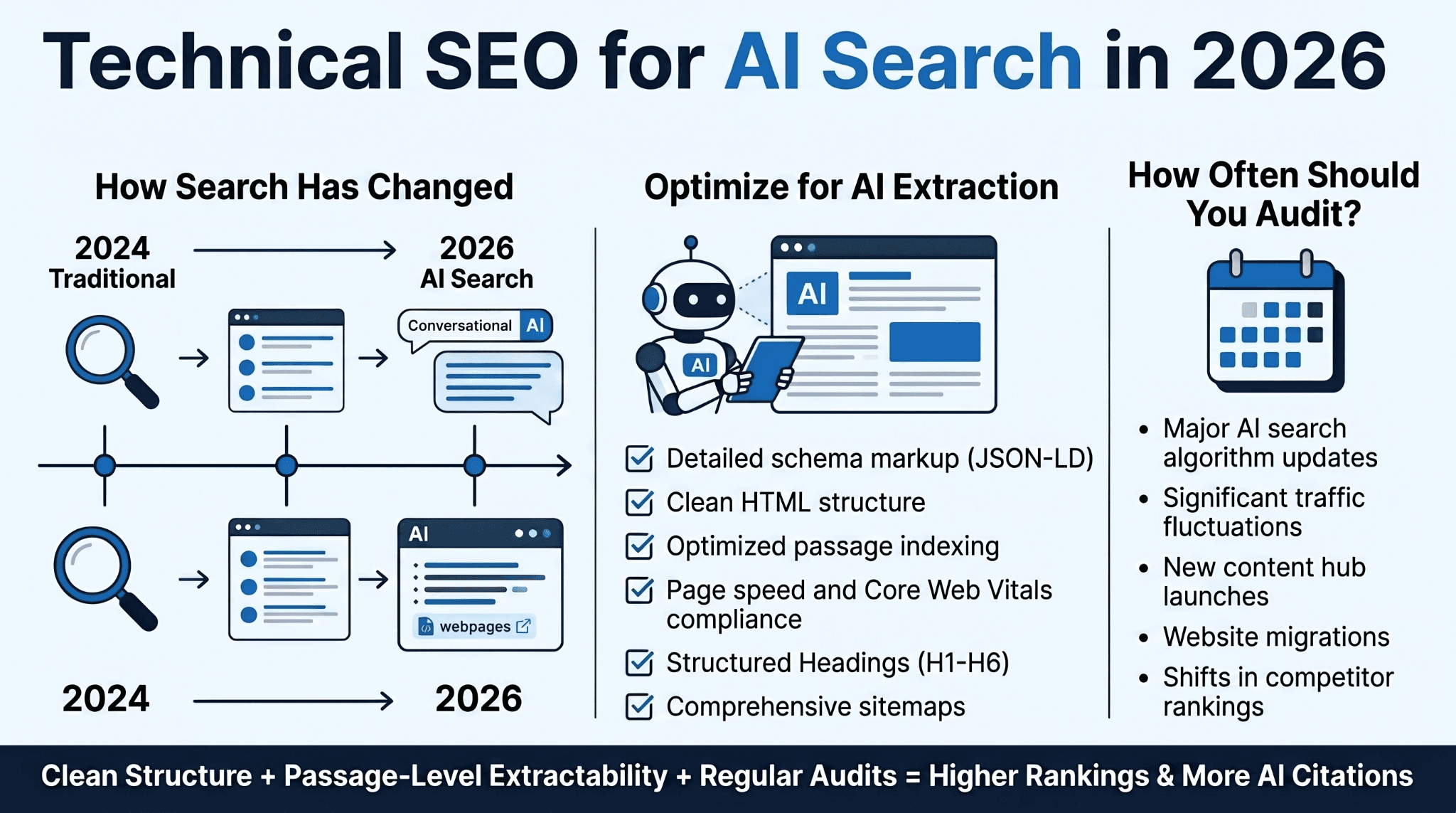
The defining shift between 2024 and 2026 is that AI-generated answers have become the primary search interface for millions of queries. Google AI Overviews, ChatGPT Search, and Gemini are not supplementing traditional search; they are increasingly replacing the first interaction users have with information online.
This means the technical SEO checklist now includes a sixth consideration: passage-level extractability. AI engines pull discrete content blocks from pages, not entire documents.
How Do You Structure Content So AI Search Engines Can Cite It?
AI systems extract from cleanly rendered semantic HTML. The technical decisions that most directly influence citability:
-
Use H1, H2, H3 hierarchy with question-based, descriptive phrasing
-
Place direct answers immediately under headings rather than burying them mid-paragraph
-
Keep critical content out of JavaScript components, iframes, and image-based text
-
Implement FAQ schema on all question-and-answer sections
-
Use short paragraphs; dense text blocks resist passage extraction
How Often Should You Run an SEO Technical Audit?
Run a full seo technical audit at minimum once per quarter, and immediately after any major site event, migration, CMS upgrade, redesign, or an unexplained traffic drop.
Many scaling businesses work with a technical SEO agency or technical SEO consultant on a fixed audit schedule, separating the review function from the team managing the site. For teams building internal capability, a structured technical SEO course covering crawl analysis, Core Web Vitals, and schema is a practical starting point.
Common Mistakes and What Experts Catch
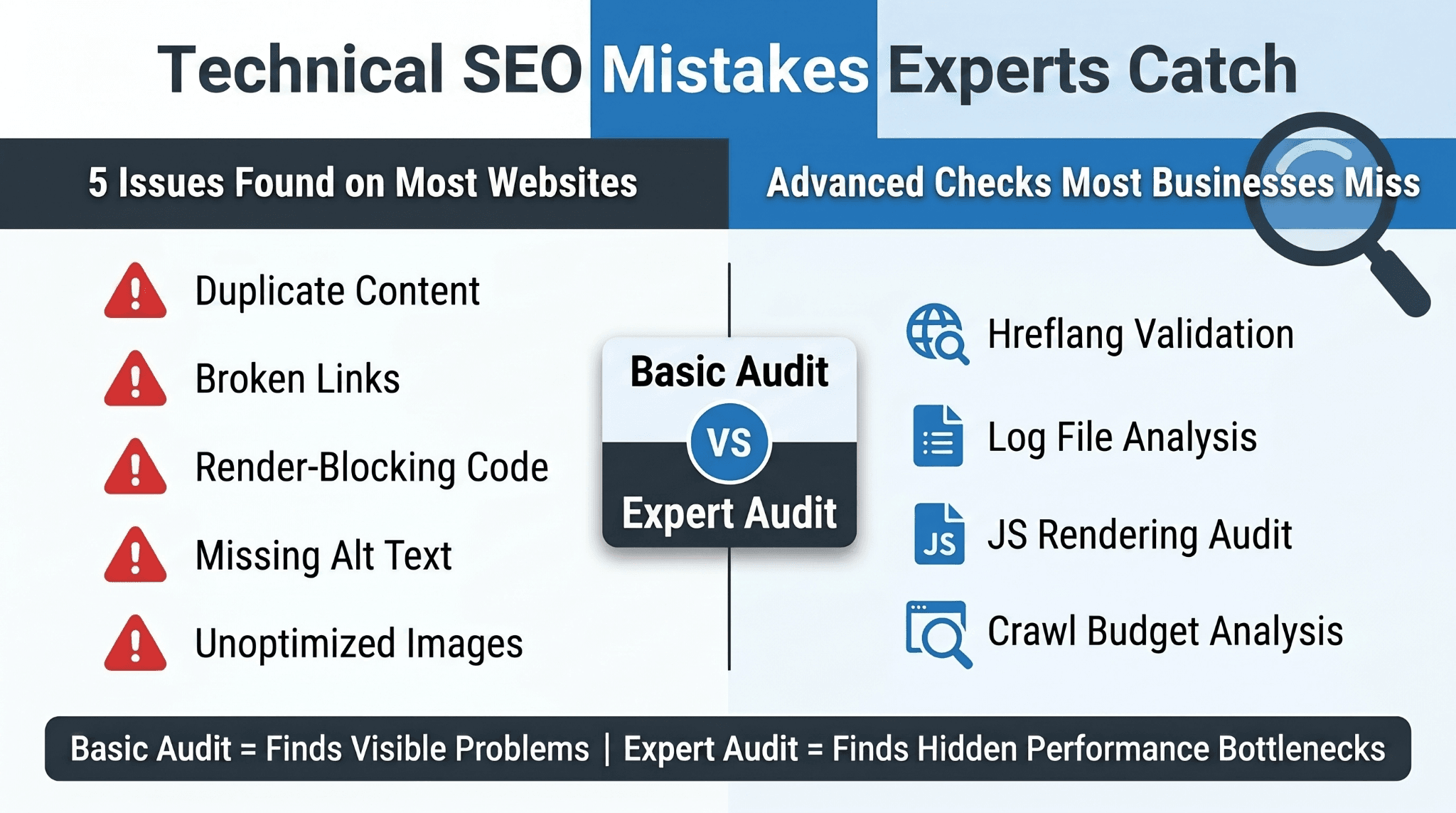
The most damaging technical SEO issues are not exotic. They are recurring, preventable errors that accumulate quietly over months of updates made without an audit framework. A technical SEO specialist auditing real sites across industries will find the same problems repeatedly:
-
Duplicate content served without canonical tags, splitting ranking signals across multiple URLs
-
Broken internal links waste crawl budget and create dead ends for users
-
Render-blocking JavaScript and CSS delaying LCP into the "Needs Improvement" range
-
Missing or generic image alt text, removing a secondary indexing signal
-
Uncompressed images in legacy formats (JPEG, PNG) instead of WebP or AVIF
What Do Technical SEO Experts Check That Most People Miss?
A technical SEO agency or senior technical SEO consultant goes further into areas that require specialized tooling or experience with non-obvious signals. These are the checks that rarely appear on beginner-level audit guides:
-
Hreflang tags: Incorrect implementation causes Google to serve the wrong language version, splitting traffic across unintended URLs
-
Log file analysis: Raw server logs reveal exactly which URLs Googlebot crawls, how often, and whether patterns match your intended priorities
-
JavaScript rendering audit: Comparing raw HTML against what Google actually renders after executing JavaScript, using the URL Inspection tool
-
Crawl budget analysis: Identifying parameter-generated URL patterns that produce thousands of low-value crawlable pages on large sites
These are the gaps that separate a site passing basic audits from one operating at full technical capacity.
Quick Answers About Technical SEO
Two lines before the first question, as requested: the questions below address the most common starting-point queries from founders and operations teams picking up a technical SEO checklist for the first time.
Is technical SEO hard to learn?
The fundamentals, crawl checks, sitemaps, and basic schema are learnable without a development background. A technical SEO course can bring a non-technical marketer to a functional audit level within weeks. Log analysis and JavaScript rendering benefit from developer collaboration or specialist support.
What does a technical SEO specialist actually do?
A technical SEO specialist diagnoses and fixes structural issues preventing a site from ranking or being cited in AI search. Their work spans crawl audits, Core Web Vitals optimization, schema implementation, site architecture review, and ongoing monitoring.
How is a technical SEO audit different from a regular SEO audit?
A general audit covers content quality, backlinks, and keywords alongside technical factors. A dedicated seo technical audit focuses exclusively on the structural layer, crawl, indexation, speed, schema, security, and mobile compliance.
Can I do technical SEO without coding knowledge?
Yes. Tools like Search Console, PageSpeed Insights, and Screaming Frog surface issues in plain language. Fixing them, particularly schema and server configuration, will often need developer support, but identifying the problems does not.
Your 2026 Technical SEO Checklist Starts Here
Technical SEO is not a project with a completion date. It is an operational layer requiring the same ongoing attention as any other system your business depends on.
Start with the crawl layer. Run Search Console's Coverage report this week. Fix what is broken. Then move to Core Web Vitals, then structure, then AI readiness. The sequence matters because each layer supports the one above it.
Whether you run these checks internally, bring in a technical SEO consultant periodically, or work with a technical SEO agency that monitors continuously, the checklist only delivers value when it is consistently executed.
WellsGroup runs technical SEO audits covering all five layers: crawl health, Core Web Vitals, schema, mobile compliance, and AI search readiness. Get a proposal and find out exactly what is holding your site back.