Website Lead Generation Strategy That Drives Real Revenue
Turn website traffic into qualified leads with a system built to capture, score, nurture, and convert visitors into revenue-ready contacts.

The analytics dashboard is open. Traffic is up 28% this quarter. The team is celebrating. Then someone asks the question that kills the mood: “How many of those visitors actually became leads?”
Silence.
Most websites are built to impress, not to convert. They look polished, load fast, and rank for the right keywords. But without a deliberate system behind them, they hand off anonymous visitors to the void. A well-run website lead generation strategy is not about accumulating visitors. It is about building a system that identifies, captures, qualifies, and nurtures the right people before they leave.
This article covers everything from why most sites fail at conversion to the operational workflows that turn anonymous traffic into revenue-ready contacts. Book a free consultation with WellsGroup and get a clear picture of where your website is losing leads today.
Why Most Websites Fail to Generate Qualified Leads
Most growing businesses treat their lead problem as a traffic problem. They push more volume into a site that was never built to convert. The result is a wider top of funnel pouring into the same leaky bucket.
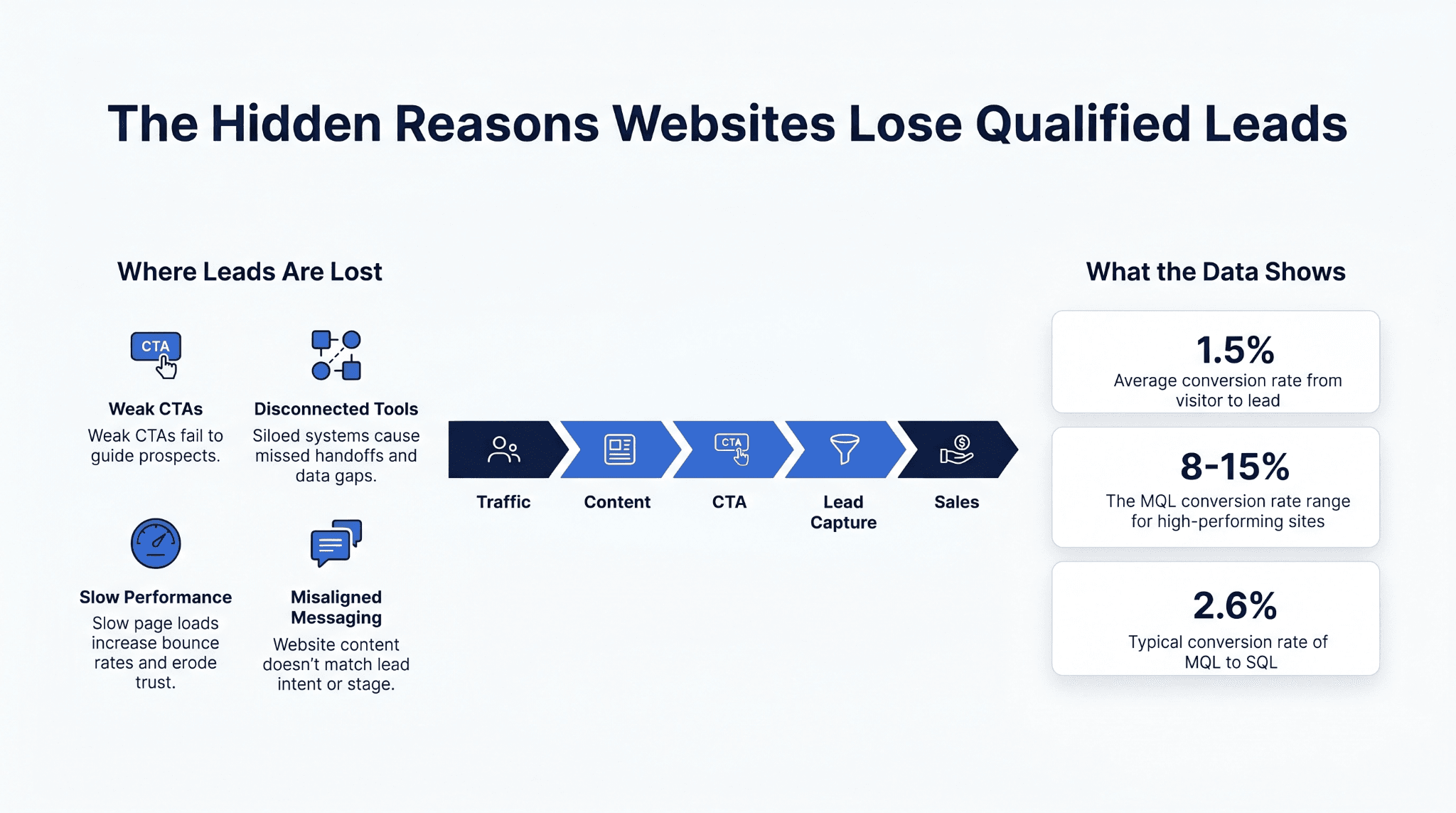
The real issue is structural. A website without a coordinated lead generation system bleeds revenue at every stage through:
-
Weak CTAs that send qualified visitors to dead ends
-
Disconnected tools that create data gaps between marketing and sales
-
Slow or poorly optimized pages that push users out before they engage
-
Misaligned messaging that fails to match the source that brought the visitor in
Knowing how to reduce website bounce rate for leads is not a design task. It is a content alignment task, and it starts with fixing the structure above.
What the Data Says About Traffic-to-Lead Conversion
The traffic-to-lead conversion rate benchmark for B2B gives a clear diagnostic baseline. According to 2026 data compiled across multiple industry sources:
-
The average B2B company converts 1.5% of visitors into leads, while top performers hit 8% to 15%.
-
SEO converts at 2.6% visitor-to-lead, nearly double the 1.5% rate of paid search.
-
SEO leads convert to SQL at 51%, nearly double the rate of PPC leads at 26%
Organic content is not just a visibility asset. When aligned with buyer intent, it functions as a qualification mechanism.
The Foundation of a High-Converting Website Lead Generation Strategy
A reliable website lead generation strategy is not a stack of tactics. It is a set of interconnected systems that share data and operate continuously. Four pillars hold the structure together:
-
Audience definition: Build a precise buyer profile before publishing a single page. Effective B2B website lead generation tactics start here.
-
Content alignment: Each piece of content should serve a specific role in moving a visitor closer to a decision.
-
Capture architecture: The right tools, placed at the right moments, for the right intent levels.
-
Qualification layer: A system that separates browsing behavior from buying intent.
Website personalization for lead generation becomes operational at the content alignment stage. When a logistics company visits a page about fleet management, the content and CTAs should reflect their operational context, not a generic pitch.
First-Party Data as Your Strategic Foundation
In 2026, the first-party data collection website strategy has shifted from a technical consideration to a core revenue function. Third-party cookies are largely phased out, and AI search is mediating more discovery journeys than ever before.
First-party data from your own forms, session behavior, and CRM is more accurate and more actionable than any external signal. It tells you:
-
Which companies are actively researching your services
-
What content do they consume before converting
-
What sequence of interactions preceded a sales conversation
A well-configured analytics setup connected to your CRM is a functional starting point. No enterprise stack required.
How to Capture Leads Before They Leave Your Website
Knowing how to capture leads from website traffic requires more than a homepage contact form. Capture mechanisms need to match visitor intent, appear at the right moment, and offer enough value to justify the exchange of contact information.
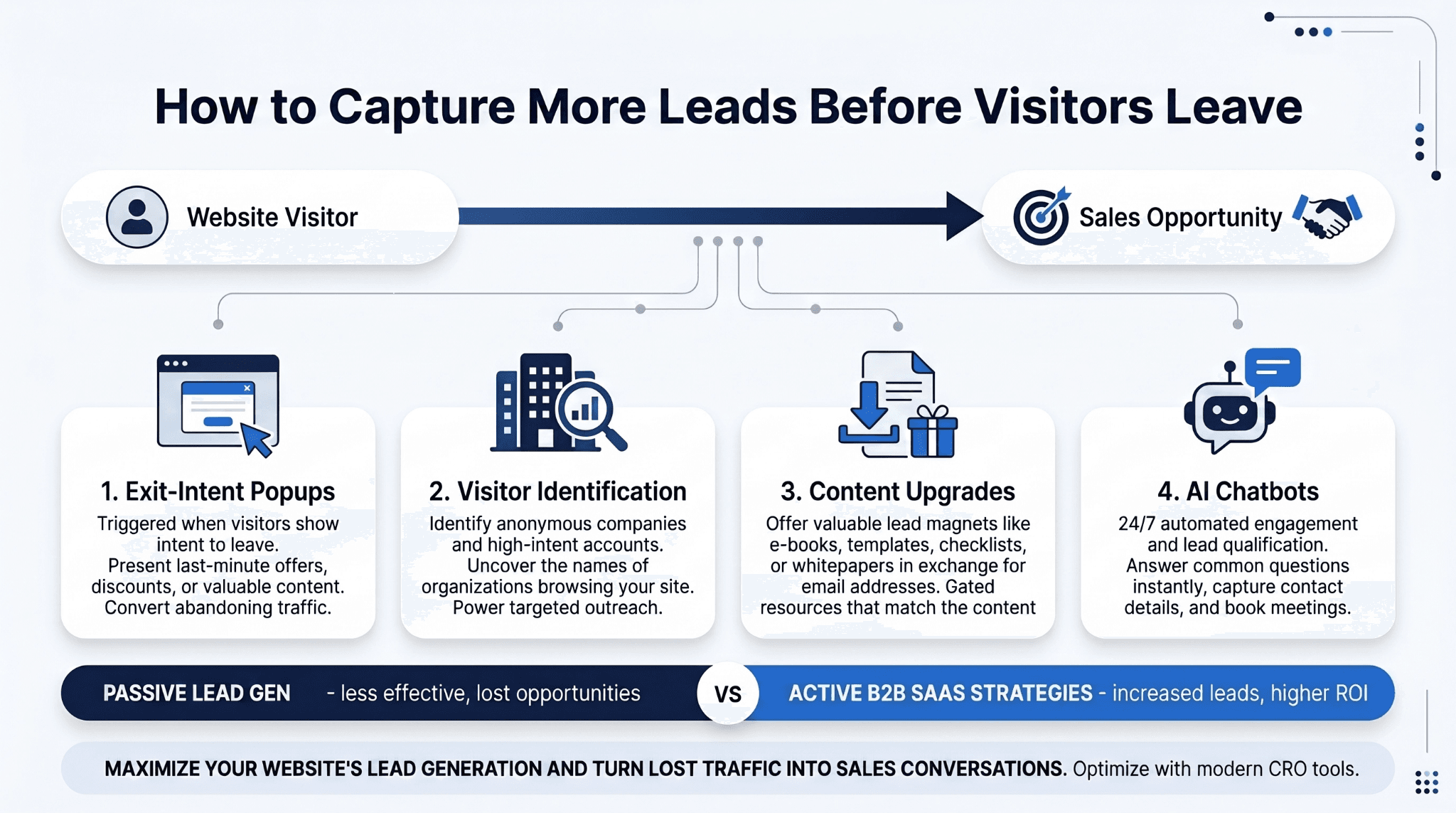
The right combination depends on your traffic profile and conversion goals. The most effective capture tools in 2026 are:
-
Exit intent popups: Exit intent popup best practices now center on relevance, not urgency. A popup offering a resource tied to the page being viewed consistently outperforms generic offers.
-
Anonymous website visitor identification: Tools that resolve company-level identity from IP data let your sales team follow up with accounts that browsed but never converted. Especially valuable in long B2B research cycles.
-
Inline content upgrades: Embedded offers within blog posts that extend the topic a visitor is already reading.
-
AI chatbots: A chatbot for a lead-generation website operates 24/7, qualifies intent, and pre-populates CRM fields automatically.
Choosing Between Contact Forms, Live Chat, and Chatbots
The contact form vs live chat for lead capture question is a buyer behavior question, not a design one. Each tool serves a different intent level and a different moment in the session.
The table below compares the three options across key operational dimensions:
|
Capture Tool |
Best For |
Response Speed |
Qualification Depth |
2026 Fit |
|
Contact Form |
High-intent, decision-ready visitors |
Delayed (hours) |
Low |
Reliable baseline |
|
Live Chat |
Mid-funnel researchers |
Immediate (if staffed) |
Medium |
Strong with staffing |
|
AI Chatbot |
All intent levels, 24/7 |
Instant |
High (auto-qualifies) |
Leading option in 2026 |
Building Lead Magnets and Gated Content That Actually Convert
A lead magnet works when it solves a specific, immediate problem. The most effective lead magnet ideas for digital marketing in 2026 are narrow and actionable, tied directly to the page a visitor is already consuming.
The gated content strategy for lead generation follows a selective model in 2026:
-
Keep open: Awareness and introductory content that supports SEO and early-stage trust-building
-
Gate: Operational resources, templates, calculators, and deep-dive guides that carry genuine exchange value
Website CTA placement for lead conversion matters as much as the offer itself. CTAs placed mid-article, right after a key insight, outperform footer CTAs. The visitor is most engaged immediately after learning something useful.
Matching Content Upgrades to Reader Intent
Understanding how to use content upgrades for leads starts with mapping content to buyer stages. Two practical pairings illustrate the principle:
-
An early-stage blog post explaining a concept pairs best with a checklist or framework that moves the reader from understanding to action
-
A mid-stage comparison or technical guide pairs best with a template, ROI calculator, or deployment guide that supports a vendor decision
The format and depth change with the audience. The principle stays constant: the closer the upgrade matches the page intent, the higher the conversion rate.
Qualifying Your Leads: From Anonymous Visitor to Sales-Ready Contact
Capturing a lead is the beginning, not the end. Without a qualification layer, sales teams waste time on contacts who will never buy. The MQL vs SQL difference is the most important distinction in a functioning lead generation system.
-
An MQL has demonstrated enough behavioral interest to warrant continued nurture
-
An SQL has met a defined threshold of intent and fit that makes a direct sales conversation appropriate
-
Confusing the two stages strains the marketing-sales relationship and wastes pipeline capacity
Inbound lead qualification criteria should be defined jointly by both teams. Common criteria include company size, industry, job title, and behavioral signals like visiting a pricing page. When these are codified, qualification becomes a system rather than a judgment call.
How Lead Scoring Turns Data Into Sales Priority
A website lead scoring model assigns numerical values to actions and attributes, producing a composite score that reflects purchase intent and fit. Here is a framework most B2B teams can implement without a complex CRM configuration:
|
Signal Type |
Example Action |
Score Weight |
Stage Triggered |
|
High-intent behavior |
Visited the pricing or demo page |
+10 |
SQL review |
|
Content engagement |
Downloaded gated resource |
+7 |
MQL |
|
Return visit |
3+ sessions in 14 days |
+5 |
MQL |
|
Email engagement |
Opened 3+ emails this week |
+4 |
MQL |
|
Fit attribute |
Target industry and company size |
+8 |
SQL review |
|
Inactivity decay |
No activity for 30+ days |
-5 |
Cooling |
For teams learning how to qualify leads from organic traffic, adding fit scoring on top of behavioral data creates a two-dimensional filter more reliable than either signal alone.
Nurturing Leads From First Touch to Closed Deal
A captured lead without a nurture workflow goes cold. The purpose of nurture is to maintain relevance, build trust, and surface intent signals that indicate readiness for a sales conversation.
Lead nurturing workflow examples that perform in 2026 are shorter and more behavior-triggered than the long drip sequences that defined automation in 2024 and 2025. Modern B2B buyers expect follow-up that reflects what they have already engaged with.
A Simple Nurture Workflow Most B2B Teams Can Deploy Today
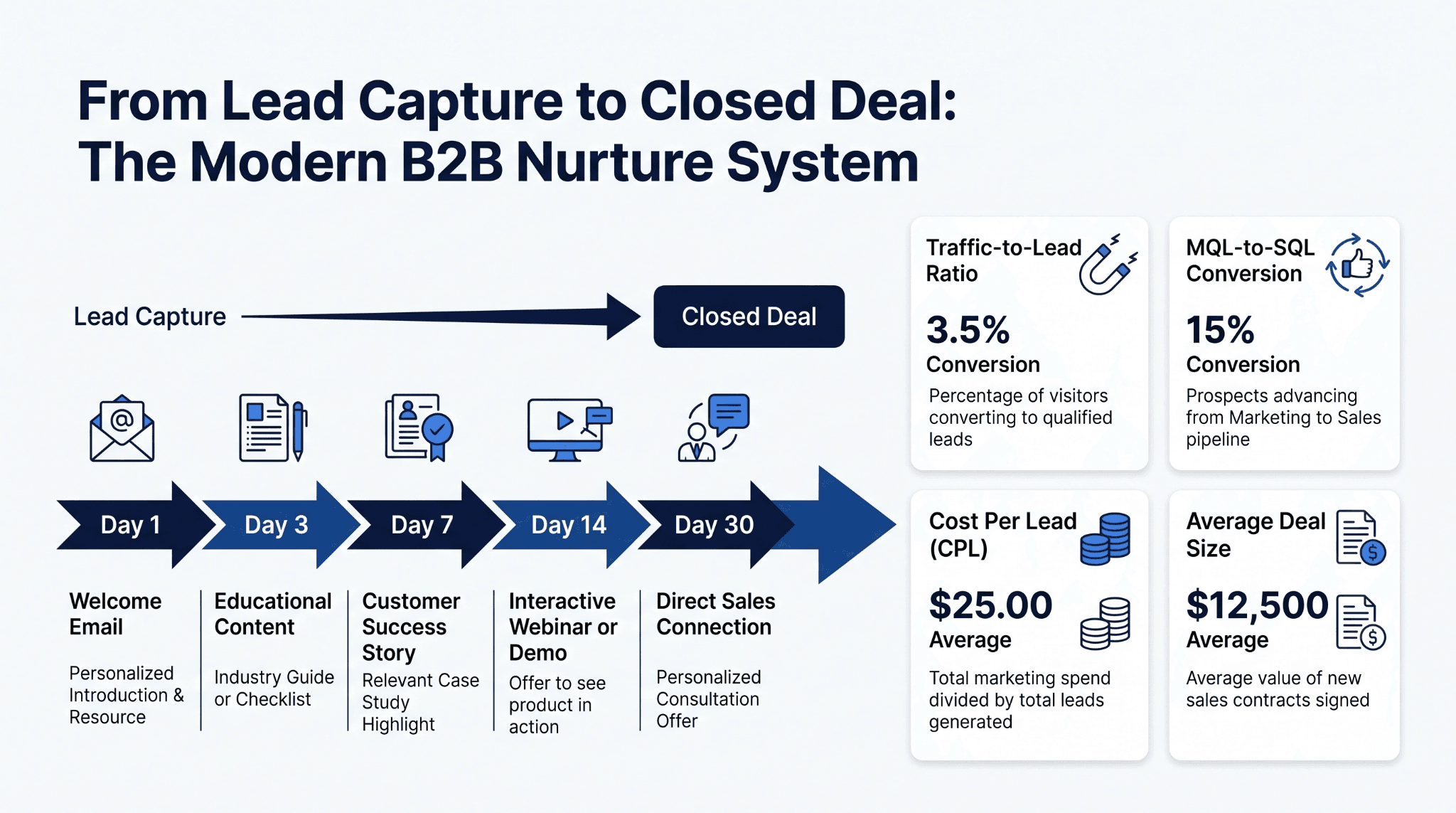
A functional B2B nurture sequence does not need to be complex. The following five-step structure works for most service-based and SaaS businesses:
-
Day 1: Deliver the lead magnet with a confirmation email. Include one relevant case study. Keep it short.
-
Day 3: Send a behavioral follow-up. Route to sales if they revisited the pricing page. Send deeper content if they engaged with the resource.
-
Day 7: Share a proof point. A short case study or outcome from a relevant industry vertical.
-
Day 14: Soft re-engagement. Offer a consultation or next-step resource. Intent becomes visible here through action or silence.
-
Day 30: Re-engagement check. If no activity, move to a lower-volume track rather than removing the contact.
Measuring What Matters in Your Lead Generation System
Measurement is not a reporting function. It is the feedback loop that tells you where the system is working and where it is losing revenue. The metrics that matter most, by funnel stage, are:
-
Top of funnel: Traffic to lead conversion rate benchmark, your baseline health check
-
Mid funnel: MQL-to-SQL ratio reflects whether qualification criteria are calibrated correctly
-
Acquisition efficiency: Cost per qualified lead tracks whether channels are worth the spend
-
Revenue quality: Average deal size by lead source confirms the right buyers are entering the funnel
The website lead scoring model should be reviewed quarterly. Scoring logic calibrated for 2024 and 2025 behavior may over-qualify or under-qualify leads in current 2026 market conditions.
What Smart Businesses Ask About Lead Generation Strategy
The questions below reflect the most common decision points founders and operations leaders face when building or rebuilding a lead generation system. Each answer is kept direct and operational.
What is a realistic website conversion rate for B2B?
The average B2B site converts between 1.4% and 2.5% of visitors into leads. Top performers reach 8% to 15%. Below 1.4% usually signals mismatched messaging, conversion friction, or a traffic-to-page mismatch. WellsGroup typically identifies these gaps within the first audit.
Should I gate all of my best content?
No. Gating everything reduces SEO reach and adds friction for early-stage visitors. Keep foundational content open for discoverability and gate operational resources that carry genuine exchange value.
What is the difference between an MQL and an SQL?
An MQL has shown enough engagement to justify continued nurture. An SQL has met the defined intent and fit criteria that make a direct sales conversation appropriate. Treating an MQL as an SQL too early wastes sales time and damages buyer trust.
How long does it take to see results?
Capture improvements show results within 30 to 60 days. Qualification improvements stabilize over one to two quarters. Full-funnel results are visible over a six-month horizon. Speed depends on how completely the system is built, not on individual tactical performance.
From Strategy to System: The Revenue Gap Most Websites Leave Open
Most businesses do not have a traffic problem. They have a conversion architecture problem. Individual tactics produce temporary lifts that fade when conditions change. A connected system where capture, qualification, nurture, and measurement operate together produces compounding results.
That is the difference between running lead generation campaigns and operating a lead generation system. A lead generation strategy is only as strong as the system behind it. WellsGroup builds and operates that system end to end, from traffic acquisition to qualified pipeline. Request a proposal and let us show you where your current setup is leaving revenue on the table.