What Is Generative Engine Optimization and Why It Matters in 2026
Generative Engine Optimization helps brands earn AI citations, increase visibility across ChatGPT and Google AI, and stay discoverable in 2026.

Generative engine optimization (GEO) is the practice of structuring content so that AI-powered search engines, including ChatGPT Search, Google AI Overviews, and Gemini, select, cite, and surface it in generated responses. Unlike traditional SEO, which targets rankings and clicks, GEO targets citation selection. It is the foundational visibility discipline for 2026.
In 2026, 68% of Google searches end without a single click to an external website, and ChatGPT alone processes 2.8 billion queries every day. Your audience is getting answers directly from AI engines, and if your content is not structured to be cited, your brand is not part of those answers. GEO is how you change that.
WellsGroup specializes in building AI Search Visibility systems that get your content cited across ChatGPT, Gemini, and Google AI Overviews. Get a Proposal and find out where your brand stands today.
What Is Generative Engine Optimization?
Generative engine optimization, or GEO, is the process of formatting, structuring, and enriching digital content so that large language models (LLMs) retrieve and cite it when generating answers to user queries. Where traditional search returns a list of links, generative engines synthesize a response, and what appears in that response is determined by how well a piece of content communicates relevance, authority, and extractability to the model.
Where Did the Term "GEO" Come From?
The term was introduced in November 2023 when a research team from Princeton University, Georgia Tech, the Allen Institute for AI, and IIT Delhi published a paper titled "GEO: Generative Engine Optimization". Their study ran controlled experiments across 10,000 queries using nine distinct content optimization methods.
The two most impactful findings from the research were:
-
Adding verifiable statistics to content increased AI citation visibility by up to 40%
-
Citing authoritative sources consistently outperformed keyword-focused optimization across all nine methods tested
What Makes GEO Different From Just "Writing Good Content"?
Quality writing is necessary but not sufficient for AI citation. A well-written article that lacks structural signals, clear definitions, verifiable statistics, consistent entity naming, and schema markup will routinely be bypassed in favor of a more plainly structured piece that makes information easier for a model to extract.
GEO adds an intentional technical layer on top of content quality. The four elements that separate GEO-optimized content from simply well-written content are:
-
Answer-first formatting: The most citable passage appears immediately under the heading
-
Entity consistency: Brand names, services, and key concepts are written the same way every time
-
Structured data: Schema markup helps machines parse content type and relationships
-
Citable specifics: Verifiable statistics and named sources give AI engines something concrete to extract
Traditional SEO optimizes for Google's ranking algorithm, keyword signals, backlink authority, and page experience, with organic click-through rate as its primary success metric. GEO operates on a different model entirely: it optimizes for citation selection inside a generated response. The content does not need to rank in position one. It needs to be structured well enough that a model can extract and trust it.
When comparing generative engine optimization vs traditional SEO, the distinction comes down to what each discipline defines as a win. Traditional SEO wins when a page ranks and earns a click. GEO wins when a passage is selected and cited inside an AI-generated answer; no click required.
The two disciplines share technical foundations, but they diverge sharply in what they optimize toward. The table below maps the five key dimensions where generative engine optimization and traditional SEO operate differently.
|
Dimension |
Traditional SEO |
Generative Engine Optimization (GEO) |
|
Goal |
Rank on page one |
Be cited in an AI-generated response |
|
Success Metric |
Organic click-through rate |
Citation frequency and AI impression score |
|
Optimization Target |
Algorithm ranking signals |
Passage extractability and entity clarity |
|
Content Format |
Long-form keyword-optimized pages |
Short paragraphs, definition blocks, answer-first structure |
|
Ranking Signal |
Backlinks, authority, keywords |
Semantic clarity, schema, verifiable specifics |
Can You Do GEO Without an Existing SEO Foundation?
No, GEO is not a standalone strategy. Domain authority, a crawlable site architecture, and indexed content are prerequisites for AI engines to consider a source for citation at all. Models pull from sources that have already demonstrated credibility through traditional search signals.
Before GEO work can be applied effectively, three SEO foundations must be in place:
-
A technically sound, crawlable website with indexed content
-
Established domain authority through consistent backlinks and content signals
-
A baseline content library that AI engines can associate with a topic or category
WellsGroup's AI Search Visibility service is structured this way, beginning with a technical and authority audit before any GEO-specific work is applied.
Why Does GEO Matter for Businesses in 2026?
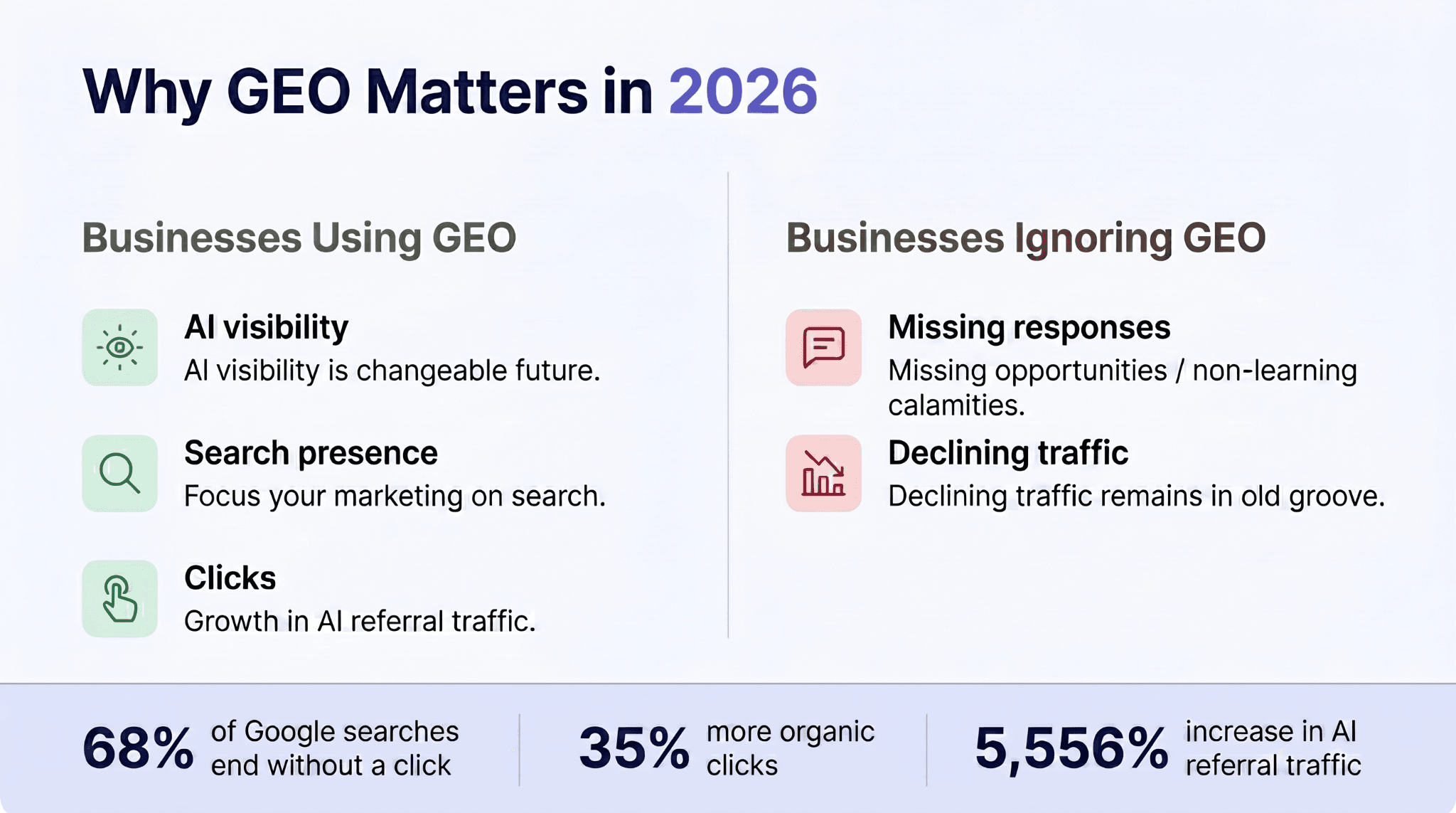
The scale of AI-driven search in 2026 makes GEO an operational requirement. According to SparkToro's 2026 research, 68% of all US Google searches in the first four months of 2026 ended without a click to any external website. Your audience is finding answers inside the search results page itself, and the brands being cited inside those AI-generated answers are the ones that have structured their content for extraction.
For businesses, the numbers translate into three concrete visibility shifts happening right now:
-
AI platforms have become primary discovery channels for product research, service comparisons, and purchasing decisions
-
Traditional blue-link results are being bypassed entirely on informational queries; the answer lives in the generated response
-
Brands not structured for AI citation are invisible in these channels, regardless of their domain authority or years in the market
WellsGroup's own portfolio recorded a 5,556% increase in AI referral traffic and a 404% increase in Gemini-sourced traffic through 2025, the result of systematic GEO implementation across client content systems.
What Happens to Businesses That Ignore GEO?
Ignoring GEO creates a compounding visibility gap. According to Seer Interactive's September 2025 study, which analyzed 3,119 queries across 42 organizations and 25.1 million impressions, brands cited in AI Overviews earn 35% more organic clicks and 91% more paid clicks than non-cited brands on the same query. The three outcomes that consistently emerge for businesses without GEO implementation are:
-
Declining referral traffic: Competitors earn AI citations and capture the clicks; non-cited brands lose both organic and paid performance on shared queries
-
Absence from comparison responses: When users ask ChatGPT or Gemini to compare providers, only sources with strong entity signals appear, regardless of how long a brand has been in the market
-
Erosion of LLM knowledge associations: Brands that do not appear in well-structured, cited content gradually lose their association with their own category inside AI knowledge systems
How Do Generative Engines Decide What to Cite?
Generative engines do not rank pages the way Google's algorithm does. They score individual passages for fitness to a specific query. A single well-structured paragraph from a mid-authority domain can be cited ahead of a poorly structured page from a high-authority one, because citation selection is about extractability, not just domain strength.
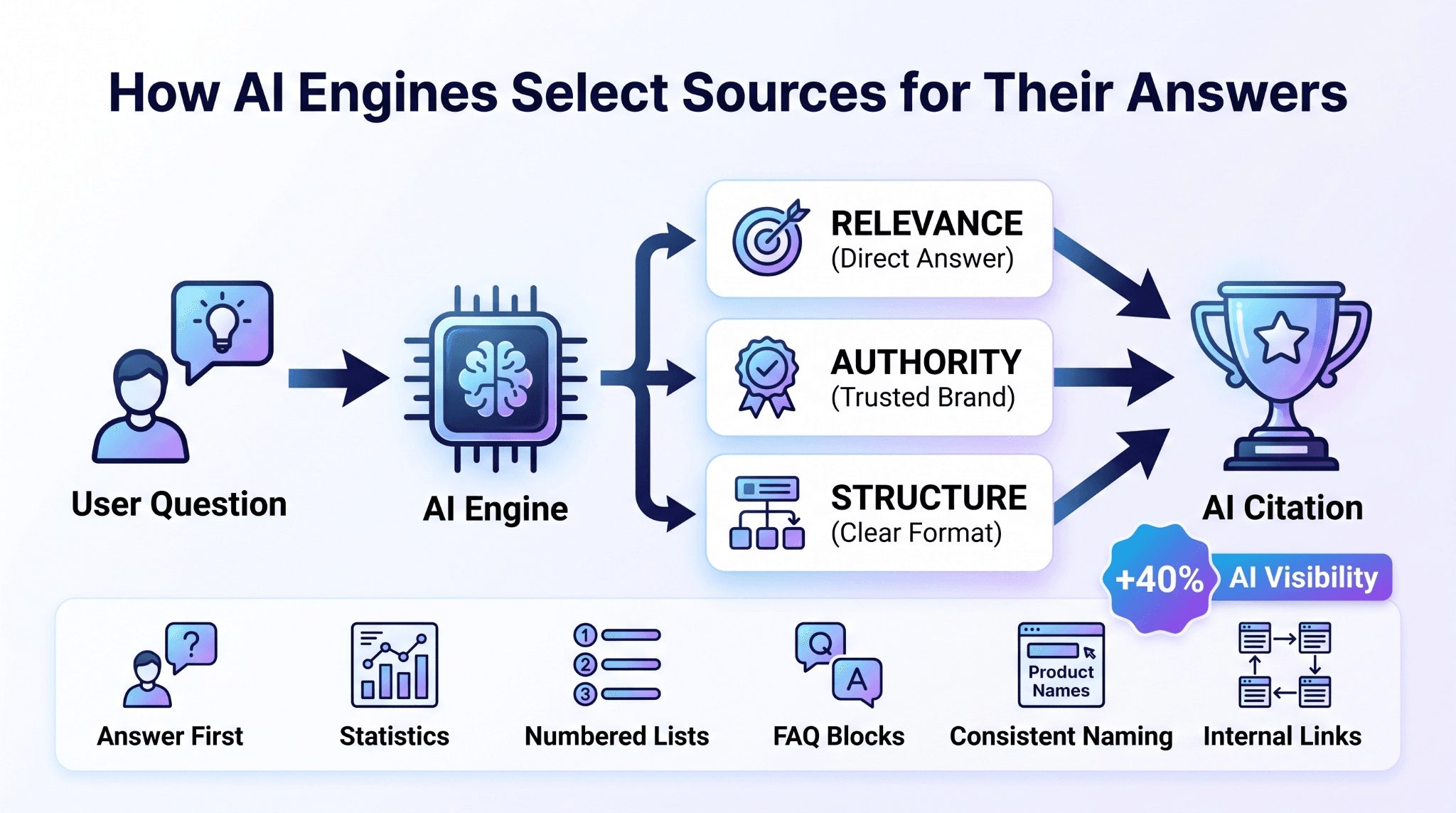
Understanding what generative engine optimization is, GEO means understanding that a citation is won at the passage level. The three primary signals that determine whether a passage gets cited are:
-
Passage-level relevance: Does this specific chunk of text answer the query directly and completely?
-
Source authority and entity recognition: Has this domain been associated with the topic across multiple credible contexts?
-
Content structure and extractability: Can the model isolate a clean, self-contained answer without parsing dense blocks of text?
Does Content Structure Affect AI Citation Rates?
Yes, and the research is specific. The Princeton/Georgia Tech GEO study found that structural and evidential changes outperformed keyword-focused changes across all nine content methods tested. Adding verifiable statistics alone improved AI visibility by up to 40%.
The formatting signals that most consistently improve AI citation rates are:
-
Answer-first structure: lead every section with a direct response before elaborating
-
Short paragraphs of two to three sentences, which allow models to extract cleanly
-
Numbered steps and comparison tables, which provide a pre-parsed structure
-
Definition boxes for key concepts, which become directly quotable
-
FAQ blocks with concise, complete answers, which match conversational query patterns
How Does Entity Recognition Influence AI Citations?
Entity recognition is how AI engines build and maintain associations between named concepts, brands, and topics. For WellsGroup, this means writing "WellsGroup," "WellsOpsFX," and "generative engine optimization" the same way across every page and article. Inconsistent naming weakens the entity signal with each variation. Every consistent mention reinforces the association; every variation introduces noise the model has to resolve.
The entity signals that matter most for AI citation are:
-
Consistent brand and product naming across every page, article, and metadata field
-
Named authorship with credentials that appear on the page itself
-
Internal linking between topically related content that reinforces subject-matter associations
-
External brand mentions and citations from authoritative third-party sources
What Are the Core GEO Strategies That Work in 2026?
GEO is a set of architectural decisions that must be applied consistently across an entire content system. The goal is to make every piece of content independently citable, structured so a model can extract value from it without needing surrounding context. The six strategic pillars are: answer-first structure, entity consistency, schema markup, first-party data, E-E-A-T signals, and topical completeness.
What Role Does Schema Markup Play in GEO?
Schema markup is machine-readable metadata that tells AI engines what type of content they are parsing, who created it, and what entities it references. Without a schema, a model has to infer all of this from text alone, a less reliable process that increases extraction errors and reduces citation confidence.
The five schema types with the highest GEO impact are:
-
Article: Establishes content type, author, and publication date
-
FAQPage: Makes Q&A pairs directly parseable for conversational responses
-
HowTo: Structures step-based content for process queries
-
Organization: Anchors brand entity data, including name, URL, and description
-
BreadcrumbList: Communicates site hierarchy for topical authority mapping

Which Generative Engine Optimization Tools Do Professionals Use?
No single platform handles GEO comprehensively. Practitioners combine several tools to cover different parts of the visibility picture, and no generative engine optimization tools audit is complete without testing actual AI platform responses directly.
The core toolkit used by GEO practitioners in 2026 includes:
-
Semrush AI Search Tracking: Monitors which queries trigger AI Overviews and whether a brand's content is cited
-
Ahrefs: Brand mention tracking and citation monitoring that feeds entity signal building
-
Surfer SEO: Semantic completeness scoring to identify topical coverage gaps
-
Direct prompt testing: Manual validation in ChatGPT, Gemini, and Perplexity to confirm live citation performance
WellsGroup's AI Search Visibility service connects these generative engine optimization tools into a unified operational system, monitoring citation performance, identifying structural gaps, and continuously optimizing content for extraction across all major AI platforms.
How Do E-E-A-T Signals Factor Into GEO?
Experience, Expertise, Authoritativeness, and Trustworthiness are citation selection signals for AI engines, not just Google ranking factors. When deciding between two structurally similar sources, a model will weight the one with a named author, a visible last-updated date, first-party data, and links to case studies.
The E-E-A-T elements that carry the most weight for AI citation are:
-
Named authorship: A real author with documented credentials signals human expertise behind the content
-
First-party data: Proprietary statistics give AI engines a verifiable, source-specific figure to cite rather than a generic industry claim
-
Visible update dates: Freshness signals matter heavily for time-sensitive topics like GEO
-
Links to case studies: Contextual proof that the brand operates in the space it is writing about
What Do Businesses Most Often Get Wrong About GEO?
Three misconceptions lead businesses to delay implementation or misapply effort. Each one is worth addressing directly before beginning any GEO program.
-
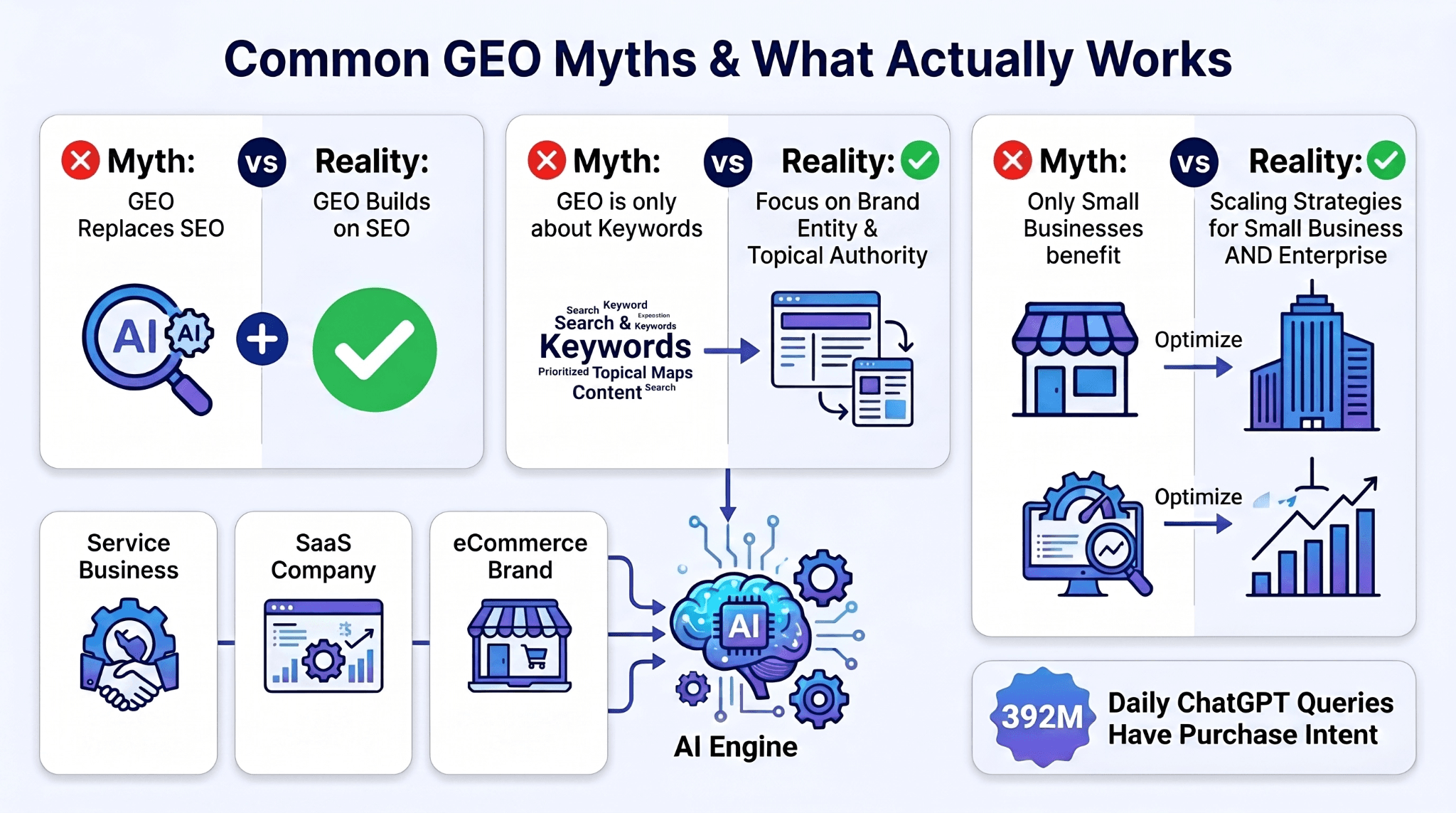
"GEO will replace SEO." It will not. GEO builds on an SEO foundation; domain authority, crawlability, and indexed content are prerequisites. Abandoning SEO to focus on GEO removes the infrastructure the strategy requires.
-
"Keyword density drives AI citations." AI engines respond to semantic relevance, structural clarity, and entity consistency. Repeating "generative engine optimization (GEO)" throughout a page does not improve citation frequency; it can reduce it by making content harder to parse.
-
"GEO only matters for large brands." AI engines cite well-structured small-site content regularly when entity signals are clear. A mid-size SaaS company with schema-marked, tightly structured articles can earn more AI citations than an enterprise competitor with high domain authority but poor content architecture.
Does GEO Strategy Change Depending on Business Type?
Yes, the variation is driven by query intent, not industry alone. The same structural principles apply across all business types, but the emphasis shifts based on how customers search and what AI engines are asked about each category.
Here is how GEO priorities differ across three common business types:
-
Service businesses need to prioritize entity clarity around location, service category, and differentiators. The competition is for a specific answer slot in ChatGPT local queries, not a ranking position
-
SaaS companies need topical completeness covering use cases, integrations, and competitive distinctions. The goal is to become a natural citation when a model constructs a product comparison response
-
eCommerce brands need structured product data, schema-marked reviews, and purchase-intent content. Approximately 392 million daily ChatGPT queries now carry purchase intent, making AI citation a direct revenue channel
What People Ask About GEO
Here are the questions founders and marketing leaders ask most often when navigating AI-driven search visibility shifts.
Is generative engine optimization the same as AI SEO?
The most common question is what generative engine optimization (GEO) is or whether it is simply a new name for AI SEO. They are near-synonyms used differently in practice. GEO refers specifically to the structural and technical decisions that improve AI citation rates. AI SEO is the broader practice that includes GEO alongside traditional SEO infrastructure, schema strategy, and AI traffic attribution.
How long does it take to see GEO results?
Structured content changes typically begin surfacing in AI-generated responses within 60 to 90 days. Google AI Overviews tend to reflect changes faster than ChatGPT Search, which updates its knowledge associations on a different cycle.
Does GEO work for small businesses?
Yes. Entity clarity, structural formatting, and topical authority matter more than domain authority scores for AI citation selection.
What is the difference between GEO and AEO?
Answer Engine Optimization (AEO) targets featured snippets and voice search. GEO targets citation selection inside LLM-generated responses. The tactics overlap significantly, but the success metrics and target platforms are distinct.
Do I need to rewrite existing content for GEO?
Not always. Structural overlays, adding an answer block, applying schema, inserting a definition box, and frequently updating statistics can significantly improve GEO performance without a full rewrite.
Which AI platforms does GEO apply to?
ChatGPT Search, Google AI Overviews, Google AI Mode, Gemini, Perplexity, and Bing Copilot. Each platform has slightly different citation behavior: Google AI Overviews place greater weight on structured data, while ChatGPT Search responds more strongly to entity consistency and external brand mentions.
The Next Step for Businesses Serious About AI Visibility
The shift from traditional search to AI-generated responses is already underway at scale. With 68% of Google searches ending without a click in 2026 and ChatGPT processing 2.8 billion queries daily, the channels where your audience finds information have fundamentally changed. Businesses that structure their content for AI extraction now will own citation authority in their categories. GEO is not a content marketing initiative; it is an operational infrastructure decision that determines whether your brand appears in the answers your market is already reading.
WellsGroup builds and operates AI Search Visibility systems that connect content architecture, schema strategy, and citation tracking into a unified performance layer. If your business is not currently appearing in AI-generated responses for your core queries, request a proposal and we will audit your current visibility across ChatGPT, Gemini, and Google AI Overviews.