How to Rank in AI Overviews: 5 Proven Tactics for 2026
Learn how to rank in AI Overviews using proven strategies, structured content, schema, and citations to increase visibility and organic traffic.

To rank in AI Overviews, a page needs to answer the query directly within the first few lines, use clear structural formatting that machines can parse, and be backed by verifiable, well-cited information. Google's Gemini-powered system rewards clarity and topical depth over keyword density, which means content built for humans first tends to perform best.
Search behavior has shifted permanently. AI Overviews now trigger on roughly 48% of all Google search queries as of March 2026, and Google's own disclosures put AI Overviews' reach at around 2 billion monthly users across more than 200 countries and 40 languages. For any business built on organic visibility, learning how to rank in AI Overviews is no longer optional. If your team is trying to figure out where your current content stands in this shift, WellsGroup's AI search audit maps your existing pages against these new selection criteria. Get a Proposal to see where you stand.
What Are AI Overviews and How to Rank in AI Overviews
Google AI Overviews are AI-generated summaries that appear above the traditional list of search results. Instead of showing ten blue links first, Google shows a short written answer, built from several web sources, with citations linked underneath.
Think of it as asking a well-read friend a question rather than handing you a stack of books. The friend reads several sources, pulls out the relevant parts, and gives you one answer with a note on where it came from.
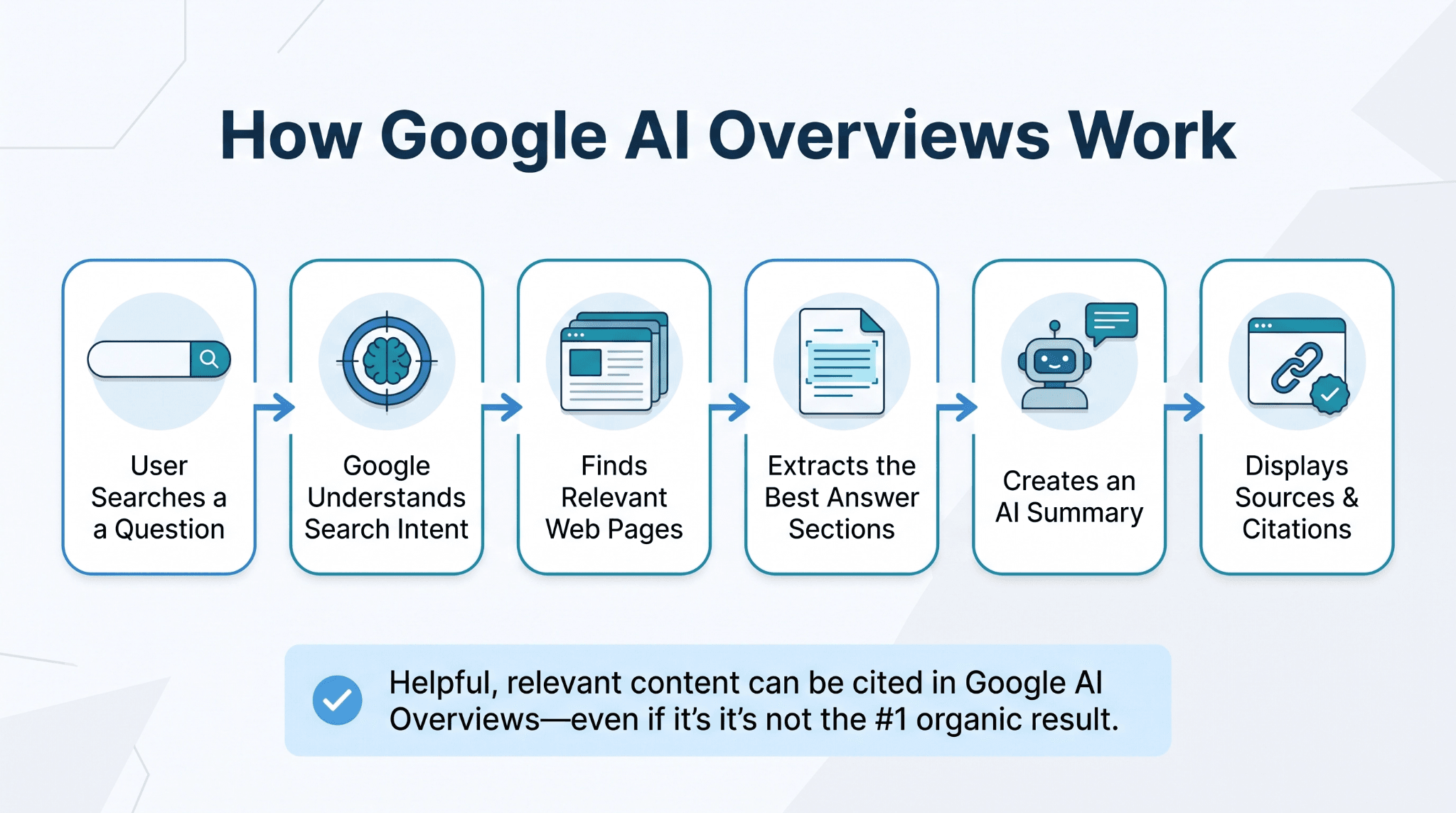
Here is how AI Overviews work in practice, broken into steps:
-
Google identifies the intent behind the search query
-
It retrieves a pool of candidate pages that match that intent
-
It extracts the specific passages that answer the question most directly
-
It synthesizes those passages into one written summary with linked sources
Understanding how AI Overviews work changes what "ranking" actually means, and it is the real answer to how to rank in AI Overviews consistently rather than by chance. A page can influence an AI Overview without holding the top organic spot. In fact, roughly 17% of cited sources in AI Overviews also rank in the organic top 10, according to BrightEdge's tracking.
It also helps to separate AI Overviews from Google's newer AI Mode:
-
AI Overviews sit inside standard Google Search results
-
AI Mode is a separate, full conversational search experience
-
The two surfaces cite the same URL only 13.7% of the time, according to Ahrefs, even though they reach a similar conclusion in about 86% of cases.
That gap matters. Optimizing for one surface does not automatically cover the other, so a complete strategy needs to account for both.
How Do You Turn On AI Overviews in Google Search?
For most users in supported regions, AI Overviews already appear by default inside regular Google Search results. There is no separate app to download.
If you want to check or turn on AI Overviews in Google Search deliberately, here is where to look:
-
Open Search Labs from your Google account settings, where available
-
Check your search settings directly on desktop or mobile, since availability varies by device
-
Confirm your region is supported, since rollout still differs by country and language
From a business standpoint, the more useful question is not how to turn on AI Overviews in Google, but whether your target audience is already seeing them. In markets where the feature is fully live, most informational searches show one by default. That is why content strategy now has to plan around this surface rather than treat it as optional.

How Can You Check If Your Content Appears in AI Overviews?
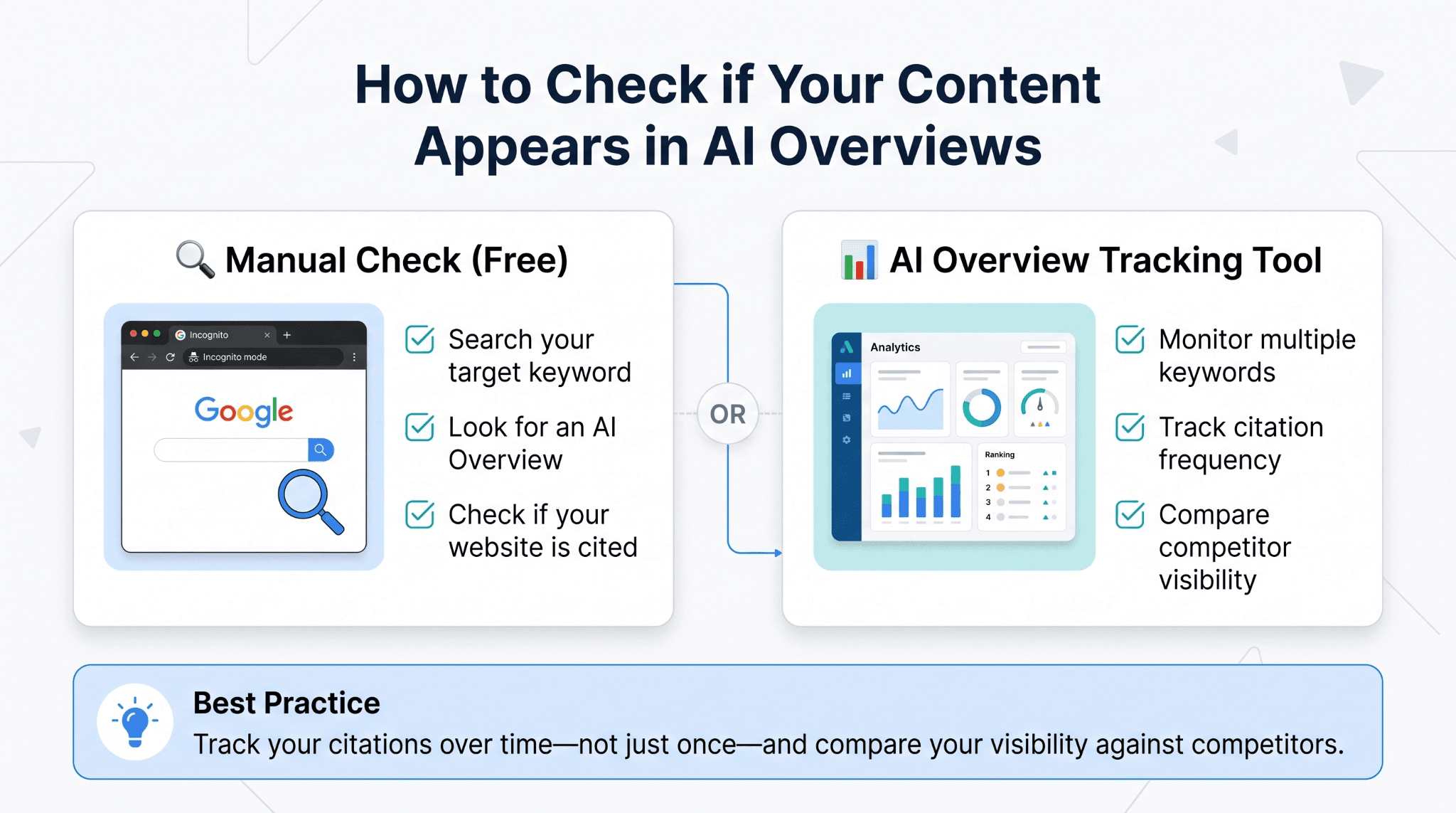
The simplest AI overview checker method costs nothing. Search your target query directly in Google, in an incognito window, and note whether your domain appears among the cited sources beneath the summary. If nothing shows up at all, it is worth confirming the AI Overview Google Turn On setting is active for your account and region before assuming your content was skipped.
For ongoing tracking across dozens or hundreds of keywords, manual checking does not scale. This is where a dedicated AI overview checker tool becomes useful, since this tool samples search results at scale and reports which queries triggered a summary and which domains got cited.
Two things matter more than the tool itself:
-
Track citation frequency over time, not just a single snapshot, since AI Overview presence shifts as Google updates its models.
-
Compare your citation rate against competitors on the same query set, since relative visibility is what actually affects traffic.
Once you know where you stand, the next question is what to actually change. That is where the tactics below come in.
How to Rank in AI Overviews: What the Five Core Tactics Look Like in Practice
There is no single trick that guarantees inclusion. What consistently works is a combination of structural clarity, technical signals, and earned trust, applied together rather than in isolation.
1. Answer The Question In The First 50 Words
Google's extraction models favor content that states the core answer immediately, before background or context. Bury the answer in paragraph four, and you reduce the odds it gets lifted, even if the rest of the page is accurate.
2. Structure Content With Clear Headings And Lists
Question-based H2s and H3s, short paragraphs, and bullet or numbered lists give the system clean units of text to extract. Dense, unbroken paragraphs are harder to parse and less likely to be cited cleanly.
3. Build Topical Authority With Supporting Content
A single strong article rarely outperforms a cluster of related pages that cover a topic from multiple angles and link to one another. This depth signals to Google that your domain understands the subject beyond one keyword.
4. Use Structured Data And Schema Markup
FAQ schema, Article schema, and HowTo schema help systems confirm what a page is about and how its content is organized, reducing ambiguity during extraction.
5. Earn Citations From Trusted External Sources
Digital PR and backlinks remain a trust signal. Brands cited in AI Overviews earn approximately 120% more organic clicks per impression than uncited brands on the same query, and that citation status is influenced by how the wider web references your brand, not just your own site.
Two lines before this comparison: the shift from traditional SEO to AI Overview optimization is less about abandoning old tactics and more about reordering priorities.
|
Traditional SEO Focus |
AI Overview Optimization Focus |
|
Keyword density on page |
Direct, front-loaded answers |
|
Backlinks for domain authority |
Backlinks plus brand mentions across trusted sources |
|
Rank position as the main metric |
Citation frequency as a parallel metric |
|
Long-form content for depth |
Long-form content structured into extractable units |
|
One target page per keyword |
Topic clusters covering related sub-questions |
What Mistakes Keep Content Out of AI Overviews?
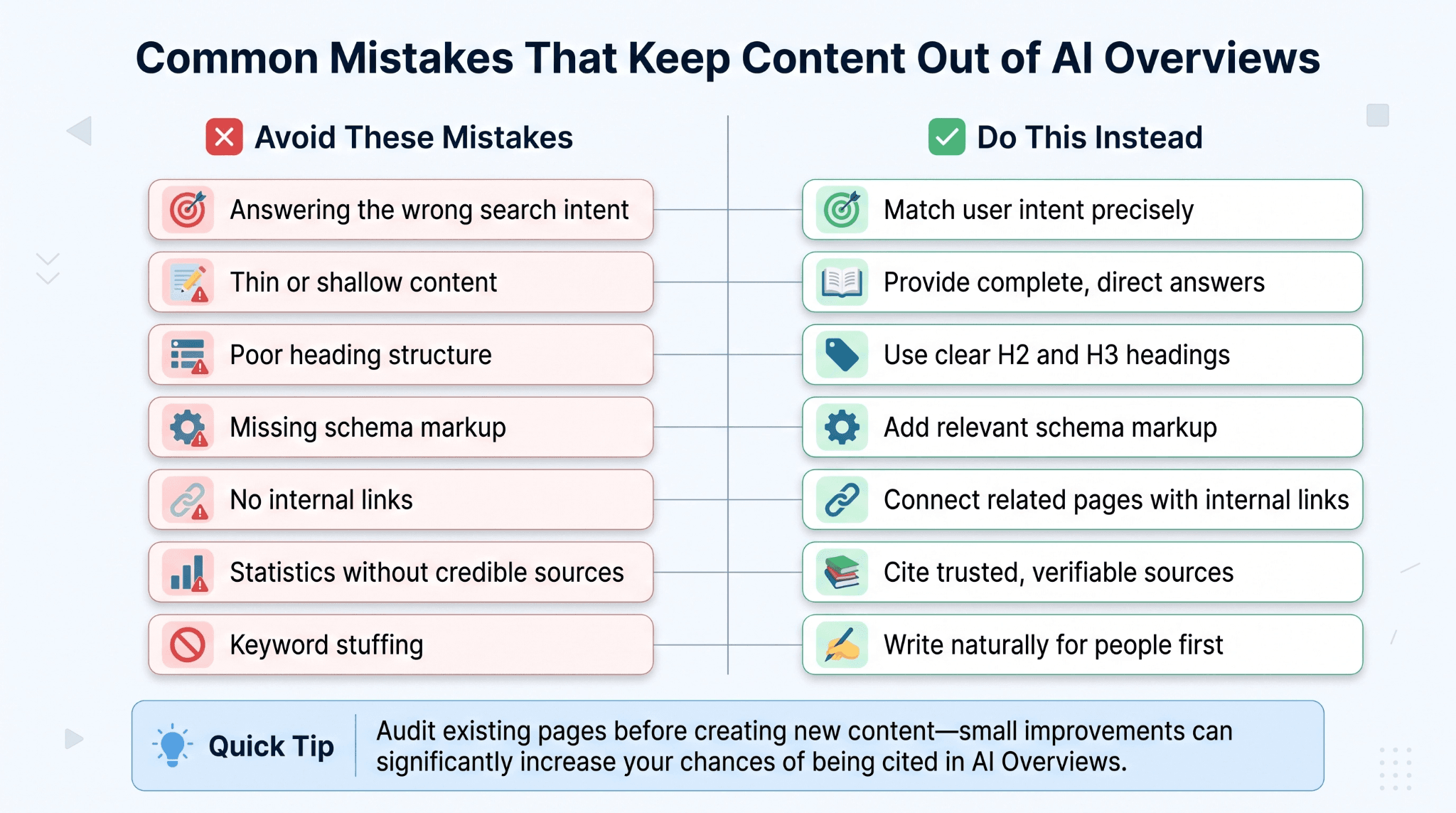
Most pages that fail to get cited are not low-quality; they are structured in a way that makes extraction difficult. The common failure points overlap directly with the tactics above.
Thin content that restates a question without answering it, answers buried under lengthy introductions, and pages with no clear heading hierarchy all reduce extraction odds. Unverifiable statistics and unsourced claims are treated with less confidence by the system, and keyword stuffing tends to work against clarity rather than for it.
Two lines before this list: these mistakes are worth auditing on any page that is not currently being cited, since fixing them is often faster than building new content from scratch.
-
Content that answers a different question than the one being searched
-
Missing or incomplete schema markup on informational pages
-
No internal links connecting related topic pages
-
Statistics without a named, checkable source
How Should You Measure AI Overview Performance Going Forward?
Traditional rank tracking alone will not tell you whether a page is winning in this new environment. Two data points matter more now: citation frequency and AI referral traffic, meaning visits that originate from users clicking through an AI-generated summary.
Google Search Console still shows impressions and clicks, but it does not distinguish which impressions came from inside an AI Overview. Pairing Search Console data with an AI overview checker tool and reviewing both on a monthly cadence gives a clearer picture of whether structural changes are actually improving citation rates.
Two lines before this table: here is a simple framework for tracking AI visibility alongside traditional metrics, reviewed on a recurring basis rather than as a one-time audit.
|
Metric |
What It Tells You |
Review Frequency |
|
Citation frequency |
Whether your pages appear inside AI Overviews for target queries |
Monthly |
|
AI referral traffic |
Volume of visits originating from AI-generated summaries |
Monthly |
|
Organic CTR on AIO queries |
Whether being cited translates into clicks |
Quarterly |
|
Schema validation |
Whether structured data is error-free and current |
Quarterly |
What Else Do People Ask About AI Overviews?
A few questions come up consistently from founders and marketing leads evaluating this shift, worth answering directly before moving on.
Do AI Overviews reduce website traffic?
Often, yes, for the specific query where one appears, since fewer users click through when a direct answer is already visible. Being cited within the summary partially offsets this, since cited brands see meaningfully higher click rates than uncited competitors on the same query.
Can small businesses appear in AI Overviews?
Yes. Citation depends more on how clearly a page answers a specific question than on domain size, which is why niche, well structured content from smaller sites regularly gets cited alongside larger competitors.
How long does it take to rank in AI Overviews?
There is no fixed timeline, since it depends on how quickly Google recrawls and reevaluates a page after structural changes. Most teams see measurable shifts in citation frequency within one to two months of restructuring existing content.
Is AI Overview optimization different from regular SEO?
It builds on regular SEO rather than replacing it. Strong organic rankings remain a foundation, but extraction-friendly structure and earned citations are now separate, additional requirements.
Where AI Visibility Strategy Goes From Here
AI Overviews are not a temporary feature to wait out. They represent a permanent shift in how information gets surfaced, and the businesses that adapt their content architecture now will hold an advantage as the surface continues to expand into commercial and navigational queries.
This is not a one-time optimization project. It is an ongoing operational discipline, closer to maintaining infrastructure than to running a campaign, which means it needs consistent monitoring, periodic restructuring, and a system for tracking citation performance over time rather than a single audit.
Get a Proposal to see how WellsGroup builds AI search visibility into the same operational systems we manage for cloud infrastructure and revenue tracking, so it stays current as the landscape shifts rather than going stale after a single project.