7 Best Generative Engine Optimization Tools Shaping AI Search in 2026
Choose the right generative engine optimization tools to monitor AI citations, optimize content, and improve visibility across leading AI platforms.

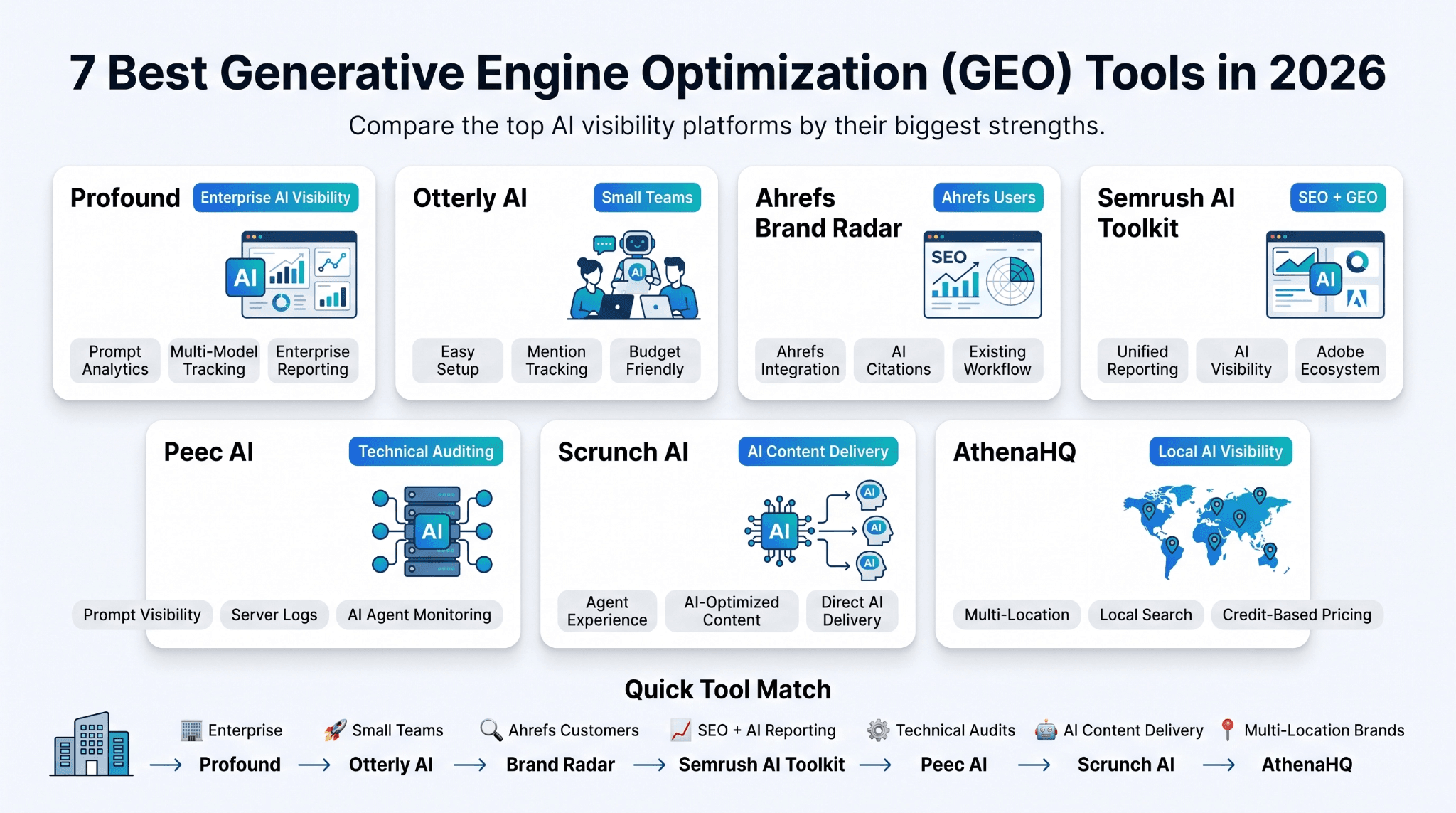
The best generative engine optimization tools in 2026 combine AI citation tracking, prompt-level analytics, and content structuring to help brands appear inside answers generated by ChatGPT, Gemini, and Google AI Overviews. Leading platforms include Profound, Otterly AI, Ahrefs Brand Radar, Semrush AI Toolkit, Peec AI, Scrunch AI, and AthenaHQ.
Each platform solves a different part of the same problem. Search increasingly ends inside a generated answer, and a business either shows up there or doesn't exist in that moment of the buyer's decision. If your team is evaluating which system to build around this shift, WellsGroup can map your current AI visibility gaps and recommend the right stack. Get a Proposal to start that assessment.
What Is Generative Engine Optimization?
Generative engine optimization, often shortened to GEO, is structuring content and brand information so AI systems can locate it, interpret it correctly, and cite it inside a generated answer.
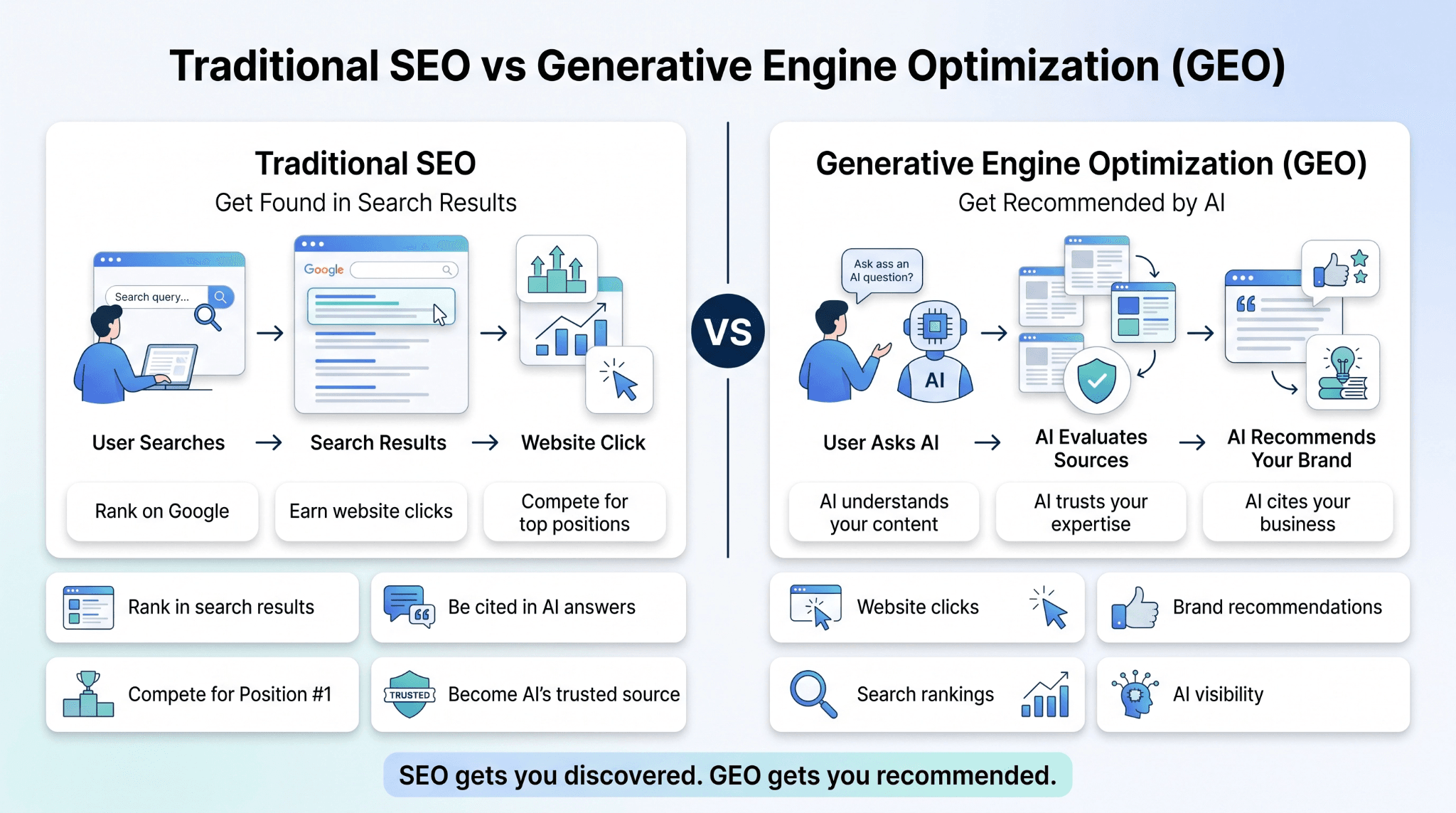
The simplest way to separate GEO from traditional SEO:
-
Traditional SEO gets your shop placed on the busiest street in town, ranked on a results page.
-
Generative engine optimization gets the town's most trusted guide to personally recommend your shop, every time someone asks where to go. The guide, in this case, is an AI model deciding what to say on your behalf, based on how clearly and credibly your content answers the underlying question.
This is functionally the same discipline as what most buyers now search for as answer engine optimization tools. Industry usage of the two terms has largely converged, with "AI visibility" emerging as the broader umbrella term covering both, and most teams now build their content strategy around it rather than treating it as a side project.
Why Do Businesses Need Generative Engine Optimization Tools in 2026?
The scale of this shift is no longer theoretical:
-
ChatGPT now processes queries from over 900 million weekly active users, and Google AI Overviews appear across a meaningful share of search queries, especially for commercial and informational terms.
-
AI-referred traffic to retail and business websites has grown sharply over the past year, a trend most analytics teams are still catching up to in their reporting.
-
More than half of U.S. consumers now say they use AI to inform a purchasing decision.
Manually checking whether ChatGPT, Gemini, Perplexity, and Copilot mention your brand across dozens of buyer questions isn't realistic at scale, which is why dedicated answer engine optimization tools have emerged to automate the monitoring. This is the core reason generative engine optimization tools exist: turning a manual, buyer-by-buyer guessing game into a system you can operate.
What Should You Look For in the Best Answer Engine Optimization Tools?
Before comparing specific platforms, it helps to know what actually separates a strong system from a shallow one. The best answer engine optimization tools tend to share three capabilities.
Does It Track Citations Across Multiple AI Platforms?
Most credible generative engine optimization tools track ChatGPT, Claude, Gemini, Perplexity, and Microsoft Copilot as a baseline. A tool monitoring only one engine gives you a fraction of the picture, since buyer behavior is now spread across several AI surfaces.
Does It Offer an AI Overview Checker?
Google's AI Overviews pull from a narrower, more technical set of ranking signals than a chatbot citation does. An AI overview checker isolates this surface, since a brand can be well cited in ChatGPT while invisible inside Google's own AI layer, or the reverse.
Does It Provide Actionable Content Recommendations?
Tracking alone tells you where you stand, not what to fix. Stronger platforms pair monitoring with recommendations, such as:
-
Which pages need clearer answer blocks near the top of the content
-
Which entities or facts are missing from your content's context
-
Which competitor sources are being cited instead of yours, and why
What Are the 7 Best Generative Engine Optimization Tools in 2026?
Here is how the most popular answer engine optimization tools compare as of mid-2026, each carving out a distinct position rather than competing on identical features.
Profound: Best for Enterprise AI Visibility Tracking
Profound is an enterprise-grade platform, with granular prompt-level analytics across ChatGPT, Perplexity, Google AI Overviews, and Gemini. It is frequently benchmarked directly against other mid-market and enterprise platforms, reflecting its role as a reference point for larger organizations needing deep reporting over lightweight monitoring.
Otterly AI: Best for Small Teams and Starting Budgets
Otterly AI is built for approachability:
-
Simple mention tracking, minimal setup
-
Pricing that starts at an accessible entry-level rate compared to enterprise platforms
-
A low barrier to entry for teams new to GEO
Ahrefs Brand Radar: Best for Teams Already Invested in Ahrefs
Ahrefs Brand Radar is sold as an add-on to an existing Ahrefs subscription:
-
Priced as a premium layer on top of an existing Ahrefs plan, rather than a standalone product
-
Its advantage is integration, since teams already using Ahrefs get AI citation tracking layered into a workflow they already run daily
Semrush AI Toolkit: Best for Unified SEO and GEO Reporting
Semrush AI Toolkit became part of a much larger shift in April 2026:
-
Adobe completed its acquisition of Semrush, folding one of the industry's largest SEO data sets into a broader customer experience platform
-
Semrush's own research has highlighted a meaningful gap between what ranks in traditional search and what gets cited in AI-generated answers, along with stronger conversion behavior among AI-referred visitors
For teams that want SEO and GEO reporting in one dashboard, this consolidation under Adobe strengthens that case.
Peec AI: Best for Prompt Level Visibility and Technical Auditing
Peec AI has grown quickly:
-
Backed by significant outside investment and reaching strong recurring revenue within its first year on the market
-
Recently added server log integration, letting technical teams audit dozens of distinct AI agents in real time, a deeper layer than most citation trackers offer
Scrunch AI: Best for Content Delivery to AI Agents
Scrunch AI was founded in 2023 and emerged publicly in 2024. It differentiates itself with an Agent Experience Platform, serving AI-optimized content directly to AI agents while leaving the human-facing site unchanged. The company has raised significant outside funding to build out this stack.
AthenaHQ: Best for Multi-Location and Local AI Visibility
AthenaHQ prices its platform on a credit model:
-
Structured as a tiered credit system rather than a flat monthly fee, scaling with usage
-
Partnered with Uberall to launch a GEO Studio product for multi-location brands, addressing a network of more than 1.3 million business locations globally
How Do These AI Search Optimization Tools Compare?
Choosing between the most popular answer engine optimization tools and the best generative engine optimization tools broadly comes down to two questions: operation size, and whether you need monitoring alone or monitoring paired with execution.
|
Tool |
Best Fit |
Primary Strength |
|
Profound |
Enterprise teams |
Prompt-level analytics depth |
|
Otterly AI |
Small teams, new to GEO |
Low cost, fast setup |
|
Ahrefs Brand Radar |
Existing Ahrefs users |
Workflow integration |
|
Semrush AI Toolkit |
Teams wanting unified reporting |
Combined SEO and GEO data |
|
Peec AI |
Technical, mid-market teams |
Server log and crawler auditing |
|
Scrunch AI |
Teams wanting execution, not just tracking |
AI-facing content delivery |
|
AthenaHQ |
Multi-location brands |
Local AI visibility at scale |
Cost tends to track operational maturity rather than company size alone.
|
Business Stage |
Recommended Tier |
Typical Monthly Cost Range |
|
Just starting GEO |
Entry-level monitor |
29 to 100 dollars |
|
Established program |
Mid-market platform |
100 to 400 dollars |
|
Enterprise or multi-location |
Full platform with add-ons |
400 dollars and above |
How Can You Avoid Common Mistakes When Using GEO Tools?
The biggest mistake is treating a single AI citation as a finished result rather than one data point in an ongoing system. A brand mentioned once by ChatGPT this month can disappear next month if a competitor publishes more structured content.
A few operational habits reduce this risk:
-
Track more than one AI engine, since ChatGPT, Gemini, and AI Overviews often cite different sources for the same query
-
Tie AI citation data back to actual traffic and conversion numbers, not mention volume alone
-
Review your AI overview checker data on a recurring schedule, not as a one-time audit
-
Confirm the tool integrates with the SEO stack you already run
Ignoring traditional SEO fundamentals is the second common error. AI engines still draw on the signals of authority, structure, and technical accessibility that have always mattered. GEO extends that foundation; it does not replace it.

Quick Guide to the Best Generative Engine Optimization Tools
These are the questions that come up most often across buyer guides and product comparisons in this category, which is a reasonable proxy for what people are actually asking before they choose a tool.
Is GEO the Same as SEO?
No. Traditional SEO optimizes for a ranked list of links, while GEO optimizes for a mention or citation inside a generated answer, following different structural rules even though the two share a foundation. Most teams get further faster managing both as one connected system, which is the approach WellsGroup builds for its clients.
How Much Do Generative Engine Optimization Tools Cost?
Pricing spans a wide range, from around 29 dollars a month for entry-level monitors to several hundred dollars a month for enterprise platforms with deeper analytics and dedicated reporting. The right spend depends less on the price tag and more on fit with your existing stack, which is worth assessing before committing to a plan.
How Does a GEO Tool Integrate With the SEO Tools I Already Use?
Most platforms are built either as standalone trackers or as add-ons to an existing SEO suite, such as Ahrefs or Semrush. Before buying, confirm whether the tool plugs into your current reporting workflow or requires a separate dashboard. This is the kind of integration mapping WellsGroup handles as part of a broader buildout, so nothing runs in a silo.
Which GEO Tools Are Best for Small Teams or Startups?
Otterly AI and Peec AI's entry tiers are generally the most accessible, with simple setup and no need to switch your existing SEO platform. Even here, it pays to have a clear plan for using the data, which is where a strategy partner like WellsGroup adds value early on.
Which GEO Tools Are Best for Enterprise or Agencies?
Profound, Scrunch AI, Semrush AI Toolkit, and Ahrefs Brand Radar are the more common choices for larger teams needing multi-brand support and agency-ready reporting. At this scale, the tool matters less than the system operating around it, which is the layer WellsGroup specializes in building.
Can You Use More Than One GEO Tool at Once?
Yes. A common pairing is a tracking-focused tool alongside one that adds content structuring or delivery, since few single tools do both well. Stacking tools without a unifying strategy tends to create noise, so it helps to have a partner tying the outputs into one coherent view.
Choosing the Right System for Where Your Business Is Today
There is no single winner among the best generative engine optimization tools for every business. The right choice depends on your current scale, existing marketing stack, and whether you need a monitoring layer or a full execution system. Whichever mix of AI search optimization tools you land on, the goal stays the same: earning a place inside the answer, not just a spot on the page.
What matters more than the individual tool is whether AI visibility is treated as a project or as an operating system. A dashboard checked occasionally will always lag behind a brand's actual position in AI-generated answers. A properly integrated system, tied to your CRM, content pipeline, and reporting, keeps that visibility current as the underlying AI models change.
If you want a technology partner to design and operate that system rather than hand you another disconnected tool, book a free consultation with WellsGroup, and we will walk through what AI search visibility looks like for your specific business today.