5 LLM SEO Techniques to Boost AI Citation Rates
Boost AI citation rates with five proven LLM SEO techniques, including structured content, verified data, LLMs.txt, tracking, and topical authority.

LLM SEO is the practice of structuring content so AI systems like ChatGPT, Gemini, and Google AI Overviews can find it, trust it, and cite it in generated answers. The five techniques that move citation rates in 2026 are answer-first formatting, verified data, machine-readable signals like LLMs.txt, citation tracking, and sustained topical authority.
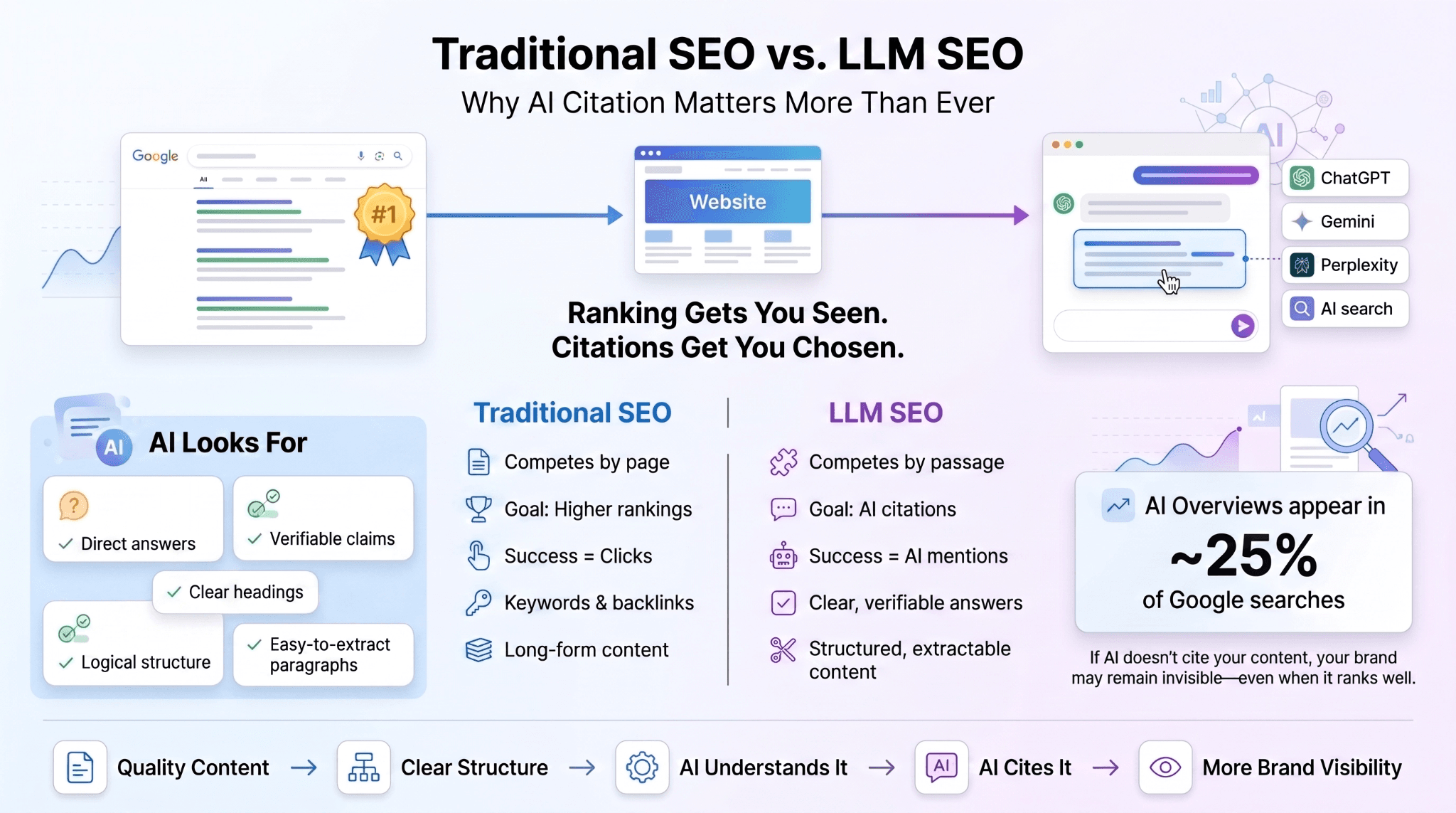
Most teams still treat AI visibility as an extension of ranking. It is not. Ranking gets you into a list of ten links, while citation gets your brand named inside an answer with no click required. That distinction now shapes how digital infrastructure gets built, and it is why WellsGroup treats AI search visibility as a system to operate, not a campaign to run.
Want a working AI citation strategy instead of another theory piece? Book a free consultation, and we will map where your content stands with the AI systems your customers already use.
What Is LLM SEO and Why Does It Affect Citation Rates?
LLM SEO means optimizing content so large language models such as ChatGPT, Gemini, Perplexity, and Google AI Overviews can locate a page, understand its claims, and quote or reference it.
It sits alongside traditional SEO rather than replacing it. Both still depend on crawlable, well-structured content, and neither works well on a page that is confusing or poorly organized.
The real shift is what counts as success:
-
Traditional SEO measures the position on a results page
-
LLM SEO measures whether a brand gets named inside an answer, often with no click at all
Google's AI Overviews now appear in roughly 25.11 percent of searches, up from 13.14 percent in March 2025, according to Conductor's analysis of 21.9 million queries. When a brand is not the one cited inside that answer, it is effectively invisible for that query, regardless of where it ranks underneath.
That is why citation rate now behaves like its own metric, separate from rankings and separate from click-through rate. A business can rank well and still lose visibility if a competitor's content is the one that an AI system chooses to quote.
How Is LLM SEO Different from Traditional SEO?
Traditional SEO optimizes a whole page to rank for a query. LLM SEO optimizes a specific passage to be lifted, verbatim or paraphrased, into an AI-generated answer.
The table below breaks down the core differences.
|
Factor |
Traditional SEO |
LLM SEO |
|
Unit of competition |
The full page |
The individual passage or paragraph |
|
Success metric |
Ranking position |
Inclusion in a generated answer |
|
Reader outcome |
A click on the page |
An answer without a click |
|
Key lever |
Keyword coverage and backlinks |
Clarity, direct answers, verifiable claims |
|
Content shape |
Long form, narrative-friendly |
Short, structured, extractable |
Keyword density barely factors into LLM SEO. Selection instead favors:
-
Clear, direct answers stated early
-
Claims a model can verify against other sources
-
Clean structure that is easy to extract from
Technique 1: How Does Structuring Content for Direct Answers Improve Citations?
The answer-first method places a concise, factual answer within the first 40 to 60 words of a page, right after the heading, before any narrative buildup.
This is the block AI systems lift with the least interpretation required, since it does not force a model to infer meaning from surrounding context.
A page built for extraction typically includes:
-
A direct answer in the opening paragraph, stated as fact rather than teased
-
Short paragraphs of two to four lines, with no buried claims deep in prose
-
Question-based subheadings that mirror how people actually prompt AI tools
-
Bullet points for comparisons, steps, or criteria instead of long narrative sentences
This structure is not a style choice. It is the difference between a model lifting a clean passage and skipping the page because the answer is wrapped in three paragraphs of setup.
Writers accustomed to building suspense or easing readers into a topic often need to unlearn that habit for this format, since AI systems reward pages that state the point immediately rather than pages that build toward it.

Technique 2: Why Does Verified Data Increase AI Trust in Your Content?
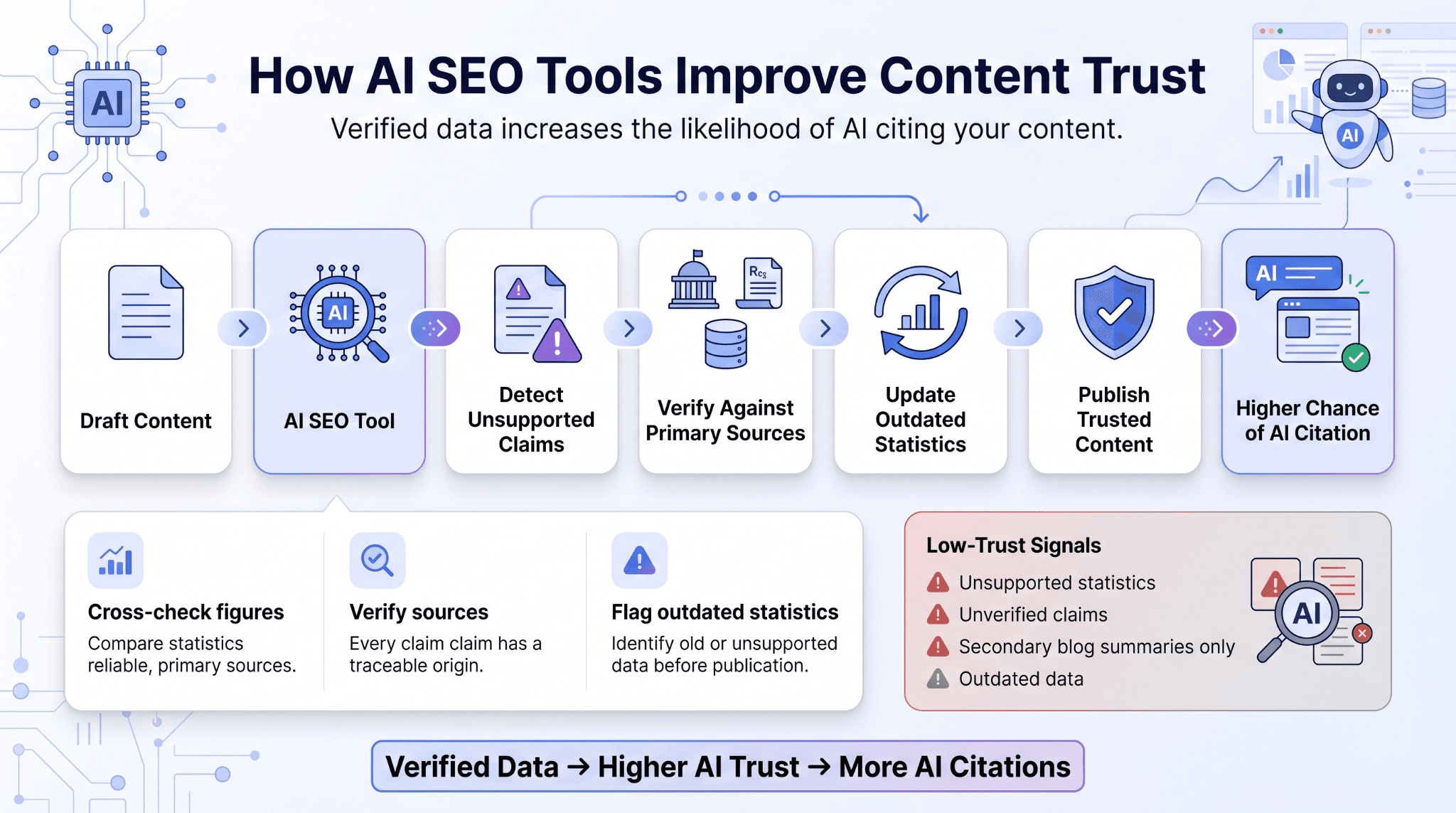
AI systems favor content backed by sourced, checkable claims over vague or promotional language. A model deciding whether to cite a page is effectively asking whether the claim can be trusted enough to repeat.
In practice, this means:
-
Linking to primary sources such as government data, peer-reviewed studies, or original research
-
Avoiding secondary blog summaries as your main source
-
Removing any statistic that cannot be traced back to where it came from
Unverifiable claims tend to get filtered out before they ever reach a citation, since AI systems cross-check content against other sources before treating it as trustworthy.
This is a shift from how content has traditionally been written for search engines. A page can rank well with confident-sounding claims, but an AI system is more likely to skip a source if its numbers cannot be verified elsewhere. Treating every statistic as something that needs a traceable origin, rather than a stylistic detail, is now a core part of writing for AI visibility.
What Role Do AI SEO Optimization Tools Play in Fact-Checking Content?
AI seo optimization tools increasingly include citation verification features that flag unsupported claims before publication.
Teams use these tools as a quality control layer:
-
Cross-checking figures against primary sources
-
Flagging claims that cannot be verified
-
Catching outdated statistics before they go live
This is a different function from ranking tools. The goal is to claim integrity, not keyword density, since one unverifiable statistic can get a whole page excluded from a model's trusted source pool.
Technique 3: How Does LLMs.txt Help AI Models Understand Your Site?
LLMs.txt is a plain text Markdown file published at a site's root domain. It gives AI systems a curated map of the most important pages, similar in placement to robots.txt but built to guide interpretation rather than restrict crawling.
First proposed by Jeremy Howard in late 2024, it has become a common talking point in AI SEO discussions.
Adoption is still early. A SE Ranking study of 300,000 domains found a 10.13 percent adoption rate across the sample.
Google has also confirmed it does not use LLMs.txt as a ranking or retrieval signal, and major consumer-facing AI platforms have not confirmed relying on it either.
The table below compares LLMs.txt with robots.txt, since the two are often confused.
|
Factor |
robots.txt |
LLMs.txt |
|
Purpose |
Restricts crawler access |
Curates what to read |
|
Audience |
Search engine crawlers |
AI models and agents |
|
Function |
Access control |
Editorial guidance |
|
Format |
Plain rules syntax |
Markdown with links and summaries |
|
Adoption status |
Long-established web standard |
Early, community-driven convention |
The realistic read for 2026: LLMs.txt functions more as a developer experience and agent routing tool than as a proven driver of AI search citations. WellsGroup still recommends publishing one, since the cost is low. It should never be the only technical signal a business relies on.
What Should a Basic LLMs.txt File Include?
A basic file should include:
-
A one-paragraph summary of what the site or business does
-
Links to the highest value pages, ranked by importance
-
Short one-line descriptions for each linked page
Larger sites may add sections for documentation, policies, or product data. The core structure stays simple enough to build in an afternoon.
Technique 4: Which LLM SEO Tools Help Track Citation Performance?
An LLM SEO tracker monitors when and how often a brand is mentioned or cited in AI-generated answers across platforms like ChatGPT, Perplexity, Gemini, and Google AI Overviews.
This category of LLM SEO tools exists because standard analytics were never built to see inside a generated answer. A page can receive zero referral traffic in Google Analytics while still being cited by name inside an AI response, and without dedicated tracking, that citation goes completely unmeasured.
Citation behavior also varies significantly between platforms and changes over time, which is exactly why ongoing tracking matters more than a single audit. Without a tracker built to compare platforms, a business could be well-cited on one surface and completely absent on another without ever knowing it.
This makes citation tracking closer to uptime monitoring than to a traditional analytics report. It is something to check on a recurring schedule, not something to review once and set aside.
What Should You Look for in an LLM SEO Tool?
Look for a tool that offers:
-
Citation tracking across multiple major platforms, not just one
-
Competitor comparison to benchmark relative visibility
-
Alerts when new mentions or citations appear
Citation visibility tends to shift from one answer to the next, so ongoing tracking is a requirement, not a one-time check.
Technique 5: How Does Topical Authority Increase Your Chances of Being Cited?
Topical authority is consistent, in-depth coverage of a subject across multiple connected pages, rather than a single optimized article standing alone.
Models tend to trust domains that demonstrate depth across a topic cluster, not just one strong page surrounded by unrelated content. A single excellent article sitting on a site with little else on the subject sends a weaker trust signal than the same article surrounded by several related, well-connected pages.
Building this in practice means:
-
Internal linking between related pages
-
Consistent terminology for the same concept across the site
-
Depth that goes beyond a surface-level definition into practical application
-
Original data or first-party research, where possible, since it tends to earn stronger trust than reworded summaries of other sources
This is a longer-term investment than the other four techniques, since it depends on a body of content rather than a single page, but it tends to compound as more pages reinforce the same subject over time.
Should You Hire an LLM SEO Agency or Build This In-House?
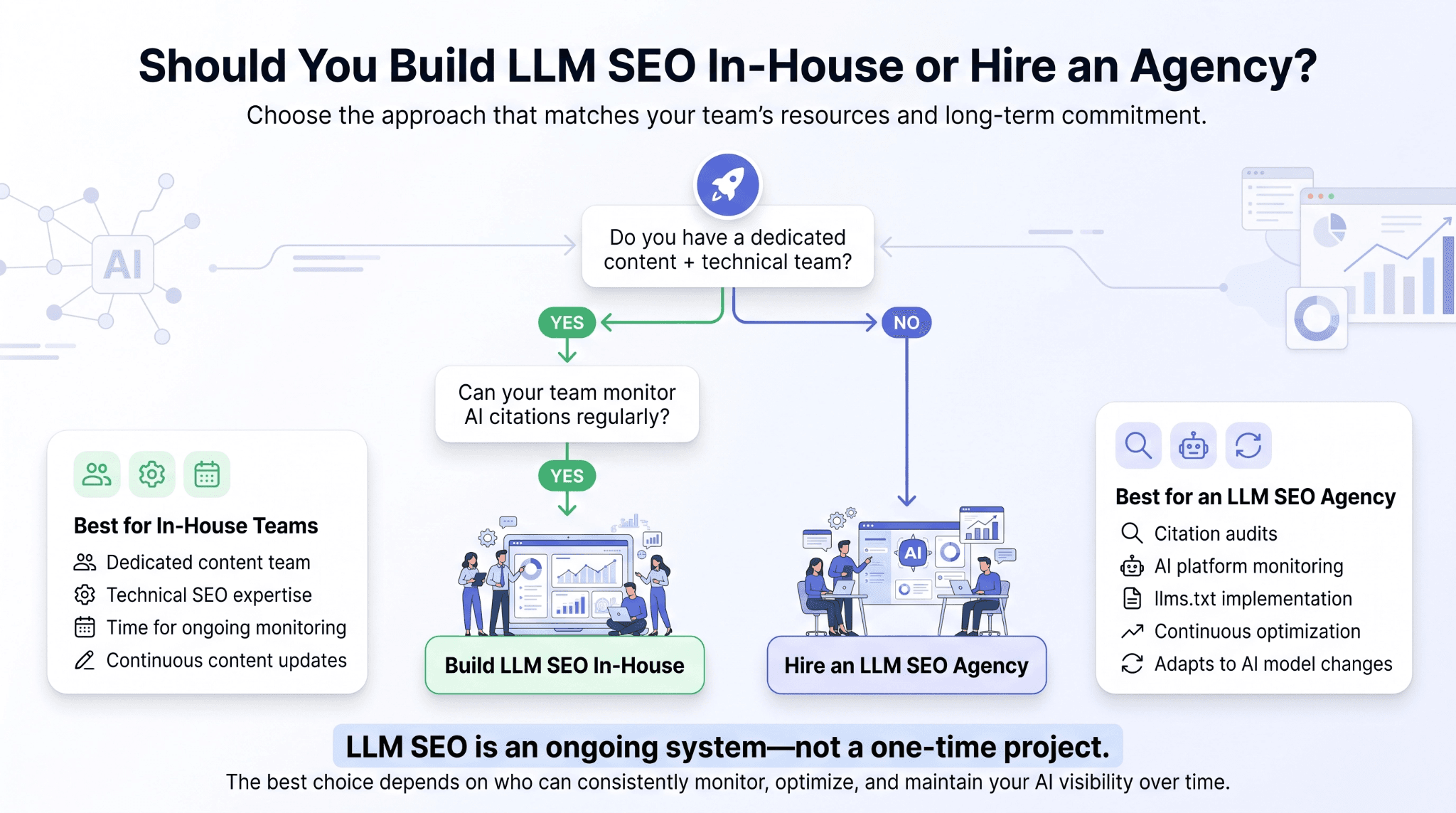
The answer depends on team size and how much of this needs to run continuously rather than as a one-off project. An LLM SEO agency or technology operator typically handles the harder parts to sustain internally:
-
Citation audits across platforms
-
LLMs.txt and technical signal setup
-
Ongoing tracking as models change how they select sources
A small team with one dedicated writer can realistically apply the five techniques above to individual pages. What is harder to sustain alone is monitoring, since citation behavior shifts often and needs consistent measurement, and few internal teams have the bandwidth to check multiple AI platforms on a recurring basis.
The decision usually comes down to this:
-
Teams with a dedicated content and technical resource can run this in-house using the techniques above
-
Teams without ongoing bandwidth for monitoring typically need an operator or agency to maintain the system rather than build it once and walk away
Neither option is inherently better. The right choice depends on whether a business can commit to treating this as an ongoing operation rather than a single project.
What Readers Often Want to Know About LLM SEO
These reflect the practical follow-up questions teams ask once they understand the five techniques above.
How long does it take to see results from LLM SEO?
Citation behavior changes faster than traditional rankings but is also less stable. Some pages get cited within weeks of restructuring. Sustained visibility depends on continuous tracking, which is exactly why we treat this as an operational system rather than a one-time update.
Does LLM SEO replace traditional SEO?
No. Traditional SEO still governs crawlability, indexing, and organic ranking, which AI systems often draw from when selecting sources. We build both into the same content system rather than treating them as separate workstreams.
Do small businesses need dedicated AI search optimization tools?
Not immediately. A small business can apply structural techniques manually first, then adopt AI search optimization tools once tracking across multiple platforms becomes too time-consuming to do by hand. This is typically the point where clients bring us in to take tracking off their plate.
Is LLMs.txt required for AI search visibility?
No. Adoption sits at around 10 percent of domains studied, and major platforms, including Google, have not confirmed using it as a citation signal. It remains a low-cost addition worth implementing anyway, and it is one of the smaller technical items we set up as part of a broader AI visibility build.
Can one page be optimized for both Google rankings and AI citations at the same time?
Yes. The same qualities- clear structure, verified data, and direct answers tend to support both outcomes, since AI systems often pull from well-ranked, well-sourced pages. This dual optimization is a standard part of how we structure content from the first draft, rather than something added after the fact.
Turning LLM SEO Techniques Into a Repeatable Content Process
None of these five techniques work as a single project completed once. Structure, verify, signal, and track form a cycle that needs to repeat as models change how they select and weigh sources. A page built for extraction today may lose that advantage in six months if the underlying data goes stale or a competitor publishes something more current.
This is the same operational logic WellsGroup applies across cloud infrastructure, CRM systems, and marketing systems. A system built once and left alone degrades, while a system monitored, verified, and adjusted on a schedule keeps performing as the environment changes, whether that environment is a production server or an AI model's retrieval behavior. If you want this managed as a system rather than a project, get a proposal from WellsGroup, and we will show you what a continuously operated AI visibility process looks like for your business.