Technical SEO Basics Every Business Website Needs in 2026
Master the technical SEO basics that improve crawlability, speed, indexing, and AI search visibility to strengthen rankings and drive sustainable business growth.

A logistics company publishes detailed service pages, invests in content, and runs paid ads, yet organic traffic stays flat. A SaaS brand rewrites its homepage three times and still does not appear on page one. An eCommerce store builds backlinks for months with nothing to show in the rankings. In most of these cases, the problem is not the content, the budget, or the strategy. It is the infrastructure underneath. Search engines cannot properly access, read, or trust the site.
Understanding the technical SEO basics your site depends on is not optional in 2026. It is the structural decision that determines whether your content reaches your audience or disappears into the index. Book a free consultation with WellsGroup and get a clear picture of what is holding your rankings back.
What Is Technical SEO and Why Does It Matter for Business Websites
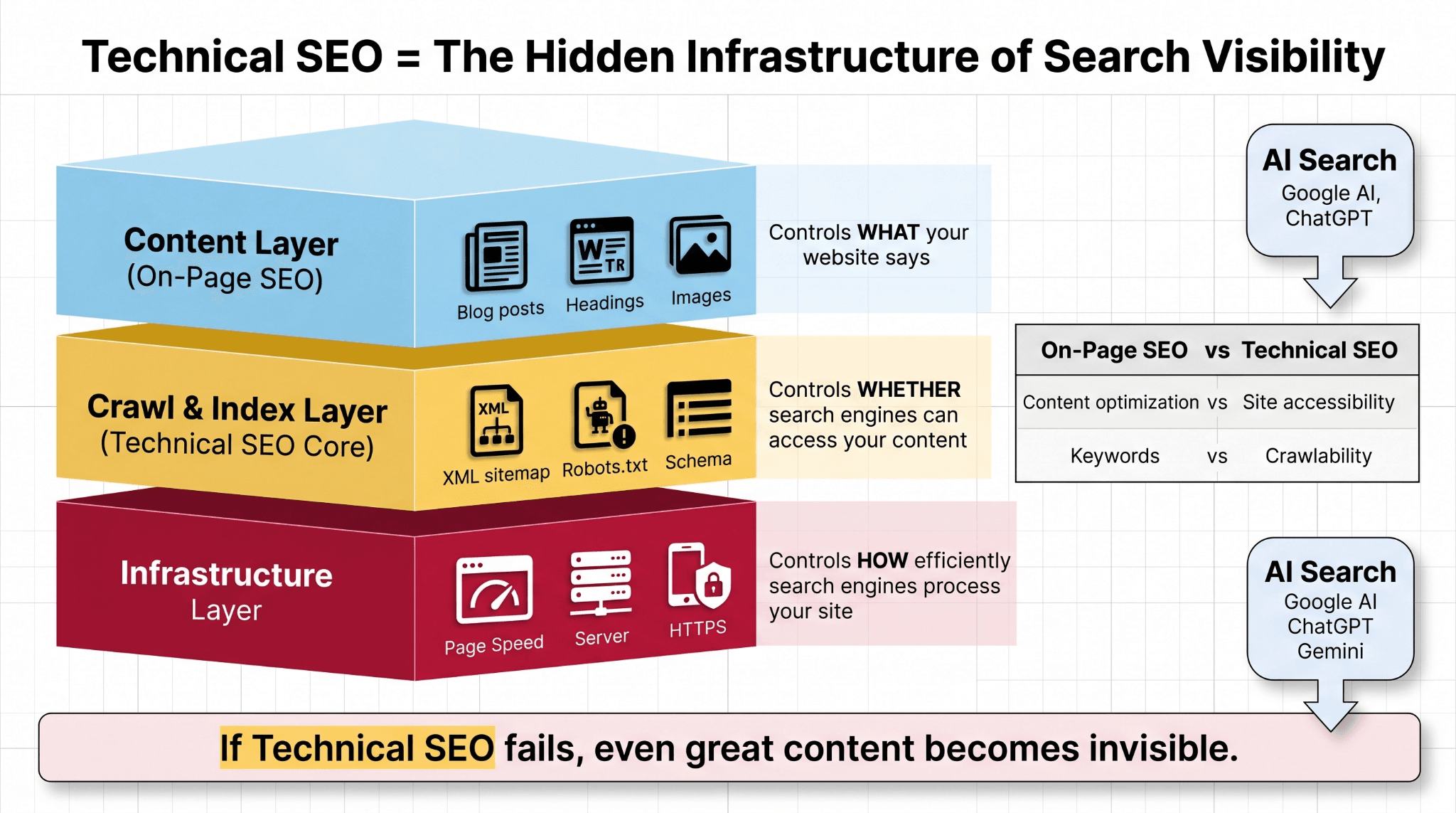
Technical SEO is the discipline of configuring a website so search engines can efficiently crawl, index, and rank its pages. It operates beneath the content layer, in server settings, URL structures, metadata, performance configurations, and markup.
Many business owners conflate on-page SEO vs technical SEO. On-page SEO governs what your content says. Technical SEO governs whether search engines can access that content at all. One enables the other.
For SEO for business website success in 2026, the stakes are sharper than they were two years ago. Google now processes queries through AI Overviews. ChatGPT Search and Gemini pull from indexed, well-structured web content. Sites with weak technical foundations are invisible in both traditional and AI-driven search. Technical SEO for beginners often feels abstract, but it answers one question: can search engines find, read, and trust your website?
The Core Technical SEO Basics Your Site Cannot Ignore
The fundamentals have not changed, but the consequences of ignoring them have grown. In 2026, search engines will be faster and less forgiving of structural errors. Here are the non-negotiable elements every business site must have in place.
Website Crawlability and How Search Engines Access Your Site
Crawlability is the first gate. Before Google can rank a page, it must reach it. Your robots.txt configuration tells crawlers which pages to access and which to skip.
A misconfigured robots.txt can block entire site sections silently. Website crawlability issues are invisible to human visitors but costly in search. Regular checks using Google Search Console catch these problems early.
XML Sitemap Optimization and Why It Guides Google to Your Content
An XML sitemap lists every important URL on your site and signals how frequently pages change. XML sitemap optimization means pointing crawlers to high-value pages, not redirected URLs or noindexed content.
Common mistakes that cause site indexing issues include:
-
Submitting sitemaps with 404 pages or outdated URLs
-
Including pages marked noindex in the sitemap
-
Failing to update the sitemap after content restructures
When multiple URLs serve the same content, Google decides which version to rank. Without guidance, it may split ranking signals across both. Canonical tags solve this by designating the preferred URL for each piece of content.
Duplicate content SEO problems are more common than most businesses expect, often originating from www vs non-www variations, trailing slash inconsistencies, or URL parameters. According to Raven by TapClicks, 29% of websites have duplicate content issues, nearly one in three businesses unknowingly splitting their ranking power. Left unaddressed, it quietly erodes organic visibility and reduces citation chances in AI-driven search. Learn how WellsGroup's technical SEO systems fix this before it affects your rankings.
Page Speed, Core Web Vitals, and the Performance Standards Google Enforces in 2026
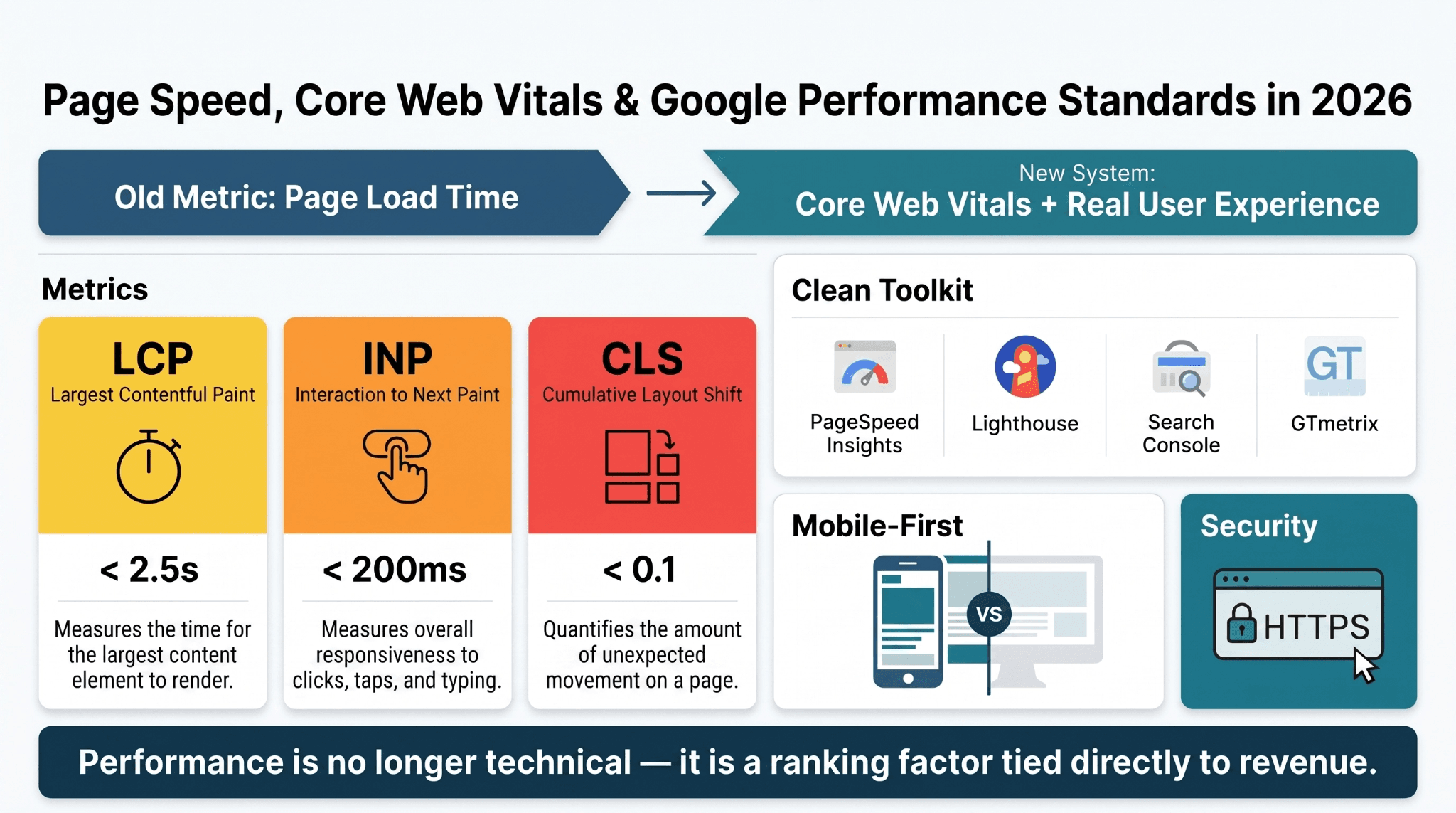
Page speed optimization has matured significantly over the past two years. Google no longer measures performance through generic load time. It evaluates your site through Core Web Vitals and mobile infrastructure standards that reflect real user experience across devices.
Core Web Vitals: What Google Actually Measures
Google evaluates performance through three specific metrics that measure real user experience rather than generic load time.
The three metrics every business site is evaluated against are:
-
LCP (Largest Contentful Paint): How quickly the main content loads. Target: under 2.5 seconds
-
INP (Interaction to Next Paint): How fast the page responds to interaction. Target: under 200ms
-
CLS (Cumulative Layout Shift): How much the layout shifts during load. Target: under 0.1
Site speed and SEO rankings are directly connected. Pages that fail these thresholds are at a measurable disadvantage against pages of similar content quality and authority. The right tools make diagnosis straightforward.
The following tools are most effective for identifying and resolving performance issues:
|
Tool |
Primary Use |
|
Google PageSpeed Insights |
Lab and field data for LCP, INP, and CLS |
|
Lighthouse (Chrome DevTools) |
Diagnostic breakdown by performance category |
|
Search Console Core Web Vitals Report |
Real user data segmented by page type |
|
GTmetrix |
Waterfall analysis for slow resource identification |
Mobile-First Indexing and HTTPS: Two Baselines Google Expects
Google uses the mobile version of your site as the primary basis for ranking decisions. If your mobile experience is broken or missing content, your rankings reflect that, not your polished desktop version. Mobile-first indexing is the current default, and it demands that your mobile site carry the same content, structured data, and internal links as the desktop.
HTTPS and site security operate as baseline trust signals. An unsecured site triggers browser warnings that damage user trust and increase bounce rates. For any business handling contact forms, payments, or user accounts, HTTPS is not negotiable.
Structured Data, Schema Markup, and Getting Featured in AI Search
Structured data SEO refers to standardized code, most commonly JSON-LD using Schema.org vocabulary, that tells search engines exactly what a page contains. Rather than inferring meaning from text, search engines read schema markup for websites as direct, machine-readable declarations.
In 2026, structured data will become critical for AI visibility. Google AI Overviews and Perplexity use schema as a primary signal when selecting content to cite. Pages with validated schema are more likely to appear in zero-click results and AI-generated answers.
Basic schema types every business site should implement include:
-
Organization schema for brand identity and contact details
-
LocalBusiness schema for location-based visibility
-
FAQPage schema for search result expansion
-
BreadcrumbList schema for site structure clarity
-
Article or BlogPosting schema for content pages
Implementation does not require a developer for most schema types. WordPress plugins like Yoast and Rank Math support schema through native settings.

Internal Linking, Site Architecture, and How Authority Flows Through Your Site
Website architecture SEO is about how pages relate to each other and how authority moves through your site. A well-structured site guides crawlers logically from high-authority pages to supporting content.
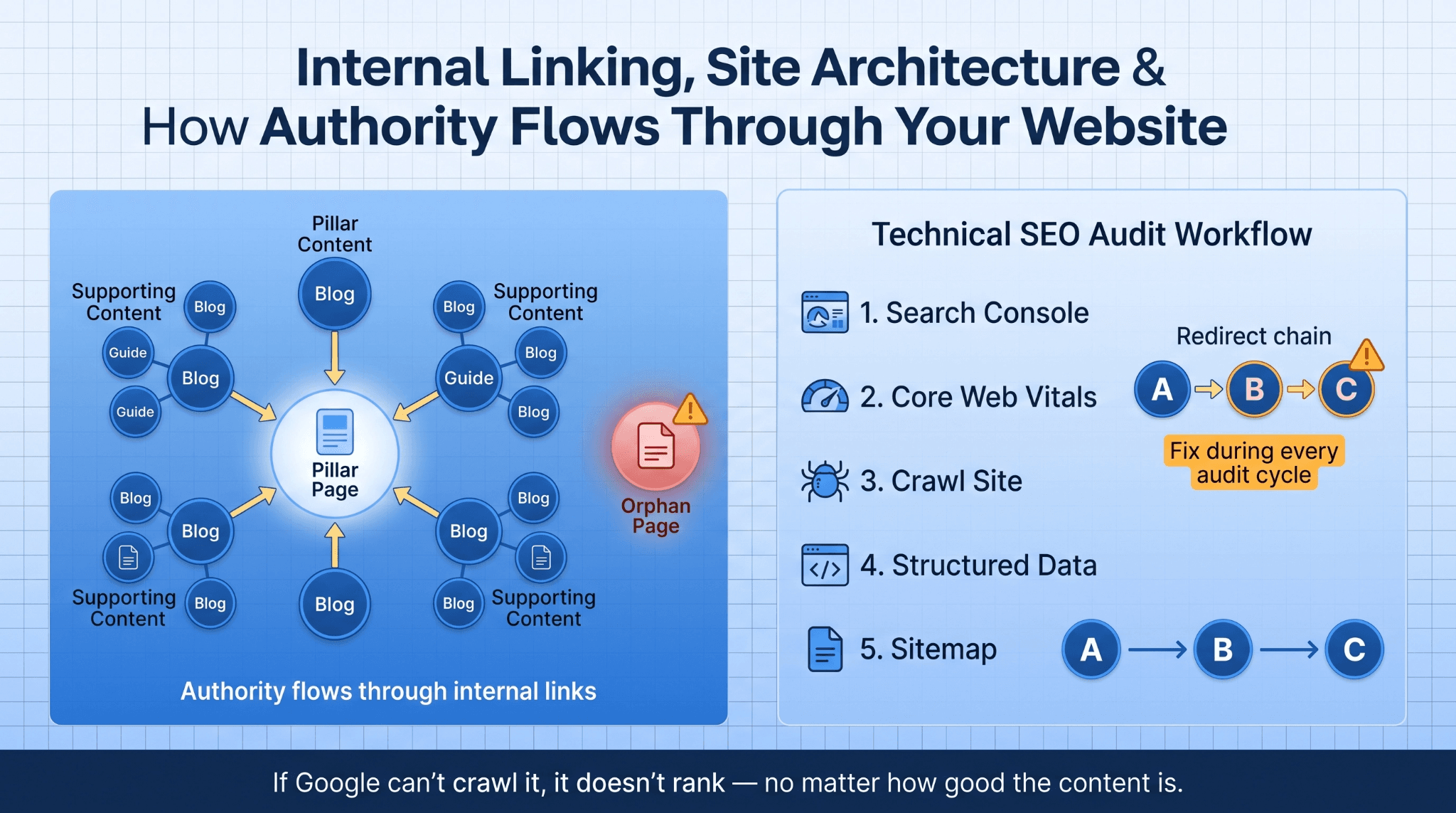
Internal linking structure should reflect your content hierarchy. Your most important pages, service pages, conversion pages, and cornerstone content should receive the most internal links. Orphan pages, those with no internal links pointing to them, receive no authority and are rarely crawled.
For larger sites, crawl budget optimization becomes a direct concern. Sites that waste crawl budget on low-value pages and redirect chains give Google less opportunity to discover their most important content. A hub-and-spoke architecture, where a pillar page links to and receives links from a cluster of related pages, is the most effective model for both crawl efficiency and topical authority.
How to Run a Technical SEO Audit and Fix What's Holding You Back
A technical SEO audit is a systematic review of your site's infrastructure. An SEO site audit does not need to be complex, but it does need to be methodical. Google Search Console setup is the starting point; it is free, built for this, and surfaces crawl errors, indexing issues, and Core Web Vitals failures before they compound.
The audit process, in order of priority, is as follows:
-
Check the Coverage report in Search Console for excluded or errored pages
-
Review the Core Web Vitals report for failing page groups
-
Crawl the site with Screaming Frog to surface broken links, SEO impact, redirect chains, SEO issues, and missing meta tags
-
Validate structured data using Google's Rich Results Test
-
Review robots.txt and sitemap for conflicts or outdated entries
Most site indexing issues fall into three categories: pages blocked by robots.txt or noindex tags, pages excluded due to duplicate content signals, and pages with no internal links. Knowing how to fix indexing issues begins with identifying which category applies. Redirect chains, where URL A redirects to URL B, which redirects to URL C, dilute link equity and slow crawl efficiency. Both broken links and redirect chains should be resolved during every audit cycle.
Technical SEO Checklist: What to Review Every Quarter
Technical SEO is not a one-time project. Sites change, content is added, and technical issues accumulate silently. A consistent technical SEO checklist keeps your site healthy between major audits.
Below is a quarterly maintenance framework for business sites of all sizes. Each check maps to a tool that makes execution straightforward:
|
Check |
Tool |
Frequency |
|
Crawl errors and index coverage |
Google Search Console |
Monthly |
|
Core Web Vitals performance |
PageSpeed Insights |
Monthly |
|
Broken internal links |
Screaming Frog / Ahrefs |
Quarterly |
|
XML sitemap accuracy |
Screaming Frog |
Quarterly |
|
Robots.txt review |
Manual / Screaming Frog |
After site changes |
|
Schema markup validation |
Google Rich Results Test |
Quarterly |
|
Redirect chain audit |
Screaming Frog |
Quarterly |
|
Mobile usability |
Search Console |
Monthly |
For technical SEO for small business teams, this framework removes dependency on expensive one-off audits. The goal is to improve website ranking technically through consistent maintenance, not reactive damage control.
What Business Owners Want to Know About Technical SEO
These are the recurring concerns that come up when business owners engage with technical SEO seriously.
Does technical SEO affect paid advertising performance?
Yes, indirectly. Landing page speed is a direct factor in Google Ads Quality Score. A slow or poorly structured landing page increases cost-per-click, reduces ad rank, and lowers conversion rates, meaning technical issues quietly drain paid budgets alongside organic performance.
How long does it take to see results?
Crawlability and indexing fixes can show results within days once Google recrawls affected pages. Performance improvements compound over several weeks. Authority-related changes, such as fixing internal linking or resolving duplicate content, typically take four to eight weeks to reflect measurably in rankings.
Can it be done without a developer?
For most foundational elements, yes. Google Search Console, Yoast, Rank Math, and PageSpeed Insights are fully accessible without coding knowledge. JavaScript rendering issues, server-level configurations, and log file analysis are areas where developer involvement produces faster and more reliable results.
What is the highest-impact fix for most business sites?
In most audits, it is either resolving crawl-blocking errors in robots.txt or fixing Core Web Vitals failures on high-traffic page types. Both produce measurable ranking improvements faster than most other technical interventions and should always be prioritized first.
What is the difference between a technical SEO audit and an SEO site audit?
A technical SEO audit focuses on infrastructure, crawlability, indexing, speed, and structured data. An SEO site audit is broader, covering content, backlinks, and keyword alignment on top of technical health. Running both together quarterly gives the most complete picture of where rankings are being lost.
What is the difference between a technical SEO audit and an SEO site audit?
A technical SEO audit focuses on infrastructure, crawlability, indexing, speed, and structured data. An SEO site audit is broader, covering content, backlinks, and keyword alignment on top of technical health. Running both together quarterly gives the most complete picture of where rankings are being lost.
Build the Foundation Before You Build the Traffic
Start with Google Search Console. Set it up, verify your domain, and review the Coverage and Core Web Vitals reports. What you find will tell you more about your site's search performance than any analytics dashboard. From there, work in sequence: fix crawlability, confirm HTTPS, submit a clean XML sitemap, resolve duplicate content with canonical tags, then layer in schema and performance improvements.
Technical SEO basics are the operational foundation every business website needs to function as a growth asset. WellsGroup builds and maintains these systems as part of a unified digital infrastructure because a website that cannot be found is not a business asset. WellsGroup engineers the technical infrastructure behind high-performing business websites. If your site has never been audited or your technical foundation has not been reviewed since your last redesign, book a free consultation to identify exactly what is holding your rankings back.