B2B Social Media Marketing Playbook: 12 Strategies for 2026
Build a scalable B2B social media marketing system using authority content, LinkedIn Ads, social selling, and analytics to drive revenue.

A B2B social media marketing playbook is a connected system of authority content, paid LinkedIn campaigns, and social selling that moves business buyers through a longer, research-heavy purchase cycle. In 2026, it works by turning LinkedIn, sales teams, and analytics into one coordinated pipeline instead of separate, disconnected efforts.
Most companies still treat social media as a side project. That worked when social was purely a brand awareness channel. It does not work now that buyers research vendors and form opinions long before a sales call happens. Get a Proposal from WellsGroup to build a b2b social media marketing system instead of a content calendar.
What Is B2B Social Media Marketing and Why Does It Matter in 2026?
B2B social media marketing is the use of platforms like LinkedIn, X, and YouTube to reach business buyers, build authority with decision makers, and generate a measurable pipeline. Unlike consumer marketing, it is judged less by reach and more by whether it produces conversations a sales team can act on.
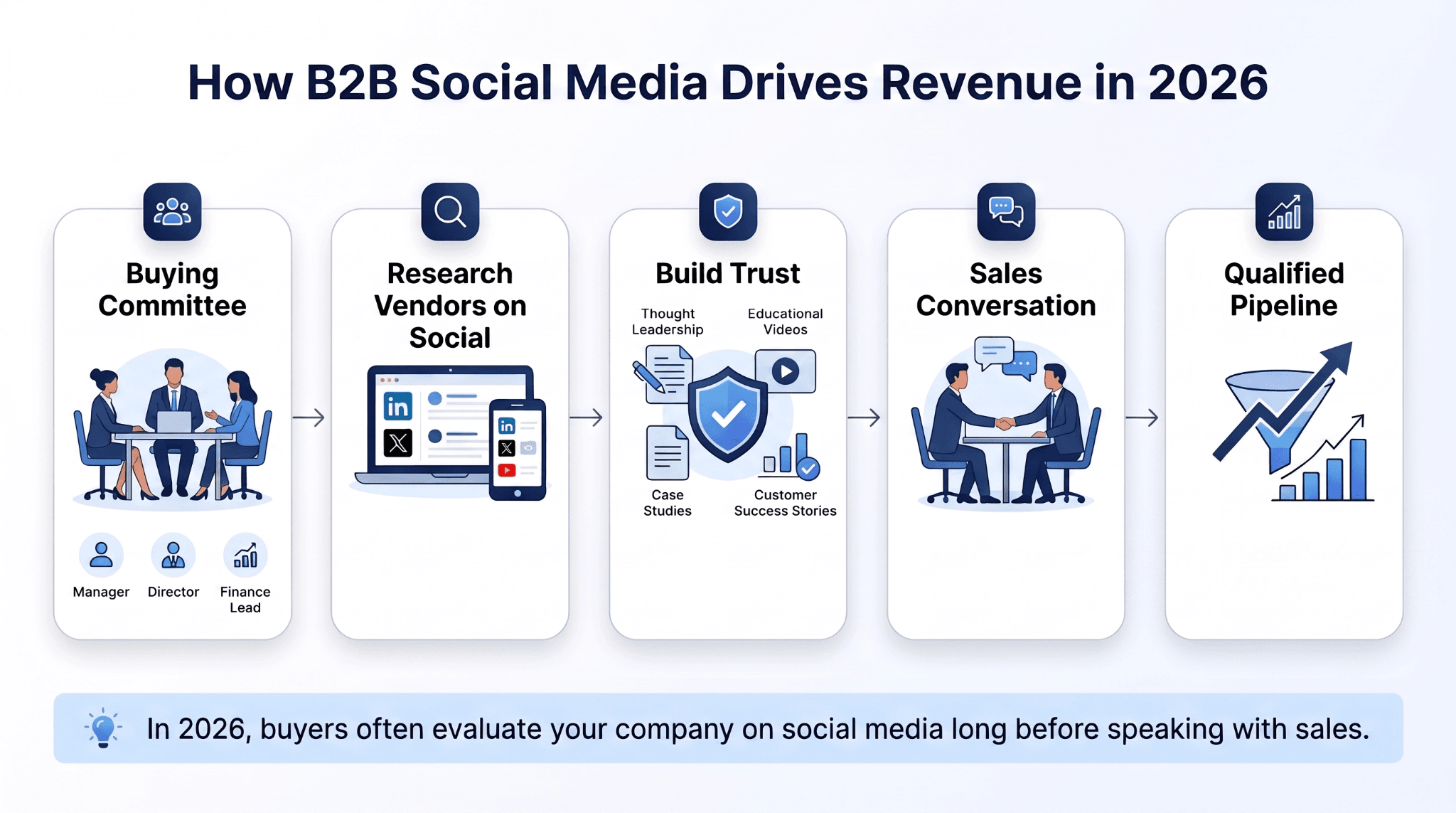
In 2026, this discipline has moved from a supporting activity to a core revenue function:
-
Buying committees form opinions about vendors before any outbound contact happens.
-
Social platforms are where much of that early research takes place.
-
A playbook approach beats ad hoc posting, because it connects content, paid media, and sales activity into one system with a clear goal.
How Is B2B Social Media Different From B2C Social Media?
B2B buying cycles are longer and involve more people. A single purchase decision might pass through a manager, a director, and a finance lead. Each of them may review a company's social presence independently before a deal moves forward.
Because of that, B2B social content has to build trust across a group, not just capture individual attention.
-
Consumer social media rewards fast, emotional reactions.
-
B2B social media rewards clarity and evidence that can survive being reviewed by several people over several weeks.
What Makes a B2B Social Media Marketing Strategy Successful?
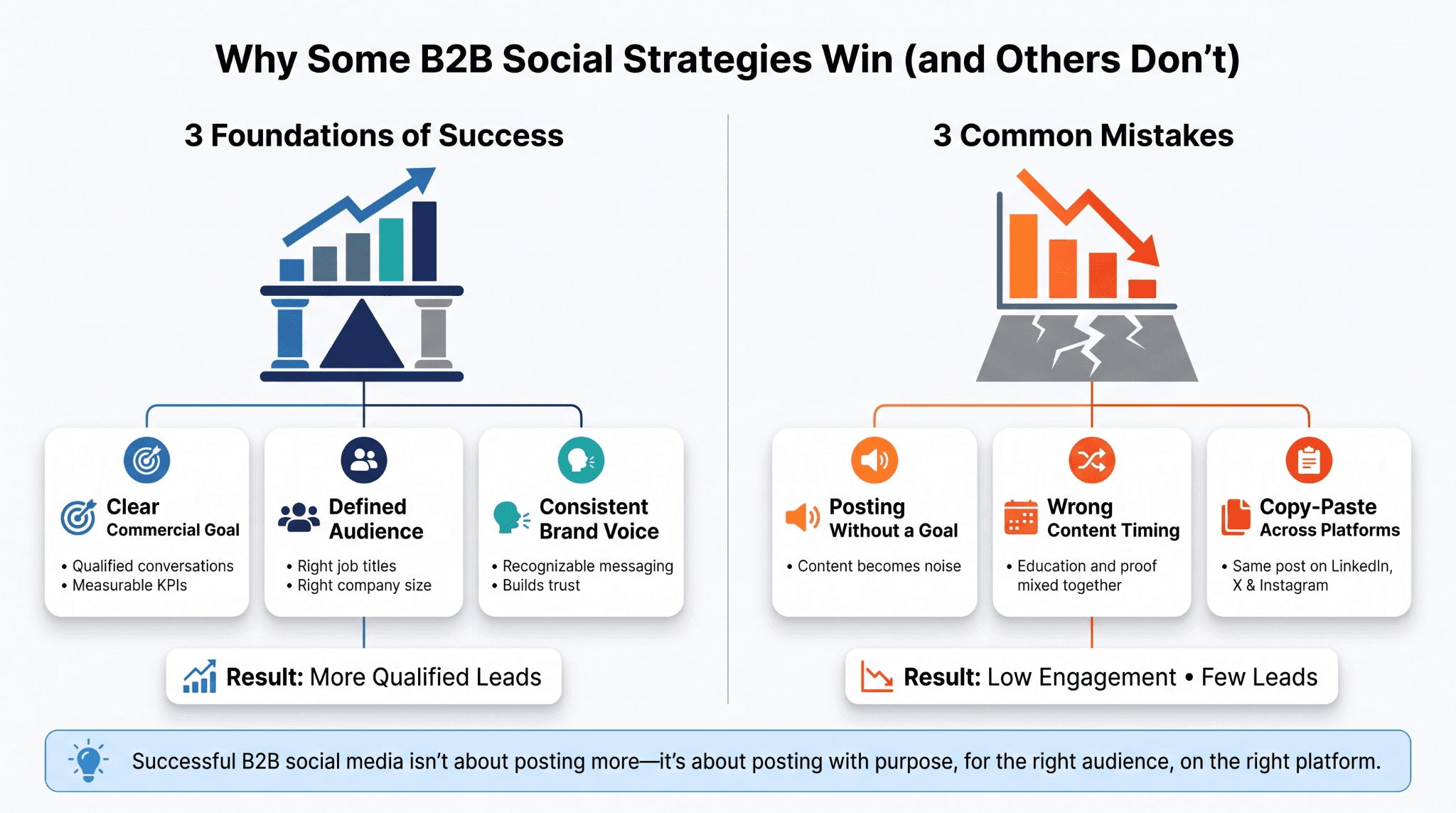
A successful strategy rests on three foundations. Without these, even well-produced content tends to drift and lose its connection to pipeline.
-
A clear commercial goal. "More engagement" is not a strategy. "Generate a set number of qualified conversations per month from operations leaders in logistics and SaaS" is a strategy, because it can be measured and adjusted.
-
A defined audience. Teams that know which job titles and company sizes they are speaking to write content that sounds relevant, not generic.
-
A consistent voice. This keeps every post recognizable as coming from the same company.
Why Do Most B2B Social Media Efforts Fail to Generate Leads?
Most efforts fail for one of three reasons:
-
Posting without a goal, which turns content into noise.
-
Ignoring where the buyer sits in their decision process, so early-stage education and late-stage proof get mixed together with no sequence.
-
Treating every platform the same way, copying one post across LinkedIn, X, and Instagram without adjusting tone or format.
Buyers notice when content feels recycled rather than built for the platform they are on.
What Are the 12 Best B2B Social Media Marketing Strategies for 2026?
The strategies below sit inside four connected systems: content and authority, paid distribution through LinkedIn Ads for B2B, social selling, and analytics. Each group builds on the one before it, so skipping a group weakens the ones that follow.
Here is how the twelve strategies map across those four systems, along with the primary outcome each one is built to drive.
|
System |
Strategies |
Primary Outcome |
|
Content and Authority |
1. Thought leadership content |
Trust and topical credibility |
|
LinkedIn Ads for B2B |
4. Precise audience targeting |
Qualified reach and efficient spend |
|
Social Selling |
7. Sales team engagement |
Conversations and pipeline velocity |
|
Analytics |
10. Tracking engagement to pipeline |
Accountability and continuous improvement |
How Can You Build a Content Strategy That Builds Authority?
Authority-based content is the foundation of any b2b social media marketing effort. Buyers engage far more with a company that clearly understands their problem than one that only promotes its product.
-
Thought leadership. Publish perspectives on industry shifts and operational challenges, not only product updates. This is one reason 76% of B2B marketers name LinkedIn as the most effective channel for thought leadership.
-
Employee advocacy. Encourage leadership and subject matter experts to post from their own profiles, which extends reach further into a professional network than a company page alone.
-
Educational formats. Turn case studies and process breakdowns into carousels and short videos, giving readers something concrete to learn, not just something to notice.
How Do You Use LinkedIn Ads for B2B Growth?
LinkedIn Ads for B2B work best as an amplifier for content that has already shown organic traction, not as a replacement for organic strategy.
-
Precise targeting. Target by job title, seniority, and company size to reach the buying committee roles identified during audience mapping.
-
Retargeting. Serve follow-up content to people who have already visited a pricing or service page, since they are further along in their decision.
-
Pairing ads with organic proof. Run campaigns behind content that already has organic engagement or a client result attached, which increases credibility and lowers cost per qualified click.
LinkedIn advertising carries a higher cost per click than most platforms, but its precision at the qualified lead level is what makes it efficient for B2B budgets.
How Does Social Selling Fit Into a B2B Strategy?
Social selling is the practice of sales professionals using social platforms to build relationships and engage prospects directly, rather than relying only on cold outreach. It complements marketing content instead of replacing it.
-
Sales team engagement. Reps commenting on and sharing company content in their own voice puts a human face on the brand for prospects comparing vendors.
-
Direct, relevant outreach. Reaching out based on something a prospect has actually posted performs better than generic connection requests.
-
Personal brand building for reps. Buyers often research the specific person they will work with, not just the company.
Reps who engage consistently on social platforms are 51% more likely to hit quota than those who do not, and companies with organized social selling programs report larger average deal sizes.
What Role Do Analytics and Optimization Play?
Analytics close the loop on the previous nine strategies. Without them, a team is guessing which content and channels are actually producing pipeline rather than just impressions.
-
Tracking engagement to pipeline. Connect engagement data to CRM records to see which posts are tied to real opportunities.
-
A/B testing formats. Test video against carousel against text post on a consistent basis to reveal what a specific audience responds to.
-
Quarterly strategy reviews. Revisit goals and channel mix regularly, since buyer behavior and platform algorithms shift often enough that a strategy built a year ago may already be outdated.
Why Is LinkedIn Still the Leading Platform for B2B in 2026?
LinkedIn remains the leading platform for B2B in 2026 because it is where decision-makers concentrate their professional attention.
-
LinkedIn generates roughly 80% of all B2B social media leads.
-
That figure has held steady as the platform's user base has grown past 1.2 billion members worldwide.
-
LinkedIn users tend to be further along in their careers and more directly involved in purchasing decisions.
That is why LinkedIn for B2B consistently outperforms broader consumer platforms on lead quality, not just lead volume.
What Other Platforms Deserve a Place in a B2B Strategy?
The table below compares how the main supporting platforms tend to be used in a B2B strategy once LinkedIn is established as the primary channel.
|
Platform |
Best Use in a B2B Strategy |
Role Relative to LinkedIn |
|
X |
Real-time industry commentary and informal professional conversation |
Supporting, high frequency |
|
YouTube |
Longer educational content, product walkthroughs, interviews |
Supporting, high depth |
|
Niche communities |
Reaching narrow, highly specific professional audiences |
Supporting, targeted reach |
None of these need equal investment. They should support the LinkedIn strategy, not compete with it for the same resources.
When Should a Business Work With a B2B Social Media Marketing Agency?
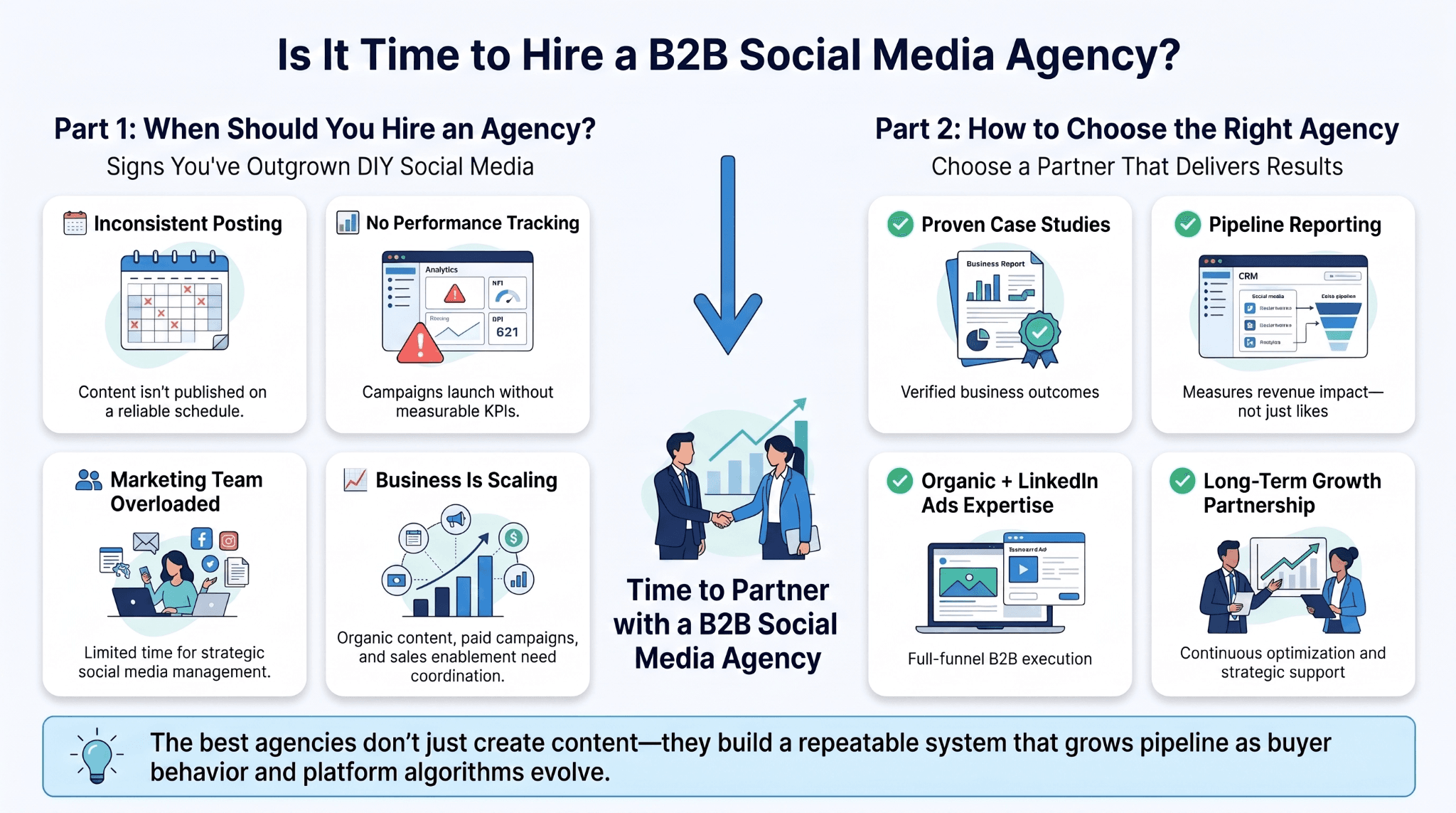
A business should consider a b2b social media marketing agency once internal bandwidth, platform expertise, or measurement capability becomes the limiting factor rather than strategy itself. This typically shows up as:
-
Inconsistent posting
-
Campaigns launched without a tracking plan
-
A marketing team stretched too thin to focus on social specifically
Scaling companies tend to outgrow informal social media management quickly. What worked with one person posting occasionally does not hold up once a company needs coordinated content, paid campaigns, and sales enablement running at the same time.
What Should You Look for When Choosing an Agency Partner?
The right partner should be judged on evidence, not promises. A few criteria consistently separate a strong long-term partner from a short-term vendor relationship:
-
Documented case studies with real, verifiable outcomes
-
Transparent reporting that ties social activity to pipeline, not just engagement
-
Demonstrated expertise across organic strategy and LinkedIn Ads for B2B execution
-
A structure built for ongoing management rather than a one-time handoff
That last point matters most. Social performance shifts as algorithms and buyer behavior change, so a static, one-time campaign rarely holds its value for long.
What Mistakes Should B2B Brands Avoid on Social Media?
A few recurring mistakes tend to undo otherwise solid strategies:
-
Inconsistent posting. Algorithms and audience trust both favor a steady cadence over sporadic bursts of activity.
-
Ignoring analytics. Teams that only track likes and shares keep investing in content that feels active but never converts into pipeline.
-
Overautomating engagement. Using bots for comments damages credibility with a professional audience that notices templated interactions quickly.
-
Copying a B2C playbook. Buyers researching a six-figure contract are not moved by tactics built for impulse purchases.
What Do Teams Usually Want to Know Before Starting a B2B Social Strategy?
Before committing budget or headcount to a new strategy, most teams ask a similar short list of practical questions. Here are direct answers to the ones that come up most often.
How much budget does b2b social media marketing typically require to start?
It depends on company size and goals, but most scaling companies start with a modest content investment before adding paid media. Increasing LinkedIn Ads for B2B spend only after organic content proves what performs tends to protect budget better than guessing upfront.
How long does it take to see results from a B2B social strategy?
Organic authority building typically takes three to six months before it produces steady inbound conversations, while paid campaigns can move faster once that groundwork is in place. Teams that track this properly from day one usually reach that point sooner.
Does a small team need a dedicated social media hire?
Not always. Many companies use a hybrid approach, relying on an experienced partner for strategy while an internal team member handles sales coordination. This is often the faster path, since a partner already has the frameworks and reporting in place.
Should LinkedIn be the first priority over other platforms?
For most B2B companies, yes. Choosing LinkedIn for B2B first makes sense given its concentration of decision makers, with other channels added once that foundation works. Getting this sequencing right early avoids wasted ad spend later.
Can social selling work without a formal content plan?
It works better with one. Reps perform best when they have credible company content to share, rather than relying only on outreach with nothing to point back to. Pairing a documented content calendar with sales enablement turns individual effort into a repeatable result.
Turning B2B Social Media Strategy Into Long-Term Growth
The 12 strategies above only work as a connected system. Authority content earns attention, LinkedIn Ads for B2B extends that attention to the right buyers, social selling turns attention into real conversations, and analytics keeps the system accurate over time.
Companies that treat b2b social media marketing as a standing operational system, reviewed every quarter, consistently outperform those running disconnected campaigns. The difference is not the quality of any single post but whether the system behind those posts is built to last. Book a Free Consultation with WellsGroup and get a clear view of where your current strategy stands and what a connected system would look like for your business.