6 Steps to a Smarter Social Media Marketing Strategy in 2026
Build a social media marketing strategy that works in 2026 with clear goals, platform selection, content pillars, consistent execution, and measurable growth.

A social media marketing strategy is a documented plan that connects your brand's goals, target audience, content approach, and chosen platforms into one operational system. In 2026, building one is not optional. Brands without a defined strategy are losing ground to AI-driven feeds, shrinking organic reach, and competitors who treat social media as a revenue system rather than a broadcasting channel.
The rules of visibility have changed fundamentally. What worked in 2023 and 2024 is now actively working against brands that have not adapted. Platforms are no longer showing your content to followers by default. They are deciding, algorithmically, whether your content deserves to exist in anyone's feed at all. These six steps will help you build a strategy that earns its place. Get a free consultation with WellsGroup and let us help you architect a social media system built for 2026.
What Is a Social Media Strategy and Why Does It Matter in 2026?
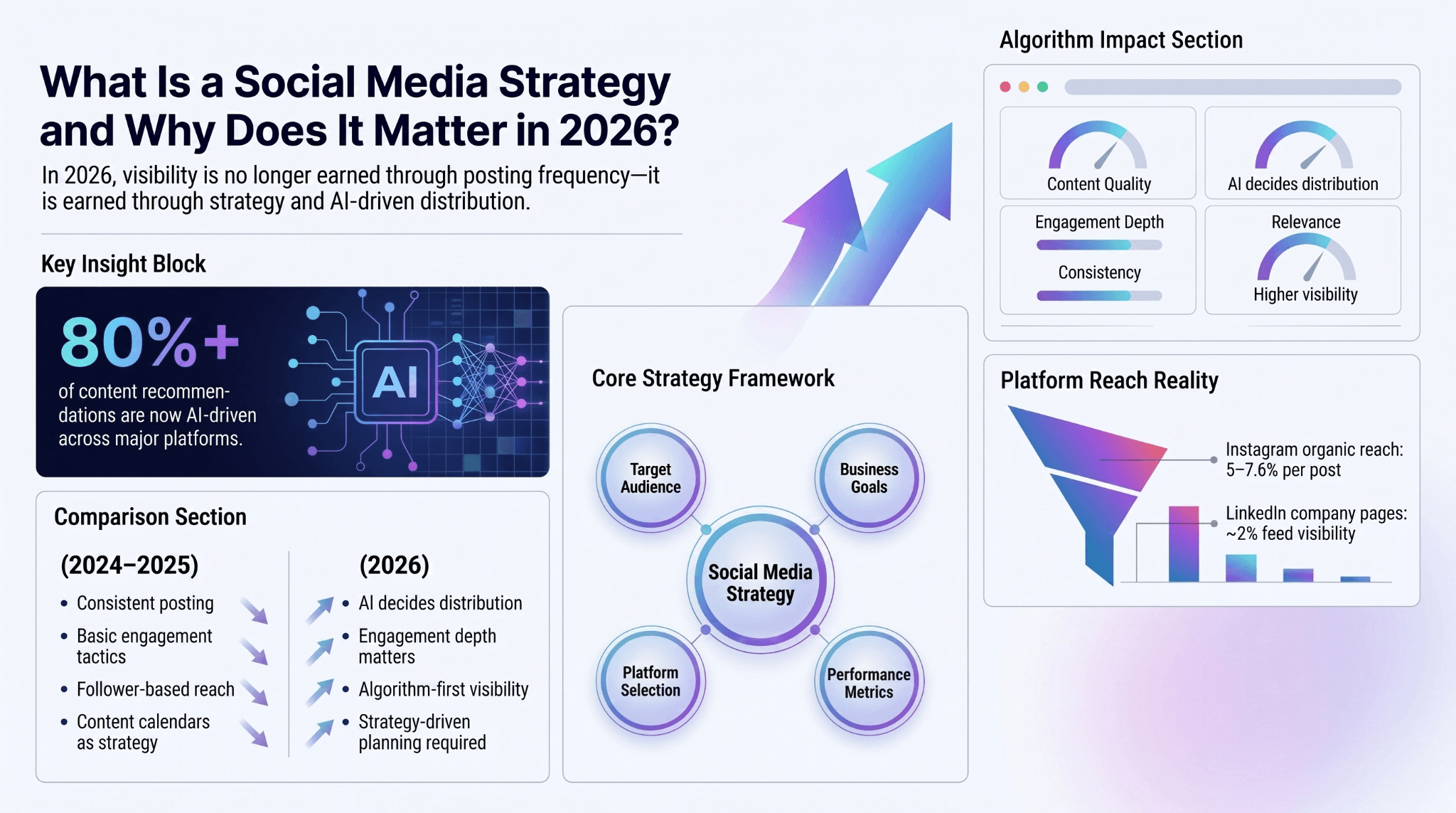
A social media strategy is not a content calendar. What is a social media strategy, at its core, is a structured plan that defines who you are trying to reach, what you want them to do, which platforms will get you there, and how you will measure success.
In 2024 and 2025, consistent posting and basic engagement tactics were enough to maintain reasonable reach. That window has closed.
In 2026, AI now drives over 80% of content recommendations across major platforms. Instagram's organic reach has fallen to approximately 5 to 7.6% per post. LinkedIn company page posts now represent around 2% of what users see in their feeds, according to Whitehat's 2026 analysis of Socialinsider data.
The algorithm no longer distributes content to your followers. It evaluates content quality, engagement depth, and consistency against everything else competing for the same attention. Brands relying on instinct or ad hoc posting are not just underperforming. They are invisible.
What Should You Include in a Social Media Marketing Strategy Template?
Before any content gets created, a solid social media marketing strategy template needs six foundational components in place. These are the structural layer that makes execution coherent.
Here are the six components every social media marketing plan template must include:
-
Audience profiles: Who you are targeting, including demographics, platform preferences, and the problems they are trying to solve.
-
Platform selection rationale: A documented reason for choosing each platform based on audience fit and business goals, not industry defaults.
-
Content pillars: Three to five recurring topic areas your brand will consistently cover, anchored to audience needs and business expertise.
-
Posting cadence: A realistic publishing frequency matched to available resources, not benchmark pressure.
-
KPIs and measurement framework: Metrics tied to business outcomes, including reach, click-through rates, conversions, and pipeline impact.
-
Review cycle: A defined schedule, typically monthly, for assessing performance and adjusting based on data.
Think of the template not as a fixed document but as a working operational reference that updates as platforms and audience behavior evolve.
How Does a Social Media Marketing Plan Template Differ from a Content Calendar?
These two tools serve entirely different functions, and confusing them is a common mistake.
A social media marketing plan template is the strategic layer. It defines goals, audience profiles, platform logic, and measurement criteria. A content calendar is the operational layer. It documents what gets posted, when, and in what format. One guides decisions. The other schedules execution. Building a content calendar before you have a strategy template is the equivalent of scheduling deliveries before you know the destination.
Step 1: How Do You Define Goals That Actually Drive Your Social Media Marketing Strategy?
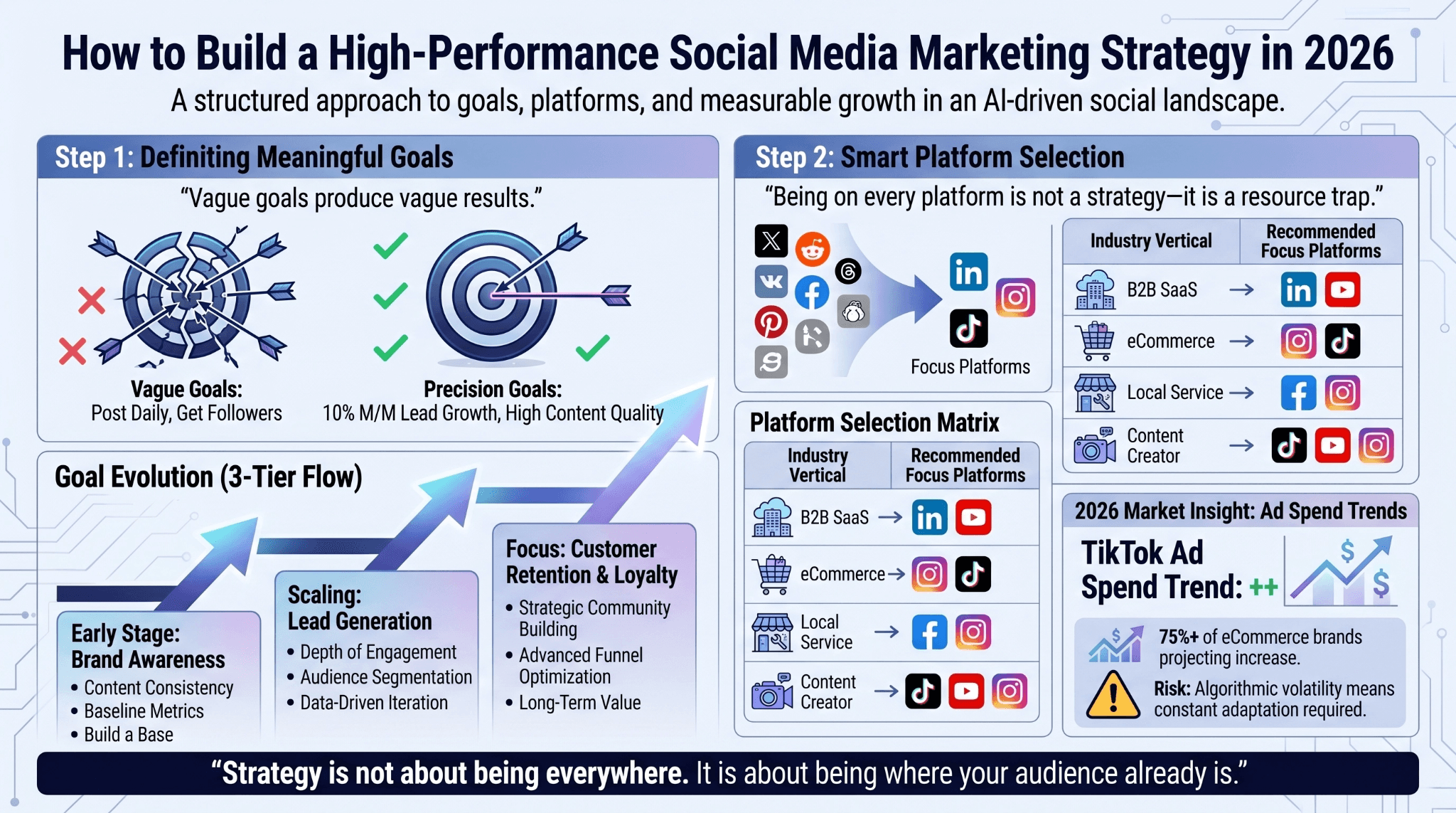
Vague goals produce vague results. "Grow our following" is not a goal. It is a direction with no destination and no way to evaluate success.
The most effective goal structure connects a specific metric to a timeframe and a business result. For example, increase qualified inbound leads from LinkedIn by 30% within 90 days by publishing three thought leadership posts per week targeting operations directors at SaaS companies.
Goal type should also reflect where the business is right now. Here is how goals typically shift by growth stage:
-
Early-stage: Brand awareness and audience building
-
Scaling: Lead generation and conversion
-
Established: Retention, loyalty, and community engagement
The goal type shapes every downstream decision, from platform selection to content format to measurement approach.
Step 2: How Do You Choose the Right Platforms for Your Audience in 2026?
Being present on every platform is not a strategy. It is a resource trap. Spreading a lean team across six channels produces mediocre results on all of them. Concentrating on two or three well-chosen platforms consistently outperforms the alternative.
Platform selection should be driven by three factors: where your audience spends time, which formats your team can produce consistently, and which platforms align structurally with your business type.
The table below provides a practical starting point for matching a platform to a business type:
|
Business Type |
Primary Platform |
Secondary Platform |
Content Format |
|
B2B SaaS |
|
YouTube |
Long-form insight, case studies |
|
eCommerce |
|
TikTok |
Short-form video, product demos |
|
Local service |
|
|
Community content, reviews |
|
Logistics/marketplace |
|
|
Industry insight, operational content |
|
Media / content brand |
YouTube |
|
Long-form video, Reels |
According to HubSpot's State of Marketing Report 2026, TikTok is the number one social media channel marketers plan to invest in this year. That does not mean TikTok is right for your brand. The question is never which platform is growing fastest. It is where your specific audience is concentrated and what behavior the platform rewards.
Step 3: How Do You Build Content Pillars That Give Your Strategy Direction?
Content pillars are the thematic backbone of your social media marketing strategy. They are the three to five topic areas your brand commits to covering consistently across every platform.
Without content pillars, posting becomes reactive. Teams chase trends, repost industry news, or fill the calendar with content disconnected from business goals.
To identify your pillars, work through these three questions:
-
What does your audience consistently need to understand or decide in your area of expertise?
-
What knowledge does your business have that competitors are not communicating clearly?
-
What topics connect naturally to your services without turning every post into a sales pitch?
For a technology operations company, pillars might include systems architecture, AI search visibility, and revenue operations. For a logistics company, they might cover fleet management, compliance, and cost optimization. Each pillar generates a repeatable stream of content that builds topical authority over time.
Step 4: How Do You Create a Posting Cadence You Can Actually Maintain?
One of the most reliable failure points in any social media marketing strategy is setting an unsustainable posting frequency and burning out within the first month.
The 2026 algorithm environment makes consistency far more important than volume. Frequent low-quality posts can be flagged as noise, reducing overall account authority. Aim for three to five high-quality posts per week rather than chasing daily output.
Two systems that make sustainable cadence achievable are:
-
Batch creation: Set aside dedicated time weekly or monthly to produce content in bulk, rather than creating day by day.
-
Scheduling: Queue approved content in advance so the team is not making last-minute decisions under pressure.
Step 5: What Does a Strong Social Media Strategy Example Look Like in Practice?
The five steps above are not abstract. Here is how they connect inside a real operational structure.
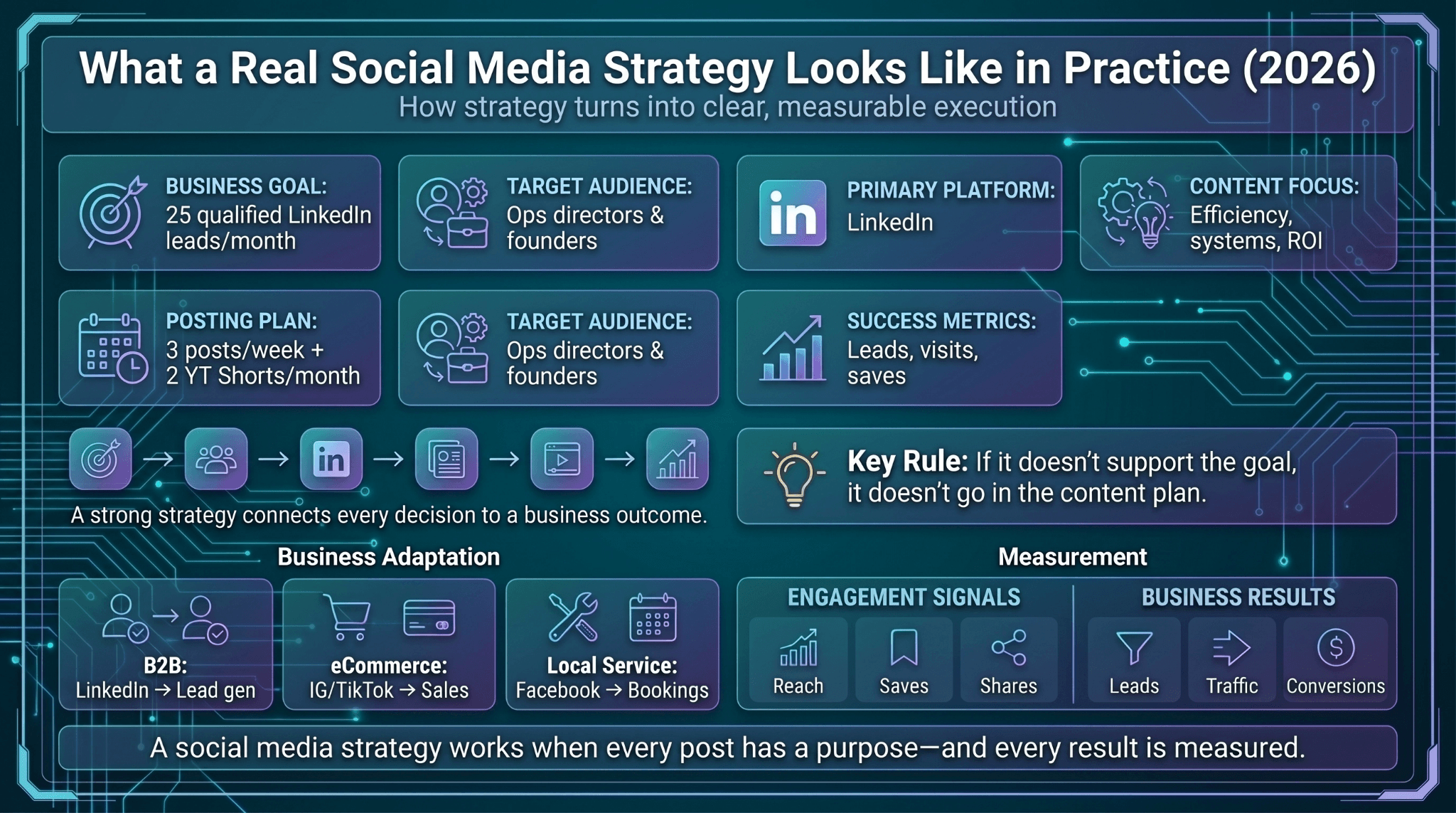
A mid-size B2B service company with a team of three builds a social media marketing strategy from scratch using the framework above and arrives at this structure:
|
Strategy Component |
Decision Made |
|
Business goal |
Generate 25 qualified leads per month from LinkedIn within 90 days |
|
Target audience |
Operations directors and founders at companies with 50 to 250 employees |
|
Primary platform |
|
|
Content pillars |
Operational efficiency, systems thinking, technology ROI |
|
Posting cadence |
3 LinkedIn posts per week, 2 YouTube Shorts per month |
|
KPIs |
Qualified lead volume, profile visits, and post saves |
|
Review cycle |
Monthly check-in, quarterly strategy refresh |
Every content decision connects back to this structure. When a trend surfaces, they evaluate it against the strategy before adding it to the calendar. When performance dips, they have a documented baseline to diagnose what shifted.
How Does This Example Apply to Different Business Types?
The strategic logic transfers directly across business types.
-
eCommerce: Goal shifts to product discovery and purchase conversion. Primary platform moves to Instagram or TikTok. Content pillars center on product education, social proof, and lifestyle fit.
-
Local service: Goal becomes foot traffic and repeat booking. The primary platform is typically Facebook. Pillars focus on community presence, customer results, and local trust signals.
The architecture is the same. The inputs change to match the business model.
Step 6: How Do You Measure and Refine Your Social Media Marketing Strategy Over Time?
Measurement is where most social media strategies quietly fail. Teams track the wrong metrics, draw the wrong conclusions, and either abandon strategies that were working or continue ones that were not.
The metrics worth tracking fall into two categories:
-
Leading indicators: Reach among non-followers, saves, shares, and video completion rates. These signals whether content is earning algorithmic distribution and genuine interest.
-
Business outcomes: Website traffic from social referral, inbound leads attributable to social content, and customer acquisition cost compared to other channels.
A monthly check-in against KPIs keeps the team calibrated. A quarterly review determines whether the platform mix, content pillars, or cadence needs adjustment.
What Are the Most Common Social Media Strategy Mistakes to Avoid?
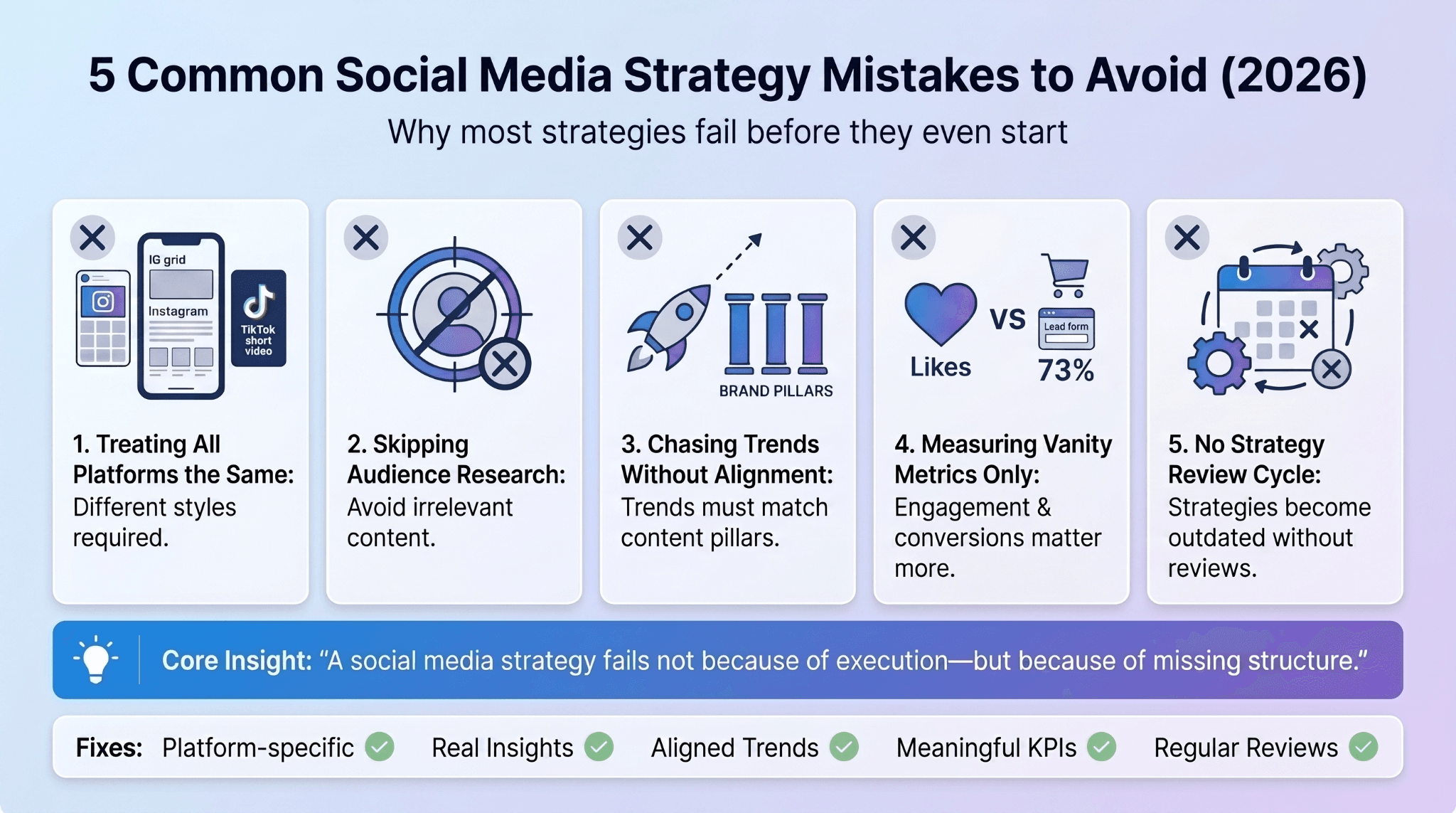
Even well-intentioned teams make structural errors that limit results from the start. These are the five most consistent ones:
-
Treating every platform identically: Content for LinkedIn requires a different structure and tone than content for Instagram or TikTok. Repurposing without adapting generates low engagement across all channels.
-
Skipping audience research: Assumptions about who your audience is are almost always partially wrong. Even basic research eliminates the guesswork that produces irrelevant content.
-
Chasing trends without brand alignment: Trending topics can generate short-term reach. They rarely build sustained authority. Evaluate every trend against your content pillars before committing resources.
-
Measuring vanity metrics exclusively: Follower counts tell you almost nothing about business impact. According to Sprout Social's 2026 Social Media Content Strategy Report, 73% of consumers say they will switch to a competitor if a brand does not respond on social media.
-
Building without a review cycle: A strategy without scheduled reviews drifts. Platform algorithms shift. A strategy that worked in Q1 of 2026 may need significant adjustment by Q3.
What Most People Want to Know Before Building Their Strategy
Before committing to a social media marketing strategy, most teams have a consistent set of questions. The answers below cut through the most common points of confusion.
Here are five of the most frequently surfaced questions on this topic:
What is a social media marketing strategy in simple terms?
It is a documented plan that defines your goals, target audience, platform choices, content approach, and measurement system, connecting what you post to what your business is trying to achieve.
How long does it take to see results from a social media strategy?
Most brands see meaningful engagement improvements within 60 to 90 days of executing a consistent strategy. Revenue and lead generation results typically require three to six months, depending on business type, platform, and audience size.
Do small businesses need a formal social media marketing plan?
Yes, and arguably more than large ones. Smaller teams have fewer resources, so every hour spent on social content needs to align with a clear goal. 90% of small businesses use social media in their marketing strategy, and 78% rely on it to help drive revenue.
What is the difference between a social media strategy and a social media plan?
A strategy defines the why and what: goals, audience, platforms, and pillars. A plan defines the how and when: formats, schedules, and workflows. Strategy comes first.
How often should you update or rebuild your social media marketing strategy?
Most brands benefit from a full strategy review every six to twelve months, with monthly check-ins in between. In 2026, with AI-driven feed curation accelerating across every major platform, an annual rebuild is no longer optional. It is baseline practice.
The Brands Winning in 2026 Started With a Strategy, Not a Post
Execution without strategy is noise. The brands generating consistent results are not the ones posting most frequently. They are the ones who built a documented operational system, connected it to measurable goals, and committed to refining it based on data.
If your current approach lacks this structure, the cost is not just lower engagement. It is a lost pipeline, wasted production hours, and a growing gap between your brand and competitors who did the strategic work first.
WellsGroup builds and operates unified digital marketing systems that connect social media strategy to measurable revenue outcomes. Get a Proposal if your current social presence lacks strategic architecture; we can help you design one.