6 Digital Lead Generation Strategies for Service Businesses
Discover six proven digital lead generation strategies that help service businesses attract qualified leads, build trust, and drive sustainable long-term growth.

Digital lead generation strategies help service businesses attract, qualify, and convert potential clients through online channels without relying on cold outreach or referrals alone. The six strategies in this article cover SEO, content marketing, paid advertising, email, referral systems, and AI lead generation. Each is actionable, scalable, and built for service-based business models regardless of budget size.
If your service business is ready to move from inconsistent pipeline activity to a repeatable lead system, book a free consultation with WellsGroup to map out the right strategy for your growth stage.
What Is Digital Lead Generation and Why Does It Matter for Service Businesses?
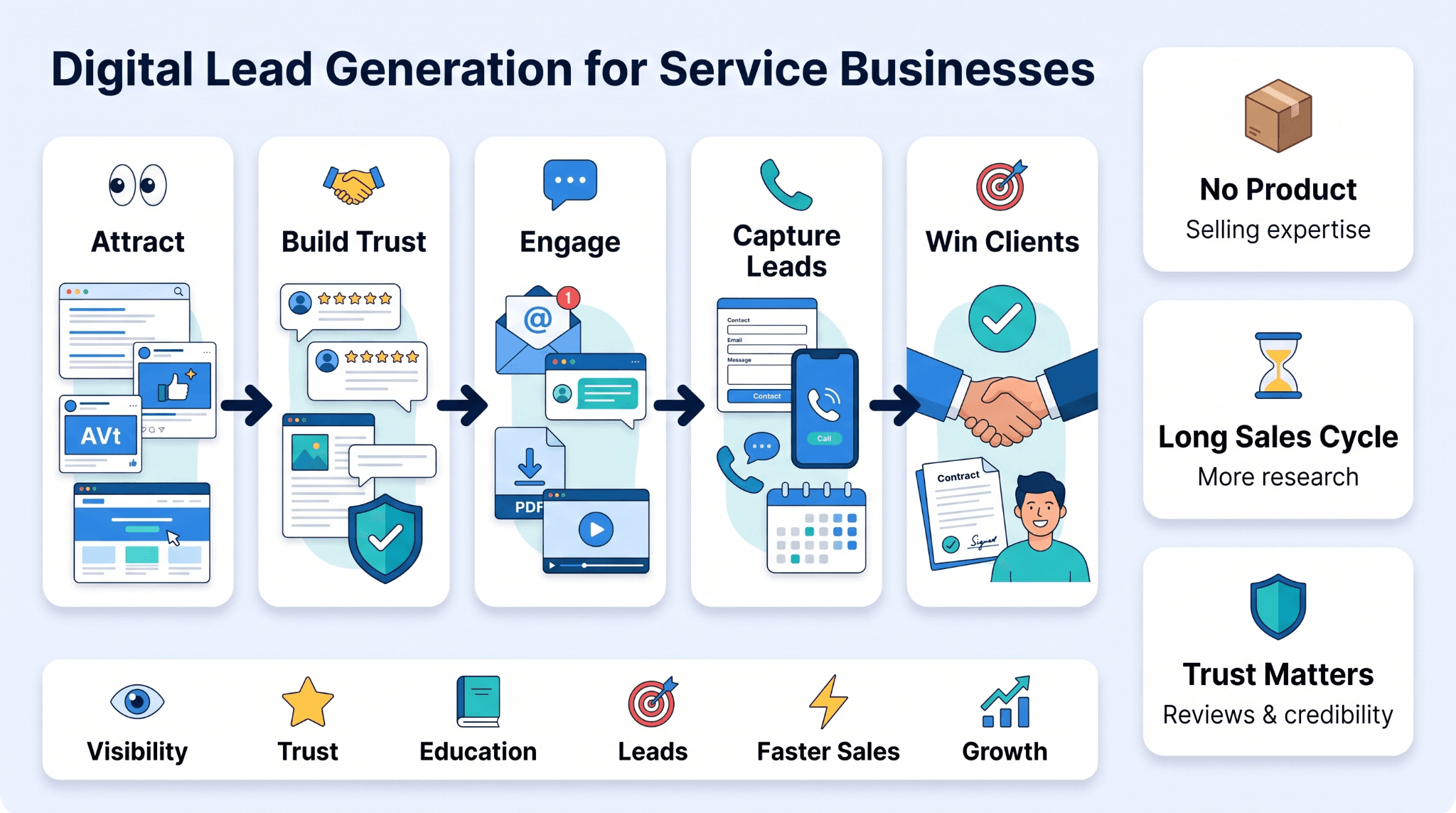
Digital lead generation is the process of using online channels to attract people who have a problem your service solves, then moving them toward a buying decision. For service businesses, this is not a simple transaction. There is no product listing, no add-to-cart button, and no instant checkout.
Service businesses sell expertise, outcomes, and trust. That means the lead generation process involves multiple touchpoints before a prospect is ready to speak with your team.
Three factors make lead generation uniquely difficult for service businesses in 2026:
-
No tangible product to showcase: You are selling a result, not an object.
-
Longer sales cycles: Enterprise and mid-market service contracts often require weeks of evaluation.
-
Trust-first purchasing behavior: Buyers research your brand, read your content, and check social proof before making contact.
A structured digital lead generation system addresses all three. It creates visibility, builds credibility, and guides prospects through the decision process before your sales team gets involved.
How Do You Choose the Right Lead Generation Strategy for Your Business?
Not every lead generation strategy works for every service business. The right choice depends on four variables: audience type, budget, existing digital infrastructure, and sales cycle length.
A B2B logistics company with a six-month sales cycle needs a different approach from a B2C coaching business that closes in a single call. Mapping your sales motion first prevents wasted spend on channels that attract the wrong audience.
Here is a practical decision framework before selecting a strategy:
|
Variable |
What to Assess |
|
Audience Type |
B2B or B2C? Decision-maker or end user? |
|
Budget |
Can you sustain 90 days of paid spend, or do you need organic first? |
|
Digital Presence |
Do you have a functioning website, CRM, and analytics baseline? |
|
Sales Cycle |
Short cycle = paid ads + email. Long cycle = SEO + content + nurture. |
Lead generation tools and lead generation platforms play a supporting role in any strategy. A CRM captures and organizes incoming leads. A landing page builder converts ad traffic. An email platform runs nurture sequences. The most common mistake service businesses make is copying a competitor's channel without understanding the operational system behind it.
What Are the 6 Digital Lead Generation Strategies That Work for Service Businesses?
The six strategies below are selected for service-based business models specifically. They account for longer sales cycles, trust-driven purchasing behavior, and the need for consistent pipeline activity. Each works independently, but the most effective lead generation systems in 2026 combine at least three.
1. How Does SEO Attract High-Intent Leads Without Paid Ads?
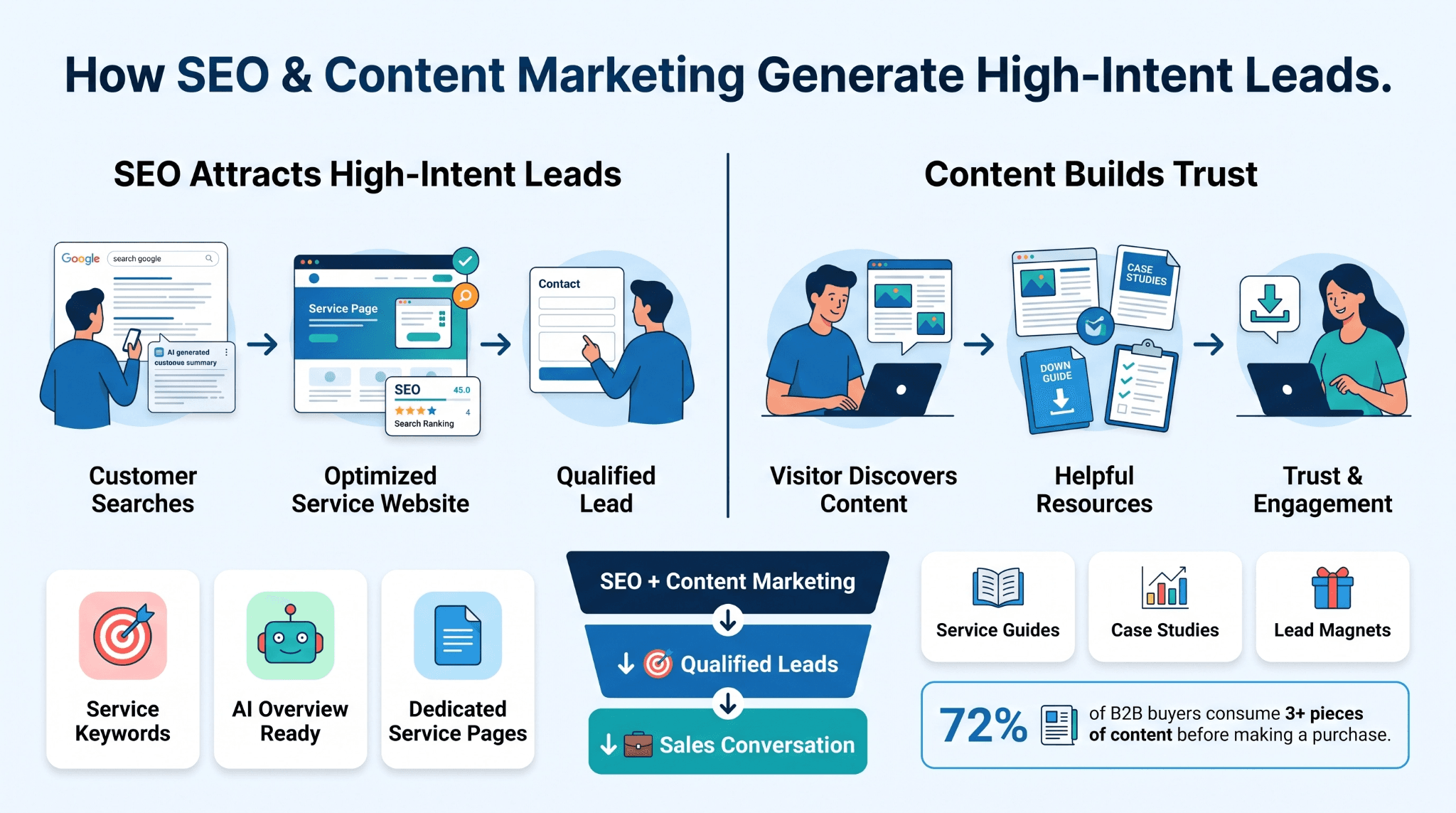
SEO positions your service pages in front of people already searching for what you offer. In 2026, this includes visibility in Google AI Overviews. In 2026, this includes visibility in Google AI Overviews, which now surface across a wide range of query types, including complex, service-specific searches.
The operational logic is straightforward. A prospect searches "CRM integration services for logistics companies." If your service page is optimized for that term, your business appears at the moment of highest intent. No interruption. No cold outreach.
SEO for service businesses should prioritize bottom-of-funnel keywords first, paired with lead generation software to capture and score organic visitors:
-
Target service-specific keywords, not just informational ones
-
Build individual service pages for each core offering
-
Optimize for AI Overviews with direct answers and clear heading structure
2. How Does Content Marketing Build Trust Before the First Sales Call?
Content marketing establishes expertise before a prospect makes direct contact. For service businesses, where purchasing decisions are largely trust-based, this matters more than in almost any other model.
According to Demand Gen Report's B2B Content Preferences Survey, 72% of B2B buyers consume at least three pieces of content before making a purchase decision. The most effective content assets address specific problems at each stage of the decision process:
-
Long-form service guides targeting informational keywords
-
Case studies showing measurable outcomes for past clients
-
Gated resources used on lead generation platforms to capture email contacts
Content paired with lead generation platforms creates a compounding system. Organic search brings visitors. Content builds credibility. Gated assets convert readers into contacts.
3. How Do Paid Ads Generate Leads Faster Than Organic Channels?
Paid advertising is the fastest way to generate leads from a standing start. For service businesses entering a new market or launching a new offering, Google Ads and LinkedIn Ads provide immediate pipeline activity while organic channels are still building.
The key distinction: paid ads generate traffic. The landing page, offer, and follow-up system generate leads. Choosing the right paid channel depends on where your buyers make decisions:
|
Channel |
Best For |
Lead Intent |
|
Google Search Ads |
Bottom-funnel, active searchers |
High |
|
LinkedIn Ads |
B2B decision-makers, enterprise |
Medium-High |
|
Meta Ads |
Brand awareness, retargeting |
Medium |
Lead generation tools for paid campaigns include conversion tracking pixels, call tracking software, and CRM integrations that log lead source data automatically. Without attribution, you cannot determine which campaigns generate revenue.
4. How Does Email Marketing Turn Cold Contacts Into Paying Clients?
Email marketing consistently ranks among the highest-ROI lead generation strategies for service businesses. According to Litmus's Email Marketing ROI research, email generates an average return of $36 for every $1 spent, higher than any other marketing channel. In 2026, AI-assisted personalization amplifies that return by adapting messaging based on lead behavior and engagement history.
The operational model involves three stages: list building, segmentation, and sequencing.
-
List building: Capture emails through gated content, consultation forms, and event registrations
-
Segmentation: Group contacts by industry, service interest, or funnel stage
-
Sequencing: Send timed, value-driven emails that address objections and demonstrate outcomes
-
CRM integration: Use lead generation software with CRM connectivity to trigger sequences based on lead behavior
Service businesses that rely on manual follow-up lose leads between touchpoints. Automated sequences ensure every contact receives consistent communication regardless of team bandwidth.
5. How Do Referral Programs and Strategic Partnerships Generate Qualified Leads?
Referred leads convert at a higher rate than leads from any other channel. A referred prospect arrives with pre-established confidence because someone they trust has already validated your business.
Building a referral system requires three components: a clear incentive structure, a tracking mechanism, and a systematic outreach process. Strategic partnerships extend this further. A SaaS business might partner with a complementary cloud infrastructure firm to exchange qualified introductions, giving both businesses access to each other's client base without competing for the same contracts.
-
Define a referral incentive (service credit, cash reward, or reciprocal referral)
-
Use a CRM or lead generation platform to track referral sources and conversion rates.
-
Review referral performance quarterly and adjust incentives based on conversion data.
6. How Is AI Lead Generation Changing How Service Businesses Find Clients?
AI lead generation refers to using artificial intelligence to identify, qualify, score, and engage potential leads faster and more accurately than manual processes allow. In 2026, it will have shifted from an experimental tactic to a standard operational layer for scaling service businesses. Tools like Clay, Apollo, and HubSpot's AI prospecting features now automate the most time-consuming parts of the process.
AI supports lead generation at four operational stages:
-
Prospecting: AI tools identify companies matching your ideal client profile
-
Lead scoring: Machine learning ranks leads by conversion likelihood based on behavioral data
-
Chatbot qualification: AI chat tools qualify website visitors in real time before routing them to sales
-
Predictive outreach: AI analyzes past win data to recommend the best time and channel for each prospect
The operational boundary to maintain: AI lead generation accelerates identification and qualification. It does not replace the relationship-building work that closes service contracts.
What Lead Generation Tools and Software Do Service Businesses Actually Need?
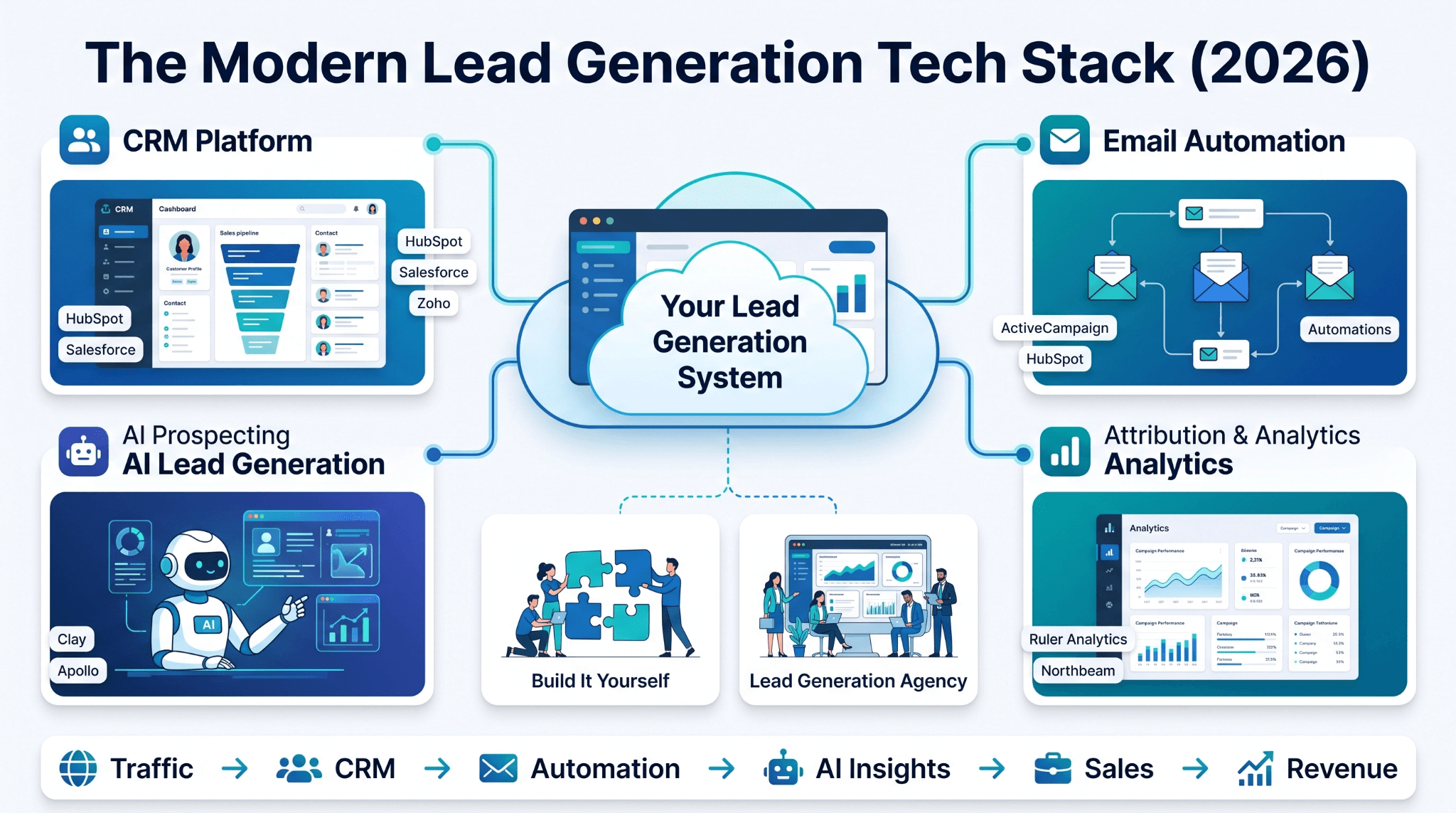
The right lead generation tools depend on team size, sales cycle complexity, and the channels you are running. The goal is not to accumulate software. It is to build a connected stack where data flows between systems without manual transfer.
The following categories represent the core infrastructure of a functional lead generation system in 2026:
-
CRM platforms: HubSpot, Salesforce, Zoho, centralize lead data, and manage pipeline stages
-
Email automation: ActiveCampaign, HubSpot, run segmented nurture sequences at scale
-
AI lead generation tools: Clay, Apollo, automate prospecting and lead enrichment
-
Attribution software: Ruler Analytics, Northbeam, connects marketing spend to closed revenue
For businesses without an internal team to manage this infrastructure, working with lead generation companies or a dedicated lead generation agency is a structurally sound alternative. An experienced agency brings pre-built systems and operational continuity that an in-house team would take 12 to 18 months to replicate.
What Mistakes Do Service Businesses Make With Lead Generation Strategies?
These are the five most common lead generation failures observed across B2B and B2C service models in 2026. Each reflects a systems gap, not a marketing gap:
-
Chasing volume over quality: High lead counts mean nothing if contacts are not qualified. Tighten targeting before scaling spend.
-
Neglecting follow-up: Most service leads require five or more touchpoints before conversion. Manual follow-up does not scale.
-
Using the wrong channel: LinkedIn Ads for a consumer service or Instagram for an enterprise B2B offer- wastes budget on misaligned audiences.
-
Skipping attribution: Without knowing which channels generate revenue, budget allocation becomes guesswork.
-
Treating lead generation as a campaign: It is a continuously operating system that requires monitoring, testing, and iteration.
What Service Businesses Ask Us About Lead Generation
Two lines before the questions: these answers are drawn from operational experience across SaaS, logistics, eCommerce, and professional services engagements.
How long does it take to see results from lead generation strategies?
SEO and content marketing typically produce measurable results within three to six months. Paid ads and email campaigns can generate leads within days of launch.
Is it better to hire a lead generation agency or build in-house?
For businesses under 50 employees, a lead generation agency with a systems-based operating model typically delivers faster results at lower total cost than hiring and training an internal team.
Which lead generation platforms work best for small service businesses?
HubSpot's free CRM tier, Mailchimp for email, and Google Search Ads for paid acquisition represent a functional starting stack. As volume grows, dedicated lead generation software for attribution and automation becomes necessary.
How much should a service business budget for lead generation?
Gartner's 2024 CMO Spend Survey notes that B2B service companies typically allocate between 7% and 10% of total revenue to marketing, with lead generation accounting for the largest share.
Build a Lead Generation System That Works Long-Term
Lead generation is not a campaign. It is an operational system that compounds in value when its components are connected and continuously optimized.
The practical starting point is to select one strategy, build the infrastructure to support it properly, measure results over 90 days, and then add a second channel. The businesses generating the most qualified leads in 2026 are not running the most campaigns. They are operating the most coherent systems, where SEO feeds content, content feeds email, email feeds CRM, and CRM feeds sales intelligence that improves targeting across every channel.
WellsGroup designs and operates lead generation systems built for scale. If your service business needs a structured approach to pipeline growth, explore WellsGroup's digital marketing services or book a free consultation to start with a strategy review.