How Programmatic Advertising Works in Digital Marketing 2026
Learn how programmatic advertising automates ad buying, improves targeting, reduces wasted spend, and drives measurable digital marketing performance in 2026.

Programmatic advertising is the automated buying and selling of digital ad inventory using real-time algorithms and audience data. Instead of negotiating placements manually, software handles bidding, targeting, and delivery in milliseconds. In 2026, it accounts for over 91% of all digital display ad spending worldwide, making it the foundation of modern digital marketing.
For businesses looking to connect ad spend directly to revenue outcomes, the architecture behind programmatic matters as much as the budget behind it. WellsGroup builds and operates a unified digital infrastructure that makes programmatic advertising accountable, measurable, and scalable from day one. Get a proposal and see how a connected digital system changes what performance looks like.
What Is Programmatic Advertising and Why Does It Matter?
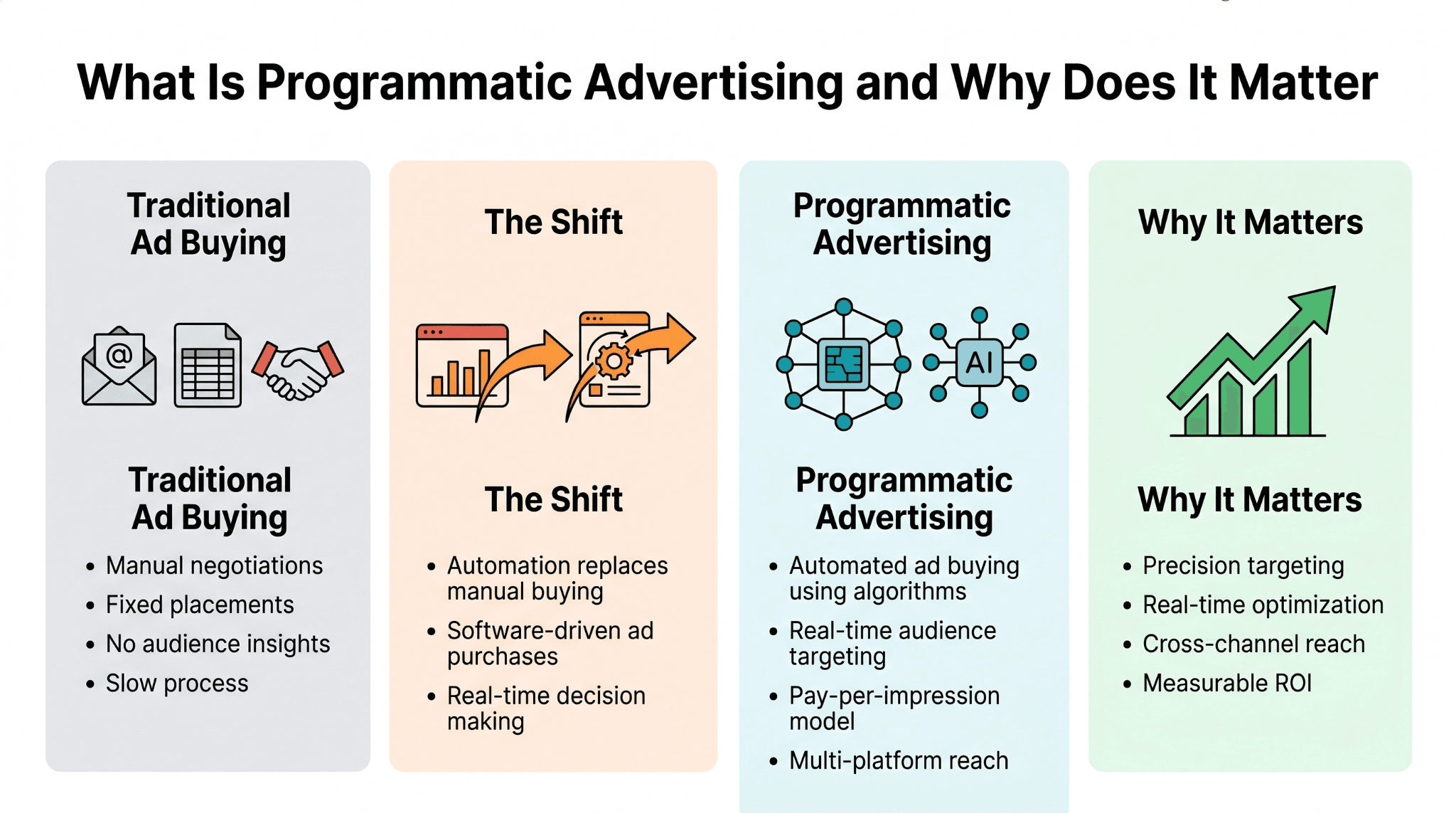
Before programmatic advertising, buying a digital ad meant emails, spreadsheets, and negotiations. A brand agreed on a fixed price for a fixed placement with no insight into who would actually see it. The process was slow, inflexible, and wasteful by design.
Programmatic advertising changed that entirely. It uses software and algorithms to buy digital ad space automatically, targeting specific audiences in real time rather than buying fixed placements in bulk.
The result is simple. The right person sees the right ad at the right moment, without a single manual process slowing things down.
How Did Digital Advertising Work Before Programmatic?
In the pre-programmatic era, advertisers worked with publishers through insertion orders. A logistics company wanting banner space on a trade publication would negotiate a flat monthly rate, run the ad for 30 days, and receive no mid-flight optimization or audience data.
Programmatic advertising eliminated that friction entirely. That same logistics company can now run campaigns across thousands of publishers simultaneously, paying per impression and adjusting targeting in real time.
Why Is Programmatic Advertising Growing So Fast?
The growth is structural, not cyclical. Four forces are driving it:
-
Precision targeting that eliminates wasted impressions
-
Real-time optimization across every digital channel
-
Cross-channel reach from a single platform
-
Measurable connection between spend and revenue outcomes
For operations-focused businesses, programmatic advertising replaces media buying inefficiency with a data-driven, accountable system.
How Does the Programmatic Advertising Process Actually Work?
The process begins the moment a user loads a webpage. The publisher's system detects an available ad slot and sends a bid request to the market, carrying data about the placement, content context, and available audience signals.
The entire auction from bid request to ad delivery completes in roughly 100 milliseconds. A human blink takes 300 to 400 milliseconds. By the time the page finishes rendering, a winner has been selected, and the ad is already loading.
What Role Do DSPs and SSPs Play in the Bidding Process?
Think of the programmatic ecosystem as a stock exchange for ad inventory.
-
Demand-Side Platforms (DSPs) are used by advertisers to define audiences, set budgets, and place bids
-
Supply-Side Platforms (SSPs) are used by publishers to list available inventory and set minimum prices
-
Ad exchanges sit in the middle, matching buyers and sellers automatically in real time
A SaaS company running a campaign through a DSP tells the system to bid on impressions from mid-market operations leaders browsing business content. The DSP evaluates each impression and decides whether to bid, without any human involvement in the auction itself.
What Is Real-Time Bidding and How Fast Does It Happen?
Real-Time Bidding (RTB) is the auction mechanism at the core of most programmatic transactions. Multiple DSPs bid on a single impression simultaneously. The highest qualifying bid wins, the ad is served, and the publisher is paid.
The entire sequence completes before the user notices anything at all.
What Is a Data Management Platform and Where Does It Fit?
A Data Management Platform (DMP) is the audience intelligence layer that feeds the bidding process. It collects behavioral, demographic, and contextual data, organizes it into audience segments, and makes those segments available to DSPs.
In 2026, first-party data will have replaced third-party cookies as the primary fuel for DMPs. Advertisers who have built clean, owned data assets have a meaningful targeting advantage over those still relying on third-party signals.
What Are the Main Types of Programmatic Advertising?
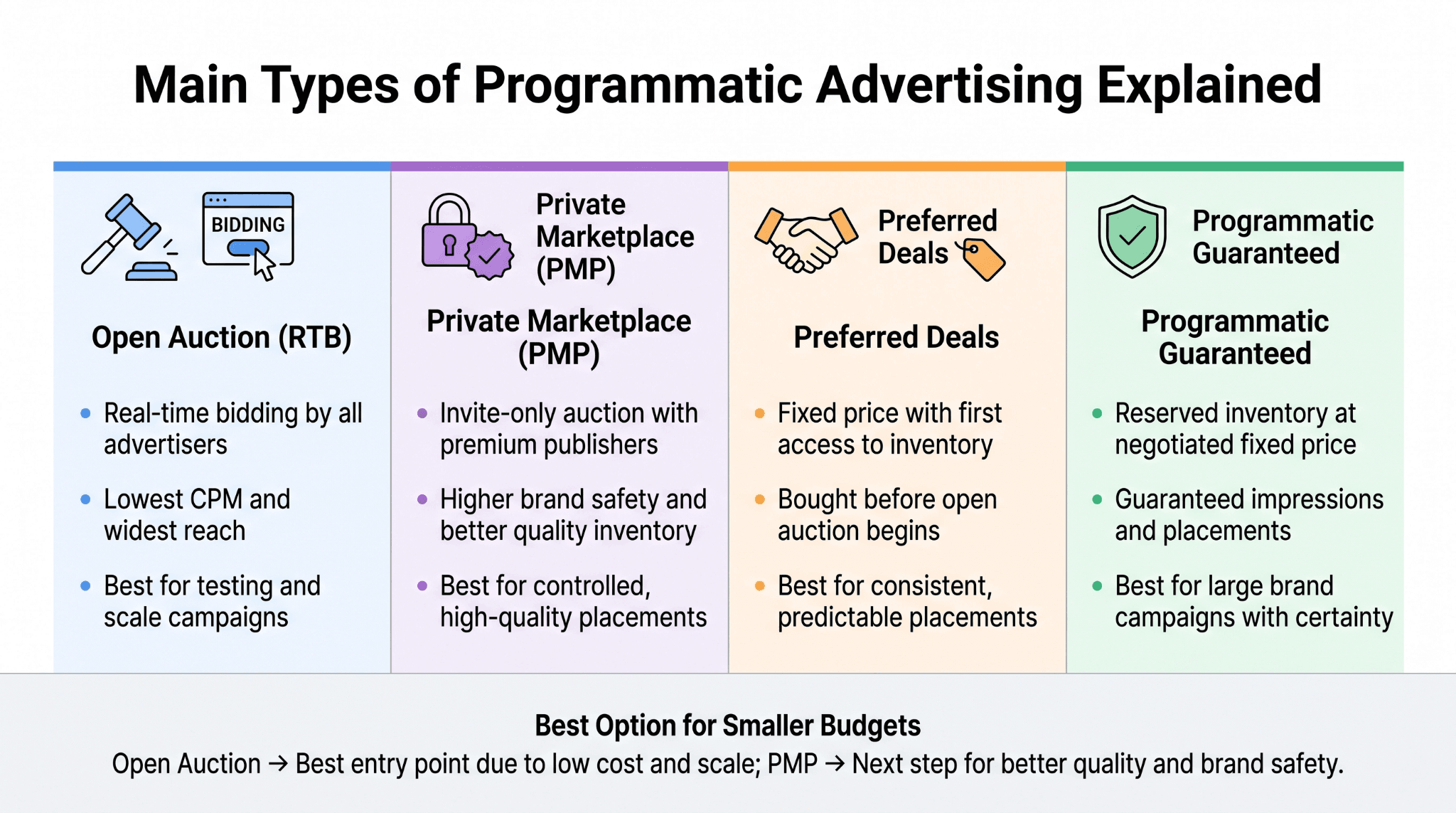
Not all programmatic advertising uses the same buying model. The right model depends on budget, inventory quality requirements, and how much control the advertiser needs over placement.
Here is how the four primary models compare:
|
Buying Model |
How It Works |
Best For |
|
Open Auction (RTB) |
All eligible buyers bid in real time |
Broad reach, testing, lower CPMs |
|
Private Marketplace (PMP) |
Invite-only auction with premium publishers |
Brand safety and viewability |
|
Preferred Deals |
Fixed price, first look before open auction |
Consistent placement with known publishers |
|
Programmatic Guaranteed |
Reserved inventory at a negotiated price |
Brand campaigns with guaranteed reach |
Which Programmatic Advertising Type Works Best for Smaller Budgets?
Open auctions are the natural entry point. They provide access to the largest inventory pool at competitive prices with no pre-negotiation required.
As campaigns scale and brand safety becomes a priority, private marketplaces offer better inventory quality with significantly lower fraud exposure.
Which Programmatic Advertising Platforms Are Leading in 2026?
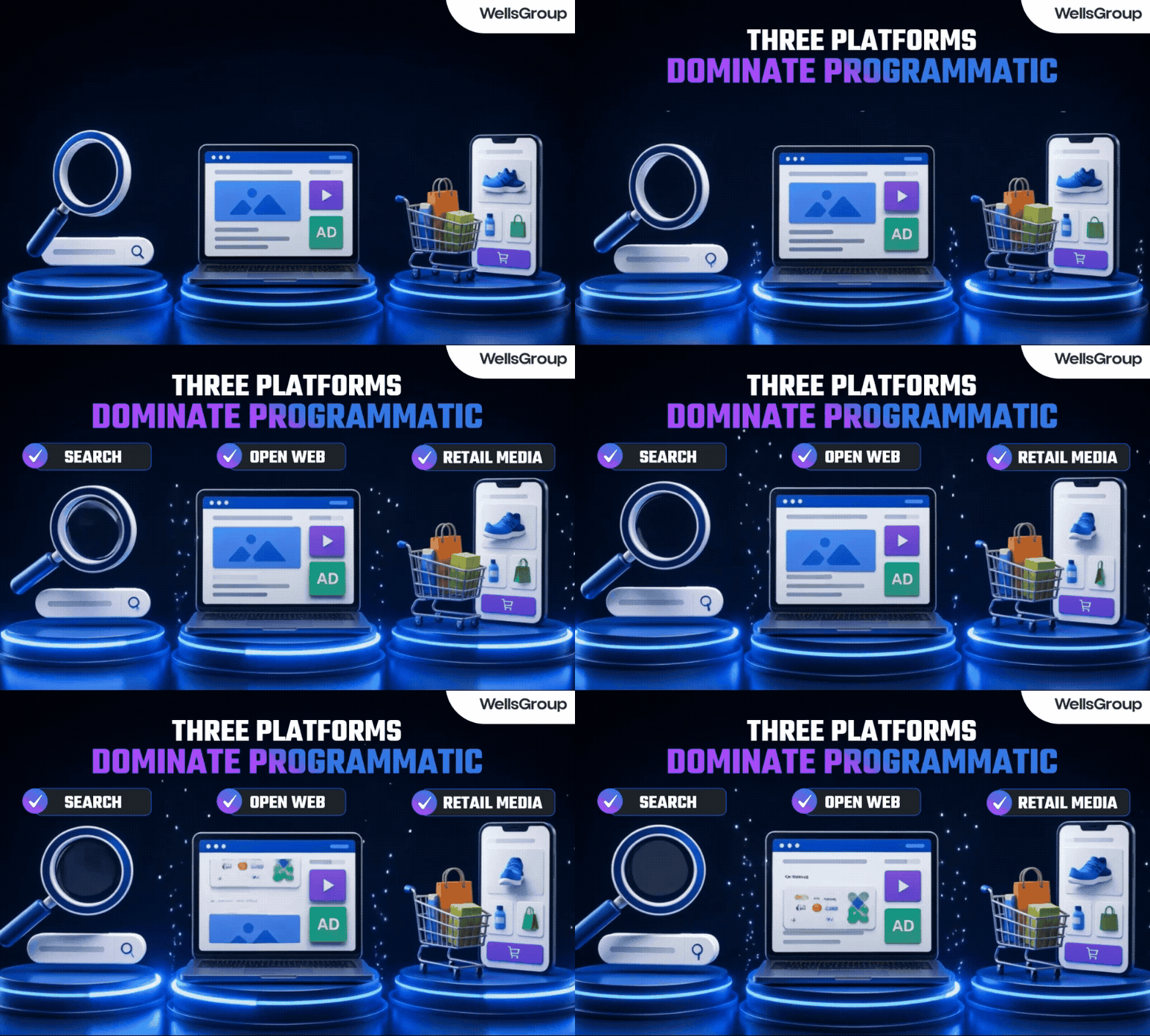
The programmatic advertising platforms market is concentrated on the demand side. Google DV360, The Trade Desk, and Amazon DSP are the three dominant players, each with distinct inventory strengths across search-adjacent display, open internet, and retail media respectively.
Beyond these, the programmatic advertising platforms ecosystem includes channel-specific DSPs for audio, connected TV, and digital out-of-home, alongside SSPs like Magnite and PubMatic on the publisher side.
What Should Businesses Look for When Choosing a Platform?
Rather than defaulting to the biggest name, operations leaders should evaluate platforms across these four dimensions:
-
Inventory quality and supply path transparency
-
First-party data integration capabilities
-
Cross-channel reporting and attribution accuracy
-
Fraud prevention controls and verification partnerships
A platform that covers all four provides a scalable foundation without sacrificing measurement clarity.
What Does a Programmatic Advertising Agency Actually Do?
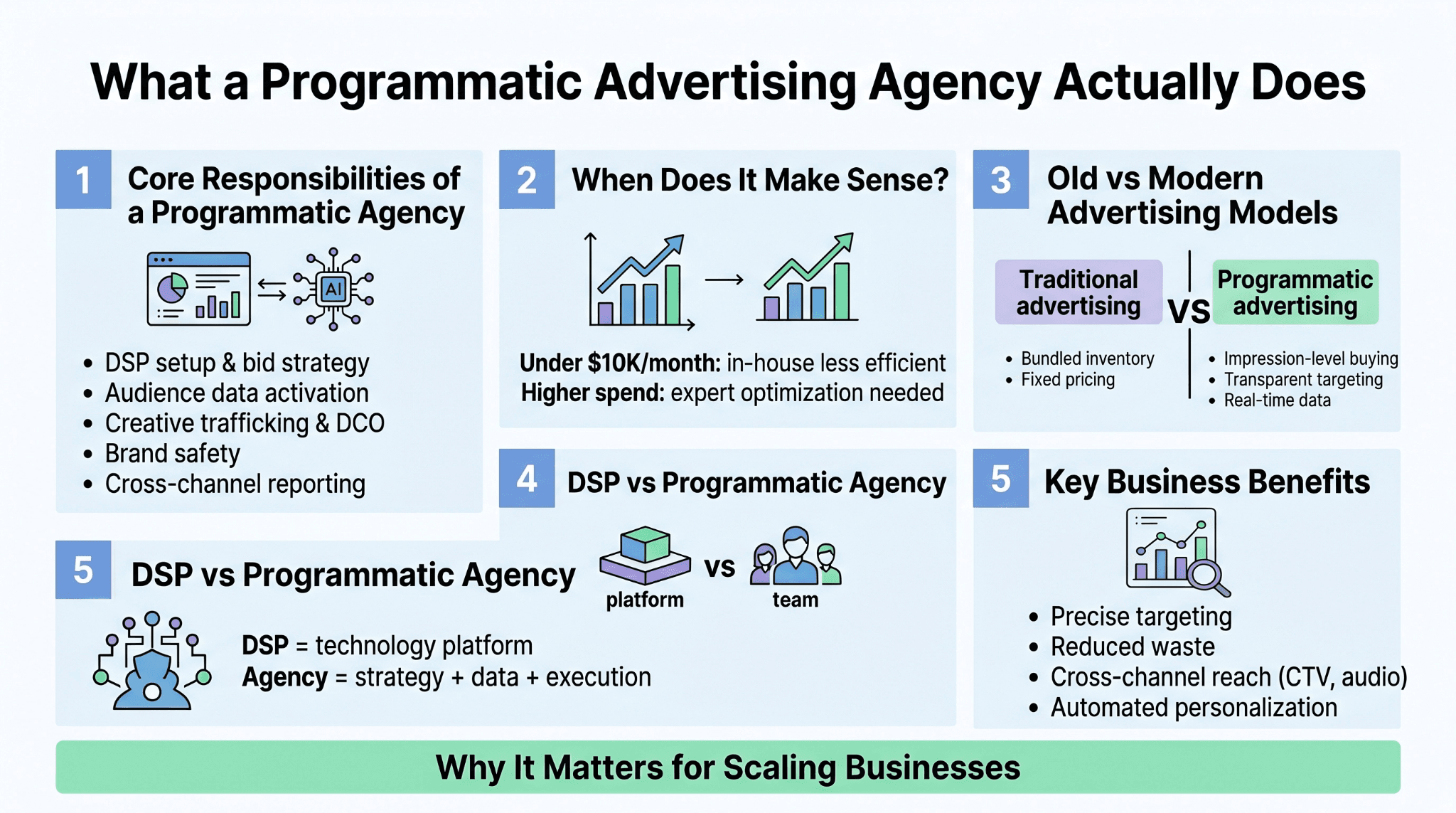
A programmatic advertising agency manages the full technology stack and strategy on behalf of an advertiser. That includes:
-
DSP access, configuration, and bid strategy
-
Audience data activation and segment building
-
Creative trafficking and Dynamic Creative Optimization
-
Brand safety controls and fraud prevention setup
-
Cross-channel performance reporting and attribution
The role is equal parts technical infrastructure and campaign strategy.
When Does It Make Sense to Hire a Programmatic Advertising Agency?
The decision comes down to internal capability and spend scale.
Businesses spending under $10,000 per month may not justify dedicated platform licenses and in-house expertise. At higher spend levels, the cost of a poor bid strategy or misconfigured targeting quickly exceeds agency fees.
For scaling SaaS companies and logistics businesses, the stronger argument for agency partnerships is not executional support. It is access to first-party data infrastructure, identity solutions, and attribution modeling that most in-house teams cannot build on their own.
How Do Programmatic Advertising Companies Differ From Traditional Ad Networks?
Traditional ad networks sold bundled publisher inventory at a fixed markup, based on broad audience categories. Advertisers had limited visibility into where ads ran or who saw them.
Programmatic advertising companies operate at the impression level. Every bid is informed by real-time audience data, contextual signals, and performance history. Pricing is dynamic. Targeting is granular. And the supply path is transparent from buyer to publisher.
What Makes a Programmatic Advertising Company Different From a DSP?
A DSP is a technology platform. A programmatic advertising company is an organization that uses DSPs, SSPs, data tools, and measurement systems together to manage advertising outcomes for clients.
A DSP gives a buyer the ability to bid. A programmatic company provides the strategy, data infrastructure, and expertise to bid effectively at scale. Businesses evaluating vendors need to know which one they are actually buying.
What Are the Real Benefits of Programmatic Advertising for Businesses?
The operational case for programmatic advertising is stronger in 2026 than at any previous point. The technology has matured, data infrastructure is more reliable, and AI-driven optimization has narrowed the performance gap between enterprise and mid-market budgets.
The clearest advantages of scaling businesses are:
-
Audience targeting based on behavioral, contextual, and first-party signals
-
Elimination of wasted impressions through real-time bid decisions
-
Cross-channel reach across display, video, CTV, audio, and DOOH from a single platform
-
Automated creative personalization through Dynamic Creative Optimization
-
Unified reporting connecting impression-level data to revenue outcomes
For marketplace and SaaS businesses specifically, the structural advantage of programmatic is not just reach. It is the ability to control spend allocation with a granularity that traditional media buying has never made possible.
What Challenges and Risks Come With Programmatic Advertising?
Programmatic advertising carries real operational risks. Understanding them is not a reason to avoid the channel. It is a prerequisite for running it responsibly.
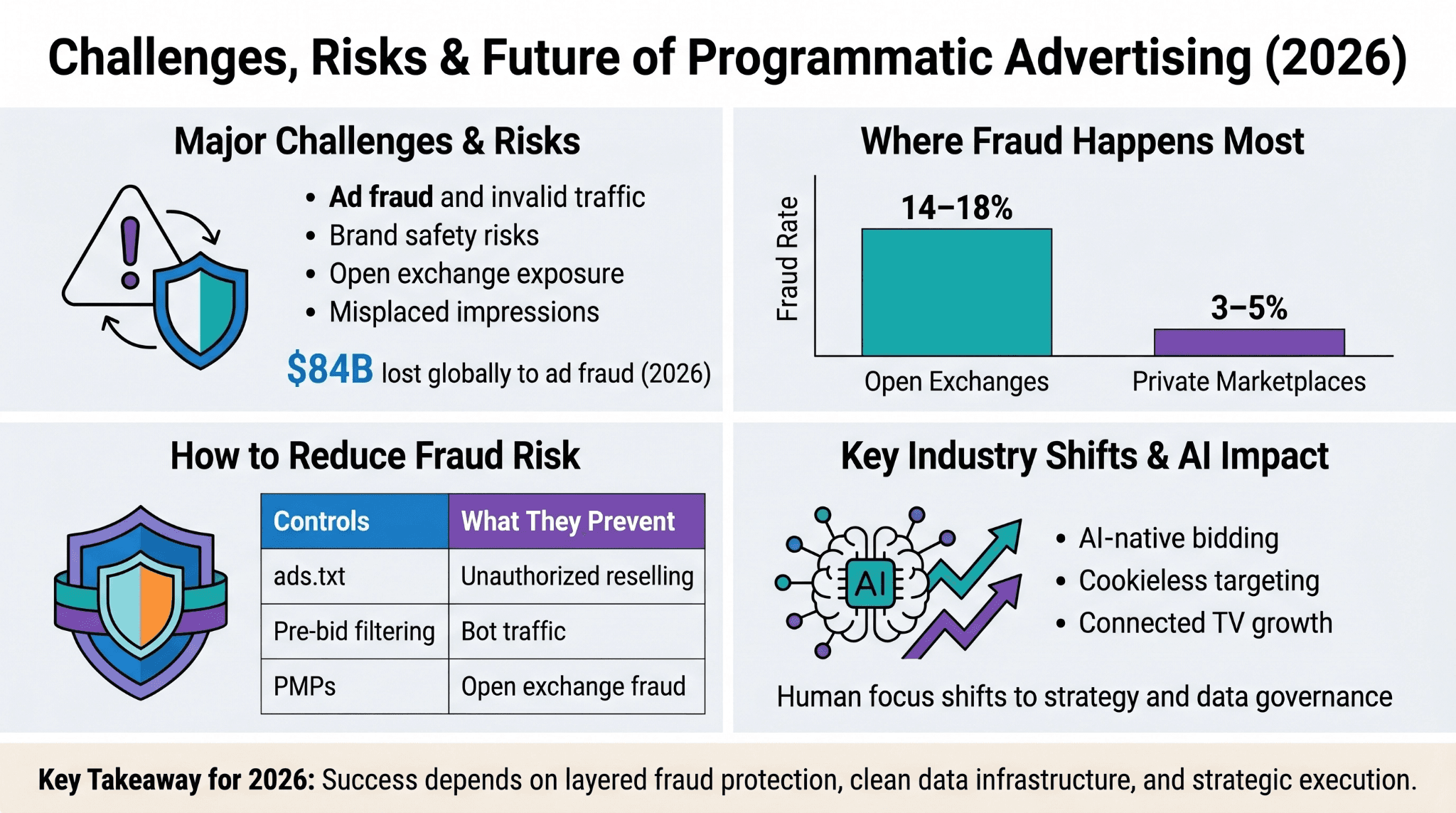
The two most consequential risks are ad fraud and brand safety. An estimated $84 billion is lost to ad fraud globally in 2026, representing approximately 11.6% of total digital ad spending. On open exchanges, fraud rates range from 14 to 18%, compared to 3 to 5% on private marketplace deals.
That gap makes inventory model selection a strategic decision, not a preference.
How Can Businesses Protect Themselves From Programmatic Ad Fraud?
Fraud prevention is a systems architecture question, not a single-tool fix. The most effective approach layers multiple controls simultaneously.
|
Control |
What It Prevents |
|
ads.txt and sellers.json compliance |
Unauthorized inventory reselling |
|
Pre-bid filtering (IAS, DoubleVerify) |
Bot traffic and invalid impressions |
|
Private Marketplace deals |
Open exchange fraud exposure |
|
Domain allowlists |
Ads appearing on unverified sites |
|
Post-bid verification |
Viewability and completion rate fraud |
Combining these controls consistently reduces fraud exposure to manageable levels at any spend scale.
What's Changing in Programmatic Advertising in 2026?
Staying current with programmatic advertising news is no longer optional for marketing and operations leaders; the landscape is shifting fast enough that a single missed trend can translate into wasted budget or lost competitive ground. Three structural shifts are defining the programmatic advertising landscape this year:
-
AI-native bidding has moved from a feature to the default operating layer of most DSPs
-
Cookieless targeting is now an operational reality, not a future concern
-
Connected TV has become the fastest-growing programmatic channel by both spend and audience reach
Each shift represents a fundamental change in how campaigns are planned, executed, and measured.
How Is AI Reshaping Programmatic Advertising Strategies?
According to the IAB's 2026 Outlook Study, five of the six top areas of advertiser focus this year are directly tied to AI, including agentic and autonomous decisioning systems that plan, activate, and optimize campaigns with limited human intervention.
Bid optimization, audience modeling, and creative rotation are now increasingly handled by machine learning rather than manual adjustments. The human role shifts toward data governance, KPI definition, and measurement design.
The brands gaining the most ground are not the ones with the biggest budgets. They are the ones who have built the cleanest first-party data infrastructure to feed the AI systems making decisions on their behalf.
Everything You Wanted to Know About Programmatic Advertising
The questions below address what businesses actually ask when evaluating programmatic advertising for the first time or restructuring an existing program.
Is programmatic advertising only for large brands?
No. Open auction programmatic is accessible at budgets of a few thousand dollars per month. What requires more investment is the data infrastructure and measurement framework, not the channel access itself.
How much does programmatic advertising cost?
Pricing is set through real-time auctions and varies significantly by audience, channel, and inventory quality. The more relevant metric is cost per acquisition, which depends on targeting quality and conversion tracking more than raw CPM rates.
Can programmatic advertising work alongside SEO?
It can, and the two channels are strongest when operated as a connected system. Programmatic re-engages audiences that organic search brings to a site. WellsGroup's unified infrastructure model treats paid and organic as a single revenue system, which is where real performance gains are found.
How do I know if my programmatic ads are performing?
Performance measurement requires connecting impression-level data to downstream revenue outcomes, not just click-through rates. Viewability, conversion lift, and cost per acquisition measured against CRM data give an accurate picture of what is actually working.
Where Programmatic Advertising Fits in a Smarter Digital Strategy
Programmatic advertising is not a standalone channel. It is one layer of a connected digital revenue system that includes SEO, content, CRM, and performance tracking infrastructure.
Brands running programmatic in isolation, without clean first-party data, unified measurement, or integrated audience strategy, are paying for reach they cannot optimize.
The businesses getting the most from programmatic in 2026 have built the underlying infrastructure first. Their CRM data feeds DSP targeting. Their SEO content informs contextual placements. Their attribution models connect every ad impression to a revenue outcome.
That is not a programmatic strategy. It is a systems architecture decision. WellsGroup builds and operates that kind of unified digital infrastructure, connecting programmatic advertising to a complete revenue system rather than running it as an isolated campaign. Get a proposal to see what that looks like for your business.