The Complete Google Ads Management Framework for 2026
Master Google Ads management in 2026 with proven strategies for optimization, tracking, budgeting, automation, and sustainable revenue growth.

Google Ads management is the ongoing process of building, monitoring, and optimizing paid search campaigns to drive measurable business results. In 2026, it requires a structured system of bidding strategy, audience targeting, performance tracking, and continuous optimization. Launching ads is the starting point. Managing them is where results are actually made or lost.
Picture a logistics company spending $15,000 a month on Google Ads. Campaigns went live six months ago. Clicks are coming in, but the cost per lead keeps climbing, and the sales team sees no quality inquiries. Nobody has touched the negative keyword list in three months. The search term report is full of irrelevant traffic. The bidding strategy is still set to Maximize Clicks. This is not a budget problem. It is a Google Ads management problem, and it is far more common than most businesses realize.
WellsGroup builds and operates Google Ads systems that connect campaign performance directly to revenue. Request your free proposal and find out what that looks like for your business.
How Do Google Ads Work, and Why Does Management Matter?
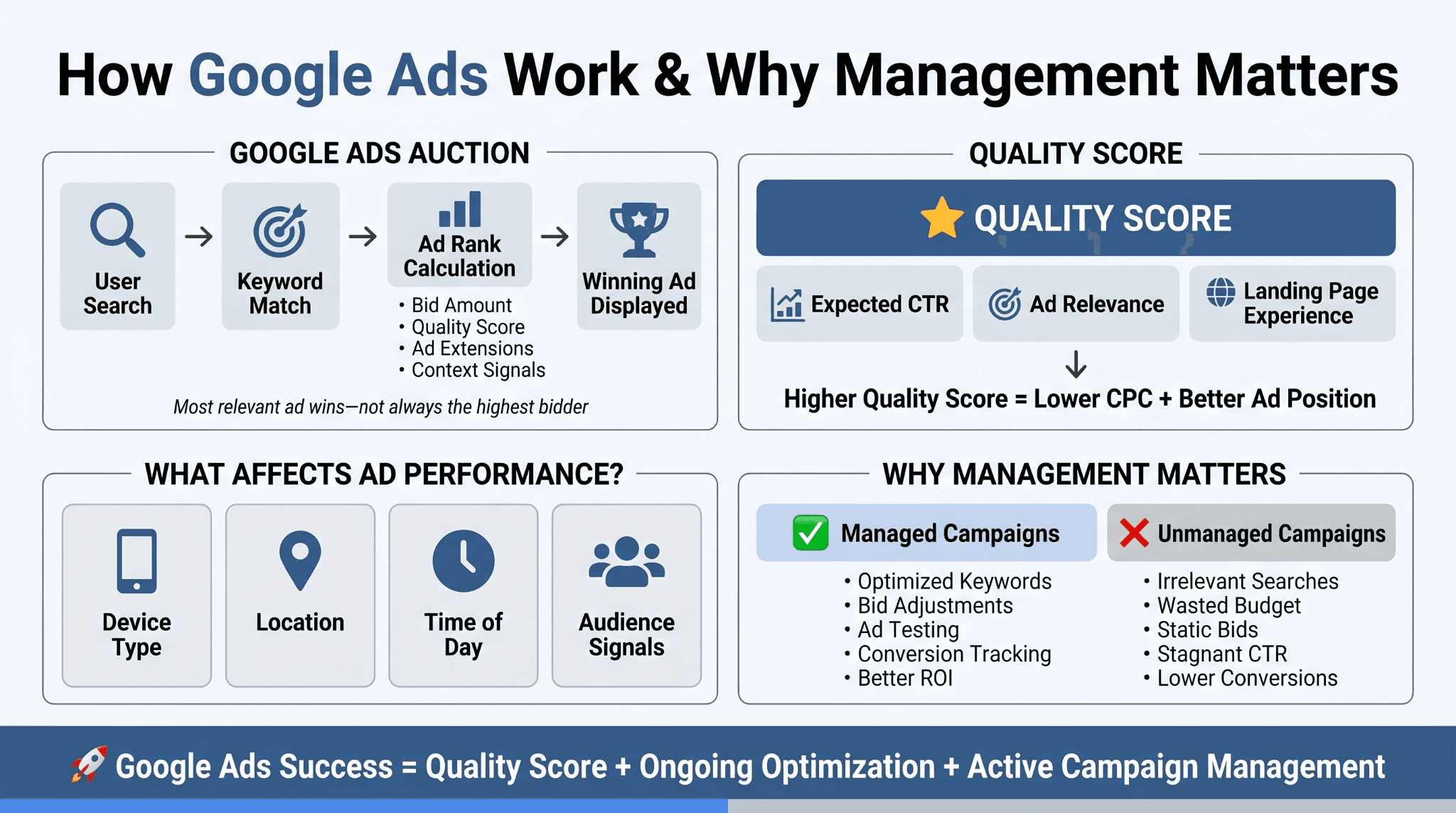
Google Ads runs on a real-time auction. Every time a user searches, Google calculates an Ad Rank for every competing advertiser using bid amount, Quality Score, expected ad extension impact, and context signals. The highest bidder does not automatically win. The most relevant, well-structured ad does.
Quality Score is built from three factors:
-
Expected click-through rate
-
Ad relevance to the search query
-
Landing page experience
A strong Quality Score lowers your cost per click and improves placement, even against competitors bidding more.
What happens when someone searches on Google?
When a user types a query, Google matches it against active keywords in advertiser accounts. Within milliseconds, the auction runs and winning ads are placed. The advertiser pays only when someone clicks, which is the pay-per-click model at the core of how Google Ads works.
Ad position, cost per click, and whether an ad shows at all depend on device type, location, time of day, audience signals, and the competitive environment at that exact moment.
Why do most Google Ads campaigns underperform without active management?
Without regular intervention, campaigns deteriorate in predictable ways. The core failure patterns are consistent across industries.
Here is what typically breaks down in unmanaged accounts:
-
Budgets drain into irrelevant search terms
-
Bids stay static while competition shifts daily
-
Ad copy goes untested, and click-through rates stagnate
-
Automated bidding runs without enough conversion data to optimize correctly
The gap between managed and unmanaged campaign performance widens over time. Platform dynamics shift, competitor activity changes, and audience behavior evolves. Campaigns that are not actively managed fall behind all three.
According to WordStream's 2025 benchmarking research, the average click-through rate for Google Search ads across all industries is 6.66%. Accounts without active optimization consistently fall below that threshold, losing auction share to competitors who test and refine on a regular cadence.
What Does Google Ads Management Actually Include?
Google Ads management is not a single task. It is an operational discipline with multiple interconnected components running simultaneously.
At its core, Google Ads campaign management covers keyword strategy, negative keyword maintenance, bid management, ad copy testing, audience segmentation, Quality Score optimization, conversion tracking, and structured reporting. Neglecting any one component typically degrades the performance of the others.
What are the core components of Google Ads campaign management?
The table below outlines each core management component and the operational role it plays in a high-performing account.
|
Component |
Operational Purpose |
|
Keyword Strategy |
Captures high-intent search queries aligned with buyer behavior |
|
Negative Keywords |
Filters irrelevant traffic and protects budget |
|
Bid Management |
Controls cost per click and auction positioning |
|
Ad Copy Testing |
Improves relevance and click-through rate over time |
|
Audience Targeting |
Layers behavioral and demographic signals onto keywords |
|
Conversion Tracking |
Ties ad spend to real business outcomes |
|
Quality Score Monitoring |
Tracks relevance, landing page quality, and expected CTR |
|
Performance Reporting |
Provides structured visibility into spend and results |
What does a typical management workflow look like week to week?
Professional Google Ads campaign management follows a structured cadence. Each time horizon has a distinct focus.
The rhythm looks like this:
-
Weekly: Search term report review, bid adjustments, budget pacing checks, conversion tracking anomaly checks
-
Monthly: Ad copy rotation analysis, audience performance review, Quality Score audit, stakeholder reporting
-
Quarterly: Full campaign architecture review, keyword coverage reassessment, bidding strategy evaluation
What Has Changed About Google Ads Management in 2026?
Managers operating on 2023 or 2024 strategies are working with outdated assumptions. Three platform shifts have had the greatest structural impact on how campaigns are built and operated today.
How has AI changed the way Google Ads campaigns are managed?
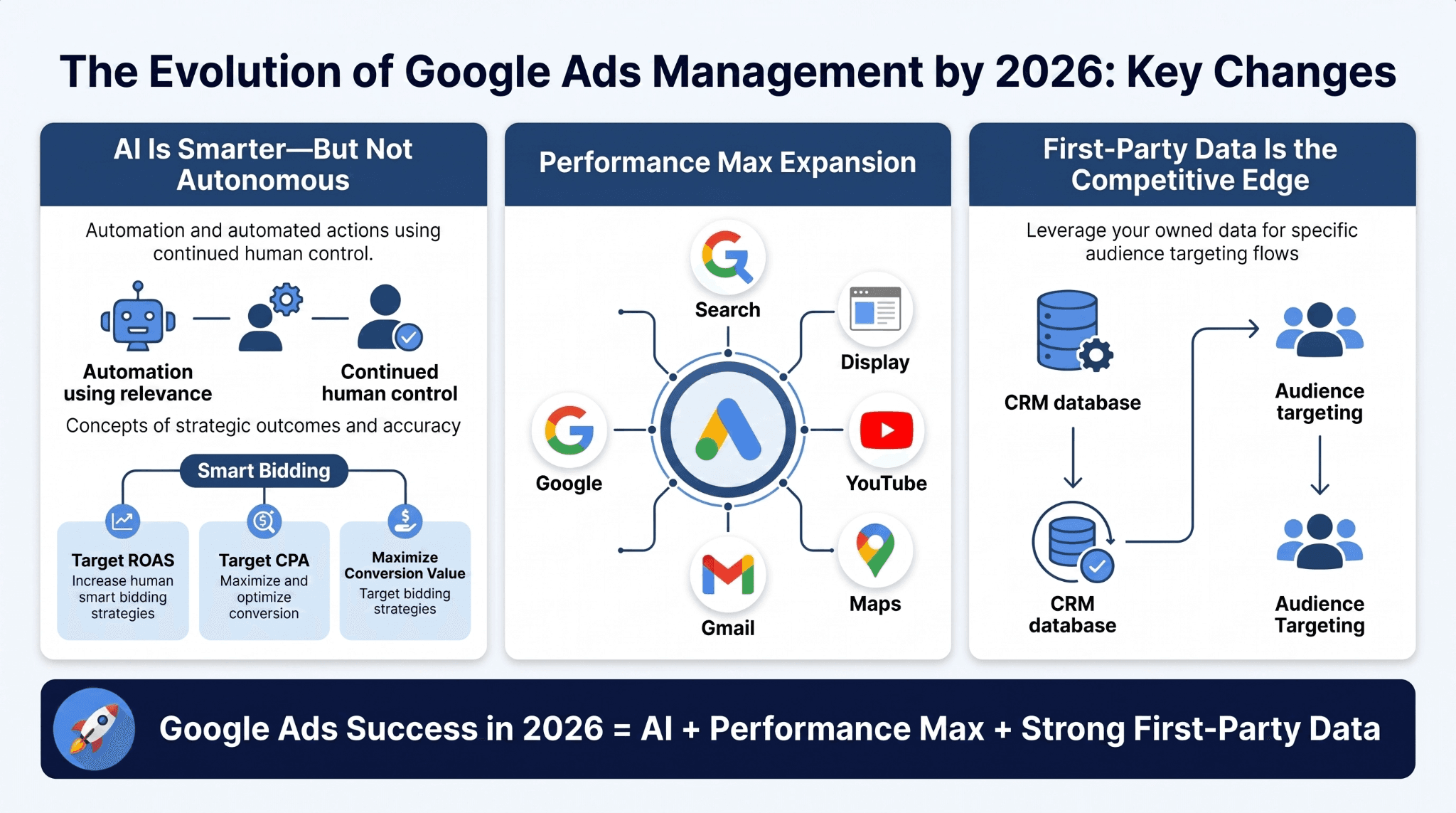
Smart Bidding strategies, including Target ROAS, Target CPA, and Maximize Conversion Value, now operate with far greater sophistication than earlier iterations. They are not autonomous. They require clean conversion data, correctly weighted conversion actions, and consistent human oversight to function as intended.
Performance Max campaigns, which Google expanded significantly through 2024 and 2025, now account for a substantial share of ad delivery across Search, Display, YouTube, Gmail, and Maps from a single campaign. The trade-off is reduced transparency. Managers have less placement control, and reading Performance Max results requires a different analytical lens than traditional Search campaigns.
Why is first-party data now central to Google Ads strategy?
Third-party cookie deprecation has fundamentally changed audience targeting. Advertisers who previously relied on third-party behavioral data have had to rebuild around first-party signals.
The businesses with a clear data advantage in 2026 are those using:
-
CRM-based customer match lists
-
Server-side tagging for accurate website behavior capture
-
Enhanced conversions connected to actual sales data
-
Suppression lists that prevent spending on existing customers
Businesses with structured CRM systems and clean customer data now hold a measurable edge. Their bidding models are better informed, their conversion tracking is more accurate, and their audience targeting is more precise.
Should You Hire a Google Ads Management Company or Manage In-House?
Neither option is universally correct. The right answer depends on internal capabilities, budget scale, and where the business is in its growth stage.
What do Google Ads management services typically include?
Professional Google Ads management services typically cover account setup and architecture, ongoing optimization, conversion tracking implementation, landing page recommendations, and performance reporting. Advanced engagements add CRM integration, audience list management, cross-channel attribution, and competitive analysis.
The distinction between basic and full-service management is significant. Basic management handles mechanical tasks. Full-service management connects campaign performance to revenue outcomes, which requires understanding the client's sales cycle, customer lifetime value, and growth targets.
What should you look for when choosing a Google Ads management company?
The table below compares in-house management against working with a specialist Google Ads management company across the factors that matter most to scaling businesses.
|
Factor |
In-House Management |
Agency or Specialist Operator |
|
Platform Expertise |
Varies by hire quality |
Higher, built across multiple accounts |
|
Cost Structure |
Salary, tools, and training |
Management fee, separate from ad spend |
|
Brand Context |
Deep, embedded knowledge |
Requires structured onboarding |
|
Tool Access |
Limited by internal budget |
Enterprise-level platform access |
|
Scalability |
Constrained by headcount |
Scales with account complexity |
|
Accountability |
Internal reporting only |
Contractual performance expectations |
Businesses spending above $10,000 per month with no dedicated PPC specialist typically see stronger ROI working with a professional operator. Below that threshold, a hybrid model often works better.
What Does Google Ads Management Cost in 2026?
Google Ads management cost is one of the most misunderstood areas of paid media planning. Management fees are entirely separate from ad spend. Both must be budgeted independently.
How do agencies typically charge for Google Ads management services?
Two pricing models dominate the market. Each has a different risk and value profile depending on spend level.
The two standard structures are:
-
Flat monthly retainer: Fixed fee regardless of ad spend, typically $500 to $5,000 per month based on account complexity
-
Percentage of spend: 10% to 20% of monthly ad spend, cost-effective at lower budgets but expensive at scale
Freelancers typically charge $50 to $150 per hour or offer flat monthly rates for defined scopes. Enterprise operators providing full-service management with CRM integration and revenue attribution sit at a higher tier.
What is a realistic monthly budget for small and mid-sized businesses?
Budget expectations should be set clearly before any engagement begins. A small business running $3,000 to $5,000 in monthly ad spend should budget an additional $500 to $1,500 for management. A mid-sized business at $15,000 to $30,000 in monthly spend typically invests $2,000 to $5,000 in management fees. These are operational investment figures, not performance guarantees.
What Google Ads Management Software Do Professionals Actually Use?
Software tools extend what a skilled manager can do. They surface data faster and automate repetitive tasks. They do not replace strategic judgment.
What is Google Ads Management Software used for?
The tools professionals rely on serve distinct operational purposes. Each one solves a specific problem in the management workflow.
The core stack looks like this:
-
Google Ads Editor: Bulk edits, campaign duplication, and offline account management
-
Google Analytics 4: Connects campaign data to on-site behavior and conversion paths
-
Optmyzr: Automated bid recommendations, Quality Score diagnostics, and rule-based optimizations
-
SEMrush or WordStream: Competitive intelligence, performance alerts, and multi-account reporting dashboards
Can software replace a Google Ads manager?
No. Google Ads management software improves efficiency but cannot interpret data in the context of a business's actual goals. Over-relying on automated recommendations without human oversight consistently misaligns platform optimization with real business outcomes.
What Are the Most Costly Google Ads Management Mistakes?
Most campaign underperformance is not a budget problem. It is a structural and operational problem that compounds over time without correction.
Why do Google Ads campaigns fail even with a decent budget?
The most damaging errors appear repeatedly across underperforming accounts regardless of industry or spend level.
The most common and costly mistakes are:
-
Running campaigns without a maintained negative keyword list
-
Ignoring the search term report entirely
-
Activating automated bidding before accumulating sufficient conversion data
-
Never testing ad copy variations
-
Misreading Quality Score signals and optimizing the wrong variables
How do you know if your current Google Ads management is underperforming?
Warning signs that indicate a management problem rather than a budget problem include the following:
-
Cost per conversion is rising with no improvement in lead quality
-
Search impression share is declining without a budget reduction
-
Conversion data in Google Ads does not reconcile with CRM records
-
Reports show clicks and impressions with no clear connection to revenue
What Does a High-Performing Google Ads Management Framework Look Like?
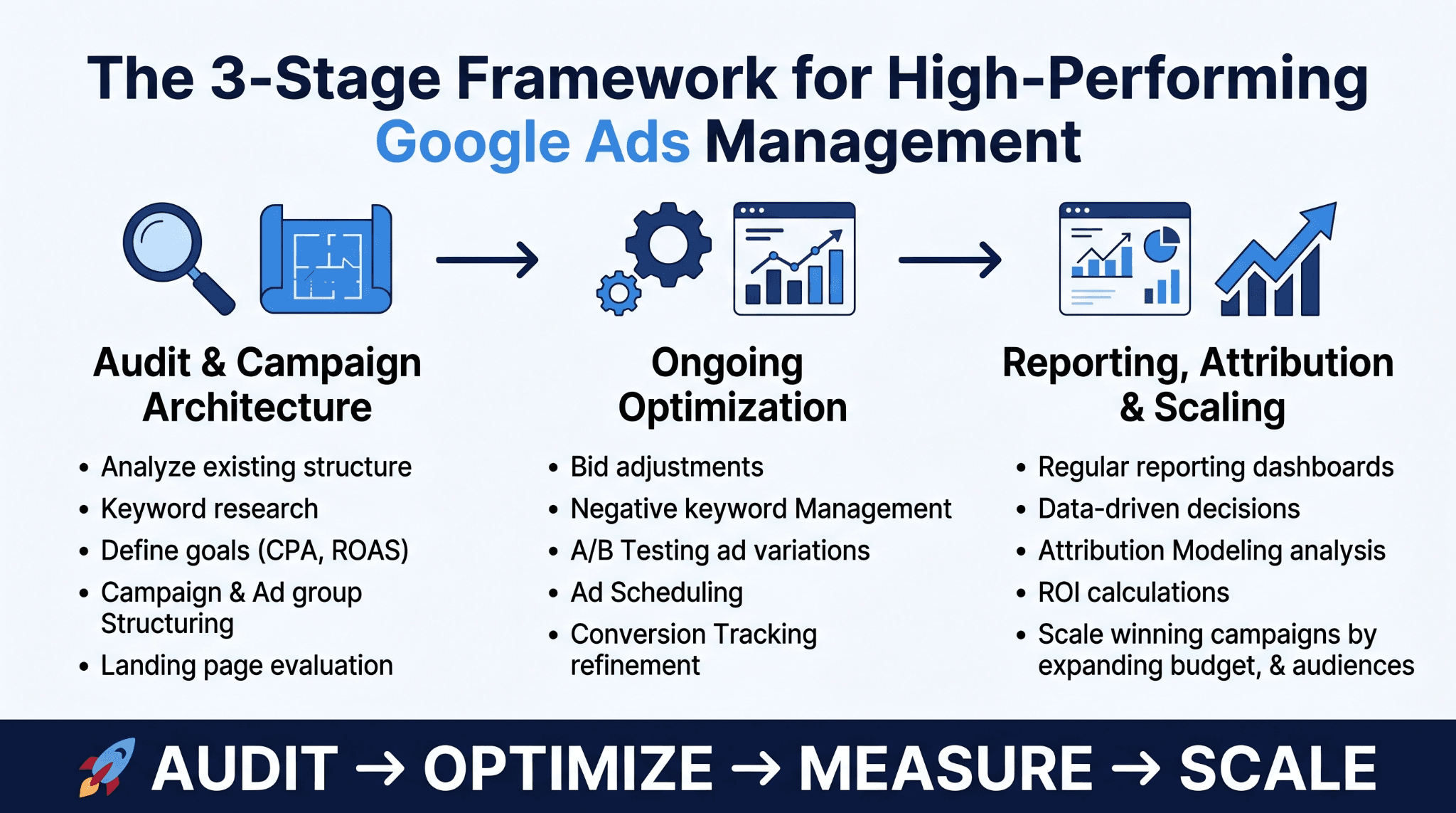
A repeatable management framework follows three operational stages. This is the architecture behind accounts that improve over time rather than plateau or decay.
Every high-performing account starts with a thorough audit before any optimization begins. The audit covers campaign architecture, keyword match-type distribution, negative keyword coverage, conversion-tracking accuracy, and bidding strategy alignment with business goals.
Stage 1: Audit and campaign architecture
The audit identifies what exists, what is broken, and what is missing. Campaign architecture then defines how keywords are grouped, how budgets are distributed, and how bidding strategies map to campaign objectives. A poorly built account cannot be optimized for strong performance. The foundation must be corrected first.
Stage 2: Ongoing optimization rhythm
The weekly and monthly cadence described earlier drives this stage. The focus is on eliminating wasted spend, improving Quality Scores, testing new ad variations, and refining audience signals. Every change is documented so performance shifts can be traced to specific decisions.
Stage 3: Reporting, attribution, and scaling decisions
Reporting at this stage connects campaign data to pipeline value, customer acquisition cost, and return on ad spend. Attribution models are reviewed to ensure conversion credit is assigned accurately. Scaling decisions, whether expanding budgets, adding campaign types, or entering new markets, are made from performance evidence rather than assumptions.
What Should You Ask Before Trusting Anyone With Your Google Ads?
Handing over Google Ads account access is a significant operational decision. The wrong operator can consume months of budget without producing results, and recovery takes time. Before committing to any agency, freelancer, or in-house hire, these are the questions worth asking directly.
Who owns the account and its historical data if the relationship ends?
The account and every bit of historical data inside it should belong to your business, not the agency. At WellsGroup, account ownership stays with the client from day one. No lock-ins, no data held hostage.
How is conversion tracking set up, and is it verified against CRM data?
Unverified conversion tracking is one of the most common sources of inflated performance reports. A competent operator builds tracking that reconciles with your CRM so the numbers you see reflect real leads and real revenue, not platform assumptions.
What metrics are included in reports, and how do they connect to revenue?
Clicks and impressions are activity metrics, not business metrics. Reports worth reading connect ad spend to pipeline value, cost per acquisition, and return on ad spend. That is the reporting standard WellsGroup holds every account to.
How are campaign changes documented and communicated?
Every optimization decision should have a paper trail. A professional operator maintains a change log and explains the reasoning behind every significant adjustment so you always know what changed and why.
What conversion data threshold is required before switching to automated bidding?
Running Target CPA or Target ROAS without sufficient conversion history produces erratic results that damage account performance. A disciplined operator sets clear data thresholds before activating any automated bidding strategy and does not cut corners to show early results.
The Standard That Separates Good Google Ads Management from Great
The difference between average and high-performance Google Ads management is not tools or budget. It is the discipline of treating every campaign as a living operational system that demands structured attention, clean data, and accountability at every stage.
Average management maintains campaigns. High-performance management builds compounding returns by connecting every optimization decision to a business outcome, not just a platform metric. WellsGroup engineers paid media infrastructure that integrates Google Ads campaign management with CRM data, attribution systems, and performance reporting so every dollar spent is traceable to a result. To see how WellsGroup can bring structure, accountability, and measurable results to your Google Ads campaigns, get your custom proposal today.