How Paid Ads Tracking and Attribution Drive Real ROI
Learn how paid ads tracking and attribution connect ad spend to revenue, improve ROI, and eliminate costly marketing blind spots.

Every business running paid ads eventually hits the same wall. The dashboard looks healthy. Clicks are coming in. Conversions appear strong. But when you check actual revenue, the numbers do not match.
Paid ads tracking and attribution are the system that closes that gap. It connects what your ads are doing to what your business is actually earning. Without it, every budget decision is built on incomplete data.
Understanding how attribution works, which models to use, and how to build the right infrastructure is what separates businesses that scale paid channels from those that bleed budget without knowing why. Get a proposal from WellsGroup and build a tracking system that reflects what your ads are actually earning.
What Paid Ads Tracking and Attribution Actually Means
These two terms are often used interchangeably. They are not the same thing, and confusing them leads to measurement gaps that cost real money.
-
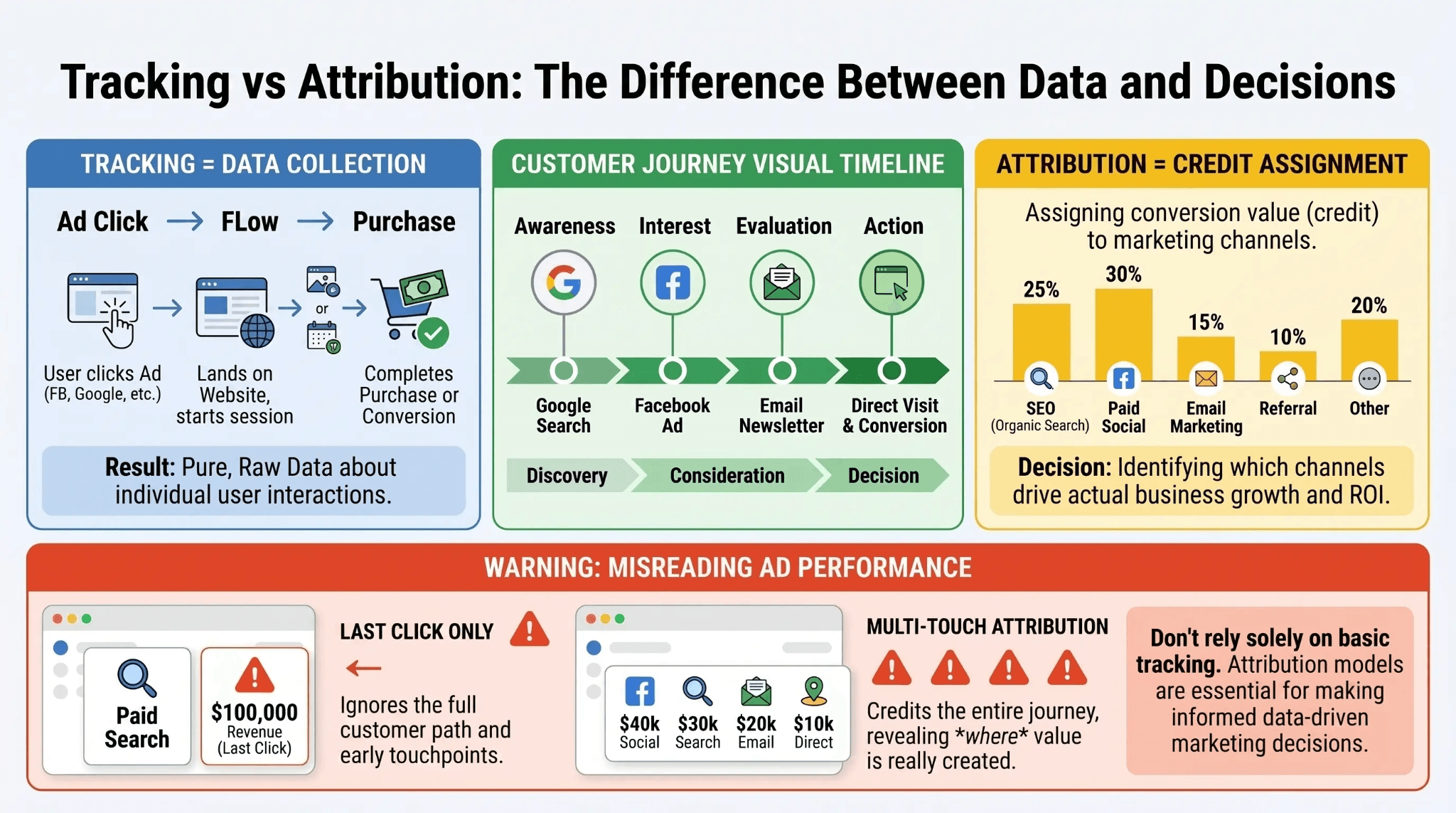
Tracking is the data collection layer. It records what users do after clicking an ad, including page visits, form submissions, purchases, and other conversion events.
-
Attribution is the analytical layer. It assigns credit to the specific touchpoints that contributed to a conversion.
A simple way to think about it: tracking tells you a customer visited your site three times before buying. Attribution tells you which of those three visits deserves credit for the sale.
Tracking vs Attribution: Two Different Jobs
Ad attribution tracking without a solid tracking foundation is a model running on guesswork. Tracking without attribution leaves you with raw data that cannot inform a single budget decision.
-
Tracking answers: What happened?
-
Attribution answers: What caused it?
Why Both Work Together
How attribution works in digital advertising depends entirely on the quality of the tracking layer feeding it. A misconfigured tracking setup produces inaccurate attribution outputs. Inaccurate outputs produce bad budget decisions.
One does not work without the other. They are two halves of the same operational system.
Why Most Businesses Are Flying Blind Without It
Running paid campaigns without proper ad spend attribution is one of the most expensive mistakes a scaling business can make. The problem is rarely visible because ad platforms are designed to report favorably.
Google reports conversions. Meta reports results. But both platforms measure within their own ecosystems using their own logic, and they will almost never agree with your CRM.
Industry analysts estimate that up to 44% of digital advertising spend is wasted due to inaccurate attribution, a figure that has worsened with the shift to privacy-first data models.
The Gap Between Platform Data and Real Revenue
Meta measures view-through conversions. If someone saw your ad, never clicked, and converted later through a different channel, Meta may still claim that sale. Google's default attribution has historically overcredited last-click interactions.
The result looks like this:
-
Google reports 80 conversions
-
Meta reports 60 conversions
-
Your CRM records 75 total customers
None of these numbers match. Budget decisions made from platform dashboards alone are decisions made on fiction.
How to track paid ad performance accurately means building a measurement layer that is independent of the platforms reporting on themselves.
What Misattribution Actually Costs
When credit flows to the wrong campaigns, budget follows. Upper-funnel campaigns that introduced customers in the first place get cut. Bottom-funnel retargeting and branded search absorb all the credit and all the spend.
PPC conversion tracking built only on platform data will:
-
Overvalue bottom-funnel keywords
-
Undervalue awareness-stage campaigns
-
Systematically misdirect budget over time
Campaign ROI tracking built on accurate attribution corrects all three of these problems.
The Main Attribution Models and How They Work
Marketing attribution models range from simple single-touch approaches to machine-learning systems. The model you choose directly affects how performance is reported and how budgets are allocated.
The six primary models in active use are compared below. Choosing the wrong model for your sales cycle will reward the wrong activities consistently.
|
Attribution Model |
Credit Distribution |
Best Suited For |
|
Last-Click |
100% to the final touchpoint |
Short sales cycles, direct response |
|
First-Click |
100% to the first touchpoint |
Brand awareness measurement |
|
Linear |
Equal credit across all touchpoints |
Long journeys, consistent value at each stage |
|
Time-Decay |
More credit to recent touchpoints |
Short to mid-length sales cycles |
|
Position-Based |
40% first, 40% last, 20% middle |
Businesses valuing both acquisition and close |
|
Data-Driven |
Credit based on actual conversion patterns |
Accounts with sufficient conversion volume |
Last Click vs First Click Attribution
Last-click attribution credits the final interaction before a conversion. It systematically favors retargeting and branded search while ignoring everything that came before.
First-click attribution does the opposite. It credits the first touchpoint entirely and ignores everything that followed.
Neither model reflects how customers actually buy, particularly in B2B or high-consideration environments where the difference between last click attribution vs first click is the difference between seeing the full journey and seeing only its edges.
Data-Driven Attribution and Why It Is Now the Default
Data-driven attribution for Google Ads became the platform's default in 2025. Instead of applying fixed rules, it uses machine learning to analyze actual conversion paths and assigns credit based on which touchpoints had a measurable impact.
It requires a minimum conversion volume to work accurately. For lower-volume accounts, it draws on broader patterns rather than account-specific data. The shift to this default reflects a wider industry recognition that rule-based models produce systematic distortions.
Choosing the Right Model for Your Sales Cycle
The best attribution model for paid advertising depends on how your customers actually make decisions:
-
eCommerce or short-cycle direct response: last-click or time-decay models work without major distortion
-
SaaS with a 30-day trial: position-based or linear models reflect the nurturing period more accurately
-
B2B or logistics with multi-week decision cycles: data-driven or multi-touch models are essential
Multi-touch attribution marketing is not more complicated for its own sake. It is more accurate because it reflects a more complex customer reality.
How Multi-Touch Attribution Gives You the Full Picture
Today's buyers move across multiple platforms, devices, and ad formats before converting. A single-touch model collapses that entire journey into one interaction and rewards it accordingly.
What is multi-touch attribution in digital marketing is a framework that distributes credit across every meaningful touchpoint rather than crediting only the first or last one.
Mapping the Customer Journey Across Touchpoints
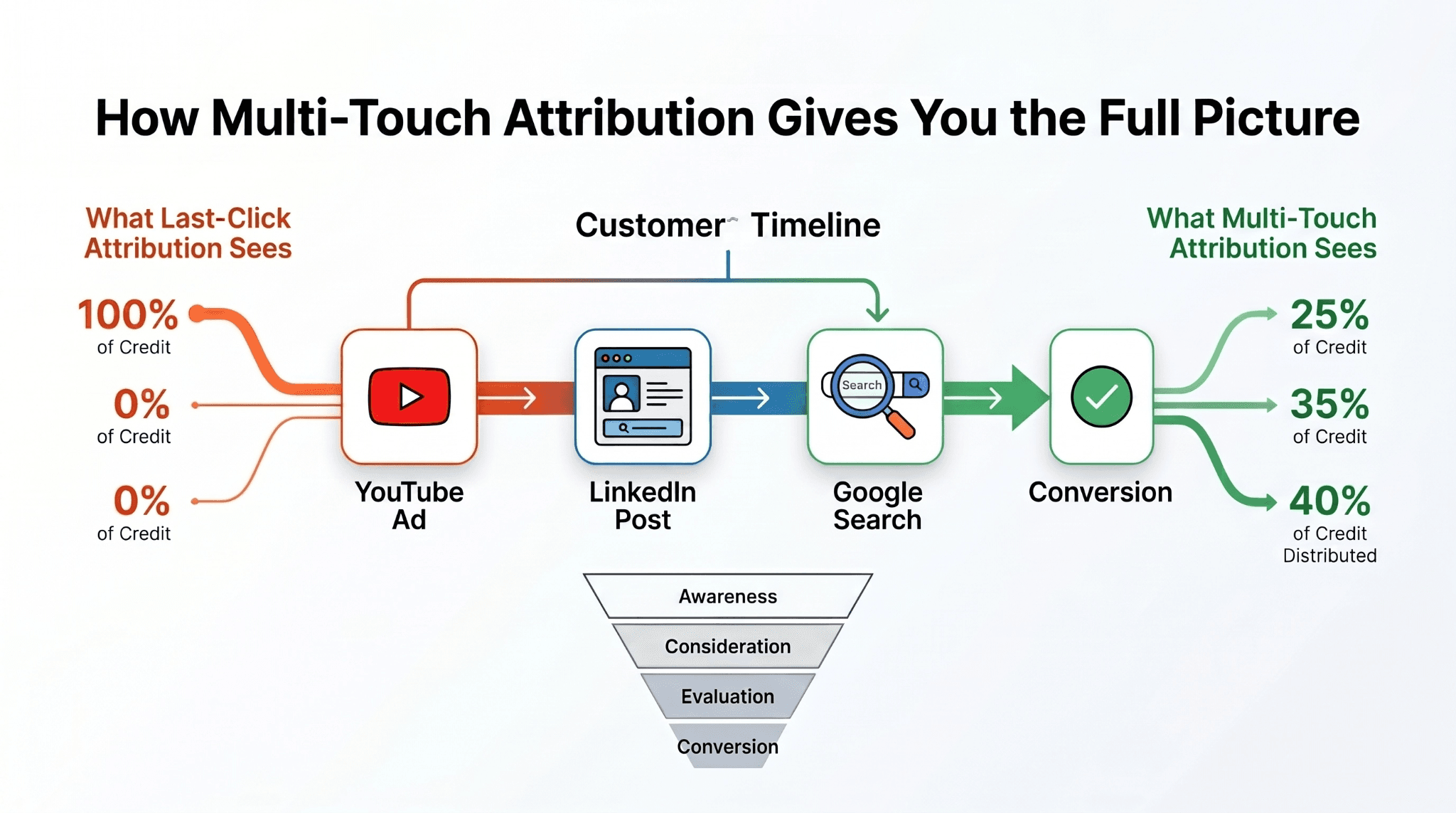
Consider a logistics company running ads across Google Search, LinkedIn, and YouTube. A prospect's journey might look like this:
-
Sees a YouTube pre-roll ad while researching industry topics. Does not click.
-
Sees a LinkedIn sponsored post three days later. Visits the website.
-
Searches a specific service term on Google one week later. Clicks an ad. Requests a demo.
Under last-click, Google Search gets full credit. LinkedIn and YouTube receive nothing. The budget gets cut from the two channels that started the journey.
Marketing funnel tracking with a multi-touch model distributes credit across all three, which keeps the full pipeline funded.
Linear, Time-Decay, and Position-Based Models Compared
These are the three rules-based multi-touch models. No one uses machine learning, so accuracy depends on whether the underlying assumptions match your actual customer behavior.
|
Model |
Logic |
Strength |
Limitation |
|
Linear |
Equal credit to every touchpoint |
No touchpoint ignored |
Overvalues low-impact middle touches |
|
Time-Decay |
More credit to recent touches |
Reflects urgency and recency |
Undervalues early awareness activity |
|
Position-Based |
40/20/40 across first, middle, last |
Balances acquisition and close |
Middle touches still underrepresented |
Revenue attribution using any of these is more accurate than single-touch but less precise than data-driven for high-volume accounts.
The Tracking Tools and Setup That Make It All Work
Understanding models is only half the equation. The infrastructure collecting the data must be configured correctly or even the best attribution model will produce inaccurate outputs.
The core infrastructure for paid ads tracking and attribution in 2026 consists of four layers working together:
-
UTM parameters for campaign source identification
-
Google Ads conversion tracking via GCLID
-
GA4 attribution reports for cross-channel visibility
-
Server-side tracking for privacy-resilient measurement
Setting Up Conversion Tracking in Google Ads
Google Ads conversion tracking works through the GCLID system. When someone clicks an ad, a unique identifier is appended to the landing page URL, linking all subsequent actions back to the specific campaign, ad group, and keyword.
To set this up accurately:
-
Define conversion actions in Google Ads, such as form submissions, purchases, or calls
-
Link Google Ads to GA4 via the account integration
-
Assign conversion values where possible to enable ROAS optimization
-
Confirm auto-tagging is enabled so GCLIDs pass through correctly
How to set up conversion tracking in Google Ads correctly is the single most impactful technical step a paid media team can take.

How UTM Parameters Feed Your Attribution Data
UTM parameters are text strings appended to ad URLs that pass campaign information into GA4. A correctly structured tag looks like this:
website.com/page?utm_source=google&utm_medium=cpc&utm_campaign=q2-brand
How to use UTM parameters for paid campaigns requires enforcing consistent naming across every platform. Inconsistent naming, such as "CPC" in one campaign and "cpc" in another, splits data in GA4 and breaks attribution reporting. A shared naming convention is one of the highest-impact, lowest-cost improvements a marketing team can make.
Meta Pixel and Cross-Platform Tracking
Meta Pixel conversion tracking operates independently of Google's system. When running campaigns on both platforms simultaneously, each platform will report overlapping conversions using its own logic.
GA4 attribution reports consolidate data from multiple sources into a single reporting view. How to track ad conversions in GA4 across platforms requires this unified setup to avoid reading siloed, inflated platform metrics as ground truth.
Attribution Windows and Why They Change Your Results
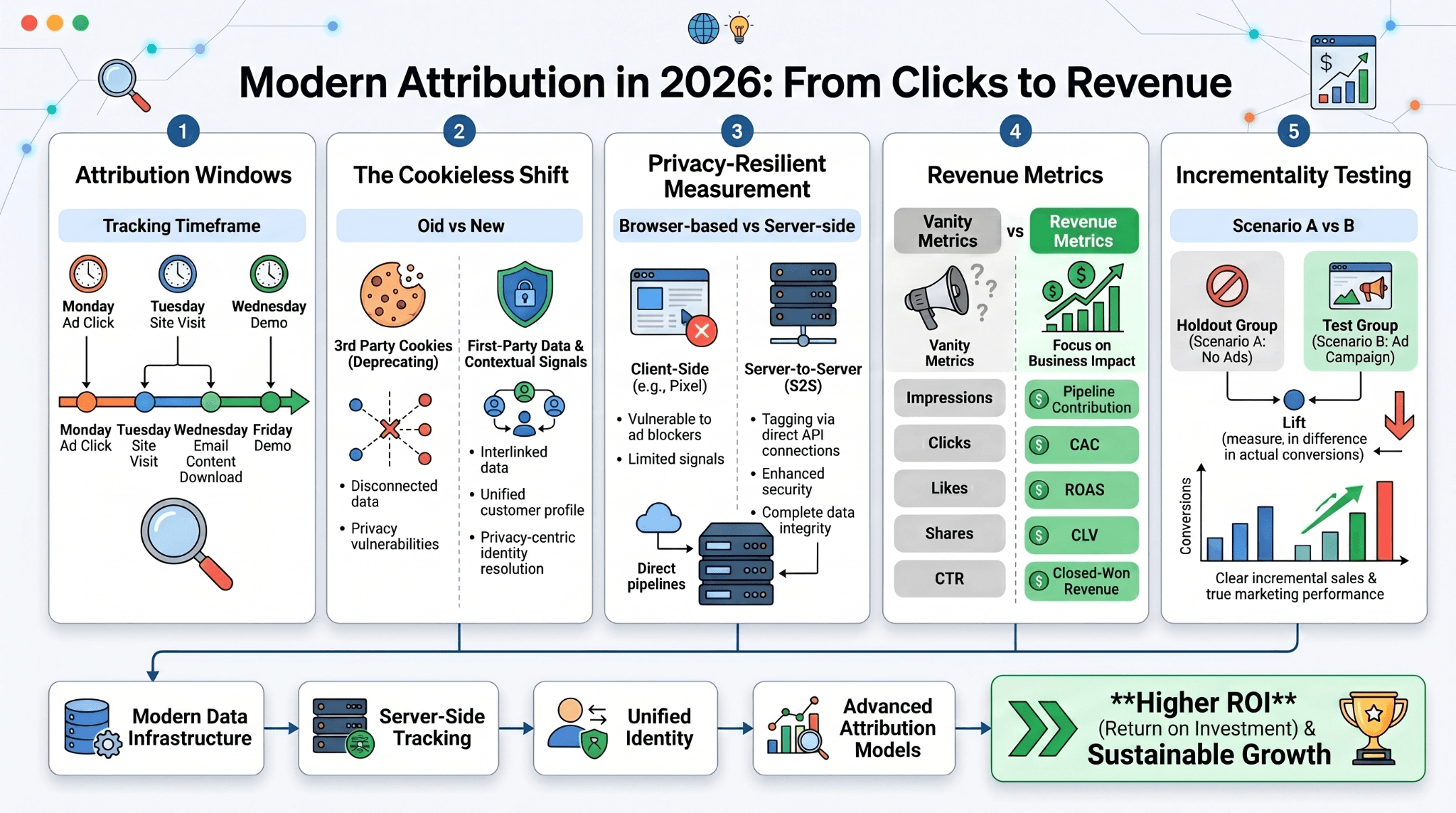
An attribution window is the time period after an ad interaction during which a conversion can be credited to that ad. The window length directly determines how many conversions appear in campaign reports.
A 1-day window credits only conversions within 24 hours of a click. A 7-day window captures conversions happening within a week. For businesses with longer decision cycles, narrow windows make campaigns appear less effective than they are.
Short Windows vs Long Windows: What Gets Missed
Consider a B2B company where a prospect clicks an ad on Monday, reviews the product internally, and submits a demo request on Friday. Under a 1-day attribution window, that conversion is invisible to the campaign entirely.
Attribution window in paid ads decisions should be based on the average time between first click and conversion in your specific business, not platform defaults. Paid search attribution tracking becomes significantly more accurate when the window matches the actual sales cycle.
Tracking Paid Ads Without Third-Party Cookies
Cookieless attribution is not a future concern. It is the current operational reality. Safari and Firefox have blocked third-party cookies for years. Chrome's privacy changes continue to evolve. The gap between platform-reported conversions and actual revenue is widening as a direct result.
First-Party Data as the New Tracking Foundation
First-party data is collected directly through a business's own platforms, including CRM records, website behavior, email interactions, and authenticated user accounts. It is not subject to browser restrictions because it comes from a direct relationship with the customer.
Paid advertising tracking without third-party cookies is viable when built on:
-
CRM integrations that capture lead and customer data
-
Email capture and authenticated user experiences
-
Offline conversion tracking imported directly into Google Ads and Meta
Server-Side Tracking and Enhanced Conversions
Server-side tracking moves data collection from the user's browser to the business's own server. It is immune to ad blockers, browser restrictions, and cookie limitations.
Google's enhanced conversions allow businesses to send hashed first-party customer data alongside conversion events, improving attribution accuracy in privacy-constrained environments. These two approaches together make first-party data tracking the durable foundation for paid media measurement going forward.
Using Attribution Data to Optimize Ad Spend
Attribution data is only valuable when it drives budget decisions. The shift from collecting data to acting on it is where most businesses fall short.
From Vanity Metrics to Revenue Metrics
Marketing ROI measurement built on clicks and impressions feels productive but rarely connects to business outcomes. The metrics that matter are:
-
Cost per acquisition (CPA): what it actually costs to acquire a customer through each channel
-
Return on ad spend (ROAS): revenue generated per dollar of ad spend
-
Revenue per keyword: attributed revenue divided by keyword cost
Why attribution matters in PPC campaigns comes down to this: how to measure ROI on paid ads accurately requires knowing not just that a conversion happened, but which combination of touchpoints produced it and at what total cost.
Incrementality Testing: Are Your Ads Actually Working
Attribution models measure the correlation between touchpoints and conversions. They do not prove causation. Incrementality testing fills that gap by running controlled experiments to determine whether ad spend is generating conversions that would not have happened otherwise.
If a business pauses retargeting for a defined test period and conversion volume holds steady, that spend was capturing demand that would have converted anyway. Budget optimization for paid ads based on incrementality data ensures spend is genuinely driving new revenue, not just claiming credit for it.
Cross-Channel Attribution and the Multi-Platform Reality
Most businesses in 2026 are running paid media across Google, Meta, LinkedIn, YouTube, and programmatic display simultaneously. Cross-channel attribution ties all of this together so decisions are not made from each platform's self-reported numbers in isolation.
The Double-Counting Problem in Multi-Platform Advertising
A customer clicks a Google Search ad on Tuesday, sees a Meta retargeting ad on Wednesday, and converts on Thursday. Google credits its search campaign. Meta credits its retargeting campaign. Both are claiming the same conversion.
Ad attribution tracking across platforms without a unified measurement layer produces systematically inflated performance data. Paid search attribution tracking and social attribution need to be evaluated together in a single, deduplicated view. GA4 with properly configured cross-channel reporting is the most accessible solution for most businesses operating at this scale.
What Marketers Ask About Paid Ads Tracking and Attribution
Attribution raises the same questions repeatedly across businesses at every stage of growth. The answers below address the most common points of confusion.
Before the questions: most attribution problems are not technology problems. They are configuration and consistency problems stemming from incomplete setup or inconsistent data practices.
What is the difference between tracking and attribution?
Tracking records what happened after an ad interaction. Attribution assigns credit to the touchpoints that caused the conversion. Tracking collects the evidence. Attribution draws the conclusion.
Which attribution model is best for Google Ads?
For accounts with sufficient conversion volume, data-driven attribution in Google Ads is the most accurate option. For lower-volume accounts, position-based or linear models are a stronger alternative to last-click.
How do UTM parameters help with paid ad tracking?
UTM parameters tag every ad URL with source, medium, and campaign data. This flows into GA4 and enables accurate cross-channel reporting. Without consistent UTM tagging, GA4 cannot reliably connect sessions to specific campaigns.
Does attribution still work without third-party cookies?
Yes, when built on first-party data infrastructure. Server-side tracking and enhanced conversions maintain accurate paid ads tracking and attribution in cookieless environments by using hashed customer data and direct server-to-server event reporting.
What metrics should I focus on for paid ad ROI?
CPA, ROAS, and revenue per channel are the primary metrics. Clicks, impressions, and CTR are diagnostic tools, not performance indicators.
The System Behind Every Performing Campaign
Paid ads tracking and attribution are not a reporting feature. It is the operational foundation that determines whether ad spend functions as a business investment or an uncontrolled cost center.
The businesses outperforming competitors in paid media are not necessarily spending more. They are measuring more accurately. Every dollar flows toward campaigns that demonstrably drive revenue, and every underperforming element gets identified before it compounds into a larger budget problem.
Attribution infrastructure built correctly in 2026, using first-party data, server-side tracking, and platform-independent reporting, will remain durable as privacy regulations tighten and third-party data continues to erode.
WellsGroup builds attribution systems that connect every paid ad to real revenue. Get a proposal and see how your campaigns can perform with the right tracking infrastructure in place.