How to Use AI Tools for Business: The Operational Playbook for 2026
A three-person logistics team cut a nine-hour reporting process to four minutes by embedding AI into operations. Learn which AI tools deliver measurable ROI, automate workflows, improve search visibility, and help businesses build scalable systems instead of running disconnected experiments.

A three-person logistics team rebuilt its reporting workflow using AI tools connected to its cloud stack. A nine-hour Monday process now takes four minutes. Nobody was replaced. The broken process was.
That shift from "AI as an experiment" to "AI as operational infrastructure" defines where serious businesses are in 2026. The best AI tools for business now integrate into the structural layer of your operations, data pipelines, compliance monitoring, customer workflows, and search visibility.
Generative AI usage among small businesses jumped from 40% in 2024 to 58% in 2025. By 2026, the Federal Reserve found that small businesses were adopting AI faster than large firms, a reversal that had never occurred before in the monitoring data.
For founders and operations leaders who want systems over experiments, this is a breakdown of how to embed AI tools into the revenue-driving and operationally critical parts of your business, with architecture-first thinking at every step.
What AI Tools Actually Do in a Business Setting
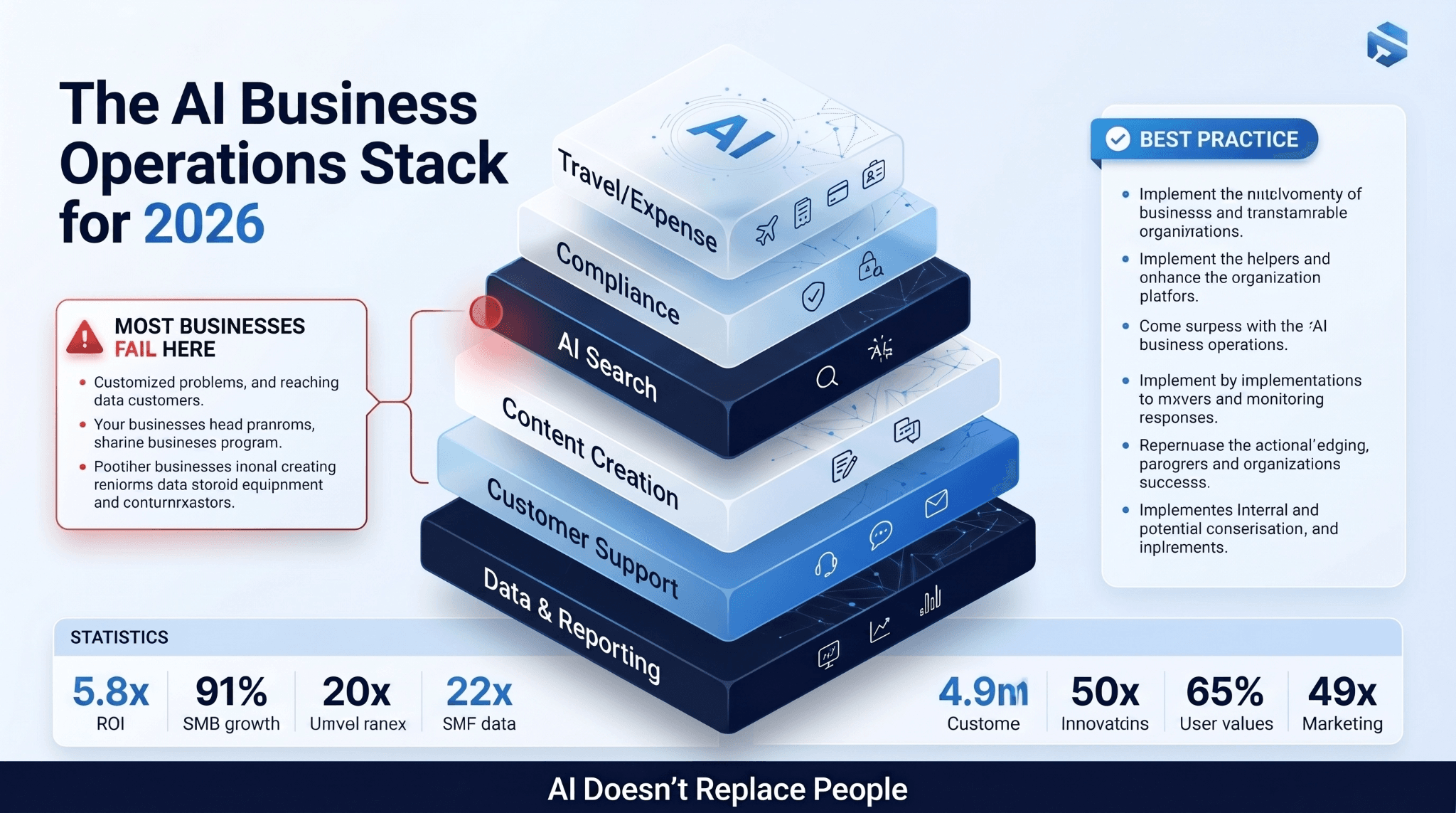
Before selecting any tool, be precise about what category of problem you are solving. AI tools for business fall into distinct operational layers, and confusing those layers is where most adoption efforts stall.
-
Content and copywriting assistants: Drafting, editing, and scaling written output
-
Data analysis and reporting tools: Useful for a business analyst spending hours in disconnected spreadsheets weekly
-
Customer support automation: Ticket routing, first-response generation, and CSAT collection
-
AI SEO and search visibility tools: Keyword mapping, content gap analysis, and LLM citation targeting
-
Compliance monitoring systems: Continuous flagging of data privacy gaps, contract risks, and regulatory changes
-
Travel and expense management platforms: Carbon tracking, policy enforcement, and cost optimization
No tool category serves every business model equally. The mistake most operations teams make is buying tools horizontally, across categories, before solving a specific workflow vertically within one.
The honest framing is not that AI replaces headcount. It removes the parts of every role that require time but not judgment, repetitive data entry, report generation, and ticket classification.
McKinsey's 2025 Global AI Survey found a 5.8x average ROI on AI investments within 14 months of moving to production deployment. Salesforce reported that 91% of SMBs actively using AI say it directly boosts their revenue.
Core operational benefits:
-
Faster decision-making through real-time data surfacing
-
Reduced human error in repetitive, high-frequency tasks
-
Lower operational costs as automation compounds over time
-
Consistent customer experience without proportional headcount growth
The benefits of using AI search optimization tools for small businesses deserve specific attention. In 2024 and 2025, most SMBs treated SEO as a separate marketing function. In 2026, it is an infrastructure function. So why use AI search optimization tools for your business now? Because customers are finding vendors through Google AI Overviews, Gemini, and ChatGPT Search, not just blue links. If your content is not structured for AI retrieval, you are invisible in the channels where buying decisions begin.
AI Tools for Business Operations: What to Use Where
Knowing that AI tools exist is not the same as knowing where to deploy them. The two sections below break down the most operationally impactful application areas, with practical tool comparisons for each.
Managing Data, Reporting, and Analysis
The core problem for most scaling businesses is data fragmentation: CRM in HubSpot, financials in QuickBooks, analytics in GA4, ad performance in a siloed dashboard. AI tools for centralizing business data eliminate most of that manual layer.
|
Tool |
Primary Use |
Best For |
Free Tier |
|
Polymer |
Natural language querying of spreadsheet data |
Analysts across disconnected exports |
Yes |
|
Akkio |
Predictive modeling and automated reporting |
Operations teams need forecasting |
Limited |
|
Obviously.ai |
No-code predictive analytics |
SaaS and ecommerce teams |
No |
|
Tableau with Einstein AI |
Enterprise visualization with AI summaries |
Larger teams with data warehouses |
No |
The best AI tools for business analysts eliminate the report-building cycle entirely and redirect effort toward decision-making. If you spend more than 90 minutes weekly generating the same report, the tool already exists.
AI Tools for Ecommerce and Retail Business Operations
AI tools for ecommerce businesses address one specific problem: volume and speed. Inventory moves fast, customer queries spike, and product descriptions need constant updating. Key areas where AI tools for retail businesses create leverage:
-
Dynamic pricing based on competitor positioning and stock levels
-
Inventory forecasting from sales velocity, seasonality, and supplier lead times
-
Personalized product recommendations driven by behavioral data
-
Automated first-response customer service across chat and email
-
Sentiment analysis across reviews to surface issues before they compound
Tidio works well for small-to-medium ecommerce support automation; Klaviyo's AI features handle behavioral email personalization at scale. Identify the workflow consuming the most time at the highest error rate, and start there.
AI and SEO: How Businesses Compete in AI-Driven Search
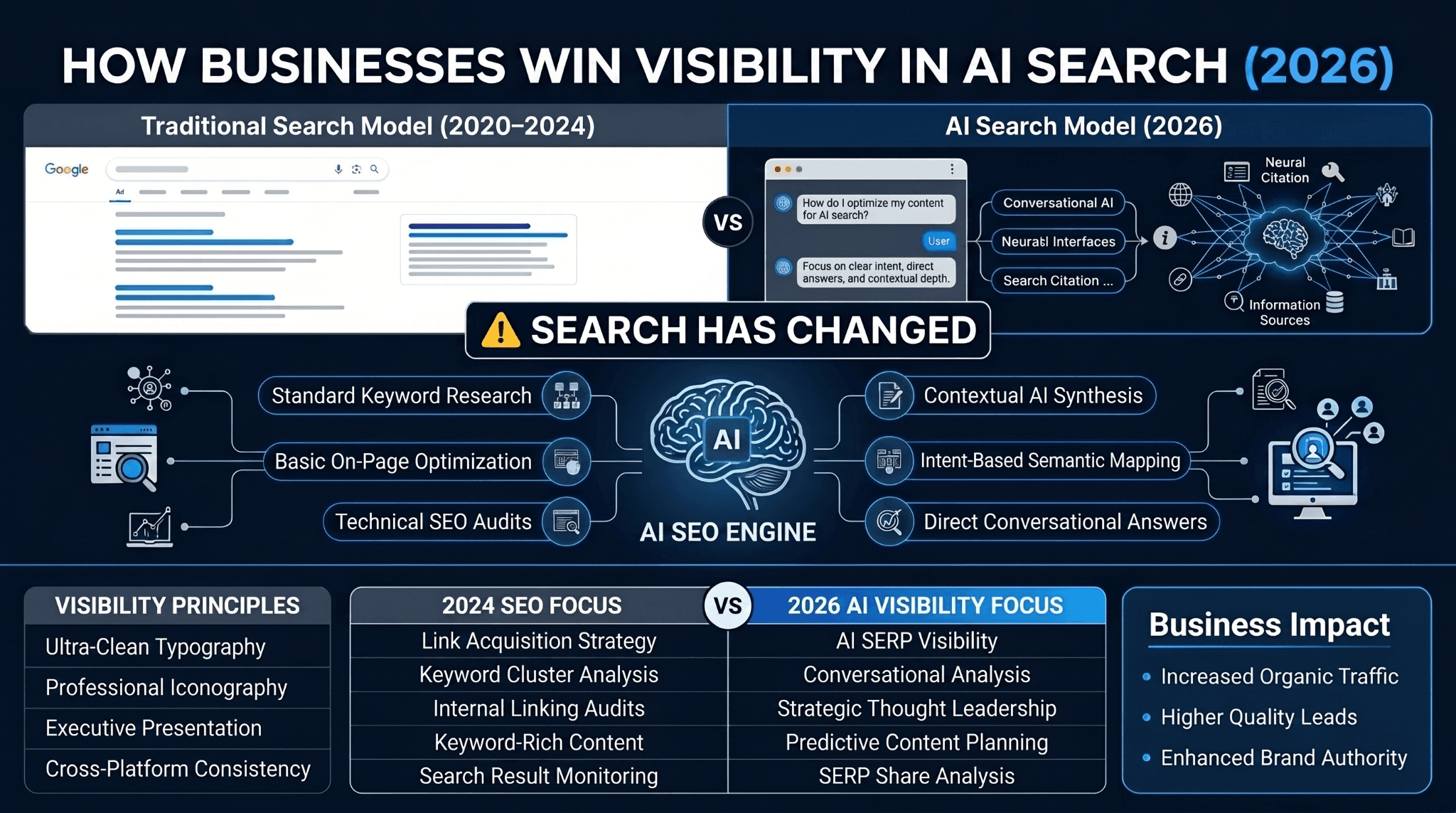
Search behavior has structurally changed. Most commercial queries now surface AI-generated responses before any blue link, and businesses that have not adapted their content architecture are losing visibility they cannot see.
What AI SEO Tools Actually Do for Small Businesses
AI SEO tools for small businesses do not automate ranking. They compress the time required to do the technical work that produces ranking conditions. The most effective AI search optimization tools for businesses operate across keyword clustering, content gap analysis, on-page optimization, SERP feature targeting, and local SEO recommendations.
In 2024 and 2025, these tools were primarily used to speed up content creation. In 2026, the priority is AI visibility, structuring content so AI systems can retrieve, cite, and surface it in conversational queries. This requires semantic depth and factual specificity at every level of your content operation.
Choosing the Right AI SEO Tool: A Practical Comparison
Not every AI SEO tool is built for the same operational context. The right choice depends on your team size, content volume, and whether you are managing one brand or multiple client accounts.
|
Tool |
Best For |
Key AI Feature |
Price Range |
Free Plan |
|
Surfer SEO |
On-page optimization |
Real-time NLP scoring |
$89 to $219/mo |
No |
|
Semrush AI |
Full SEO and content workflow |
AI writing with SERP integration |
$130 to $500+/mo |
Limited |
|
Clearscope |
Content depth and relevance |
Topic modeling and grade scoring |
$170 to $1,200/mo |
No |
|
NeuronWriter |
Semantic optimization for lean teams |
NLP recommendations |
$23 to $117/mo |
No |
|
SE Ranking AI |
Multi-client audits and reporting |
Automated site audit with fix suggestions |
$65 to $260/mo |
No |
For lean teams, NeuronWriter or SE Ranking AI offer the best ease-to-impact ratio. For analysts managing multiple clients, Semrush provides the depth the best AI tool for business environments requires at scale.
AI Tools for Customer Support and Complex Workflow Automation
Customer support is where lean teams absorb the most unproductive time. One generalist handling 50 tickets per day manually is an unsustainable model past early traction. Popular AI tools for improving complex support workflows in business solve this through structured automation, not simple chatbots.
|
Tool |
What It Automates |
Best Business Size |
Integrations |
|
Intercom AI |
Conversation resolution and routing |
Mid-market SaaS |
HubSpot, Salesforce, Stripe |
|
Freshdesk Freddy |
Ticket tagging and suggested replies |
SMB to mid-market |
Slack, Shopify, Jira |
|
Zendesk AI |
Intelligent triage and macro suggestions |
Enterprise |
Full API ecosystem |
|
Tidio |
First-response and live chat hybrid |
Small ecommerce |
Shopify, WooCommerce |
|
Help Scout AI |
Summarization and reply drafts |
Content-heavy SMBs |
WordPress, Zapier |
The architecture principle that matters: automation works best when the human escalation path is explicitly designed into the system. AI handles volume. Humans handle ambiguity. Among the best AI tools for small businesses in 2026, support automation delivers the fastest measurable ROI because the baseline, manual ticket handling, is easy to measure against.

Compliance and Sustainable Travel: Two Underrated AI Applications
These two use cases share a common operational logic: both involve continuous monitoring across high-volume data points that no human team can realistically track manually. Getting either wrong carries measurable financial consequences.
Best AI Compliance Tools for Businesses
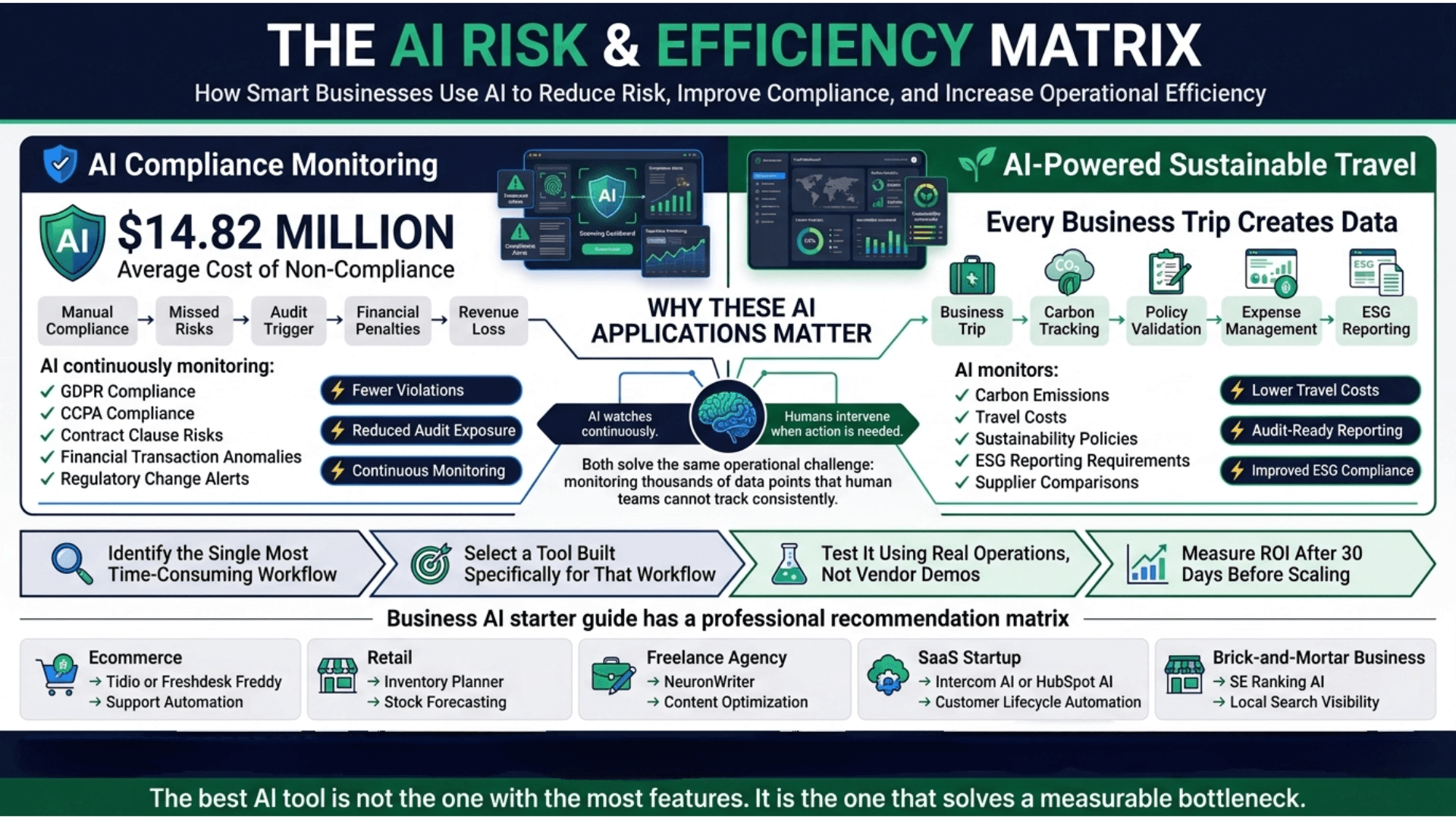
Most small businesses treat compliance as reactive, something you address when an audit notice arrives. The best AI compliance tools for businesses run continuous checks instead. The average cost of non-compliance reached $14.82 million in 2025, according to the Ponemon Institute, covering fines, remediation, business disruption, and lost revenue.
These tools monitor GDPR and CCPA adherence, financial transaction anomalies, contract clause risks, and regulatory update alerts by industry. Colorado's Senate Bill 24-205 takes effect June 30, 2026, the first comprehensive state-level AI law in the U.S. It will not be the last.
AI Tools for Sustainable Business Travel Management
AI tools for sustainable business travel now track carbon emissions per trip, compare options by environmental impact, and flag itineraries violating internal sustainability policies, all within existing expense management systems. For companies with ESG reporting requirements, AI tools for sustainable business travel management integrate directly with finance dashboards. Platforms like TravelPerk's GreenPerk, Thrust Carbon, and Spotnana offer varying levels of carbon data granularity and policy enforcement, producing both cost reduction and audit-ready data in the same workflow.
How to Start: Picking the Right AI Tools Without Wasting Money
Tool proliferation before operational clarity is the most common and expensive mistake. A straightforward framework:
-
Identify the single task costing your team the most time per week; be specific about the workflow, not the department.
-
Find tools built specifically for that task, not general-purpose AI platforms.
-
Run the free trial against your actual workflow, not a vendor demo.
-
Measure against a defined baseline after 30 days before expanding.
|
Business Type |
First AI Tool to Try |
Use Case |
Approx. Monthly Cost |
|
Ecommerce |
Tidio or Freshdesk Freddy |
Support automation |
$19 to $49 |
|
Retail |
Inventory Planner |
Stock forecasting |
$99 to $299 |
|
Freelance Agency |
NeuronWriter |
Content optimization |
$23 to $89 |
|
SaaS Startup |
Intercom AI or HubSpot AI |
Customer lifecycle automation |
$74 to $200+ |
|
Brick-and-Mortar |
SE Ranking AI |
Local search visibility |
$65 to $130 |
The best AI tool for business is always the one that solves a defined operational problem with a measurable output, not the one with the most features.
What Operators Are Still Getting Wrong About AI
The points below reflect the most common areas of confusion among founders and operations leaders actively evaluating their AI tool stack. They come up repeatedly, and getting them right before committing to budget matters.
What are the best AI tools for small businesses in 2026?
It depends on the workflow. For support, Tidio and Freshdesk Freddy are strong. For SEO, Surfer SEO and NeuronWriter are highly effective. For data analysis, Polymer and Akkio serve non-technical teams well. Start with one specific problem rather than buying across categories.
How can AI tools help a business analyst work faster?
AI tools for business analysts eliminate the manual data aggregation cycle. Polymer allows natural language queries against raw data; Akkio automates predictive modeling without SQL expertise. The best AI tools for business analysts redirect effort from preparation to decision-making.
Are there free AI tools that work for ecommerce?
Yes, though free tiers are limited in volume. Tidio offers a functional free plan for support automation. Most ecommerce operations outgrow free tiers within 60 to 90 days, at which point the cost-to-time-saved ratio makes paid tiers easy to justify.
How do AI search optimization tools help small businesses rank?
AI SEO tools for small businesses automate the work behind ranking conditions, keyword clustering, content gap analysis, and on-page scoring. In 2026, they also structured content for AI citation in Google AI Overviews and Gemini, a discovery channel traditional SEO cannot address at scale.
What is the best way to start without overspending?
Identify the single workflow consuming the most time. Find a tool built specifically for it. Run the free trial against real data for 30 days. Measure before expanding. This single-problem-first approach consistently produces ROI within the first billing cycle.
Where to Go From Here
The gap between businesses using AI tools strategically and those running disconnected experiments is no longer a future risk. It is an active competitive disadvantage widening right now. Businesses that adopt AI automation early report a six-month head start on competitors in operational efficiency, according to Boston Consulting Group's 2025 analysis.
Pick one section from this article that matches your highest-friction workflow. Find the tool listed there. Run the free trial against a live workflow this week and measure the time delta against your current baseline. The businesses that will hold structural advantage through the rest of 2026 are the ones that chose the right problem first, built the system correctly, and let operational efficiency compound from there.