How Much Does a Website Cost Across 5 Different Types
Discover real website costs in 2026, from simple brochure sites to custom SaaS platforms, plus ongoing expenses and budgeting tips.

How much does a website cost in 2026? The answer ranges from $0 for a basic DIY build to over $500,000 for a custom web application or enterprise SaaS platform. The actual number depends entirely on the type of website, who builds it, and what it needs to do operationally. Many businesses overspend on features they do not need or underspend and end up rebuilding within two years. Understanding the five main website types and their realistic price ranges puts you in control of that decision before you speak to a single developer or agency.
Below is a complete breakdown of pricing across all 5 website types, covering build costs, ongoing monthly expenses, and the factors that move the number up or down in today's market. Book a free consultation with WellsGroup and get a straight answer before you commit to a budget.
Why Does a Website Cost Vary From One Business to Another?
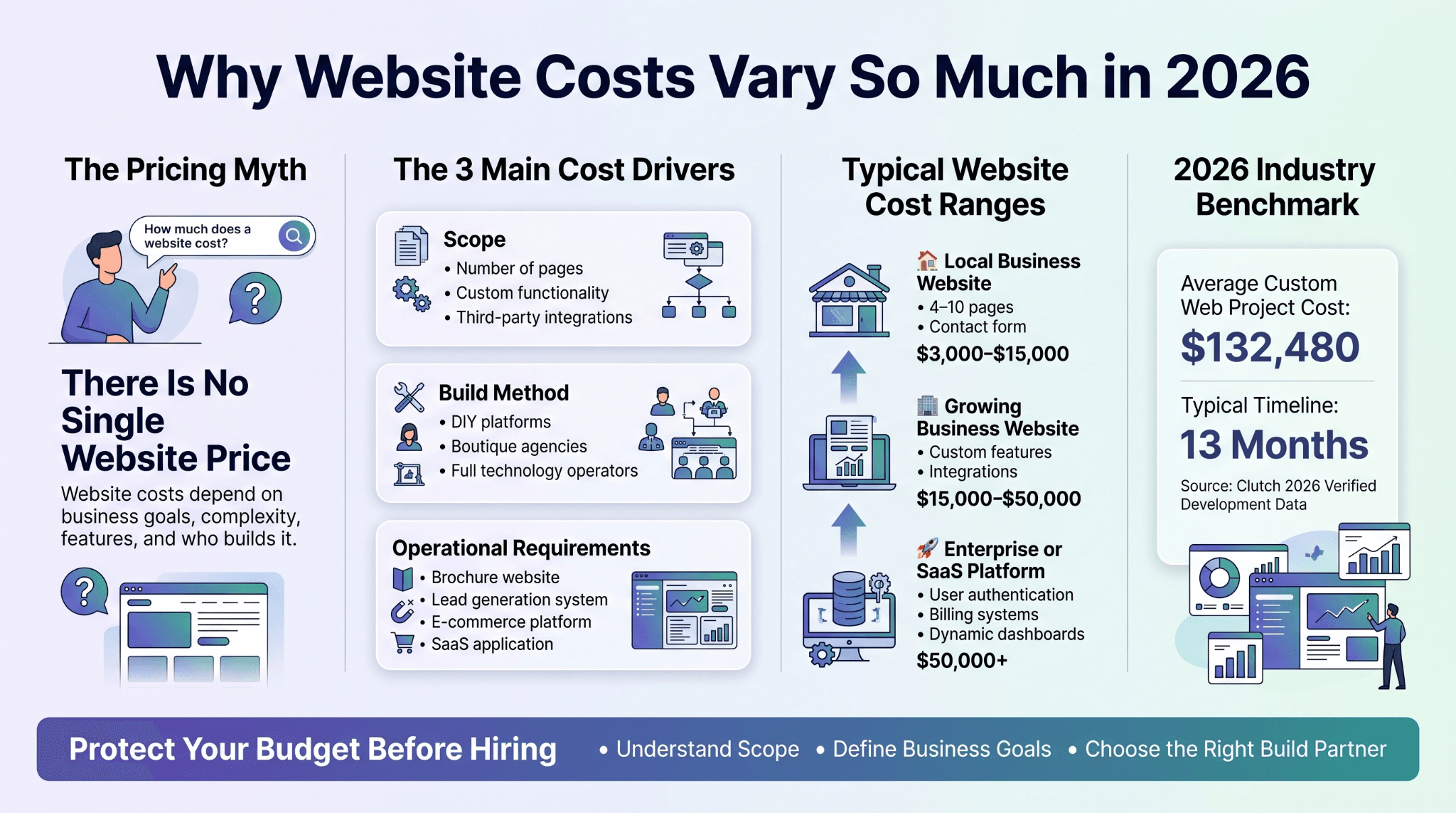
Most people search "how much does a website cost" expecting a single number. There is no single number. Website pricing is determined by a combination of scope, complexity, technical requirements, and the type of professional building it.
A local plumber needs a 4-page site with a contact form. A SaaS company needs a platform with user authentication, billing integration, and a dynamic dashboard. These are not the same product. Treating them as comparable leads to either overspending or building something that cannot support real business operations.
The three variables that consistently drive website design cost and website development cost are:
-
Scope: Number of pages, features, and integrations required
-
Build method: DIY platforms, freelancers, boutique agencies, or full technology operators
-
Operational requirements: Whether the site needs to function as a passive brochure or an active revenue system
According to Clutch's 2026 verified software development review data, the average custom web project cost has risen to $132,480 with a typical timeline of around 13 months, reflecting how significantly build expectations have shifted upward. For small business websites, most professional builds now land between $3,000 and $15,000, with enterprise-level builds regularly exceeding $50,000. In 2026, those ranges have shifted upward as AI-readiness, Core Web Vitals compliance, and LLM visibility optimization have become standard requirements for competitive websites.
Understanding these variables before engaging any developer or agency is the single most effective way to protect your budget.
What Are the 5 Types of Websites and How Much Does a Website Cost Across Each One?
Website type is the most reliable starting point for estimating cost. Each type has a distinct purpose, technical footprint, and pricing floor.
The five types covered below represent the most common builds in 2026, from the simplest entry-level site to complex operational platforms.
How Much Does a Basic Brochure or Informational Website Cost?
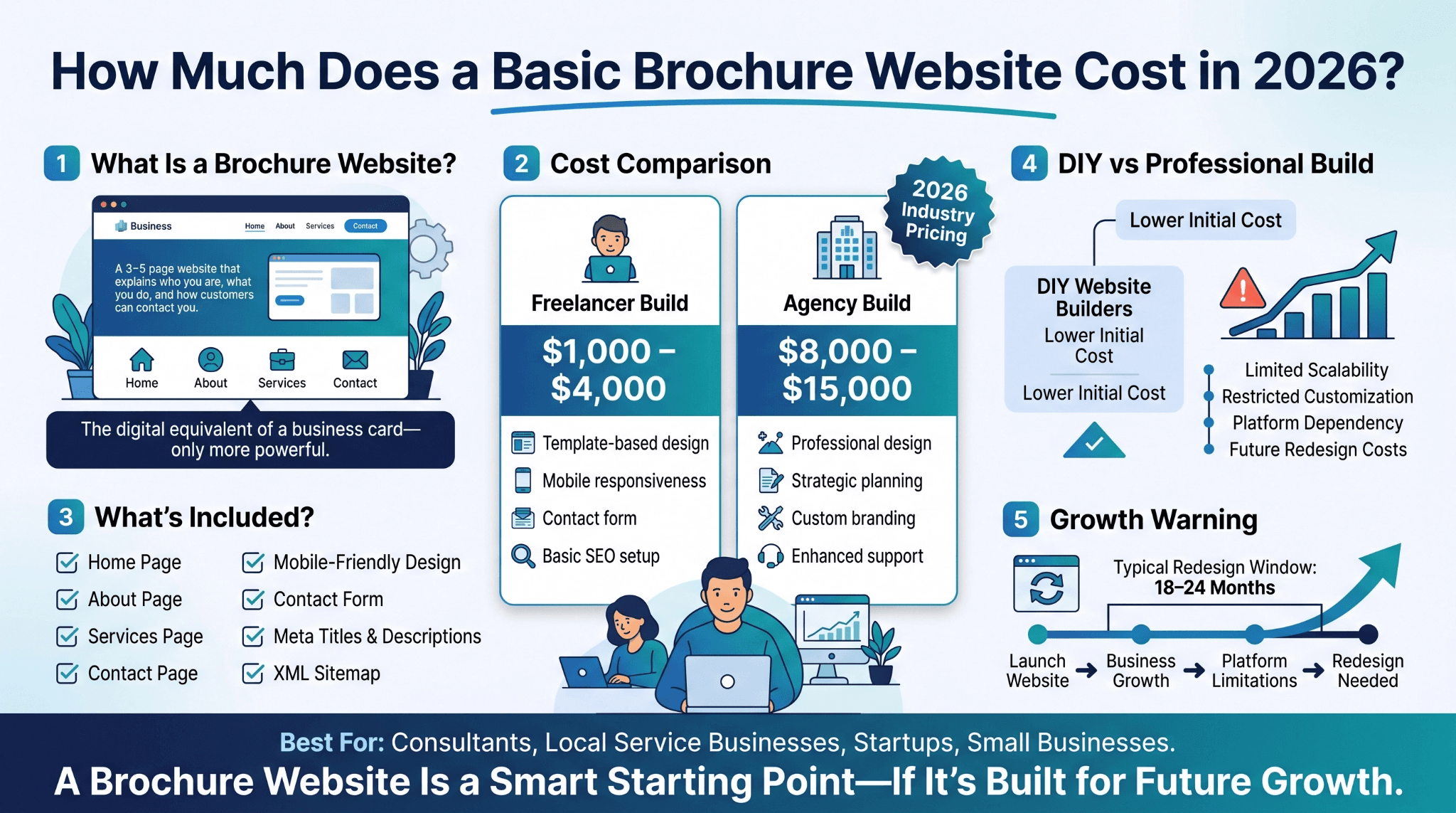
A brochure website is a 3 to 5-page site that tells visitors who you are, what you do, and how to contact you. It is the digital equivalent of a business card with slightly more detail.
According to a March 2026 pricing breakdown by JIM, a starter brochure site of about five pages costs between $1,000 and $4,000 when built by a freelancer, with full-service agency builds for small businesses running between $8,000 and $15,000.
The typical cost range for a freelancer-built brochure or informational website is $1,000 to $4,000. This range covers:
-
Template-based design on platforms like Wix, Squarespace, or WordPress
-
Basic pages: Home, About, Services, Contact
-
A contact form and mobile-responsive layout
-
Standard SEO setup (meta titles, descriptions, sitemap)
DIY builders can bring this cost close to zero, but they come with real trade-offs, including limited scalability, restricted custom code access, and platform dependency. For businesses that plan to grow, starting on a constrained platform often creates a website redesign cost problem within 18 to 24 months.
For consultants, local service providers, and early-stage businesses, a well-built brochure site is a perfectly rational starting point, provided the builder accounts for future migration.
How Much Does a Business or Service Website Cost?
A business website moves beyond information delivery into active lead generation. It includes dedicated service pages, location targeting, conversion-optimized layouts, and CMS functionality so the business owner can update content without a developer.
Shopify's 2026 web pricing guide places small business sites of around 10 pages between $3,000 and $15,000, a range echoed by Naveck Technologies' April 2026 cost report, which puts the realistic budget for a professional business site at $5,000 to $15,000.
The typical cost range for a business or service website is $3,000 to $15,000. At this level, website design cost increases because the build requires:
-
Custom or semi-custom design aligned with brand identity
-
CMS integration (typically WordPress or a headless CMS)
-
Lead capture forms connected to a CRM
-
Basic local SEO architecture and structured data markup
-
Performance optimization for Core Web Vitals compliance
In 2026, this category also increasingly includes foundational AI visibility setup, meaning content structured for retrieval by Google AI Overviews, ChatGPT Search, and Gemini. Businesses that skip this during the initial build typically pay more to retrofit it later.
This website type is the most common entry point for growing service businesses and professional firms.
How Much Does an eCommerce Website Cost?
An eCommerce website is an operational system, not just a website. It processes transactions, manages inventory, handles customer accounts, and connects to fulfilment or shipping infrastructure.
Fyresite's 2026 eCommerce pricing breakdown segments the cost clearly by build type: template-based Shopify stores run $3,000 to $10,000, semi-custom projects land between $10,000 and $30,000, and fully custom builds reach $40,000 to $150,000 or more.
The typical cost range for an ecommerce website is $3,000 to $150,000+.Website development cost at the eCommerce level is driven by:
-
Platform selection (Shopify, WooCommerce, Magento, or custom-built)
-
Product catalog size and variation complexity
-
Payment gateway integrations (Stripe, PayPal, buy-now-pay-later providers)
-
Inventory and warehouse management system connections
-
Security and PCI compliance requirements
-
UX design for product discovery and checkout conversion
The table below outlines eCommerce build costs by platform type, based on verified 2026 market data from Fyresite:
|
Platform Type |
Estimated Build Cost |
Best For |
|
Shopify (template-based) |
$3,000 to $10,000 |
Startups and small stores |
|
Semi-custom (theme with dev work) |
$10,000 to $30,000 |
Growing retailers need branded design |
|
Fully custom (headless or Magento) |
$40,000 to $150,000+ |
High-volume, complex catalog operations |
Ongoing platform fees, transaction costs, and plugin subscriptions add to the total. According to Fyresite, budgeting 10 to 20 percent of the initial development cost annually for maintenance is standard practice. A $10,000 build typically carries $1,000 to $2,000 per year in ongoing operating costs.
How Much Does a Custom Web Application or SaaS Website Cost?
A custom web application is built from the ground up to perform a specific operational function. SaaS platforms, member portals, booking engines, multi-vendor marketplaces, and internal business dashboards all fall into this category.
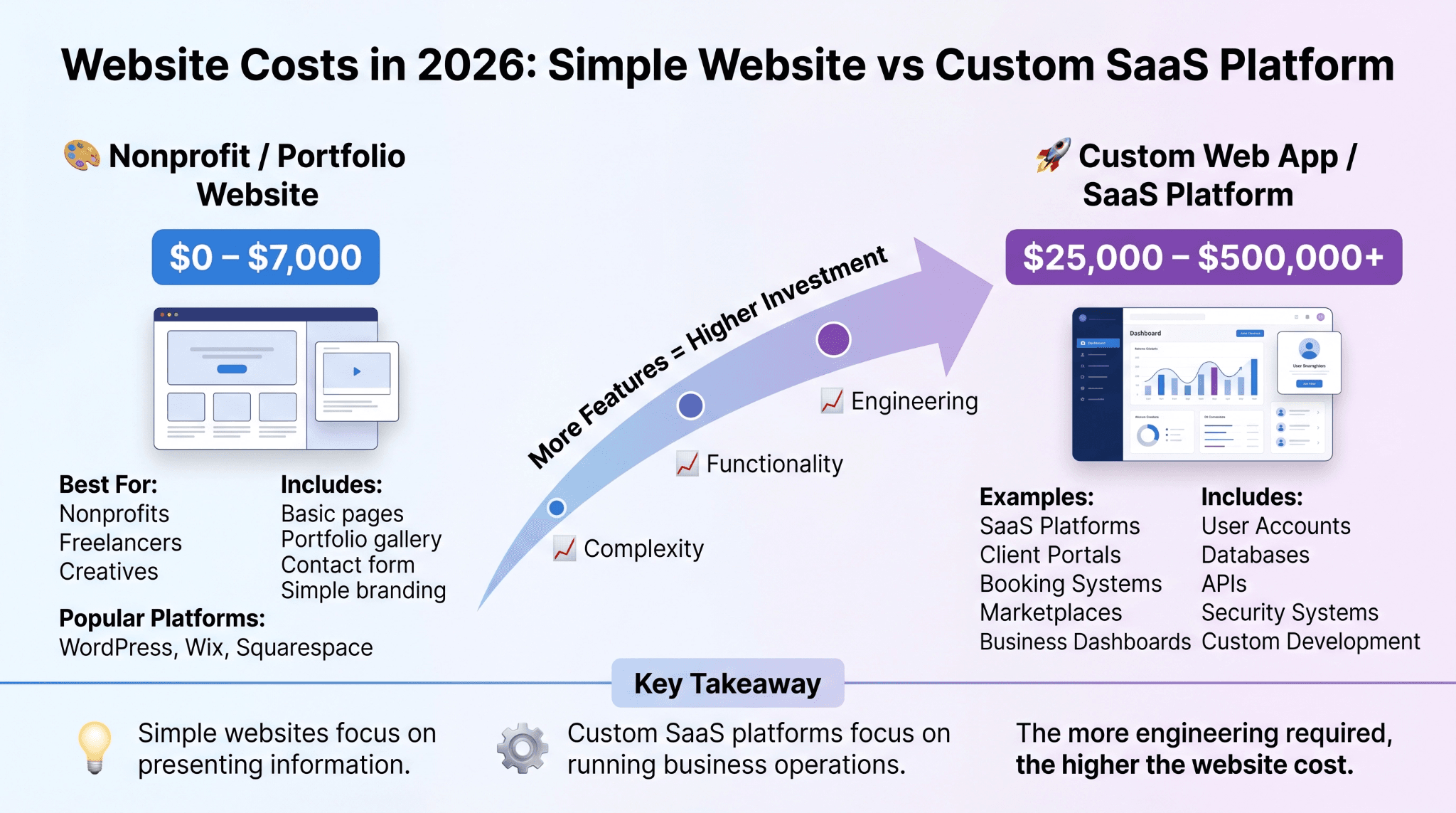
Custom web application development starts at $25,000 for a focused MVP and scales well beyond $500,000 for full SaaS products with enterprise-grade architecture. The range is wide because the scope is wide. A basic internal tool and a multi-tenant SaaS platform are fundamentally different engineering efforts, and their costs reflect that difference.
The typical cost range for a custom web application or SaaS website is $25,000 to $500,000+. This range reflects the reality that custom web application website development cost is primarily an engineering cost, not a design cost. What drives the investment:
-
Custom backend architecture (databases, APIs, authentication systems)
-
Multi-user role management and permission layers
-
Third-party API integrations (payments, communications, data feeds)
-
Security architecture for sensitive data environments
-
Ongoing engineering for updates, scaling, and infrastructure management
A logistics company building a real-time dispatch portal, or a SaaS startup building a subscription analytics dashboard, is building operational infrastructure. The website is the interface. The engineering beneath it is what costs.
At WellsGroup, builds in this category are treated as living systems, not delivered projects. The architecture is designed to scale, and the system remains under active management post-launch.
How Much Does a Nonprofit or Portfolio Website Cost?
This category covers organizations and individuals with constrained budgets and relatively simple needs: nonprofits, independent creatives, freelancers, and educators.
According to an April 2026 nonprofit website cost guide by Vice Comfort, costs range from $0 to $500 per year for DIY platforms such as Wix and Squarespace, and from $500 to $7,000 when working with a freelancer or small agency.
The typical cost range for a nonprofit or portfolio website is $0 to $7,000 (DIY to freelancer-built). Free and low-cost options in this range include:
-
WordPress.com (free to basic paid tiers)
-
Wix or Weebly on entry-level plans
-
Cargo or Format for creative portfolios
-
Google Sites for internal or community use
The trade-off is always capability versus cost. A $0 website can represent a business online, but it will not generate leads, rank competitively for commercial keywords, or integrate with business systems. For nonprofits seeking grant credibility or freelancers building client trust, a professionally designed site in the $1,500 to $3,000 range typically delivers the best return.
What Monthly Costs Should You Expect After Your Website Launches?
The build cost is the beginning of the investment, not the total. Understanding how much does a website cost per month is essential for accurate financial planning.
The table below outlines standard recurring website costs in 2026, based on pricing data from JIM, March 2026 small business website cost breakdown:
|
Cost Category |
Typical Monthly Range |
|
Web hosting |
$10 to $500+ |
|
Domain renewal |
$1 to $5 (amortized monthly) |
|
SSL certificate |
$0 to $20 |
|
CMS or platform fees |
$0 to $300 |
|
Plugin or app subscriptions |
$20 to $200 |
|
Website maintenance cost (updates, security, backups) |
$50 to $500 |
|
Content updates or SEO management |
$300 to $2,000+ |
For a professionally managed business website, a realistic website maintenance cost budget in 2026 sits between $200 and $800 per month, depending on the level of active management required.
Businesses that treat maintenance as optional typically encounter security vulnerabilities, performance degradation, and eventually a full website redesign cost that far exceeds what incremental upkeep would have cost. According to the JIM 2026 report, ongoing costs that most owners overlook add $1,100 to $5,000 per year for hosting, security, backups, and marketing tools alone.
What Makes Website Design Costs Go Up and What Keeps Them Down?
Website design cost is one of the most variable line items in any build. Two websites with identical page counts can differ by $20,000 in design cost alone. Before engaging any developer or agency, running your requirements through a website cost calculator can help you establish a realistic baseline and identify which features are driving your estimate upward.
Factors that increase website design cost:
-
Custom illustration, iconography, or motion design
-
Multilingual site structure and localization
-
Accessibility compliance (WCAG 2.2 standards)
-
Complex interactive elements or micro-animations
-
Brand identity work bundled into the design scope
-
Tight deadlines requiring accelerated timelines
Factors that keep costs reasonable:
-
Using a premium template as the design foundation
-
Providing complete brand assets before the project starts
-
Clearly defined scope with no mid-project additions
-
Phased builds that launch a core version first
-
Working with a team that has documented processes
The single biggest driver of budget overrun in website projects is scope creep: adding features, pages, or design changes after the project has begun. Businesses that approach the build with a documented brief consistently spend less and receive better results. A website cost calculator is a useful first step, but it works best when paired with a clearly scoped brief rather than a loose list of ideas.
What You Need to Know Before You Build
Many readers researching website costs have follow-up concerns that affect the final decision. Here are the most important ones addressed directly.
Is a cheap website worth it?
A cheap website can establish a basic online presence, but it typically cannot generate consistent leads, rank for competitive keywords, or scale with business growth. The true cost of a cheap website is often a full rebuild within two years.
How long does a website take to build?
A brochure site takes 2 to 4 weeks. A business or service website takes 4 to 8 weeks. An eCommerce build takes 8 to 16 weeks. Custom web applications range from 3 to 12 months depending on complexity.
Do you own your website after paying for it?
This depends entirely on the contract. With custom-built WordPress or coded sites, you typically own the site outright. With proprietary platforms like Wix or Squarespace, you own the content but not the infrastructure. Always clarify ownership, code access, and transfer rights before signing.
Are website costs tax-deductible?
In most jurisdictions, website development and maintenance costs are deductible as business expenses. Consult a qualified accountant for guidance specific to your business structure and location.
Get a Website That Is Built to Perform
Understanding how much does a website cost is only useful if it leads to a decision grounded in operational reality. A website is not a brochure. It is a system that should generate leads, support sales, and function reliably under real business pressure.
The businesses that get the most from their website investment are the ones that approach the build with clarity: clear scope, realistic budget, defined outcomes, and a builder who stays accountable after launch.
WellsGroup designs and operates websites as unified digital systems, not one-off deliverables. If you are ready to build something that performs, get a proposal and speak with a technology strategist about what your business actually needs.