How Answer Engine Optimization Changes SEO in 2026
Answer Engine Optimization helps brands earn AI citations, strengthen visibility, and stay competitive as search increasingly shifts to AI.
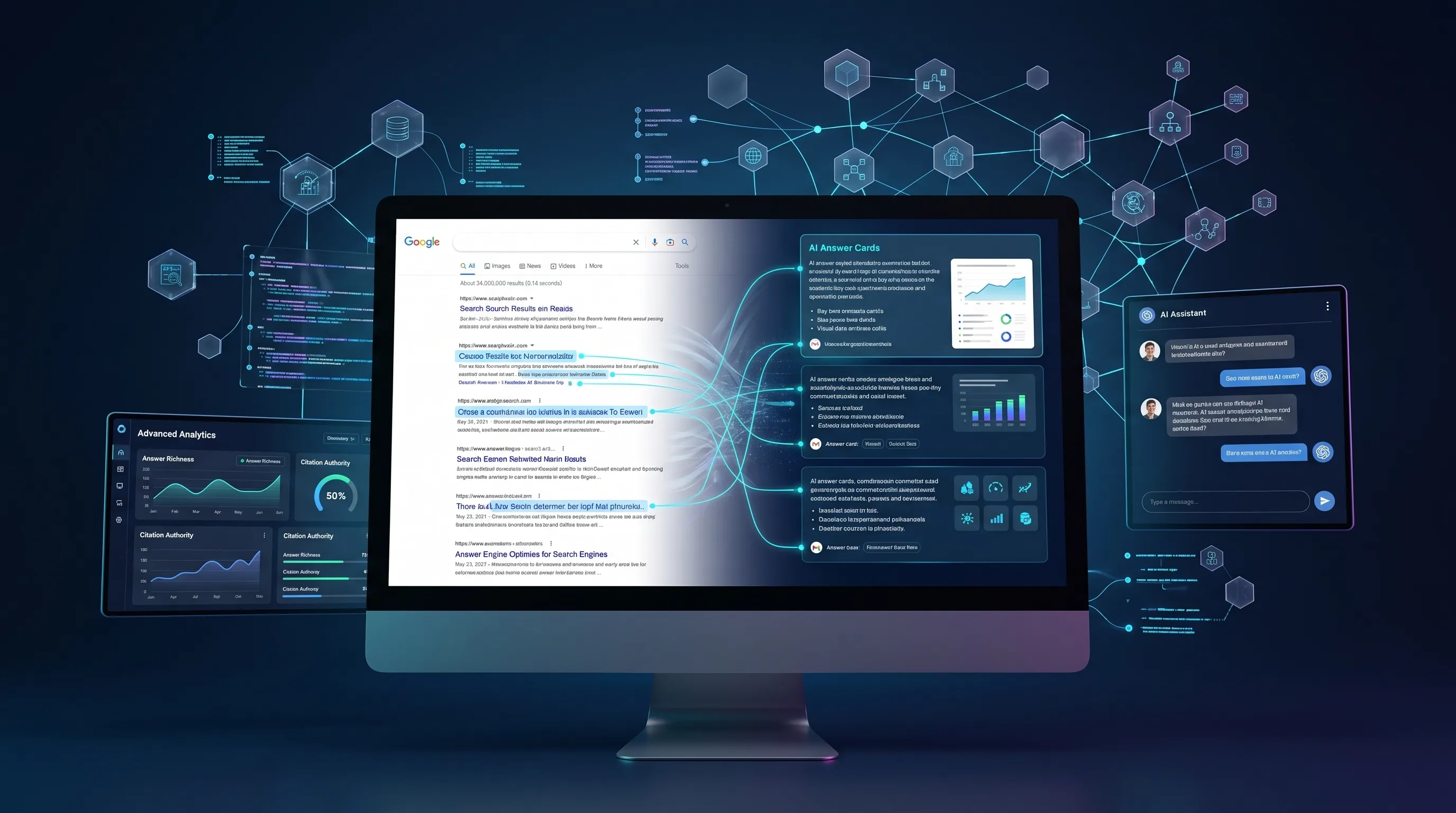
Answer engine optimization (AEO) is the practice of structuring content so that AI-powered platforms, including Google AI Overviews, ChatGPT Search, Gemini, and Perplexity, select it as a cited source when generating responses. In 2026, AEO is no longer experimental. It is a core requirement for any brand that needs to remain visible as AI handles an expanding share of search queries.
The way buyers find information has fundamentally shifted. They are no longer scrolling through search results; they are asking AI a direct question and trusting the answer it returns. Brands that are not structurally optimized for that moment are simply not in the room. If your brand's AI visibility strategy is still undefined, WellsGroup can help you build one that works. Book a free consultation and find out exactly where your brand stands in AI search today.
What Is Answer Engine Optimization and Why Does It Matter Now?
Search has structurally changed. Users are no longer browsing a list of ten blue links. They are asking AI platforms a question and receiving a synthesized answer with two or three cited sources. If your brand is not one of those sources, you are not in the conversation.
According to Frase's 2026 AEO Guide, Google AI Overviews now appear in nearly 55% of all Google searches, making AI-generated answers a dominant surface for brand discovery. Visibility is no longer earned by ranking on page one. It is earned by being selected as a trusted source when an AI generates a response.
AEO focuses on building brand authority, using digital PR to create a multi-channel presence, and earning AI overview citations. It is about total visibility across the entire network surface of a business, not just individual keyword rankings.
The platforms that matter in 2026 are:
-
Google AI Mode and AI Overviews
-
ChatGPT Search
-
Google Gemini
-
Perplexity AI
-
Microsoft Copilot
Each platform pulls from different source pools and applies different weighting to authority signals. A unified AEO strategy accounts for all of them.
How Is Answer Engine Optimization Different from Traditional SEO?
Traditional SEO and AEO share the same technical foundation, crawlability, site speed, backlinks, and content quality, but measure success against entirely different outcomes.
Traditional SEO puts a page in front of a user. AEO gets a brand cited inside the answer a user receives without clicking anywhere.
|
Dimension |
Traditional SEO |
Answer Engine Optimization (AEO) |
|
Primary goal |
Rank on page one |
Be cited inside an AI-generated answer |
|
Success metric |
Rankings, CTR, organic traffic |
Citation frequency, AI share of voice |
|
Content structure |
Keyword-optimized paragraphs |
Question-based headings, answer-first paragraphs |
|
Authority signals |
Backlinks, domain rating |
E-E-A-T, entity authority, digital PR |
|
Traffic model |
Click-through |
Zero-click brand exposure + referred sessions |
Brands optimizing only for traditional rankings are losing visibility on both fronts as AI search continues to absorb a growing share of queries that previously landed on organic results pages.
Does AEO Replace SEO or Work Alongside It?
AEO builds on SEO rather than replacing it. AI engines read top-ranked results first. If a page is not in the top 10, it is statistically unlikely to be read by the AI at all.
Most brands in 2026 are practicing hybrid optimization: traditional SEO builds the infrastructure (speed, crawlability, backlinks), while AEO handles interpretation (structured data, entity clarity, citation-ready formatting). The most competitive brands treat both as a single unified system rather than separate strategies managed by different teams.
How Does Answer Engine Optimization Actually Work?
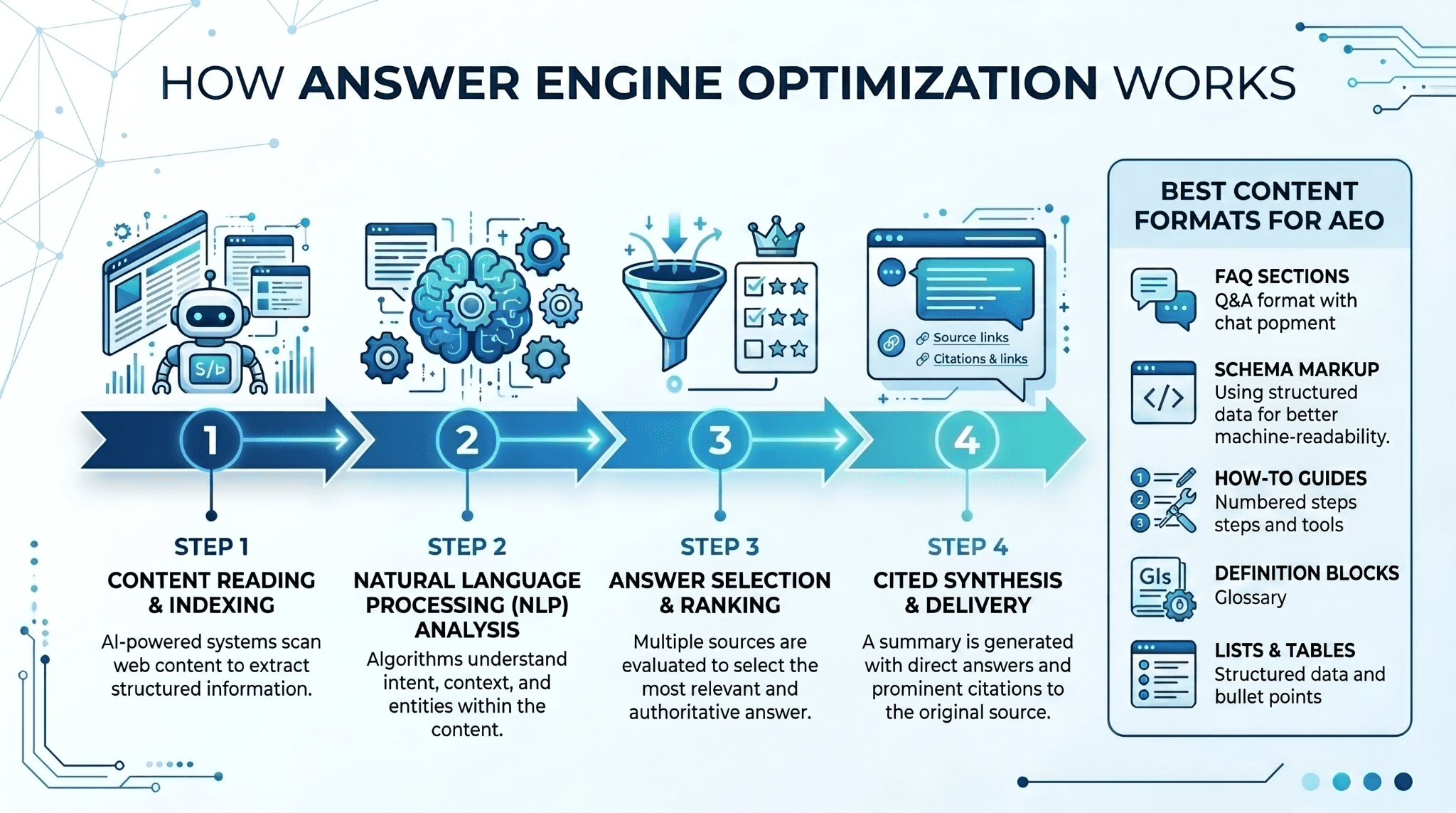
AI platforms do not rank pages. They read content, extract structured information, evaluate source credibility, and synthesize a response.
At the answer generation stage, an AI reads top-ranked source documents and synthesizes a response. It does not copy text verbatim; it extracts key facts and statistics, then rewrites them in natural language. Content that provides clear, citable facts with supporting data is more likely to be cited than content that buries insights in long paragraphs.
The three variables a content team can directly control are structure, freshness, and credible sourcing. Brands leading in AEO update content quarterly at minimum, since freshness is a mandatory citation signal.
What Content Formats Work Best for AEO?
AI systems have clear preferences that content teams can engineer toward. The formats that produce the highest citation rates are:
-
Answer-first paragraphs: A direct 40 to 60 word response placed immediately under a question-based heading.
-
FAQ sections with H3 question headings: These match the exact format AI engines use to retrieve and attribute factual responses.
-
Definition blocks: Clear, entity-specific definitions that AI can lift and attribute without ambiguity.
-
Structured data and schema: Nesting FAQPage schema inside Article schema improves AI extraction confidence and increases eligibility for AI Overview inclusion.
Expert quotes, inline citations, and supporting statistics are also measurable citation drivers, not just stylistic choices. AI systems are more likely to select content that demonstrates verifiable sourcing over content that makes claims without attribution.
What Are the Best Answer Engine Optimization Tools Available in 2026?
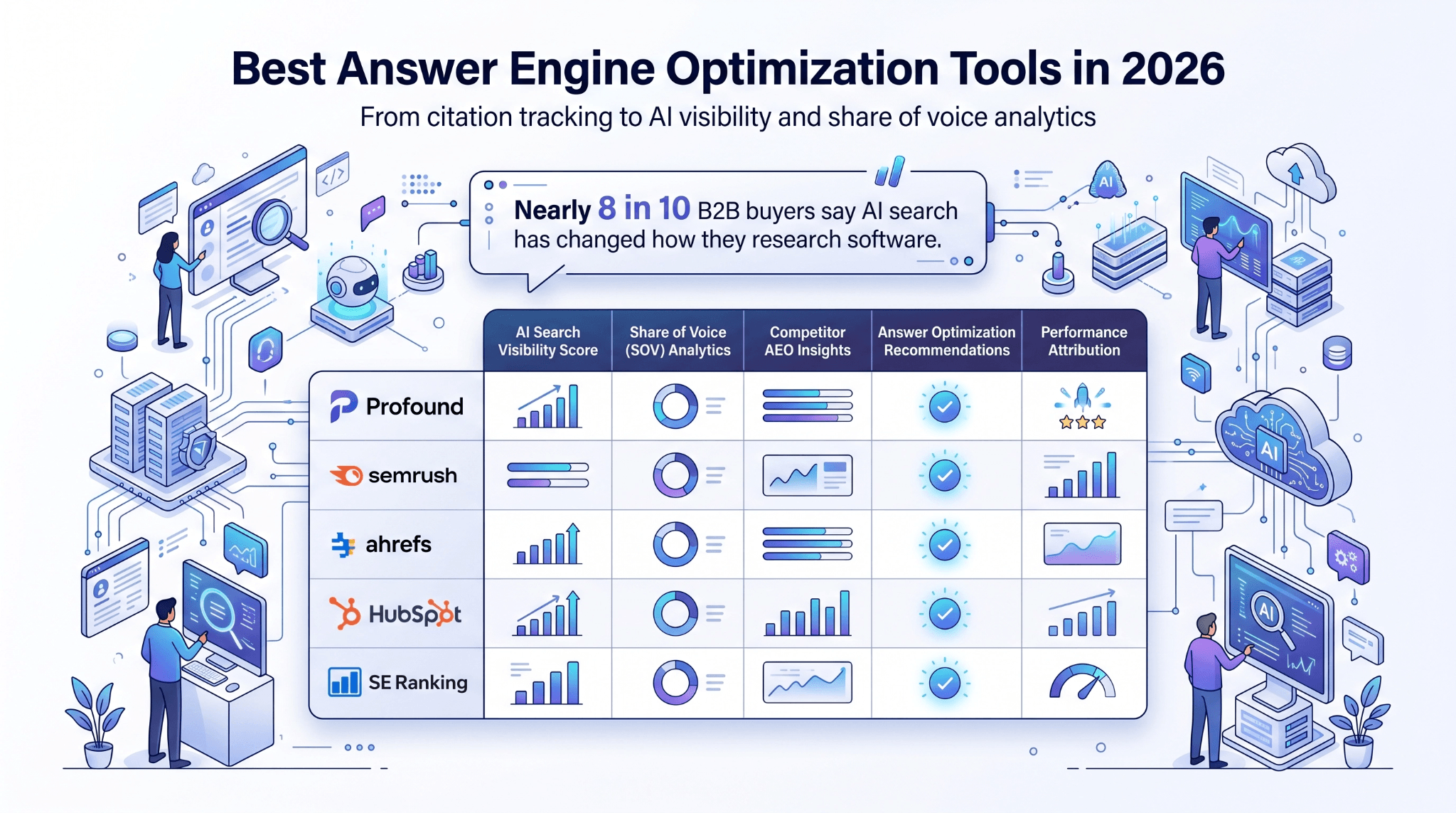
The answer engine optimization tools market has matured from a handful of citation trackers into a full category of platforms covering monitoring, content auditing, competitive share of voice, and optimization recommendations.
The most widely used tools currently fall into this landscape:
|
Tool |
Primary Function |
Best For |
|
Profound |
Brand perception and citation analysis across 10 AI platforms |
Enterprise brands managing AI narrative |
|
Semrush AI Visibility Toolkit |
AI visibility layered into existing SEO workflows |
Teams already on Semrush Pro |
|
Ahrefs Brand Radar |
Brand mention tracking powered by a large real-user prompt database |
SEO-first teams adding AI visibility data |
|
HubSpot AEO Grader |
Free brand visibility diagnostic across ChatGPT, Gemini, and Perplexity |
Initial benchmarking before investing further |
|
SE Visible (SE Ranking) |
Citation tracking with period-to-period competitor analysis |
Teams wanting unified SEO and AEO reporting |
Nearly 8 in 10 B2B buyers say AI search has changed how they research software, according to G2's 2025 Buyer Behavior Report. If a brand is not cited in AI responses, it is invisible during early-stage research. This is why the most popular answer engine optimization tools now focus on citation tracking and share of voice, not just keyword rankings. Competitors who appear in AI answers capture intent before any website visit happens.
How Do You Choose the Right AEO Tool for Your Business?
The right tool depends on where your team sits operationally.
HubSpot, Semrush, Ahrefs, and Surfer SEO have all added AEO capabilities to their existing platforms. If your current SEO stack already covers basic AI visibility, use it before adding a dedicated tool. Add a specialized answer engine optimization tool only when you need capabilities your current suite cannot provide, deeper prompt tracking, optimization playbooks, or analyst-level support.
For smaller teams, HubSpot's free AEO Grader provides a functional starting point with zero cost. For scaling companies with competitive AEO priorities, Profound or Scrunch provides the depth required to move citation share meaningfully.
How Has AEO Changed the Way Businesses Approach SEO in 2026?
The operational impact on content teams is structural. Writing for AI search requires different briefs, different success metrics, and different editorial workflows. In practice:
-
Content briefs now map headings to how users prompt AI tools, not just keyword volumes.
-
Performance reporting tracks citation frequency, AI share of voice, and brand sentiment alongside traditional CTR and impressions.
-
Digital PR has taken the place of traditional link building, being cited by authority platforms is now one of the strongest signals for both Google and LLM visibility.
-
Entity consistency, using brand names, service names, and key concepts in uniform language across all content, has become foundational for Knowledge Graph presence and LLM association.
For a SaaS company, this means every product page and help article needs to be structured for AI extraction. For a logistics operator, route pages need to answer the exact natural-language questions a buyer would ask ChatGPT before booking a shipment.
What Are the Biggest Mistakes Brands Make with Answer Engine Optimization?
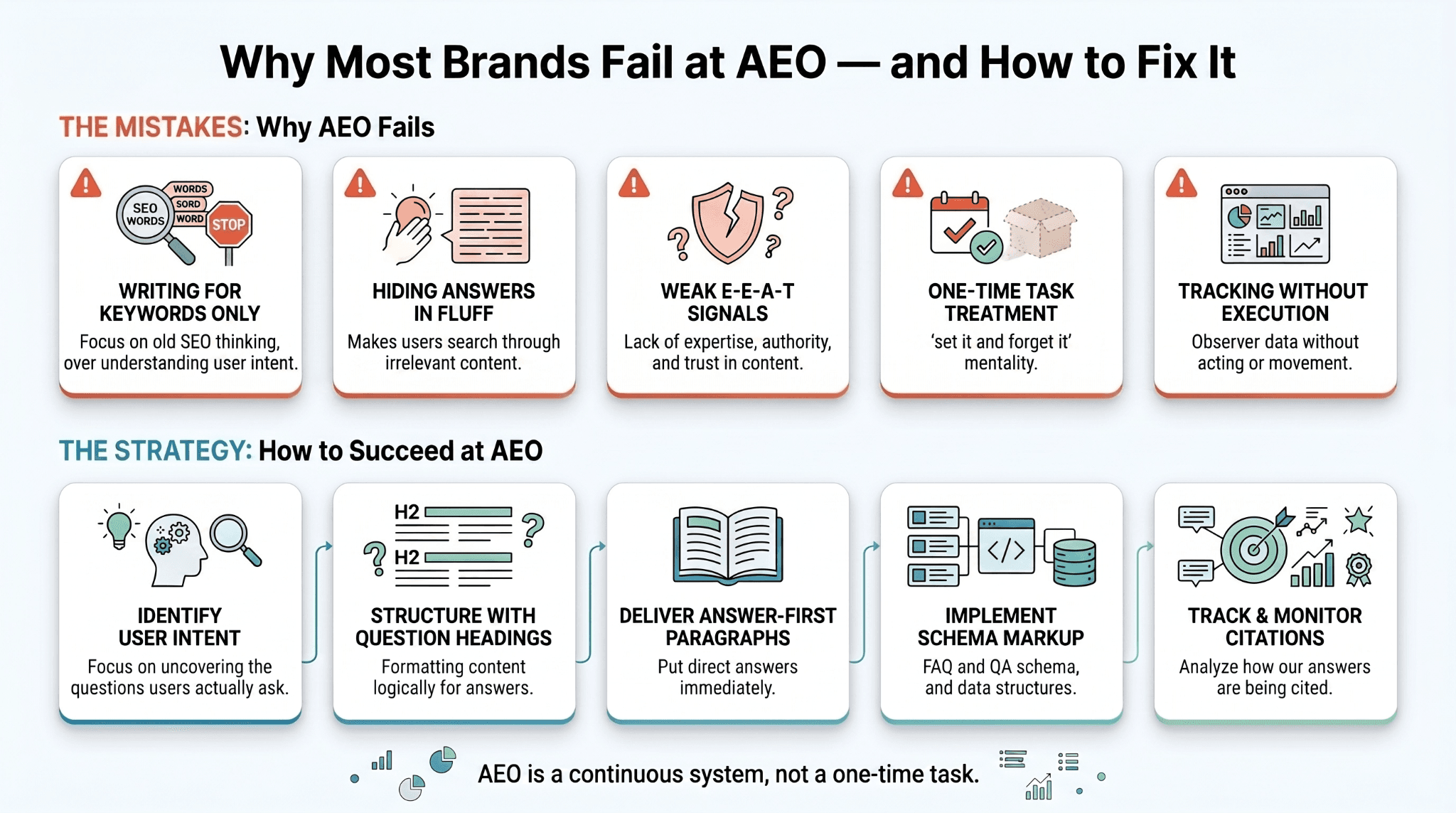
Most AEO failures share a pattern: teams apply AEO as a cosmetic layer on top of existing content rather than rethinking how content is built. The specific mistakes that reduce citation eligibility are:
-
Writing for keywords rather than questions. AI engines match content to conversational queries, not keyword-dense paragraphs.
-
Burying answers in long introductions. AI systems favor content where the answer appears in the first 40 to 60 words immediately following a question-based heading.
-
Neglecting E-E-A-T signals. No named author, no first-party data, no supporting citations; AI platforms deprioritize sources that cannot demonstrate credibility.
-
Treating AEO as a one-time project. Content that is not refreshed regularly loses citation eligibility as AI systems weigh freshness heavily for commercial and evaluation-stage queries.
-
Tracking without a content system behind it. Visibility data without a workflow to act on it produces no measurable outcome.
How Do You Build an AEO Strategy That Holds Up Over Time?
A durable AEO strategy operates as a system. The operational framework WellsGroup applies when building AI visibility infrastructure for clients follows these steps:
-
Identify high-intent pages targeting questions buyers ask during early research.
-
Restructure headings as natural-language questions matching how users prompt ChatGPT, Gemini, or Perplexity.
-
Add answer-first paragraphs of 40 to 60 words under each key H2, written to be liftable verbatim.
-
Add FAQPage and Article schema with a nested structure to improve AI extraction confidence.
-
Build topical authority clusters; comprehensive subject coverage signals depth to AI systems evaluating source quality.
-
Establish a quarterly content refresh cycle to maintain freshness signals.
-
Deploy an answer engine optimization tool to monitor citation frequency, sentiment, and share of voice on an ongoing basis.
The system does not end at publication. AI visibility is a continuous operational output, not a one-time deliverable.
What Practitioners Want to Know About Answer Engine Optimization
The four most-asked questions from founders, marketing leads, and operations teams working through AEO for the first time are answered directly.
What does AEO stand for in SEO?
AEO stands for answer engine optimization. It is the discipline of structuring content so that AI-powered platforms, Google AI Overviews, ChatGPT Search, Perplexity, and Gemini select and cite it when generating responses. AEO answer engine optimization is often used interchangeably with GEO (generative engine optimization), though AEO refers specifically to the answer-retrieval layer.
Is answer engine optimization only for large brands?
No. AEO is a high-quality, fast-growing channel, and getting in early, while the majority of businesses still have no AI search strategy, represents a compounding advantage regardless of company size.
How long does it take to see results from AEO?
Most teams see initial citation improvements within eight to twelve weeks of implementing structural changes. Sustained citation share builds over three to six months as topical authority and freshness signals accumulate.
Can small businesses benefit from answer engine optimization?
Yes, and in some categories the advantage is disproportionate. Local and niche businesses that structure content for AEO are competing in a space where most direct competitors have not yet adapted, particularly in service categories where buyers now routinely turn to AI before visiting any website.
The Search Landscape Has Already Shifted
The transition from traditional search to AI-mediated discovery is not a future event. It is the operating reality of 2026.
Brands treating AEO as something to explore later are already losing citation share to competitors who built the infrastructure earlier. WellsGroup approaches answer engine optimization as a component of unified digital infrastructure, integrated with technical SEO, content architecture, digital PR, and performance tracking.
The goal is not to appear once in an AI response. It is to be consistently cited as a trusted source across every AI platform where your buyers are asking questions. If your brand's AI visibility is currently unmeasured, that is where the work begins.If your brand's AI visibility strategy is still undefined, WellsGroup can help you build one that works. Get a proposal and discover exactly what it takes to earn citations across AI platforms.