5 eCommerce SEO Strategies to Outrank Competitors in 2026
Discover five proven eCommerce SEO strategies to improve rankings, boost AI search visibility, and drive sustainable organic growth in 2026.

Outranking competitors in ecommerce SEO in 2026 requires more than inserting keywords into product titles. The five strategies that move the needle are product page optimization, technical SEO infrastructure, category page authority, content-led topical depth, and systematic maintenance. Each one targets a specific gap most online stores continue to overlook.
The ecommerce search landscape has shifted. Google AI Overviews, ChatGPT Search, and Gemini now intercept buyer queries before users reach a traditional results page. Stores still running 2024-era tactics, keyword density and basic metadata, are losing ground to competitors with cleaner architecture and stronger entity signals. These five strategies are not quick fixes. They are operational systems that compound over time.
WellsGroup designs and operates ecommerce SEO systems built for long-term organic growth. Get a Proposal and find out what a structured SEO system looks like for your store.
Why Is eCommerce SEO Harder to Win in 2026?
According to Ahrefs' study of approximately 14 billion pages, 96.55% of all pages get zero organic traffic from Google, with thin content and the absence of backlinks cited as the primary causes.
Google's 2026 ranking systems now prioritize three things above nearly everything else:
-
Page experience and Core Web Vitals performance
-
Content depth and topical authority
-
Entity signals and structured data consistency
A store selling running shoes now competes against content publishers, review aggregators, and AI-generated shopping guides, all building broader topical authority across the same category.
The stores winning organic rankings in 2026 are not publishing more. They are operating better-structured systems with cleaner technical foundations and more purposeful content architecture.
Strategy 1: How Do You Optimize Product Pages to Rank Higher Than Competitors?
Product page SEO is the most direct ranking lever in ecommerce, yet it is consistently executed poorly. Most stores still rely on manufacturer-supplied descriptions duplicated across hundreds of competing domains, which carry no unique value signal for Google.
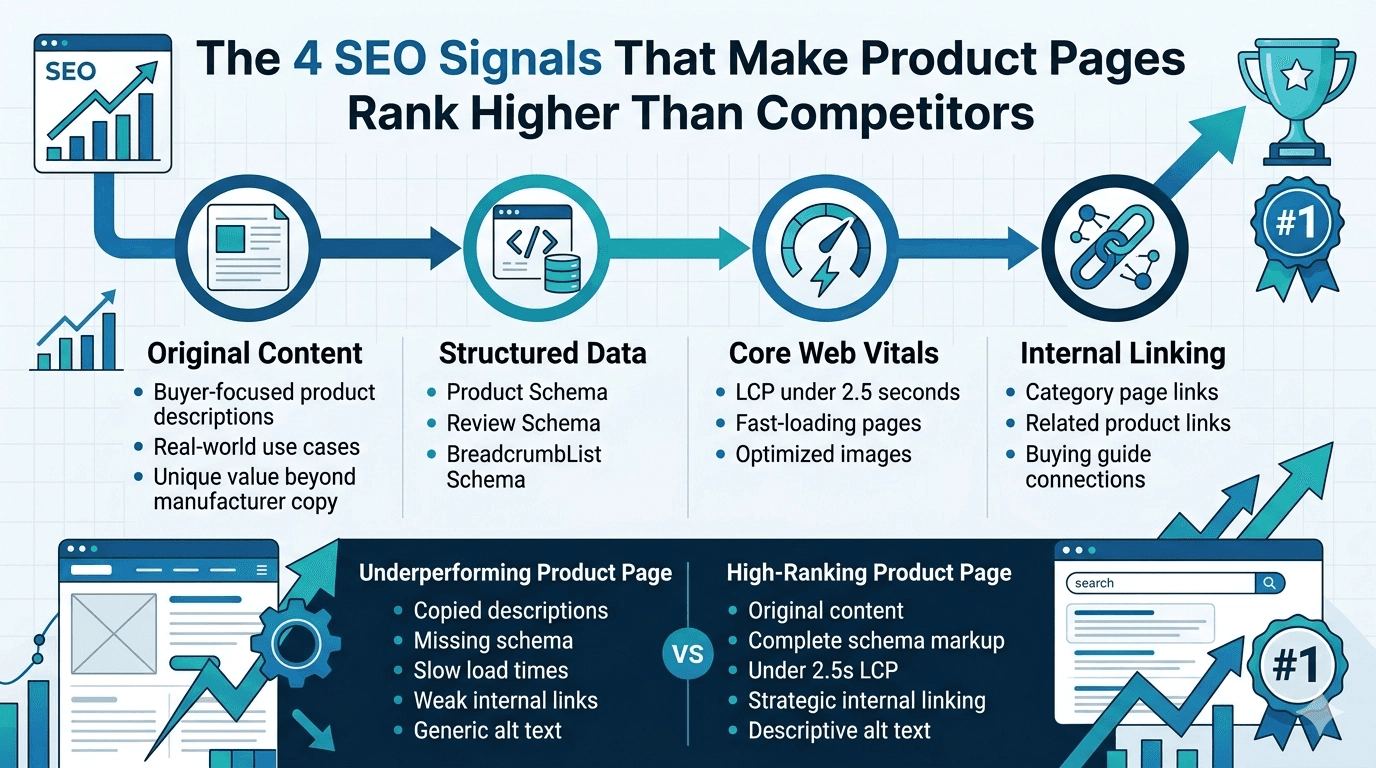
A high-ranking product page in 2026 requires four components working together:
-
Original, use-case-focused product copy written specifically for the buyer
-
Structured data markup covering Product, Review, and BreadcrumbList schema
-
Page speed that meets Google's Core Web Vitals LCP threshold of under 2.5 seconds
-
A clear internal linking position within the site hierarchy
Google's Helpful Content system is specifically designed to reward original, contextually relevant copy and penalize thin rewrites that restate manufacturer specifications without added value.
The table below shows what separates a ranking product page from one buried on page three.
|
Element |
Underperforming Page |
High-Ranking Page |
|
Product description |
Copied from the manufacturer |
Original, use-case-focused copy |
|
Schema markup |
None or basic |
Product, Review, BreadcrumbList |
|
Page speed (LCP) |
Above 4 seconds |
Under 2.5 seconds |
|
Internal links |
Isolated |
Linked from category and related products |
|
Image alt text |
Generic or empty |
Descriptive and keyword-relevant |
What Makes a Product Page SEO-Ready in 2026?
SEO for ecommerce product pages comes down to on-page architecture, where every element serves a specific function in the ranking system.
The structural requirements for a publication-ready product page include:
-
Title tag leading with the primary product keyword, under 60 characters
-
H1 matching search intent precisely without mirroring the title tag verbatim
-
Meta description addressing the buyer's core question within 160 characters
-
At least one contextual internal link from the parent category page
-
At least one internal link from a related product or buying guide
-
Image file names and alt text that are descriptive and keyword-relevant
Internal linking is where most stores leave authority on the table. Distributing links from category pages down to individual products keeps crawl paths clean and ensures page authority reaches the URLs that need it most.
Strategy 2: What Is eCommerce Technical SEO and Why Does It Determine Your Rankings?
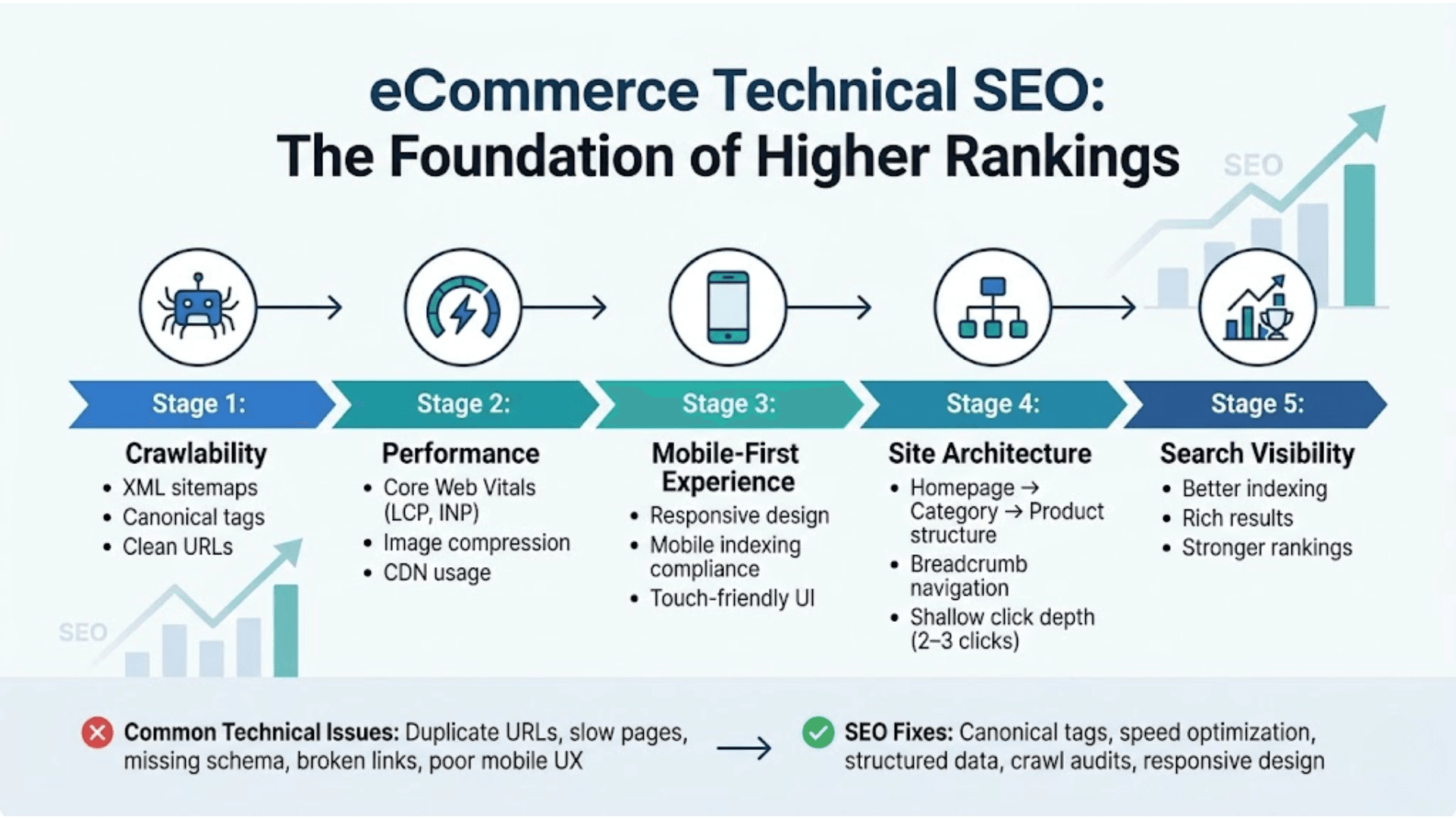
Ecommerce technical SEO is the operational infrastructure that determines whether search engines can efficiently discover, crawl, render, and index your store's pages. Without it, every other SEO effort is undermined at the foundation.
The most damaging technical failure in ecommerce is duplicate content generated by faceted navigation. A single category page can produce hundreds of near-identical URLs through size, color, and brand filter combinations. Without canonical tags, Google splits crawl budget across all of them, weakening every individual URL in the process.
Key technical areas that directly affect ecommerce rankings in 2026 include:
-
Canonical tag management across all filtered and paginated URLs
-
INP (Interaction to Next Paint) performance, which replaced FID as Google's responsiveness benchmark in 2024
-
Mobile-first indexing compliance across product and category templates
-
XML sitemap accuracy reflecting only indexable, canonical URLs
-
Hreflang implementation for stores operating across multiple regions or languages
The table below maps the most common technical issues to their operational fixes.
|
Technical Issue |
Business Impact |
Fix |
|
Faceted navigation duplicate URLs |
Crawl budget waste, diluted rankings |
Canonical tags on filter URLs |
|
Slow LCP on product pages |
Higher bounce, lower rankings |
Image compression, CDN, lazy loading |
|
Missing structured data |
No rich results in search |
Implement Product and Review schema |
|
Broken internal links |
Lost authority flow |
Monthly crawl audit and redirect mapping |
|
Non-mobile-optimized pages |
Mobile index ranking penalty |
Responsive design and touch-friendly UI |
How Does Site Structure Affect eCommerce Search Rankings?
Clean site architecture serves two functions simultaneously. It helps search engines understand the store's topical hierarchy and ensures authority flows efficiently from the homepage down to individual product pages.
The structural principles that matter most for ecommerce technical SEO are:
-
A three-tier model: homepage, category pages, then product pages
-
Category pages accessible within two to three clicks from the homepage
-
Breadcrumb navigation on all product and category pages
-
BreadcrumbList schema implemented to generate structured displays in search results
-
Subcategory pages used only where the product volume genuinely justifies an additional tier
Every additional layer of depth reduces the authority that reaches product pages. Stores with categories buried four or five clicks from the homepage consistently rank weaker than those maintaining a flatter structure.
Strategy 3: How Do Category Pages Drive More Organic Traffic Than Product Pages?
Category pages are the most underutilized asset in ecommerce SEO best practices. While product pages target specific item queries, category pages capture high-volume commercial searches where the buyer is still evaluating options, and Google tends to rank pages with strong topical coverage.
Most stores publish category pages with only a product grid and filter options, giving Google no content signal to evaluate. A well-optimized category page includes:
-
A keyword-rich introductory paragraph of 100 to 150 words placed above the product grid
-
Descriptive H2 subheadings that address common buyer questions within the category
-
Internal links to subcategories, related buying guides, and top-performing product pages
-
Canonical tags on all filter-generated URLs to protect the authority of the primary category URL
-
Unique page titles and meta descriptions that reflect the specific category intent
Ecommerce SEO best practices for category pages also require careful facet management. Allowing search engines to index every filter combination creates thousands of thin pages that dilute the authority of the primary category URL.
What eCommerce SEO Best Practices Apply Specifically to Category Pages?
Category page introductions should be written for the reader first and the search engine second. Copy that addresses what the category contains, who it is for, and what differentiates the selection performs significantly better than keyword-heavy text that reads mechanically.
Practical ecommerce SEO best practices for category page content include:
-
Opening with a 100 to 150 word paragraph that answers the buyer's primary evaluation question
-
Adding H2 subsections below the product grid to capture long-tail query clusters
-
Using the category keyword naturally in the first sentence of the introductory paragraph
-
Linking to three to five related buying guides or informational articles from within the category copy
-
Refreshing category introductions quarterly to maintain content freshness signals
A category page for "office chairs," for example, might include subsections on ergonomic options, budget picks, and chairs for standing desks, each capturing a distinct query cluster without requiring a separate page.
Strategy 4: How Does Content Marketing Support eCommerce SEO in a Competitive Market?
Content marketing is the topical authority engine behind a high-performing ecommerce SEO strategy. Google evaluates how comprehensively a domain covers a subject area, not just how individual pages are optimized. A store publishing only product and category pages will always have a narrower topical footprint than one that also publishes buying guides and comparison content.
This topical depth directly influences AI search visibility. Google AI Overviews and ChatGPT Search preferentially cite domains with established authority on a topic, making content investment a prerequisite for visibility in AI-driven search environments.
Ecommerce SEO tips that apply specifically to content strategy include:
-
Building contextual internal links from every article back to relevant product and category pages
-
Using consistent entity naming across all published content to strengthen Google Knowledge Graph signals
-
Targeting informational keywords that map to commercial intent later in the buyer journey
-
Publishing content that addresses the specific hesitations and comparisons buyers make before purchasing
-
Updating articles from 2024 and 2025 to reflect 2026 product lines, pricing, and search behavior
What Types of Content Help eCommerce Stores Rank for Buyer Intent Keywords?
The most effective content formats for ecommerce authority building each serve a distinct stage of the purchase decision:
-
Comparison guides targeting buyers evaluating two or more options
-
"Best product for specific use case" articles capturing high-intent long-tail queries
-
How-to content linked directly to the products needed to complete the task
-
Category buying guides that build topical authority around the store's core product areas
-
FAQ content structured for AI Overview and featured snippet retrieval
These ecommerce SEO tips also extend to content refresh cycles. Articles from 2024 or 2025 referencing outdated product lines or old pricing should be updated to 2026 standards, both for factual accuracy and to maintain freshness signals in Google's index.
Strategy 5: How Do You Use an eCommerce SEO Checklist to Maintain Rankings Over Time?
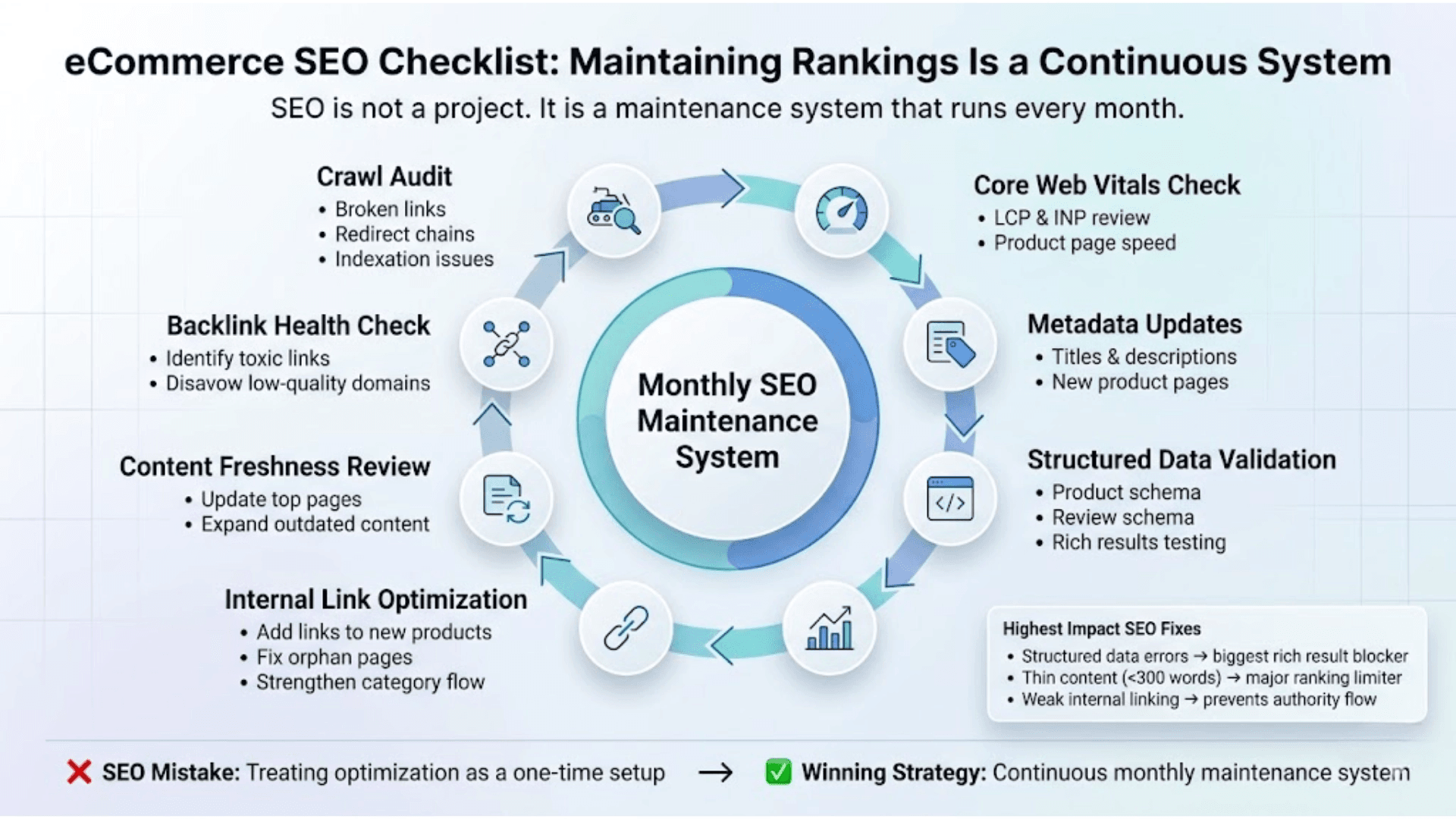
Rankings are not a destination. They are the output of a continuously maintained system. Stores that treat SEO as a launch-phase task consistently lose ground to competitors running active optimization programs.
An operational ecommerce SEO checklist executed on a monthly cadence is one of the highest-leverage maintenance protocols most stores skip entirely after initial setup. The core items that belong on every store's monthly checklist are:
-
Crawl audit for broken links, redirect chains, and new indexation issues
-
Core Web Vitals review across top product and category pages
-
Metadata audit on recently added or modified product pages
-
Structured data validation using Google's Rich Results Test
-
Keyword rank tracking for primary category and product terms
-
Internal link review to integrate new products into existing page architecture
-
Content freshness review for top-performing informational articles
-
Backlink profile review to identify and disavow low-quality referring domains
Which eCommerce SEO Checklist Items Have the Biggest Impact on Rankings?
Among all ecommerce SEO checklist items, three consistently produce the highest return when addressed for the first time:
-
Structured data validation: Missing or broken schema is one of the most common reasons product pages fail to generate rich results in search.
-
Thin content audits: Product or category pages with fewer than 300 words of unique copy should be expanded or consolidated. Search Engine Journal's 2025 case analysis showed measurable ranking improvements within 60 to 90 days of addressing thin content at scale.
-
Internal link health: New products and articles that are not linked from existing pages accumulate no authority and rank poorly regardless of their on-page optimization quality.
Straight Answers to Common eCommerce SEO Queries
Ecommerce SEO involves interconnected systems, and the questions that come up most often reflect the gap between what store owners expect and how search engines behave in 2026.
Two distinctions are worth establishing before reviewing these answers: on-page optimization versus technical infrastructure, and rankings as a short-term metric versus organic traffic as a long-term operational output.
How long does ecommerce SEO take to show results?
Most stores see measurable ranking movement within 3 to 6 months of structural changes. Technical fixes tend to show faster results than content-led authority building, which compounds over 6 to 12 months.
Does product page SEO matter more than category page SEO?
Both matter. Category pages typically carry higher search volume and stronger commercial intent. The most effective programs optimize both in parallel rather than prioritizing one over the other.
How does structured data affect ecommerce rankings?
Structured data does not directly boost rankings but enables rich results, star ratings, price displays, and availability labels, which improve click-through rates, a behavioral signal Google factors into quality evaluation.
What is the biggest ecommerce technical SEO mistake?
Faceted navigation without canonical tag management. Filter-generated URLs fragment crawl budget and dilute the authority of primary category pages across hundreds of near-duplicate URLs.
How does ecommerce technical SEO differ from standard SEO?
Scale and complexity are the primary differences. A store with 10,000 product pages faces crawl budget, duplicate content, and structured data challenges that a standard informational site never encounters. It requires an architectural approach, not page-level fixes.
Building an eCommerce SEO Strategy That Lasts in 2026
The five strategies in this article form a layered system. Technical infrastructure supports on-page optimization. On-page optimization amplifies category authority. Category authority extends into content-driven topical depth. All of it is sustained through consistent operational maintenance.
Where you start depends on where your store currently stands. Stores at the early stage should prioritize technical foundations first, crawl issues, duplicate content, and missing structured data produce the fastest measurable results. Stores with a clean technical foundation should shift focus to category depth and content authority building, the two areas where ecommerce SEO competitive gaps are widest in 2026.
WellsGroup builds and operates ecommerce SEO systems as a continuous function, not a one-time engagement. If your store is losing ground in organic search or has never had a structured SEO infrastructure in place, the right first step is a technical and content audit. Book a free consultation and get a clear picture of where your store stands and what it will take to move it forward.