Shopify SEO: 7 Ways to Outrank Competitors in 2026
Master Shopify SEO with seven proven strategies to improve rankings, boost AI visibility, optimize performance, and consistently outperform competitors in 2026.

Shopify SEO is the process of optimizing a Shopify store to rank higher in search results and AI-generated answers. In 2026, outranking competitors requires more than keyword placement. Stores that win organic traffic combine clean site architecture, buyer-intent content, technical precision, and AI visibility into one cohesive system.
Shopify powers over 4.6 million live stores globally as of 2026, according to BuiltWith. At the same time, Google AI Overviews, ChatGPT Search, and Gemini now surface product recommendations directly in search results, often before a user clicks a single link.
Stores that treated SEO as a one-time task in 2024 and 2025 are losing ground to those that treat it as ongoing infrastructure. The seven strategies below represent what separates stores that compound organic growth from those that plateau. Get a Free Consultation from WellsGroup and build a Shopify SEO system that performs long-term.
Why Is Shopify SEO More Competitive in 2026?
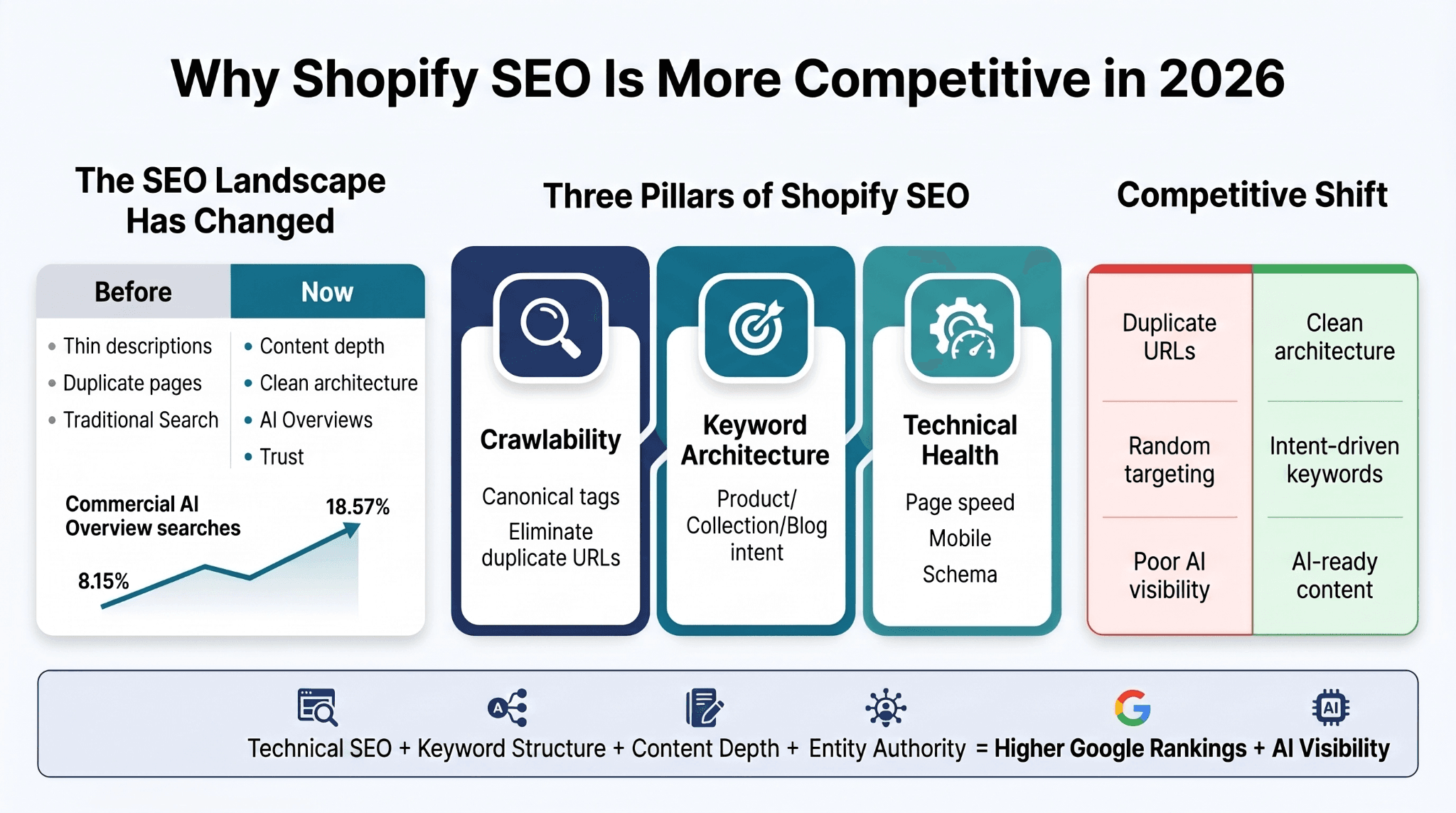
The ranking environment has shifted in ways that reward structure over volume. Google's 2025 core updates reduced the ranking power of thin product descriptions and duplicate collection page content, placing a heavier weight on content depth and entity authority.
Where buyers search has also changed. According to Semrush's AI Overviews study analyzing over 10 million keywords, commercial queries triggering AI Overviews nearly doubled from 8.15% to 18.57% between January and October 2025, a shift that has continued accelerating into 2026. Stores not structured for AI retrieval are invisible to a growing share of potential buyers.
The competitive gap is no longer about who has more products. It is about which store Google and AI systems trust more.
What Does a Strong Shopify SEO Foundation Look Like?
Three structural foundations underpin every effective Shopify SEO strategy before any individual tactic is applied:
-
Crawlability: Shopify generates duplicate URLs by default for products accessed through collections. Without canonical tags, this creates indexing confusion that limits how efficiently Google reads the store.
-
Keyword architecture: Each page should target one intentional keyword. Product pages target transactional queries, collection pages target category queries, and blog content targets informational queries. Without this mapping, pages compete against each other.
-
Technical health: Page speed, mobile responsiveness, schema markup, and internal linking form the infrastructure layer. Shopify SEO best practices begin here, not at the content layer.
What Are the 7 Ways to Outrank Competitors With Shopify SEO?
Each strategy below addresses a distinct layer of optimization. Together they function as a system, with each layer reinforcing the others.
1. How Does Keyword Research Give Shopify Stores a Competitive Edge?
Most stores target the same obvious keywords their competitors target. The stores that outrank them go deeper.
Buyer-intent keywords signal that a user is close to purchasing. A term like "best waterproof hiking boots under $150" outperforms "hiking boots" for product page conversions despite lower search volume.
The following approach covers the core Shopify SEO tips for keyword strategy:
-
Use Ahrefs or Semrush to surface keyword gaps where competitors rank, but you do not
-
Map long-tail terms to specific product pages, collection pages, and blog posts
-
Research how buyers phrase queries in ChatGPT and Gemini, not just Google, since natural language patterns differ across platforms
2. Why Does Your Shopify Site Structure Affect Search Rankings?
Site structure determines how efficiently Google crawls and distributes authority. A flat architecture, where every important page is reachable within two or three clicks from the homepage, signals that those pages are significant.
Deep, buried structures force Google to spend crawl budget on navigation rather than content. For stores with hundreds of products, this limits how many pages get indexed regularly.
Internal linking is the mechanism that makes the structure work. Linking from blog posts to collection pages, and from collection pages to products transfers ranking power that isolated pages cannot achieve independently.
3. How Do You Optimize Shopify Product Pages for Search Engines?
Product pages are the highest-priority optimization targets because they generate direct revenue. The Shopify SEO checklist for product pages covers these core elements:
-
Title tag: Primary keyword included, under 60 characters, distinct from H1
-
Meta description: Under 160 characters, primary keyword, and value statement present
-
H1: Product name with main keyword, written once per page
-
Product description: Unique and written for the buyer, never copied from a supplier
-
Image alt text: Descriptive and keyword-relevant on every product image
-
Schema markup: Product schema with price, availability, and review data for rich result eligibility
Shopify's default template handles some of these. Stores relying entirely on defaults leave ranking potential on the table, particularly in schema and meta description fields.
4. Why Does Page Speed Matter for Shopify SEO in 2026?
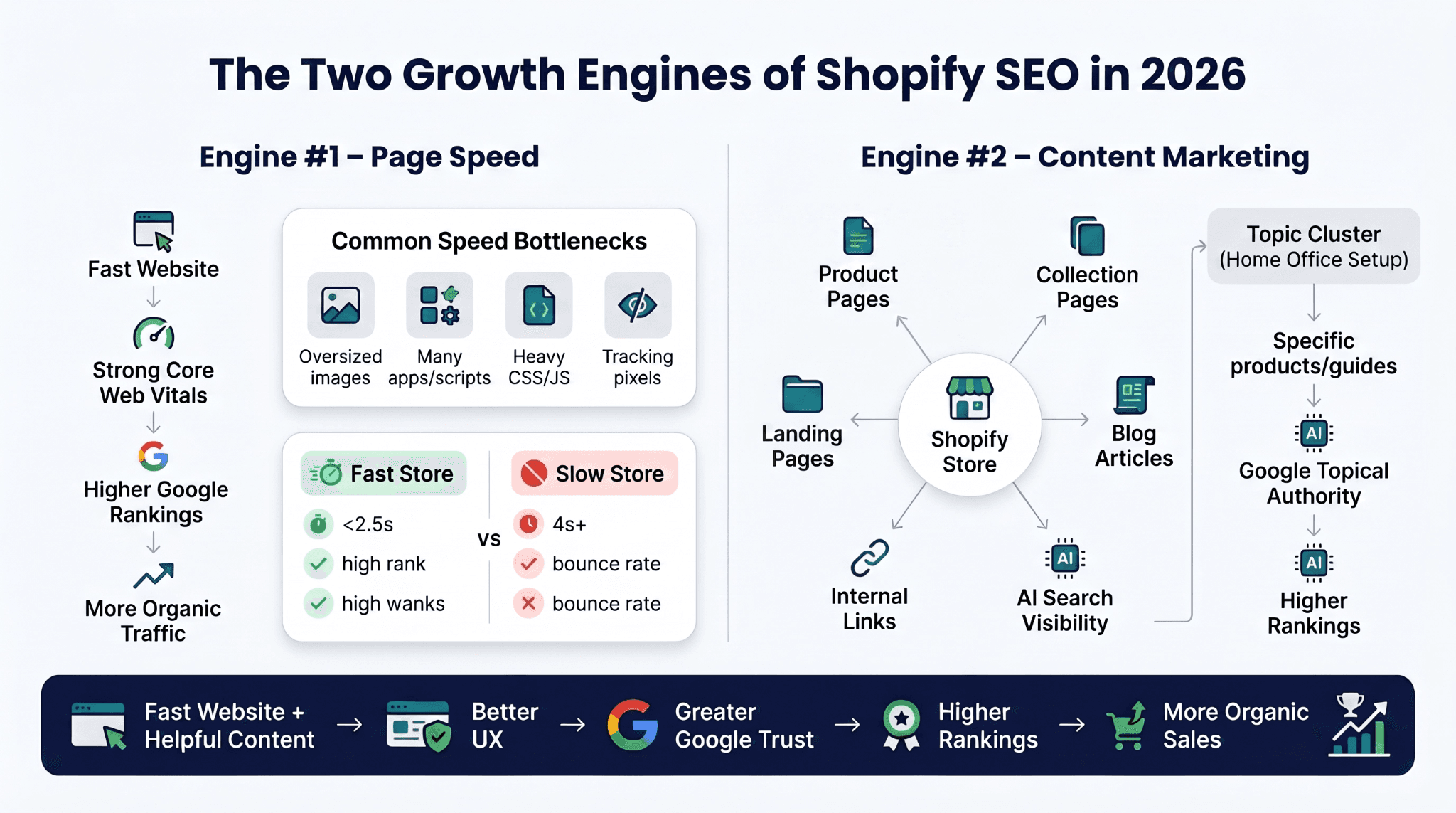
Page speed is a confirmed Google ranking signal that carries more weight in 2026 than it did in 2024, particularly on mobile. Google's Core Web Vitals metrics directly influence rankings in competitive queries.
The most common speed problems on Shopify stores are:
-
Oversized images not compressed or converted to WebP format
-
Installed apps loading scripts on every page, regardless of need
-
Heavy theme files with unused CSS and JavaScript
-
Third-party tracking pixels load synchronously
A store loading in under 2.5 seconds consistently outperforms an identical store loading in 4 seconds. Google PageSpeed Insights and GTmetrix identify the specific bottlenecks.
5. How Does Content Marketing Strengthen Shopify SEO Over Time?
Blog content is not separate from product rankings. It builds topical authority that lifts the entire store's ranking potential.
A store selling ergonomic office chairs that publishes content on home office setup and posture correction becomes an entity that Google associates with that topic cluster. That association directly benefits product and collection page rankings.
Every blog post is also an internal linking opportunity. Linking to relevant collection and product pages with contextual anchor text transfers authority to revenue-generating pages. In 2026, content structured for AI citation, using clear definitions and direct answers, earns referral traffic from AI Overviews and ChatGPT responses independent of traditional click-through behavior.
6. What Role Do Backlinks Play in Shopify Store Rankings?
Domain authority built through backlinks remains one of the most influential ranking factors in competitive niches. Fifty high-quality backlinks from relevant sources will outperform 500 low-quality directory links consistently.
Effective backlink strategies for Shopify stores in 2026:
-
Digital PR gets products featured in gift guides and industry publications
-
Buying guides and comparison content that earn organic editorial links
-
Supplier and manufacturer pages linking to authorized retailers
-
Complementary brand partnerships create mutual linking opportunities
Links from topically relevant, editorially controlled sites add ranking value. Links from link farms and irrelevant paid directories dilute it and can trigger manual penalties.
7. How Do You Make a Shopify Store Visible in AI Search Results?
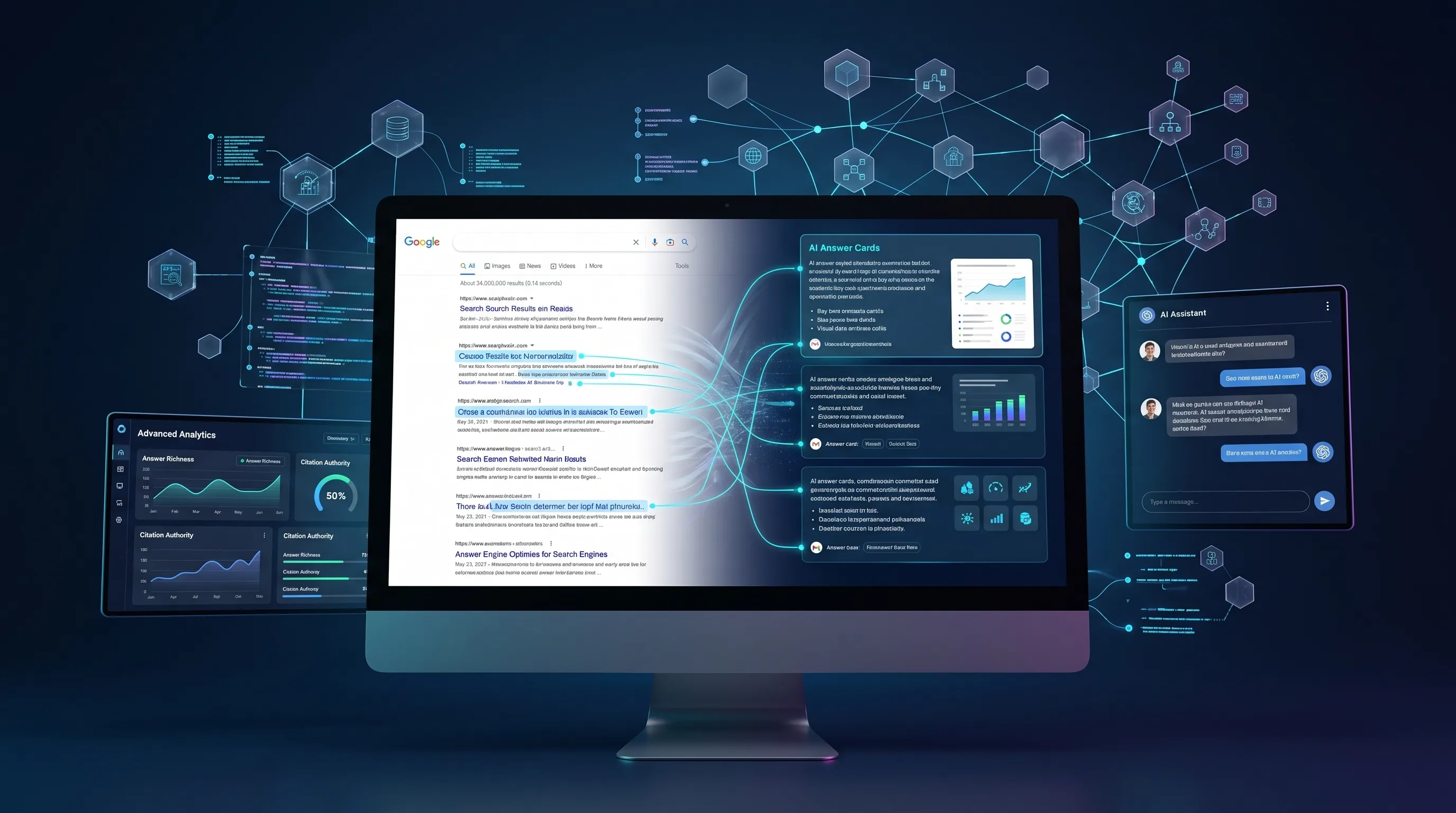
AI search visibility is the most consequential new layer of Shopify SEO in 2026. Google AI Overviews, ChatGPT Search, and Gemini surface store recommendations and product comparisons directly in response to commercial queries.
Getting cited in AI responses requires:
-
Answer-first content structure, where pages open with a direct response to the likely query
-
Structured data markup helps AI systems understand product attributes and availability
-
Entity authority built through consistent brand mentions across trusted third-party sources
-
Topical completeness, so AI systems treat your content as a reliable source
Stores that invested in AI search optimization in late 2025 are seeing measurable AI-referred traffic gains in 2026. This is where early movers build a compounding advantage.
Which Shopify SEO Tools Help You Track and Improve Rankings?
The right Shopify SEO tools make the difference between guessing and executing with precision. The table below maps each tool to its specific function across the optimization layers covered in this article.
|
Tool |
Primary Use |
What It Solves |
|
Google Search Console |
Indexing and performance tracking |
Crawl errors, keyword impressions, and click data |
|
Ahrefs |
Keyword research and backlink analysis |
Competitor keyword gaps and link opportunities |
|
Semrush |
Full SEO auditing and content planning |
Rankings, site health, and competitive positioning |
|
Google PageSpeed Insights |
Core Web Vitals measurement |
Speed issues affecting mobile and desktop rankings |
|
Screaming Frog |
Technical site crawl |
Duplicate content, broken links, redirect chains |
|
Schema App or JSON-LD |
Structured data implementation |
Product and organization schema for rich results |
A functional Shopify SEO operation uses, at a minimum, Google Search Console and one comprehensive platform such as Ahrefs or Semrush alongside a technical crawl tool.
When Should You Work With a Shopify SEO Expert and What Should You Check First?
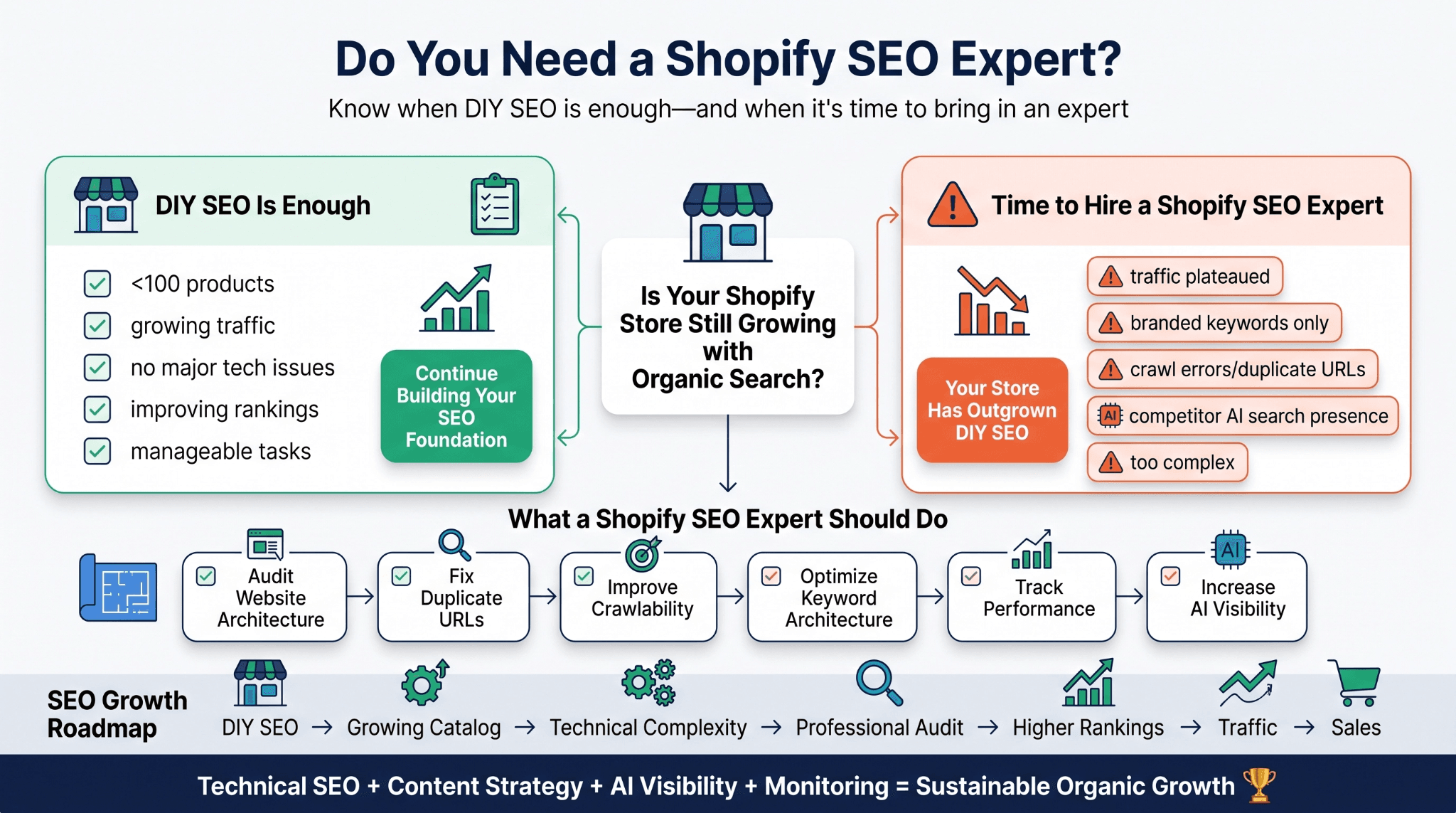
DIY optimization works well when a store has fewer than 100 products and is building a foundational structure. Beyond that point, managing keyword architecture, technical health, content production, and AI visibility simultaneously typically exceeds what a store owner or generalist can sustain.
These are the clearest signs a store needs a Shopify SEO expert:
-
Organic traffic has plateaued for two or more consecutive quarters
-
Product pages rank for branded terms but not category or intent-based queries
-
A technical audit reveals crawl errors, duplicate pages, or unresolved Core Web Vitals failures
-
Competitors appear in AI Overviews for queries where the store does not
A qualified Shopify SEO expert audits architecture before touching content, understands how Shopify generates duplicate URL structures, and tracks performance at the keyword and page level rather than total traffic volume.
Before bringing in an expert or scaling independently, running through a structured Shopify SEO checklist prevents the compounding cost of fixing foundational issues later. The table below serves as both a pre-launch verification and a quarterly audit framework, reinforcing Shopify SEO best practices at every stage of store growth.
|
Checklist Item |
Priority |
|
Canonical tags configured on all product URLs |
High |
|
Each page targets one primary keyword |
High |
|
Product page title tags under 60 characters |
High |
|
All product images in WebP format and compressed |
Medium |
|
Blog content mapped and linked to product pages |
Medium |
|
Schema markup active on product and organization pages |
High |
|
Google Search Console connected and sitemap submitted |
High |
|
Mobile PageSpeed score above 70 in PageSpeed Insights |
Medium |
Things Worth Knowing Before You Optimize
Store owners working through Shopify SEO for the first time consistently raise the same practical questions. The answers below address the most common ones directly.
Does Shopify have built-in SEO features?
Shopify includes auto-generated sitemaps, canonical tags, and editable meta fields. These provide a starting point but do not replace a deliberate strategy. Outranking competitors requires building on top of the defaults, not relying on them.
How long does Shopify SEO take to show results?
Most stores see measurable ranking movement within three to six months of consistent, correctly implemented optimization. Competitive niches take longer. Stores investing in AI visibility tend to see supplementary traffic gains faster, since AI referrals operate on a different timeline than index-based rankings.
Can Shopify SEO be done without a developer?
Most on-page and content optimization requires no development skills. Technical fixes such as resolving duplicate URL structures, implementing JSON-LD schema, or improving theme performance typically require a developer. Attempting these without technical knowledge risks functionality issues that are harder to reverse.
Is blogging on Shopify worth the investment in 2026?
Yes, with a clear content architecture behind it. Keyword-mapped blog content that links to product pages and is structured for AI retrieval builds topical authority that directly improves product rankings. Stores that publish without an architectural strategy see minimal SEO return.
Strong Shopify SEO Is Built, Not Stumbled Into
The stores outranking competitors in 2026 built SEO into their store architecture from the start, maintained technical health consistently, and adapted as AI search reshaped how buyers discover products.
Shopify SEO is infrastructure. The seven strategies in this article work because they reinforce each other, each layer making the others more effective over time.
If your store has hit an organic growth ceiling or needs a foundation built for AI search visibility, WellsGroup engineers Shopify SEO systems designed for long-term performance. Get a free consultation and build your SEO system at WellsGroup.