Generative Engine Optimization Vs Traditional SEO: Adapting Strategy for 2026
Discover how generative engine optimization and traditional SEO work together in 2026 to improve rankings, AI citations, visibility, and growth.

Traditional SEO ranks pages inside a list of links. Generative engine optimization, or GEO, structures content so AI systems like ChatGPT and Google AI Overviews can cite it directly. The comparison of generative engine optimization vs traditional SEO is not about replacement; it is about two retrieval systems operating side by side. AI Overviews already trigger on a growing share of tracked queries, making this an operational problem, not a trend. At WellsGroup, we treat search visibility as one output of a connected technology stack, and this article breaks down how to adapt for both systems in 2026.
Get a Proposal, and our team will map out exactly where your current content stands. Let's build a search strategy that works across both traditional and AI-driven channels.
What Is Generative Engine Optimization?
What is generative engine optimization, in practical terms? It is the discipline of structuring content so large language models can understand it, verify it, and quote it accurately when answering a question.
Instead of competing for a position on a results page, content competes to become the source an AI model trusts enough to cite. That is a different job than classic SEO, and it calls for a different way of building a page.
The two systems retrieve content differently:
-
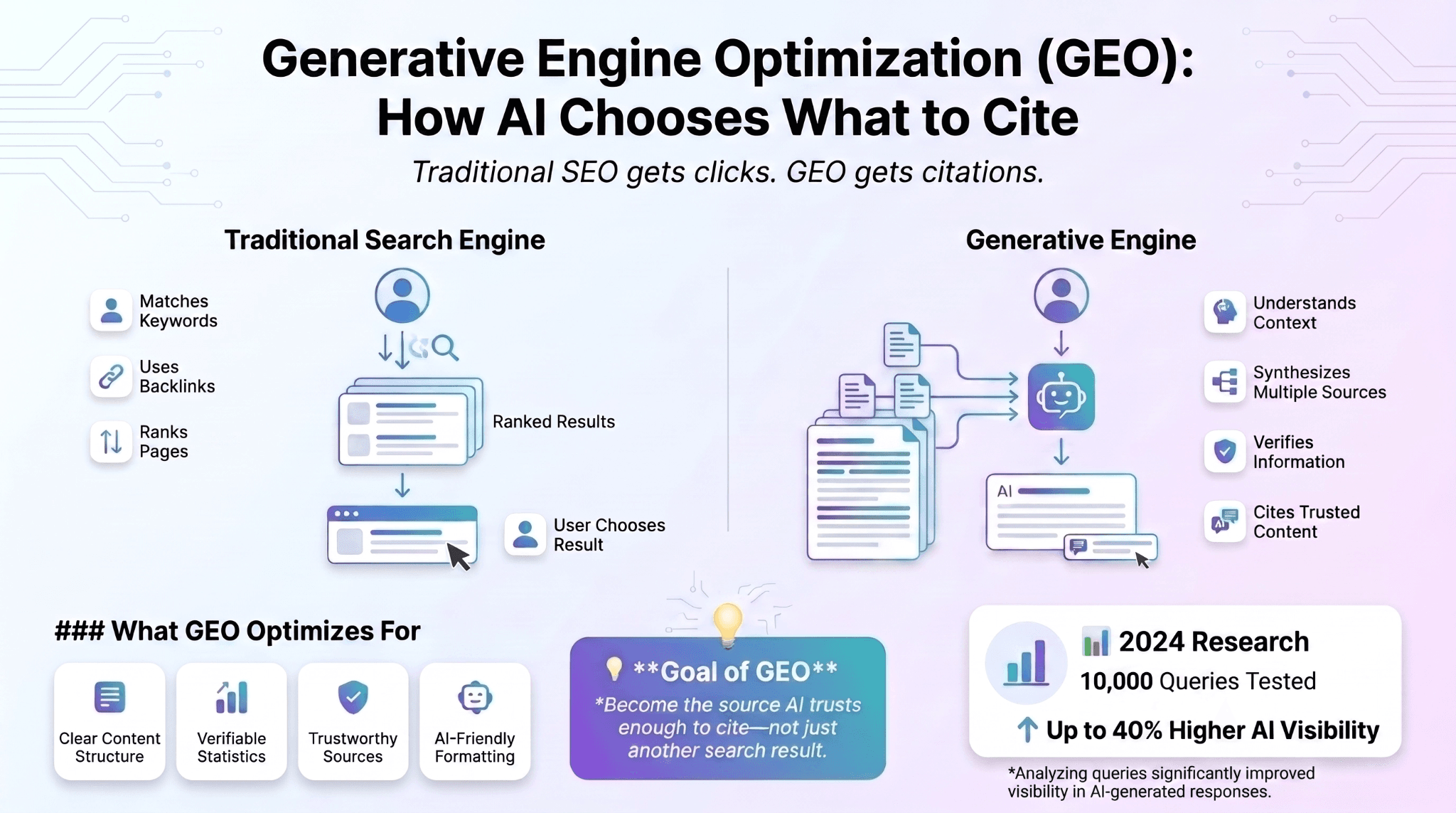
A traditional search engine matches keywords and link signals to a query, then returns a ranked list for the user to evaluate.
-
A generative engine ingests multiple sources, synthesizes them, and produces a single answer, often with a small number of citations attached.
-
The content selected for that synthesis step is the content that wins under generative engine optimization.
Princeton and Georgia Tech researchers formalized this idea in a 2024 study, testing nine content strategies across 10,000 queries. They found that adding verifiable statistics to a page improved its visibility inside generative engine responses by up to 40 percent. That research remains the closest thing the field has to an empirical baseline.
Generative Engine Optimization vs Traditional SEO: What Is the Difference?
The difference between GEO and SEO comes down to what each system optimizes for.
-
Traditional SEO optimizes for a click. It asks the user to judge a result credible and choose it over other links on the page.
-
Generative engine optimization optimizes for a citation. It asks the AI system to select the content as a trustworthy input before the user ever sees a list of options.
That distinction changes how a page is structured and how success gets measured.
How Search Results Are Changing
Zero-click search is no longer an edge case. A growing share of queries are now answered directly on the results page, whether through an AI Overview, an AI Mode response, or a chat-style answer. Users increasingly get their answer before they choose, or even see, a link to click.
How Ranking Signals Differ Between SEO and GEO
The two systems reward expertise, just through different mechanics.
-
Traditional SEO signals include backlinks, keyword relevance, site speed, and domain authority.
-
Generative engine optimization signals include clarity, factual verifiability, structured formatting, and how easily a passage can be lifted without losing meaning.
Below is a direct comparison of how the two systems evaluate content.
|
Dimension |
Traditional SEO |
Generative Engine Optimization |
|
Primary goal |
Rank in a list of links |
Get cited inside a generated answer |
|
Core signal |
Backlinks, keywords, technical health |
Clarity, structure, verifiable facts |
|
Success metric |
Ranking position, click-through rate |
Citation frequency, share of AI answer |
|
Content format |
Long form, keyword-targeted pages |
Answer-first blocks, structured data |
|
User outcome |
User compares multiple sources |
User reads a single synthesized answer |
Why Does Generative Engine Optimization Matter in 2026?
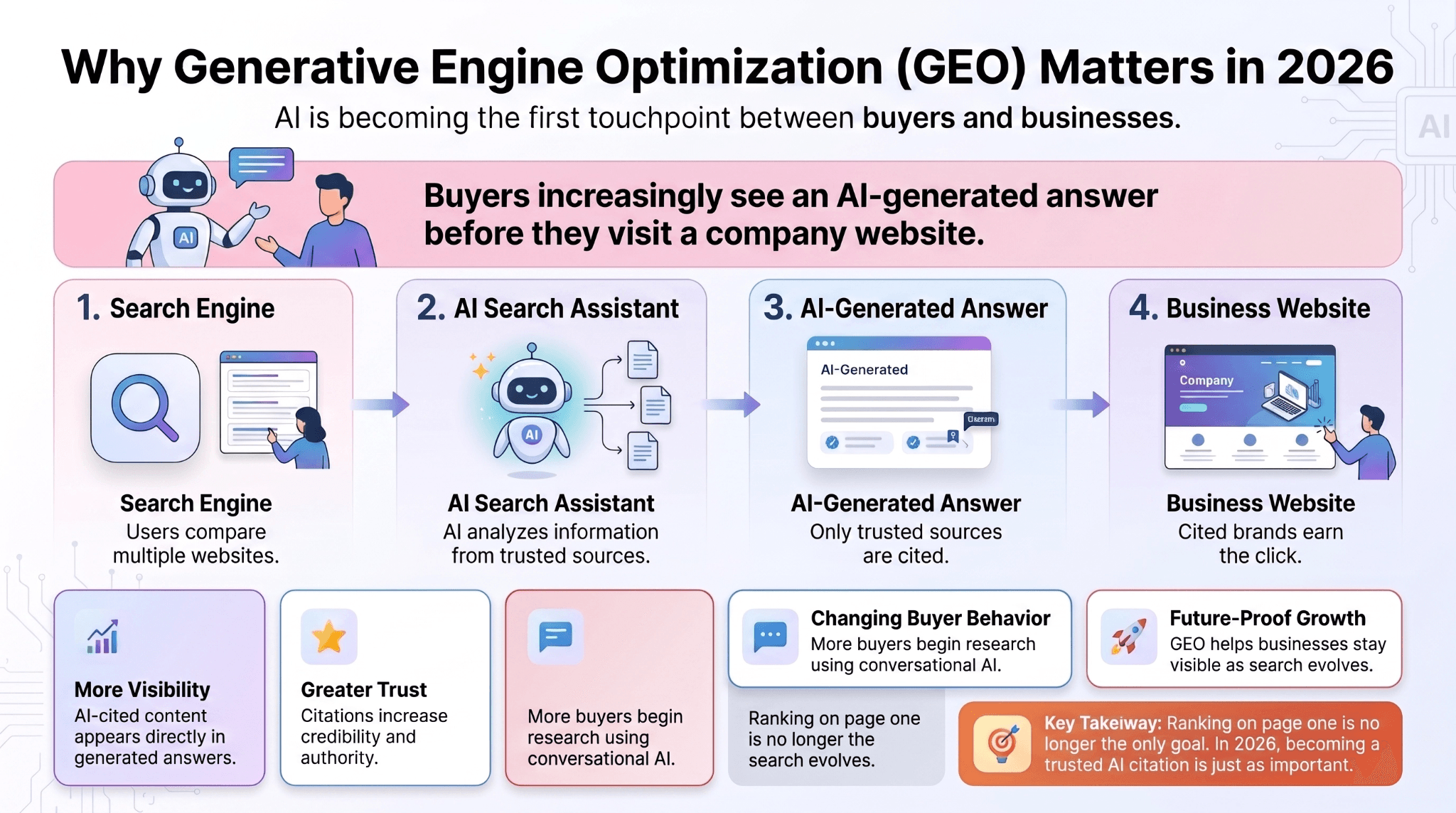
The business case for generative engine optimization is no longer speculative. AI-mediated search now represents a meaningful share of how research and commercial queries get resolved, and that share is growing faster than traditional search volume.
Ignoring it does not mean staying neutral. It means slowly losing visibility in the query types that used to drive qualified traffic. A few shifts are worth naming directly:
-
AI-powered search tools are handling a rapidly increasing volume of research and comparison queries, categories that used to route almost entirely through traditional organic search.
-
Content that gets cited inside an AI-generated answer tends to earn more visibility and trust than content that only ranks below it.
-
Conversational search interfaces are becoming a normal starting point for buyers researching a category or a cost question, not a novelty.
For logistics, SaaS, and marketplace businesses, this shift affects the top of the funnel directly. Buyers increasingly meet an AI-generated answer before they meet a company's website.
How Does AI Search Optimization Actually Work?
AI search optimization works by making content easier for a model to retrieve, verify, and quote with confidence. Generative engines do not reward the keyword density older SEO systems did. They reward passages that answer a specific question cleanly, cite a checkable source, and stand on their own without needing the rest of the page for context.
What Makes Content AI Citable?
Citable content tends to share a few traits:
-
It answers the question directly within the first few sentences.
-
It states specific figures rather than vague claims.
-
It attributes those figures to a named, checkable source.
What Role Does Structure Play?
Structure functions as a trust signal. Clear headings that mirror how people phrase questions, an answer first paragraph under every heading, and clean formatting all help a model's retrieval layer isolate the relevant passage. Disorganized pages force a model to guess at meaning, and generative engines favor sources that remove that guesswork.
Do You Still Need Traditional SEO in 2026?
Yes. Traditional SEO remains the foundation generative engine optimization builds on.
A generative engine still needs a crawlable, indexed, technically sound site to retrieve content from. Several traditional SEO signals still decide whether a page even gets considered as a source:
-
Domain authority and backlink profiles
-
Site speed and technical health
-
Structured data and clean indexing
Businesses that abandon SEO fundamentals in favor of GEO tactics tend to lose ground on both fronts, since generative engines are still built on top of traditional search indexes. Teams that treat SEO as optional often run into a few predictable problems:
-
Indexing gaps that keep pages out of consideration entirely
-
Slower crawl rates that delay how quickly new content gets found
-
Weaker domain signals that quietly undermine any GEO work layered on top
The practical position for 2026 is additive: technical and content SEO earn a page the right to be indexed, and generative engine optimization earns that same page the right to be quoted once it is found.
Generative Engine Optimization vs Traditional SEO: How Can Businesses Adapt?
Adapting strategy for both systems is a sequencing problem, not a rewriting problem. Most businesses do not need to abandon existing content. They need to audit it, restructure the highest value pages, and build new content with both systems in mind.
The table below outlines a practical adaptation framework.
|
Priority |
Action |
System Impacted |
|
1 |
Audit top-performing pages for AI readiness |
GEO |
|
2 |
Add answer first blocks under every H1 and H2 |
Both |
|
3 |
Replace vague claims with sourced, specific data |
GEO |
|
4 |
Maintain technical SEO health and internal linking |
SEO |
|
5 |
Track citation frequency alongside ranking position |
Both |
What Should Content Teams Prioritize First?
Content teams should audit existing high-traffic pages before producing new content. An audit identifies which pages already rank well but lack the answer in the first paragraphs or sourced statistics generative engines need to cite them.
How Should Content Be Structured for Both Search Types?
The most efficient structure serves both systems at once:
-
Headings written as natural language questions match how people phrase queries in a search bar and an AI chat window.
-
A direct, sourced answer beneath each heading makes the content SEO-scannable.
-
That same block gives generative engines an extractable passage without extra rewriting.
What Mistakes Should Businesses Avoid When Adopting GEO?
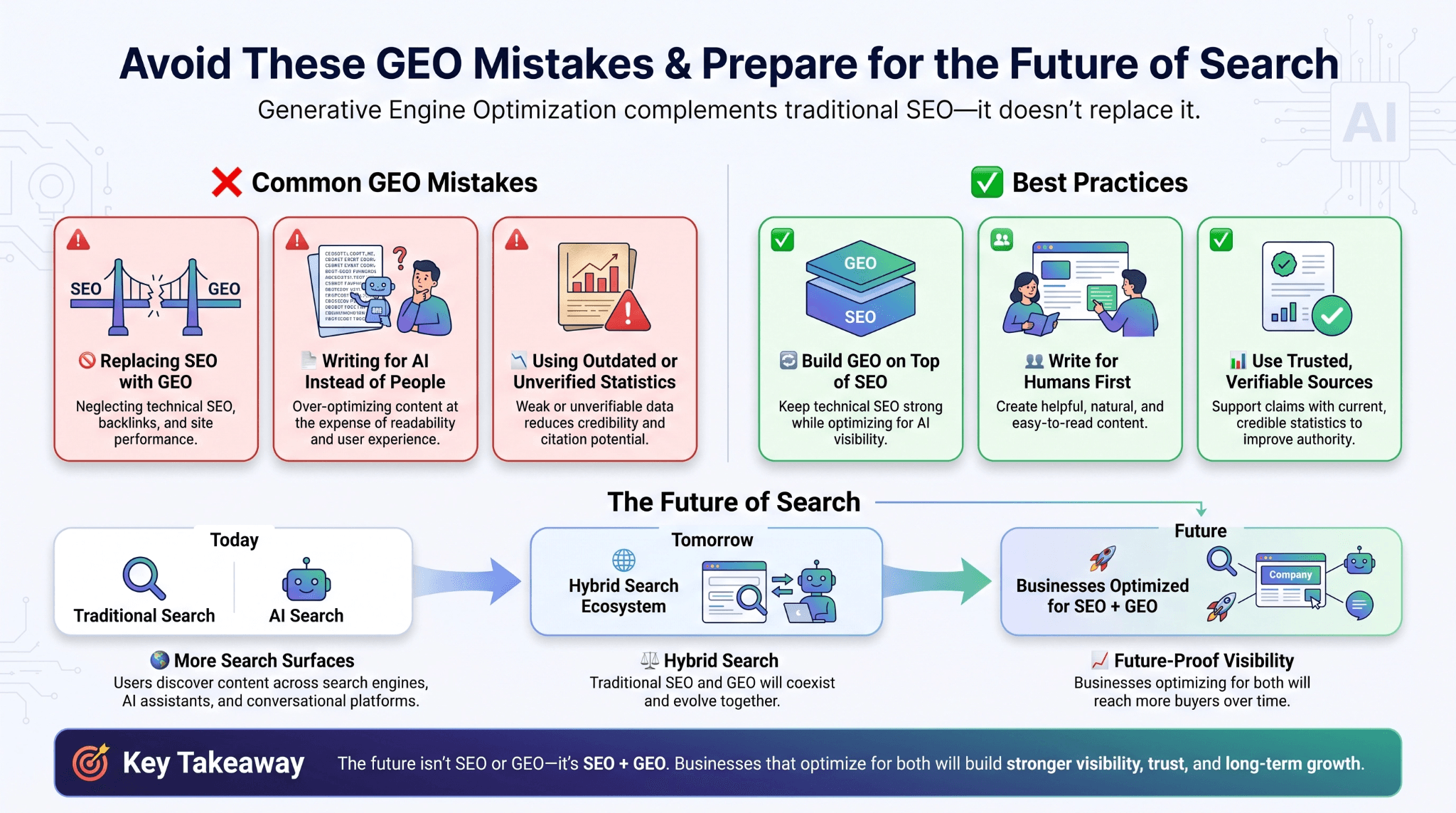
Most mistakes in the generative engine optimization vs traditional SEO transition come from treating GEO as a wholesale replacement rather than an added layer. Three patterns show up consistently:
-
Treating GEO as a replacement for SEO rather than an extension of it, leaving technical and link-based fundamentals neglected.
-
Sacrificing readability for AI-friendly formatting, producing pages that read like data dumps instead of useful content for visitors.
-
Citing outdated or unverifiable statistics, which damages credibility and reduces citation likelihood, since generative engines increasingly cross-check claims before quoting them.
What Do SEO Experts Say About the Future of Search?
On the question of generative engine optimization vs traditional SEO, the consensus among researchers tracking this shift is that search is becoming hybrid, not replaced. Most industry analysis points to a few consistent conclusions:
-
Search is being redistributed across a widening set of surfaces, not collapsing into a single winner.
-
Both systems are expected to run concurrently for years, with the balance shifting gradually rather than overnight.
-
A content operation built to serve only one system will likely be rebuilding within eighteen months.
What Founders Want to Know About GEO and SEO
The questions below reflect what founders and marketing leaders most often ask when working through the difference between GEO and SEO for their own strategy.
Is GEO replacing SEO entirely?
No. Generative engines still rely on indexed, crawlable web content as source material, so technical and content SEO remain necessary. WellsGroup treats GEO as an additional layer built on existing SEO infrastructure, not a replacement for it.
How long does it take to see results from generative engine optimization?
Most teams see measurable citation activity within a few months of restructuring high-priority pages, though timelines vary by industry and query volume.
Can a smaller business realistically compete for AI citations?
Yes, often more easily than in traditional SEO. Lower-ranked content tends to see the largest visibility gains from optimization, since generative engines are not bound by the same page one dominance that shapes traditional rankings.
What tools help track AI search visibility?
Citation tracking platforms, paired with analytics adapted to flag AI referral traffic, are the current standard. WellsGroup's systems include AI search tracking and attribution inside one unified reporting layer.
Does GEO require different content for every AI platform?
Not entirely. Answer first structure, sourced statistics, and clear entity definitions perform consistently across ChatGPT, Gemini, and Google AI Overviews, though citation patterns vary slightly by platform.
Where Search Strategy Goes From Here
The businesses that adapt well in 2026 will not pick a side between generative engine optimization vs traditional SEO. They will treat search visibility as one connected system, engineered once and operated continuously, rather than two competing campaigns run by two teams.
That is the operational difference between reacting to each algorithm update and having already built the infrastructure to absorb it. Search is not getting simpler. It is getting more distributed, with more retrieval systems evaluating the same content for different purposes.
Book a Free Consultation with WellsGroup and get a clear picture of where your content stands across both traditional and AI-driven search.