Facebook Ads vs Google Ads: Costs, ROI, and Results Compared
Compare Facebook Ads and Google Ads in 2026 with real cost, ROI, and conversion insights to choose the right advertising strategy.

Facebook Ads and Google Ads differ mainly in cost and intent. Google Ads targets active search intent at a 2026 average CPC of $2 to $5.42, while Facebook Ads reaches interest-based audiences before they search, at $0.63 to $1.92 per click. Google typically delivers stronger ROI for high-intent purchases, while Facebook delivers lower-cost brand awareness and retargeting reach.
Most businesses comparing these platforms are really asking a systems question. They want to know where a dollar of ad spend produces the most predictable return, how that return connects to the rest of the revenue infrastructure, and whether one platform should be dropped in favor of the other or run alongside it. This article breaks down current cost data, ROI patterns by business type, and a framework for choosing between them or running both inside a connected funnel.
If you would like a tailored breakdown of what this looks like for your business, request a proposal from WellsGroup, and our team will map out a channel strategy built around your margins, sales cycle, and growth stage.
Facebook Ads vs Google Ads: What Is the Difference?
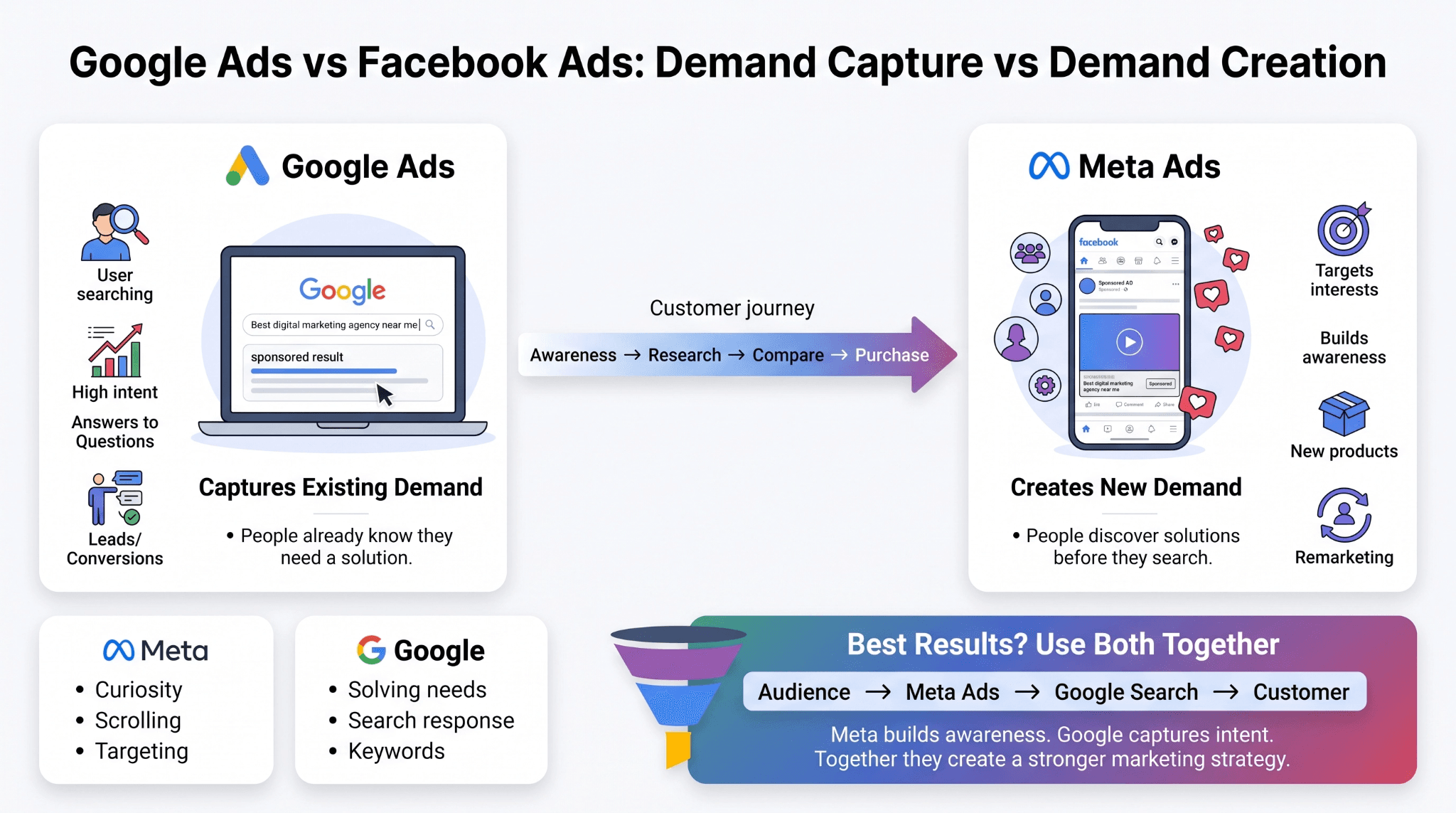
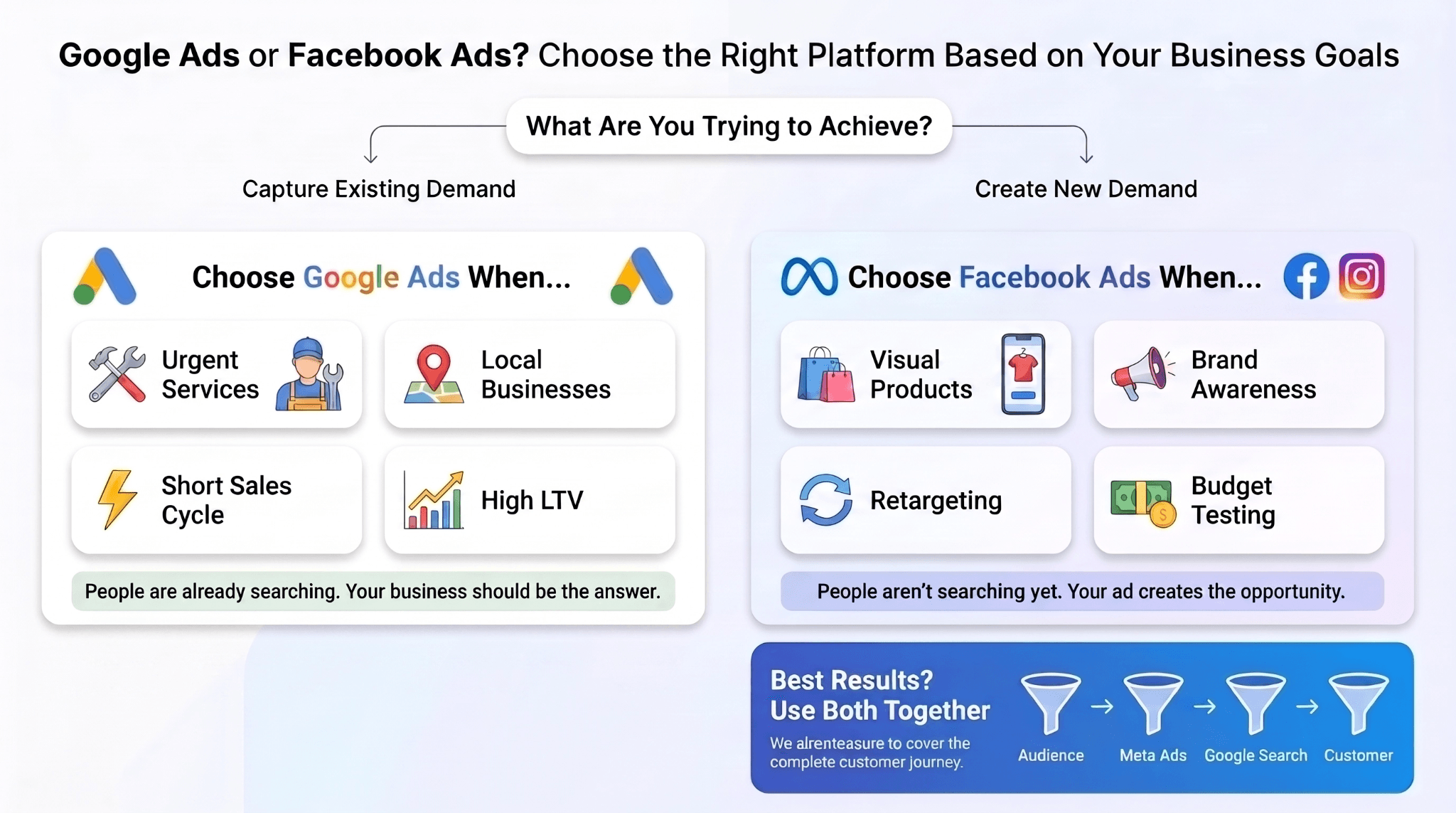
Google Ads and Facebook Ads solve two different problems. Confusing them is the root cause of most wasted ad spend. Google Ads is built on search intent. A person types a query because they already have a need. Google Ads places your business in front of that existing demand.
Facebook Ads work in reverse. Meta Ads places your business in front of people based on behavior, interests, and demographics, before those people have expressed any need at all. This is why marketers often frame the decision as Google Ads vs Meta Ads rather than a pure cost comparison:
-
Google answers a question someone is already asking
-
Meta creates a question someone hadn't thought to ask yet
Understanding this distinction matters more than any single benchmark because it sets realistic expectations for what each platform can do.
How Does Paid Social Differ From PPC Search Advertising?
Paid social vs PPC is a distinction between demand capture and demand creation:
-
PPC search advertising (Google Ads) works like a customer walking into a store and asking a specific question. You pay to be the one who answers it.
-
Paid social (Facebook and Instagram) works like a well-placed sign on a street someone is already walking down. They weren't looking for you, but the message catches them at the right moment.
Neither approach is inferior. They serve different points in a buyer's decision process, which is why systems-minded operators rarely treat this as an either/or decision.
How Much Do Facebook Ads Cost Compared to Google Ads?
Cost only makes sense in context, but the raw numbers are a useful starting point.
Google Ads Search costs, per WordStream's 2026 benchmark report (13,000+ campaigns tracked April 2025 to March 2026):
-
Average CPC: $5.42
-
Average CTR: 6.64%
Google Ads costs, per WebFX's 2026 PPC benchmarks:
-
Typical Search CPC: $2 to $4
-
Average CPA: $50 to $80
-
Ecommerce CPA tends to be lower, around $20 to $50
Facebook Ads costs, per industry data compiled by WordStream and LocaliQ via Business of Apps, 2026:
-
Average CPC across all industries: $0.63
Facebook Ads costs, per Visible Factors' 2026 analysis:
-
Average CPC (traffic campaigns): $0.70
-
Average CPC (lead gen campaigns): $1.92
-
Median ROAS across industries: 1.93x
Here's how the two platforms line up side by side:
|
Metric |
Google Ads (Search) |
Facebook Ads (Meta) |
|
Average CPC |
$2.00 to $5.42 |
$0.63 to $1.92 |
|
Average CTR |
3% to 6.64% |
1.4% to 2.2% |
|
Average CPA / CPL |
$50 to $80 |
$20 to $40 (varies by objective) |
|
Typical ROAS |
200% to 400% |
Median 1.93x (193%) |
Why Do Google Ads Clicks Cost More Than Facebook Ads Clicks?
The gap exists because of what each auction actually prices:
-
Google Ads sells access to a keyword tied to explicit intent. Advertisers bid aggressively because that click is close to a purchase decision.
-
Facebook Ads sells access to attention inside a feed, where the person hasn't decided they need anything yet, so the auction reflects lower certainty of conversion.
A higher CPC on Google isn't a flaw. It reflects the value of intercepting someone at the exact moment they're ready to act.
Which Platform Delivers Better ROI, Facebook Ads or Google Ads?
ROI isn't a property of a platform. It's a property of how well a platform's strengths match your sales cycle and customer value.
A business measuring ROI by cost per click alone is measuring the wrong layer of the system. What matters is what that click is worth once it moves through your CRM and closes as revenue.
This is why the Google Ads vs. Meta Ads debate rarely produces a single winner in practice:
-
Short consideration cycles with clear purchase intent tend to favor Google
-
Visually driven or discovery-based products often favor Meta, especially with retargeting layered in
Does Google Ads or Meta Ads Convert Better for eCommerce?
It depends on where the customer sits in their journey:
-
Meta Ads perform well for cold audience discovery, especially for visual products with lower average order values, since low CPC supports volume-based testing.
-
Google Ads (Search and Shopping) tends to convert better for buyers who already know what product they want and are comparing options, since that traffic arrives closer to a purchase decision.
Does Google Ads or Meta Ads Convert Better for Service-Based Businesses?
Service businesses, particularly B2B and local service providers, generally see stronger ROI from Google Ads:
-
A person searching "commercial HVAC repair near me" or "enterprise CRM implementation" has already defined their need
-
Google places you directly in that moment
Meta ads vs Google ads comparisons in service industries usually show Meta performing better for top-of-funnel awareness and lead nurturing rather than direct conversion, since service purchases involve longer research and trust-building before a decision.
When Should a Business Use Google Ads Instead of Facebook Ads (or Vice Versa)?
Choosing between the two platforms comes down to reading a handful of clear signals about the buyer, the sales cycle, and the budget.
When Google Ads Outperforms Facebook Ads
Google Ads tends to outperform when the buying decision is already active. Clear signals include:
-
The purchase is urgent or time-sensitive, such as emergency repair or same-day service
-
The business relies on local search intent, such as a service area business with a defined region
-
The sales cycle is short, and the product or service is well defined by category
-
The business has a high customer lifetime value, which can absorb a higher CPC
In each case, the person is already looking for a solution. Google Ads simply positions your business as the answer.
When Facebook Ads Outperform Google Ads
Facebook Ads tend to outperform when the goal is building awareness or reaching people before they start actively searching. This applies when:
-
The product benefits from visual demonstration, such as apparel, home goods, or consumer devices
-
The business needs to build brand recognition in a new or crowded market
-
The strategy depends on retargeting warm audiences who've already engaged with the brand
-
The budget requires lower cost per click to support broad top-of-funnel testing
These conditions favor Meta because the platform is built to introduce a brand to people who weren't yet looking for it.
Can a Business Combine Google Ads and Meta Ads for Better Results?
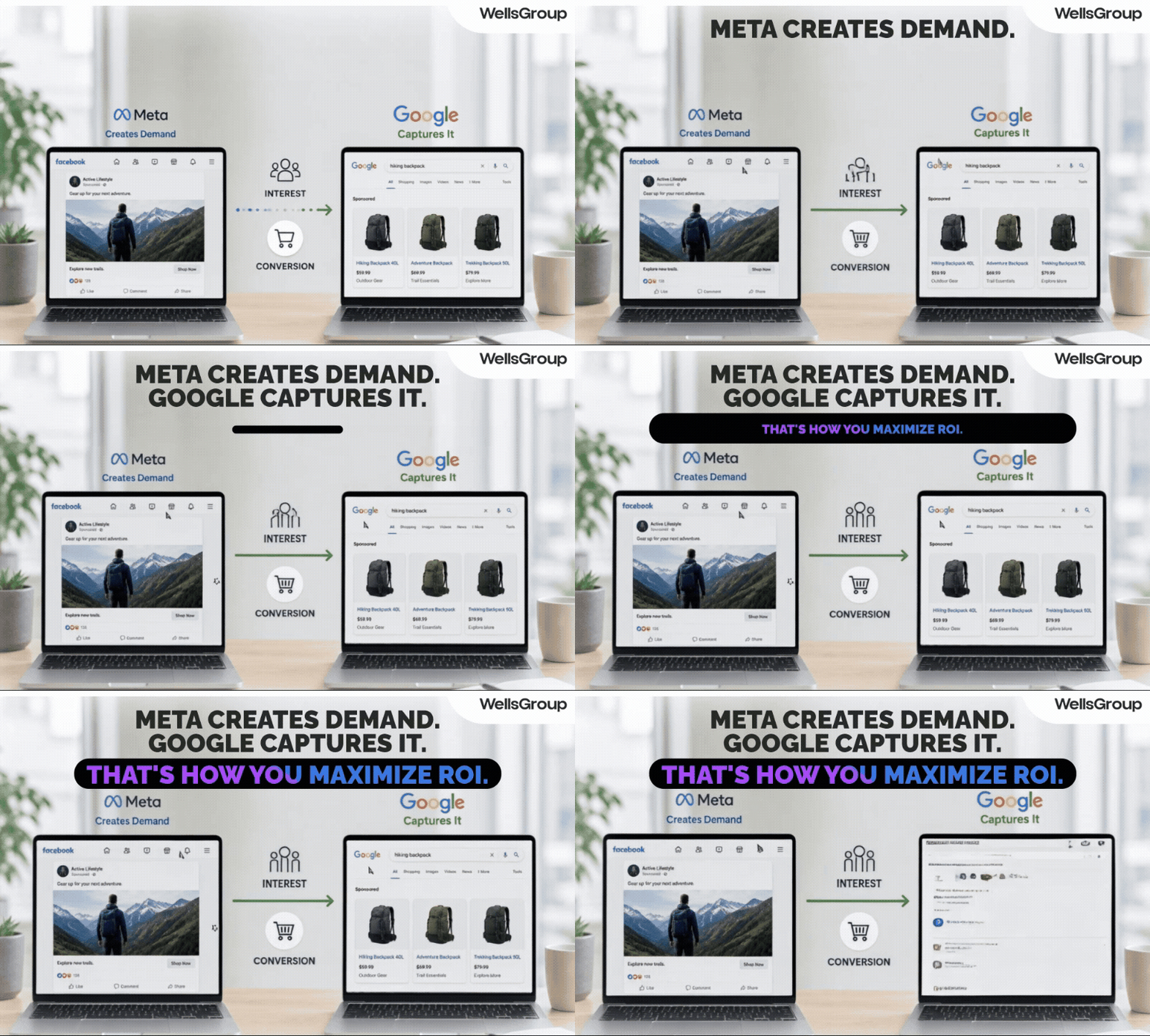
Treating this as a binary choice is where most businesses lose efficiency. In a properly architected revenue system, Google Ads and Meta Ads aren't competing budgets. They're two stages of the same funnel, each strengthening the other's performance.
What Does a Combined Facebook and Google Ads Funnel Look Like?
A connected funnel typically follows three stages:
-
Awareness: Meta Ads builds attention among audiences that match your ideal customer profile
-
Reinforcement: That same audience is retargeted, either back on Meta or through Google Display, reinforcing the brand before a decision is made
-
Conversion: Once the person begins actively searching, often for the brand name itself or a closely related term, Google Search captures that high-intent moment and converts it
This structure is why WellsGroup builds paid media inside a unified operational system rather than as isolated campaigns. When CRM data, attribution tracking, and ad platforms are connected, a business can see which Meta impressions eventually influenced a Google Search conversion weeks later, something neither platform reports on its own.
What Metrics Should You Track to Compare Facebook Ads and Google Ads Performance?
Comparing platforms fairly requires looking past surface-level numbers like impressions and likes, which don't reflect revenue outcomes. A campaign can generate thousands of impressions and still lose money, so the comparison needs to happen at the level of cost and return, not visibility. The metrics that actually matter:
-
CPC (Cost Per Click): what you pay for a single visit, useful for early-stage efficiency checks and spotting rising costs before they affect the budget
-
CPA (Cost Per Acquisition): what you pay for an actual conversion, the clearest apples-to-apples comparison across platforms since it ties spend directly to outcome
-
ROAS (Return on Ad Spend): revenue generated per dollar spent, the metric tied directly to profitability, and the one that ultimately decides whether a channel stays funded
-
Conversion Rate: the percentage of clicks that become customers, revealing landing page and offer strength independent of the platform driving traffic
Tracking these four consistently, across both platforms, in a single dashboard, is what allows a genuine Facebook Ads vs Google Ads comparison rather than a guess based on cost alone.
What Are Business Owners Most Often Getting Wrong About This Decision?
Most missteps in this comparison come down to holding one platform to the other's standard. Here are the two mistakes that show up most often.
Mistake #1: Judging Meta Ads by Google Search standards
A Facebook ad shown to a cold audience isn't supposed to convert at the same rate as someone actively searching for your product. The two channels are built for different jobs, and comparing their conversion rates directly ignores where each audience sits in the buying journey. Judging Meta this way leads businesses to abandon a channel that was working as designed, just not for the purpose they assumed, often right before retargeting and repeated exposure would have driven the conversion.
Mistake #2: Pulling Google Ads spend too early
Google's algorithm needs a meaningful sample of conversions to learn which searches are worth targeting and which keywords waste budget. Cutting a campaign in its first two to three weeks often eliminates the data the system needs to become efficient, forcing the next attempt to start the learning process over again from zero.
A systems-based approach treats both platforms as part of an ongoing operation, not a short-term test judged in isolation.
Quick Answers on Choosing Between Facebook Ads and Google Ads
A few questions come up consistently once the cost and ROI picture is clear.
Is Google Ads more expensive than Facebook Ads for small businesses?
Generally, yes, on a per-click basis. Google Search CPC averages $2 to $5.42 depending on industry, compared to $0.63 to $1.92 for Facebook Ads, based on 2026 WordStream and Visible Factors benchmark data. The cheaper platform is not always the better investment once conversion value is factored in, which is why we report on cost per acquisition rather than cost per click alone.
Which platform is better for a new business with no brand awareness?
Facebook Ads typically make more sense first, since there's limited search demand for a brand nobody has heard of yet. Google Ads becomes more effective once branded search volume builds. WellsGroup maps out that shift in advance so it happens on schedule rather than by accident.
Can a small budget run both platforms at once?
Yes, but it works best split by function rather than evenly, with awareness dollars going to Meta and high-intent search dollars going to Google. Getting that split right is where most in-house teams struggle, and it's one of the first things WellsGroup restructures on underperforming accounts.
Does industry affect which platform performs better?
Significantly. Finance, legal, and B2B services tend to justify higher Google CPCs due to high customer lifetime value, while visually driven consumer products often perform more efficiently on Meta. We review this allocation on an ongoing basis as competition and algorithms shift.
How long does it take to know which platform is working better?
Most accounts need three to four weeks of consistent spend before the data is reliable, since both platforms need time to exit their learning phase. Judging performance earlier usually leads to premature decisions, which is why we build evaluation windows into every campaign from the start.
Choosing the Right Platform for Your Growth Stage
The Facebook ads vs Google ads decision is ultimately a question about where your business sits in its growth cycle, not which platform is objectively better. Early-stage businesses building initial brand recognition often get more value from Meta's lower cost per click and broad reach, while businesses with established demand and a defined sales process tend to extract more value from Google's ability to capture people at the exact point of decision.
The businesses that scale most efficiently rarely pick a side. They build a system where both channels feed a single, measurable pipeline, with CRM data and attribution tracking connecting the dots between the two. That is the layer where most companies are underbuilt, and it is the layer that determines whether ad spend compounds over time or resets every quarter.
A paid media system that connects Meta and Google performance to real revenue data starts with the right architecture behind it and gets a free consultation with WellsGroup.