5 Ways PPC & Paid Advertising Drives Measurable Results: PPC Landing Page Best Practices That Work
PPC success depends on landing pages, tracking, testing, and optimization systems that transform ad spend into measurable business growth.

A logistics company in the Midwest runs Google Ads for three consecutive quarters. Click volume looks healthy. Traffic reports show steady growth. But inbound leads remain flat, cost per acquisition keeps climbing, and no one on the team can explain why.
Businesses pour money into paid advertising every quarter and walk away with traffic reports that look impressive but revenue numbers that do not move. The core issue is rarely the ad spend itself. It is the absence of a system.
Following PPC landing page best practices is not a design preference. It is an operational requirement. When paid advertising lacks architectural discipline, every click becomes an expense rather than an investment.
Paid advertising ROI is not automatic. It is engineered. The five strategies below are the structural foundations that separate campaigns generating measurable outcomes from those that simply burn budget. Get a proposal from WellsGroup and find out exactly what a system-built PPC infrastructure can deliver for your business.
Align Your Ad Copy and Landing Page: PPC Landing Page Best Practices Start Here
Most PPC campaigns fail at the handoff. An ad makes a specific promise, and the landing page delivers something generic. The visitor arrives, finds a mismatch, and leaves within seconds. That click still costs money.
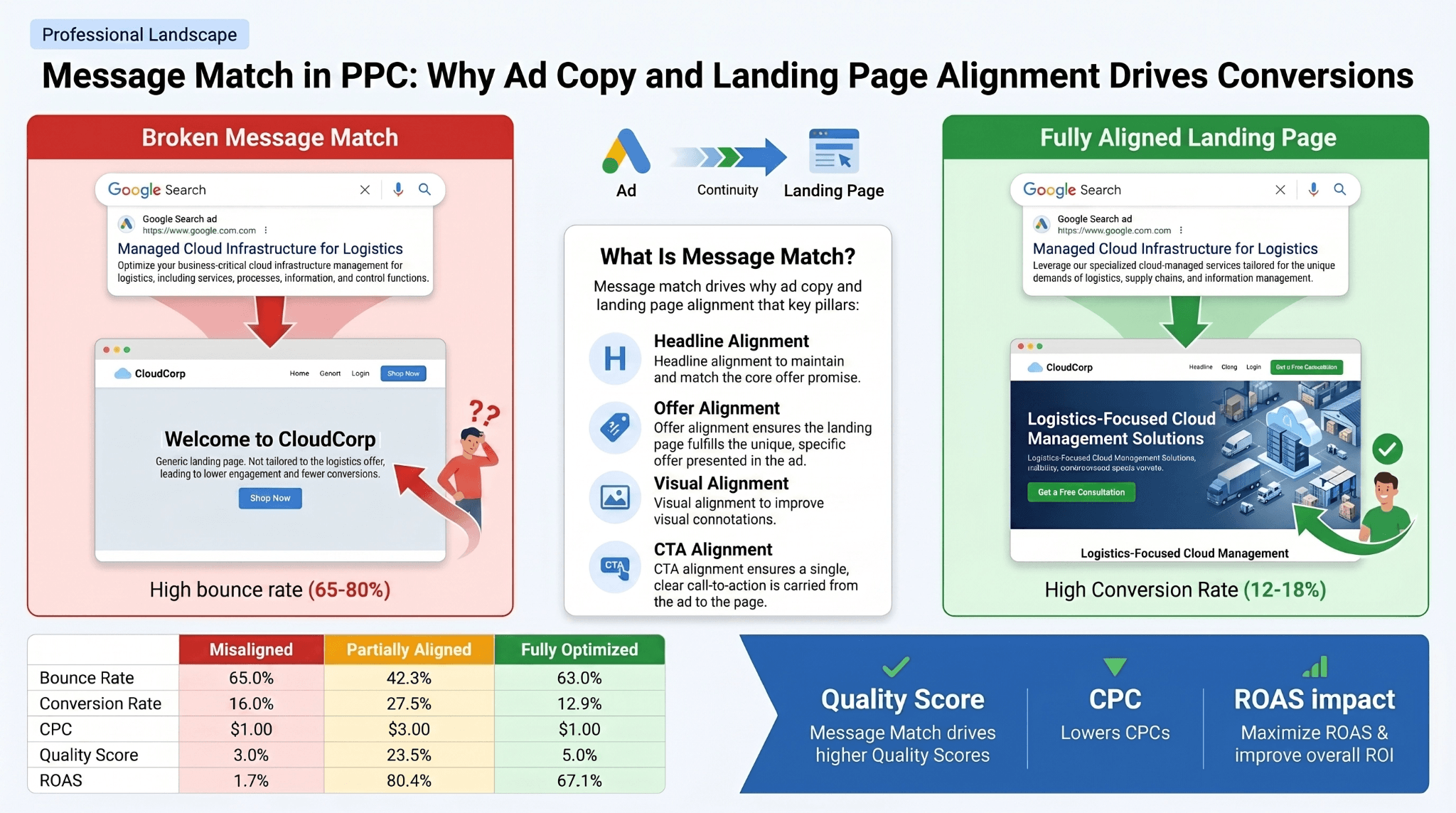
Ad copy and landing page alignment, also called message match in PPC, ensures every element on the landing page directly mirrors the expectation set by the ad. The headline, offer, visual tone, and CTA should feel like one continuous conversation.
Google evaluates this alignment as part of its Quality Score system. Poor message match signals a poor landing page experience, which raises the cost of every future click.
What Message Match Actually Looks Like in Practice
Consider two scenarios for a Google Ads landing page targeting "managed cloud infrastructure for logistics companies." Applying PPC landing page best practices from the start makes the difference between a visitor who converts and one who bounces.
In the aligned version, the ad and landing page headline match precisely. The visitor immediately knows they are in the right place. In the misaligned version, the same ad leads to a generic homepage. The visitor finds no confirmation, and the bounce rate reflects it instantly.
Build Landing Pages That Are Designed to Convert, Not Just Inform
A paid search landing page has one job. It is not to showcase every service or educate visitors about the company's full history. It exists to move one type of visitor toward one specific action.
Sending paid traffic to a homepage is one of the most costly mistakes in PPC campaign optimization. Homepages serve too many audiences, fragment attention, and destroy landing page conversion rate before a campaign has a chance to prove itself.
The median dedicated landing page converts at 4.02% in 2026, nearly double the 2.35% median for general website pages, with the top quartile exceeding 11.45%. That gap represents significant recovered value from existing ad spend.
The Core Elements Every Paid Search Landing Page Needs
A high-converting paid search landing page is built on a small number of non-negotiable components. Every element must earn its position on the page.
The foundational architecture of any effective page includes:
-
Keyword-aligned headline that confirms the visitor landed in the right place within five seconds
-
Single, action-oriented CTA that removes all ambiguity about the next step
-
Social proof above the fold, such as client names, case study results, or certifications
-
Simplified lead form with only the fields needed to qualify the lead
-
Fast load speed, given that 47% of users expect pages to load in two seconds or less
Landing page optimization is not a one-time task. It is an ongoing operational discipline rooted in PPC landing page best practices, especially for PPC lead generation campaigns where a single percentage point improvement compounds across thousands of monthly clicks.
Why a High Landing Page Conversion Rate Starts With Removing Friction
Friction is anything that increases the effort required to convert. It silently kills landing page performance and inflates cost per acquisition.
The most common friction points on paid search landing pages are:
-
Multiple competing CTAs pulling the visitor in different directions
-
Long forms asking for information not needed at the inquiry stage
-
Slow page load times, particularly on mobile
-
Navigation links that allow visitors to wander away from the conversion goal
-
Vague or generic headlines that fail to confirm the visitor is in the right place
Mobile now accounts for 65% of landing page traffic but converts at roughly 58% of the desktop rate. Closing that gap through faster load times and simpler mobile forms is one of the highest-leverage improvements available to any PPC manager in 2026.
Use Quality Score as a Profitability Signal, Not Just a Grade
Most PPC managers treat quality score as a metric to monitor. The more accurate framing is that the quality score is a financial lever that directly controls how much you pay per click.
Google's auction system does not award ad positions to the highest bidder. It rewards relevance. A higher quality score allows an advertiser to achieve the same or better ad position at a lower bid, which has a direct impact on campaign profitability.
How Quality Score Optimization Lowers Your Cost Per Click
Quality Score is calculated across three components. Improving any one of them can reduce CPC. Improving all three compounds significantly improves the savings.
The three components every advertiser needs to actively manage are:
-
Expected click-through rate: How likely your ad is to be clicked relative to competing ads
-
Ad relevance: How closely your ad copy matches the intent of the keyword being targeted
-
Landing page experience: Whether your landing page delivers on what the ad promised
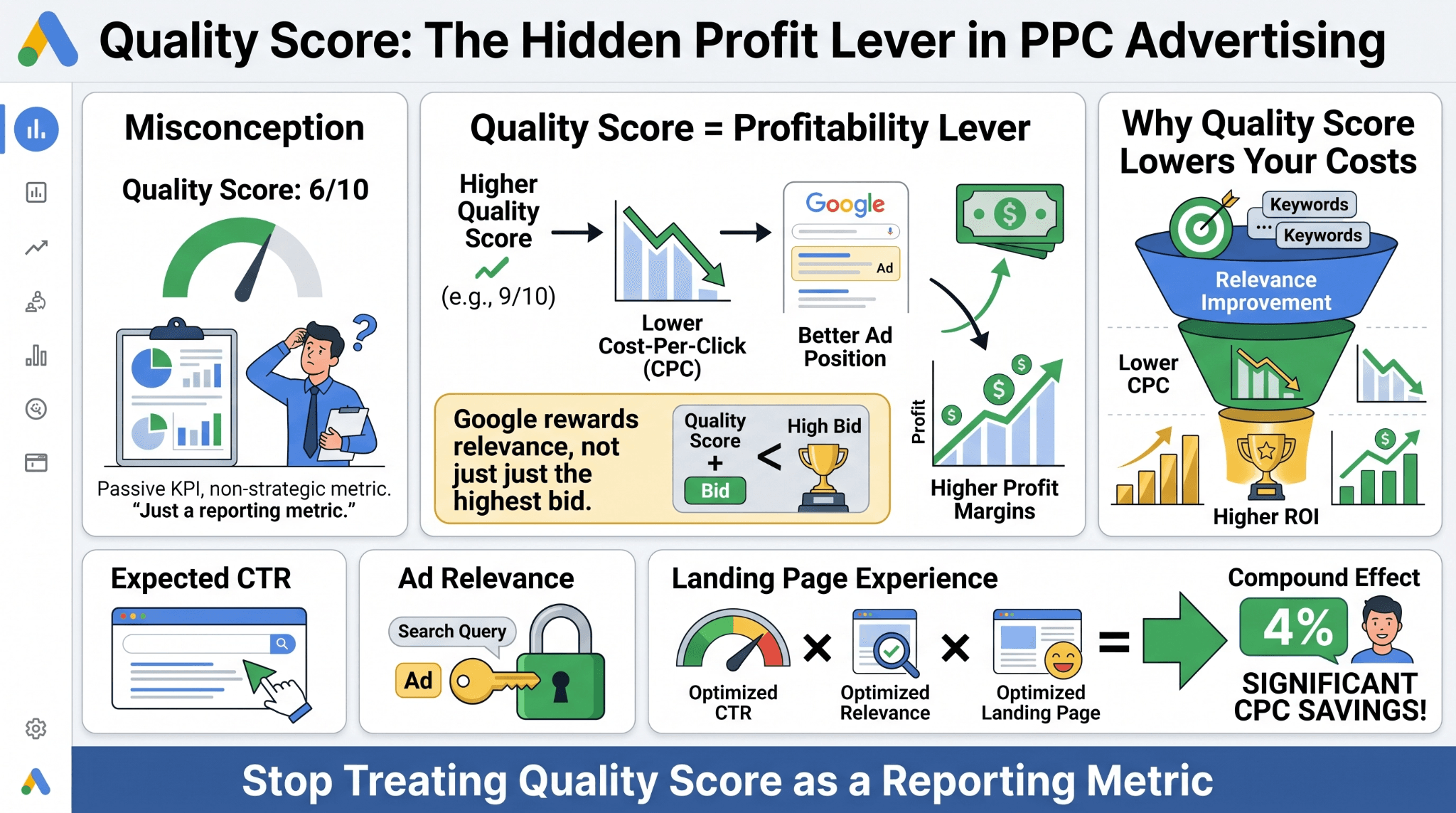
Improving Quality Score from 5 to 8 cuts CPC by approximately 30%. At the upper end, a Quality Score of 10 unlocks up to a 50% CPC discount relative to a Score of 5. For a campaign spending $5,000 per month, that differential means $1,500 to $2,500 in monthly savings with no reduction in traffic volume, and a direct improvement in PPC conversion rate without increasing a single dollar of ad spend.
Here is how Quality Score tiers map directly to CPC cost as of 2026:
|
Quality Score |
CPC Impact |
Relative Cost vs. Baseline (QS 5) |
|
1–3 |
Significant premium |
Up to 400% higher |
|
4–5 |
Baseline |
Standard auction cost |
|
6–7 |
Moderate savings |
15–30% lower |
|
8–10 |
Substantial savings |
30–50% lower |
Source: BizIQ PPC Statistics 2026; Foundry CRO Google Ads Benchmarks 2026
Set Up Conversion Tracking Before You Spend a Dollar on Ads
Running a PPC campaign without conversion tracking is the operational equivalent of running a business without a financial reporting system. Campaigns get scaled, budget gets allocated, all based on assumptions rather than data.
Conversion tracking PPC is the infrastructure layer that connects ad clicks to business outcomes. Without it, bidding algorithms have no optimization signal, and there is no defensible way to calculate return on ad spend (ROAS).
In 2026, this problem has grown more acute. Client-side pixel tracking alone now misses 30 to 50% of actual conversions due to browser restrictions and ad blockers used by over 42% of desktop users. Server-side tracking recovers 20 to 40% of that lost data.
What to Track and Why It Directly Impacts Your ROAS
Tracking page visits and time-on-site without connecting them to revenue-generating actions produces vanity metrics, not optimization signals.
The conversion events that directly feed return on ad spend calculations are:
-
Form submissions tied to qualified lead intake
-
Inbound phone calls from paid traffic sources
-
Demo or consultation requests for service-based businesses
-
Purchase completions for eCommerce and SaaS products
-
CRM-confirmed conversions that validate lead quality beyond the click

According to Digital Applied's 2026 PPC statistics report, 71% of advertisers are concerned about measurement accuracy in a cookieless environment. When conversion data is incomplete, bidding systems learn from the wrong signals. The only way to distinguish a high-performing campaign from an expensive traffic generator is a properly configured, server-side conversion tracking system.
Test Continuously: A/B Testing Is How PPC Campaigns Get Profitable
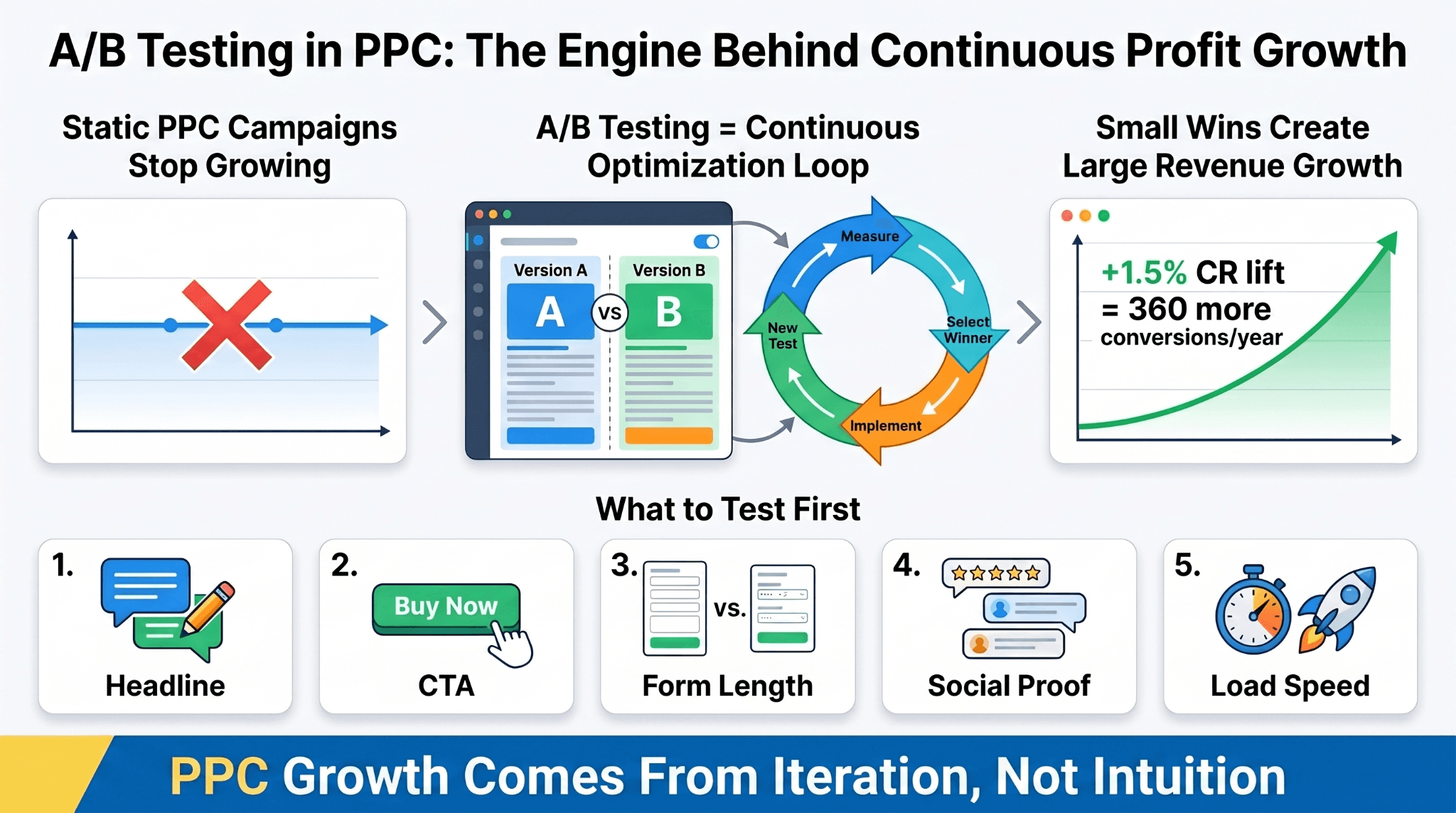
A PPC campaign that is not being tested is a campaign that is not improving. The performance ceiling of any ad or landing page is never known at launch. It is discovered through structured experimentation over time.
A/B testing landing pages is standard operational practice for any business running paid advertising. It is the primary mechanism through which campaigns evolve from acceptable performance to exceptional performance.
Small improvements compound significantly at scale. A headline test that lifts conversion rate by just 1.5 percentage points on a page receiving 2,000 monthly visitors generates 30 additional conversions per month, 360 incremental conversions annually from unchanged ad spend.
A/B Testing Landing Pages: Where to Start and What to Measure
The most common mistake in A/B testing is changing too many variables at once. When headline, CTA copy, form length, and imagery all change simultaneously, there is no way to attribute performance shifts to any specific element.
The highest-leverage elements to test on a paid search landing page, in order of typical impact, are:
-
Headline copy: Aligning it more precisely with the ad's exact keyword and promise
-
CTA button text: Testing action-specific language against generic alternatives
-
Form length: Reducing fields to the minimum required for lead qualification
-
Social proof placement: Testing trust signals above the fold versus below it
-
Page load speed: Measuring the direct conversion impact of technical improvements
PPC campaign optimization through systematic testing is not a fast process. Meaningful results require sufficient traffic volume and statistical significance. But the compounding effect of sequential tests is the mechanism that turns a functional campaign into a scalable, high-ROI system.
Real Queries of Marketers About PPC ROI and Landing Pages
These are the questions that come up most often when businesses start evaluating whether their paid advertising is actually working. The answers below are grounded in current 2026 data and operational experience across real campaigns.
How long does it take to see ROI from a PPC campaign?
Most campaigns require four to eight weeks before optimization signals become reliable. Meaningful ROI typically appears in months two and three, provided conversion tracking is configured correctly from day one.
Does a PPC landing page need to be a separate page from the main website?
Yes, for most campaigns. Dedicated paid search landing pages eliminate competing navigation and focus the visitor on a single action. Sending paid traffic to general pages consistently reduces landing page conversion rate and raises cost per acquisition.
What is a realistic paid advertising ROI benchmark in 2026?
Benchmarks vary by industry and campaign maturity. Visitors from PPC search ads convert at roughly 10.9% on dedicated landing pages when PPC landing page best practices are applied consistently. Early-stage campaigns typically perform in the 4 to 6% range before optimization matures.
What is the biggest reason PPC campaigns underperform even with a healthy budget?
The most common culprit is a disconnect between ad spend and infrastructure. Businesses invest in clicks but underinvest in the systems behind them, landing page architecture, conversion tracking, and Quality Score management. At WellsGroup, campaigns with the same budget but a properly engineered backend consistently outperform unstructured ones by a significant margin.
Should a business manage PPC in-house or work with a technology operator?
Simple campaigns can be managed in-house with the right tools. But as campaigns scale across multiple platforms, keywords, and landing page variants, the optimization workload grows fast. WellsGroup builds and continuously manages the full PPC infrastructure as a unified system, which is where the real ROI gap closes for scaling businesses.
The Difference Between PPC Spend and PPC Investment
Every business running paid advertising is doing one of two things. It is either spending money on clicks and hoping for the right outcome, or it is operating a system that tracks inputs, measures outputs, and continuously improves the relationship between the two.
The five practices covered here are not independent tactics. They are components of the same operational architecture. Message alignment, conversion-focused landing pages, Quality Score management, conversion tracking infrastructure, and continuous testing each amplify the others.
PPC campaigns built on these foundations do not just generate traffic. They generate measurable business outcomes that can be tracked, reported on, and scaled with confidence.
Turn your ad spend into a system that scales. Get a proposal from WellsGroup that builds and manages PPC infrastructures engineered for measurable ROI.