How to Rank in ChatGPT Search: 6 Proven Tactics for AI SEO
Master six proven AI SEO tactics to rank in ChatGPT Search, earn trusted citations, strengthen entity authority, and increase long-term visibility.

To rank in ChatGPT Search, structure content around direct, verifiable answers, build entity authority through consistent brand mentions, earn citations from trusted third-party sources, apply structured data, and address layered questions in one place. ChatGPT retrieves from organized, well-sourced content rather than pages built around keyword density alone.
This guide breaks down exactly how to rank in ChatGPT search, covering six tactics WellsGroup applies across client accounts today, from SaaS platforms to logistics and marketplace businesses. Each tactic is grounded in how ChatGPT actually retrieves and cites information, not in assumptions carried over from traditional keyword-based SEO. Book a free consultation with WellsGroup and talk through your AI search strategy first.
What Is ChatGPT Search and How Does It Choose Sources?
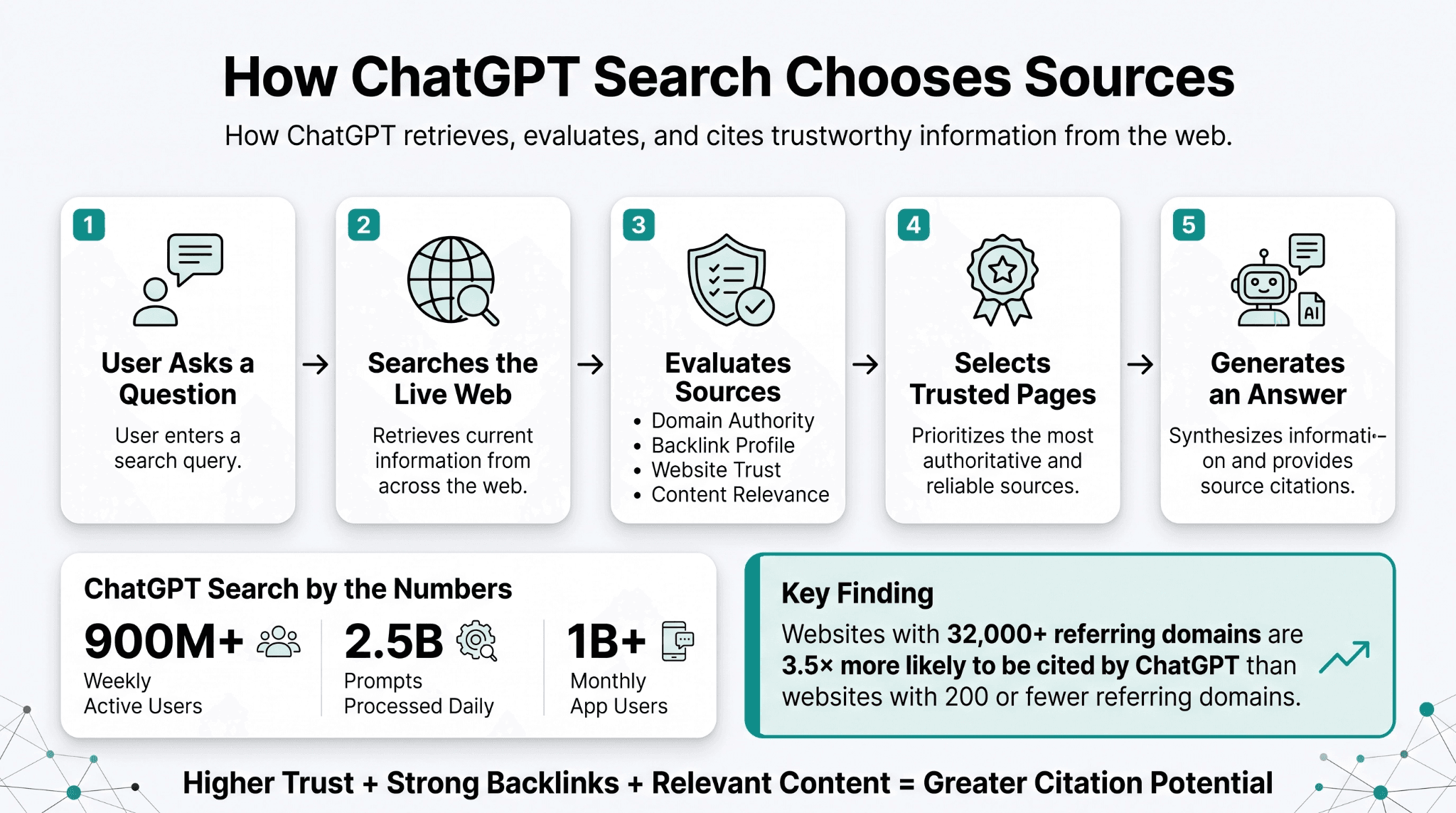
ChatGPT Search is OpenAI's retrieval layer. It lets ChatGPT pull live information from the web instead of relying only on training data. When a query needs current information, the model retrieves candidate pages and synthesizes an answer, often with source links attached.
The platform now operates at real internet scale:
-
OpenAI confirmed 900 million weekly active users on February 27, 2026
-
Reuters reported the ChatGPT app passed 1 billion monthly active users in June 2026, citing Sensor Tower data
-
The platform processes an estimated 2.5 billion prompts per day
Source selection is not random. SE Ranking's dedicated ChatGPT citation study, which analyzed 129,000 domains and 216,524 pages, found that sites with more than 32,000 referring domains are 3.5 times more likely to be cited by ChatGPT than sites with 200 or fewer referring domains. Backlink history and domain traffic act as trust signals that the model uses to decide what to cite.
 Why Does Ranking in ChatGPT Search Matter for Your Business?
AI-mediated discovery is already reshaping how buyers research vendors and compare tools, often before they ever visit a company website.
A few data points show why this shift matters now:
-
Google's AI Overviews trigger on roughly 48% of tracked queries as of March 2026, per BrightEdge's industry benchmark
-
Citation patterns inside AI Overviews increasingly mirror what ChatGPT surfaces for the same queries
-
Buyers are compressing multiple research steps into a single AI conversation instead of multiple search sessions
A business that understands how to rank on ChatGPT is not optimizing for one platform. It is building the entity signals, structured content, and citation footprint that Google, Gemini, and other retrieval systems draw from, too.
The mechanics behind that visibility differ from a decade of keyword-driven SEO, which is worth unpacking before the tactics.
How Is ChatGPT Search Different From Traditional SEO?
Traditional SEO rewards a page for ranking against a query, based on backlinks, keyword placement, and domain authority measured in aggregate.
ChatGPT Search works differently:
-
It scores at the passage level, not the page level
-
It extracts the specific paragraph that answers a question precisely, wherever it sits on the page
-
A page can rank on page one of Google and still never get cited by ChatGPT, because the model is judging individual answer blocks, not the page as a whole
Tactic 1: How to Rank in ChatGPT Search Starting with Content Structure
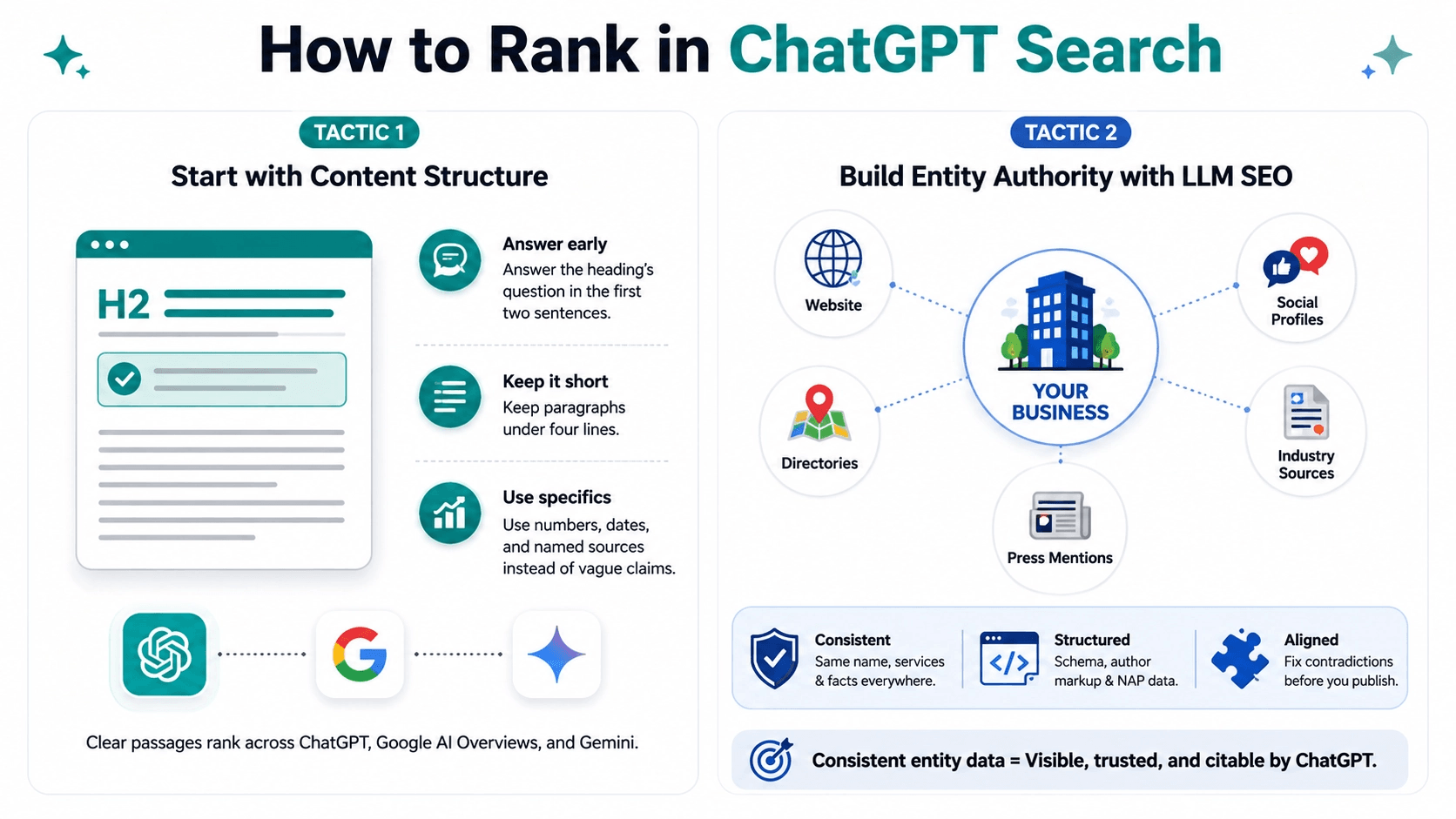
The first tactic behind how to rank in ChatGPT search is formatting content so the model can extract it cleanly. Open each section with a direct answer before any narrative buildup, so the model has a complete thought it can lift without extra context.
Three formatting habits consistently improve extraction rates:
-
Answer the heading's implied question in the first two sentences beneath it
-
Keep paragraphs under four lines so passages stay self-contained
-
Use specific numbers, dates, and named sources instead of vague claims
Pages built this way tend to perform well across ChatGPT, Google AI Overviews, and Gemini at once, since all three favor passage-level clarity over page-level polish.
Tactic 2: How to Rank in ChatGPT Search Through Entity Authority and LLM SEO
ChatGPT needs to recognize a business as a coherent, trustworthy entity before it cites that business consistently. This is the core discipline behind llm seo: reinforcing who you are, what you do, and where you operate, in the same language, everywhere the model can access.
Entity authority comes from consistency, not volume:
-
Use the same brand name, service descriptions, and founding facts across your website, directories, press mentions, and social profiles
-
Apply Organization schema, author markup, and consistent NAP (name, address, phone) data so retrieval systems have a machine-readable map of your entity
-
Fix contradictions between platforms before publishing new content, since fragmented entity data undermines everything built on top of it
This is where llm seo diverges from conventional brand building. A business can have strong human brand recognition while remaining nearly invisible to a language model, simply because its entity data is scattered across inconsistent sources.
Here is how ranking signals differ between traditional search engines and LLM-based retrieval:
|
Ranking Factor |
Traditional SEO Weight |
ChatGPT / LLM SEO Weight |
|
Backlink volume |
High, aggregated at the domain level |
Moderate, evaluated per citing source |
|
Keyword density |
High |
Low, replaced by semantic relevance |
|
Content freshness |
Moderate |
High, especially for evolving topics |
|
Entity consistency |
Low |
High, critical for citation trust |
|
Structured data |
Moderate |
High, supports machine parsing |
|
Passage-level clarity |
Low |
Very high, drives direct extraction |
Tactic 3: How Do You Get Cited by ChatGPT Through Digital PR?
Earning a mention from a third-party publication is one of the strongest ways to get cited by ChatGPT. The model treats independent validation as a stronger trust signal than a company describing itself.
What this looks like in practice:
-
Publish original data, expert commentary, or industry analysis that trade publications and forums want to reference
-
Target sites the model already trusts, since a citation on an established outlet carries more weight than dozens of low-authority mentions
-
Expect compounding returns. Once a handful of authoritative sites reference your company, later citations require less effort, since the model is reinforcing an entity it has already encountered
Tactic 4: How Do You Answer Layered User Queries in Your Content?
ChatGPT users rarely ask one isolated question. They chain follow-ups within a conversation, asking about cost, timelines, and comparisons in sequence.
To match that pattern:
-
Group related subtopics under one clear page instead of splitting them across disconnected posts
-
Give each subtopic its own direct-answer block so it can be extracted independently
-
Anticipate the next question a reader would naturally ask, such as timeline or measurement approach, and answer it on the same page
A page covering how to rank on ChatGPT should follow this same logic rather than forcing readers onto a separate page for each related question.
Tactic 5: How Do You Use Structured Data to Support ChatGPT SEO?
Schema markup is one of the most underused levers in chatgpt seo, mainly because its value is invisible to a human reader. It exists to help machines parse a page's structure and meaning accurately.
Three schema types carry the most weight for AI retrieval today:
|
Schema Type |
Primary Purpose |
Retrieval Benefit |
|
Article schema |
Identifies content type, author, and publish date |
Signals freshness and authorship to retrieval models |
|
Organization schema |
Defines entity name, logo, and official properties |
Reduces entity ambiguity across the web |
|
FAQ schema |
Structures question and answer pairs |
Aligns with how models extract Q&A content |
Applying these consistently across a site's core pages, not just the blog, reinforces the entity signals covered earlier and gives every retrieval system a clearer map of the business.
Tactic 6: How Do You Keep Content Fresh Enough for ChatGPT to Trust It?
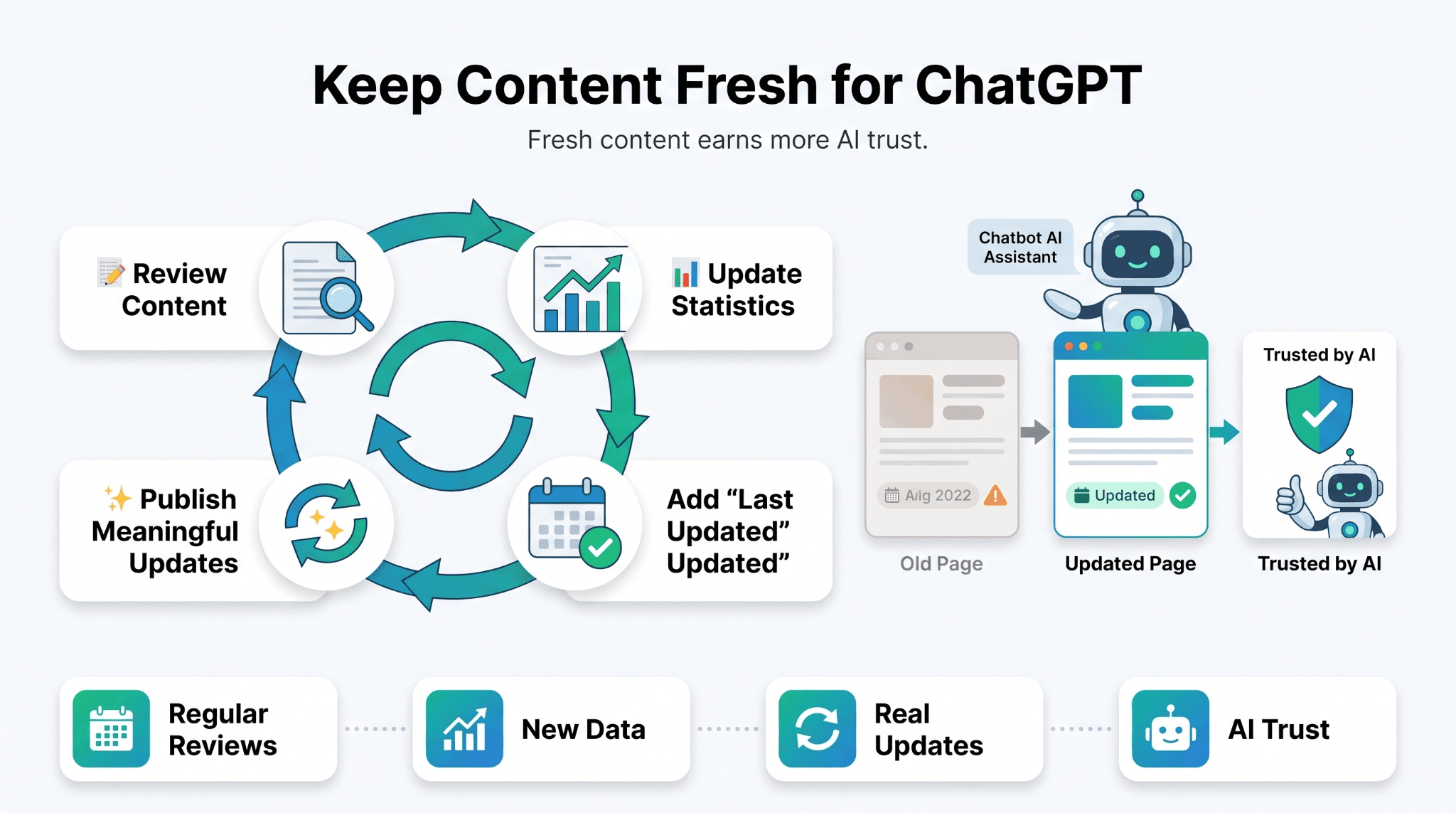
Freshness signals carry more weight in AI retrieval than they historically did in traditional SEO, since models actively avoid citing outdated information on fast-moving topics.
A practical freshness cycle includes:
-
Revisiting cornerstone content on a defined schedule
-
Updating statistics as soon as newer data becomes available
-
Marking a visible last-updated date, exactly as this article does
-
Republishing with genuinely new information rather than cosmetic edits, since surface-level updates rarely earn renewed trust
What Mistakes Prevent Businesses From Ranking in ChatGPT Search?
Most businesses that fail at how to rank in ChatGPT search are not lacking effort. A small set of recurring structural problems is usually the cause:
-
Publishing content without a direct answer near the top, forcing the model to infer intent from context
-
Letting brand name, service descriptions, or founding details vary across pages and platforms
-
Skipping structured data entirely, or applying it inconsistently across the site
-
Treating freshness as optional, leaving outdated statistics live on high-traffic pages
-
Chasing citations from low-authority sites instead of a smaller number of genuinely trusted ones
Each of these is fixable without a full content rebuild, but they need a systems-level review rather than isolated fixes to individual pages.
What Should You Watch For in AI Search Visibility Going Forward?
AI search visibility is still evolving, and the questions businesses ask about it tend to cluster around a few recurring themes.
Will AI search replace traditional Google search entirely?
Not in the near term. Roughly half of queries still return traditional results without an AI Overview, and many transactional and local searches remain largely untouched by AI summaries.
How often should content be updated for ChatGPT to keep citing it?
There is no fixed interval, but cornerstone pages on fast-changing topics benefit from a review every 60 to 90 days, with a visible last-updated date maintained throughout.
Does paid advertising influence ChatGPT citations?
No. ChatGPT's retrieval layer selects organic sources based on relevance and trust signals, independent of any advertising relationship. This differs from how paid placements work inside traditional search results.
Does adding an llms.txt file guarantee ChatGPT will cite your site?
No. Studies in 2026 found 97% of llms.txt files get zero AI crawler requests, and no major AI provider has confirmed using it as a ranking signal. WellsGroup treats it as one small piece of a broader visibility system, not a standalone fix.
How can you tell if ChatGPT is actually crawling and citing your site?
Check server logs for requests from AI crawlers like GPTBot, ClaudeBot, and PerplexityBot, since crawler activity doesn't always mean citation. WellsGroup builds this kind of citation tracking directly into client accounts.
The Businesses Winning in ChatGPT Search Right Now
The businesses gaining consistent visibility inside ChatGPT are not the ones publishing the most content. They are the ones treating entity consistency, structured data, and citation quality as an operating system, not a campaign with a start and end date.
That distinction matters because AI retrieval rewards accumulated trust over time, not short bursts of optimization. A business maintaining consistent entity signals for a year will outperform one running an intensive but temporary push, even when the second business publishes more in total. That advantage compounds further when structured data, content architecture, and citation tracking are connected inside one system rather than managed as separate tasks.
WellsGroup builds and operates this kind of system directly inside a client's existing technology stack, so visibility compounds rather than resets with every algorithm shift. You can review how this has played out across real deployments in our case studies.
If your business is ready to move from isolated content efforts to an AI-operated visibility system, get a proposal from WellsGroup.