How to Optimize Your Website for Google and AI Search
Learn how to optimize your website for AI search visibility, earn citations, build authority, and stay discoverable in 2026.

A business owner spends six months improving rankings, fixing technical issues, publishing content, and earning backlinks. Traffic holds. Then a competitor starts appearing inside AI-generated answers across Google, ChatGPT Search, and Perplexity, and inbound inquiry volume shifts without a single ranking change on either side.
That scenario is the operating reality for most industries in 2026. The need to optimize a website for AI search now runs parallel to, and in some cases ahead of, traditional SEO priorities.
Google AI Mode crossed 75 million daily active users by early 2026, a 4x increase since its May 2025 launch. AI Overviews now appear in 25.11% of Google searches, based on Conductor's analysis of 21.9 million queries. ChatGPT Search, Perplexity, and Gemini have added hundreds of millions of users now discovering businesses through AI-generated answers rather than ranked links.
For founders and operations leaders who want systems over experiments, what follows breaks down how to optimize your website for AI search while maintaining strong Google visibility.
A business owner spends six months improving rankings, fixing technical issues, publishing content, and earning backlinks. Traffic holds. Then a competitor starts appearing inside AI-generated answers across Google, ChatGPT Search, and Perplexity, and inbound inquiry volume shifts without a single ranking change on either side.
That scenario is the operating reality for most industries in 2026. The need to optimize a website for AI search now runs parallel to, and in some cases ahead of, traditional SEO priorities.
Google AI Mode crossed 75 million daily active users by early 2026, a 4x increase since its May 2025 launch. AI Overviews now appear in 25.11% of Google searches, based on Conductor's analysis of 21.9 million queries. ChatGPT Search, Perplexity, and Gemini have added hundreds of millions of users now discovering businesses through AI-generated answers rather than ranked links.
For founders and operations leaders who want systems over experiments, what follows breaks down how to optimize your website for AI search while maintaining strong Google visibility.
What "AI Search Optimization" Actually Means Today
Most businesses approaching AI search optimization for websites start in the wrong place. They add AI-related keywords to existing pages, publish AI-generated content at scale, or chase whichever tool claims to improve citation ranking. None of those approaches addresses how AI search systems actually work.
When an AI system generates an answer, it is not returning the highest-ranked page. It is doing three things:
-
Identifying trusted sources already associated with authority on that topic
-
Extracting structured information from those sources
-
Synthesizing a response that cites entities it can verify
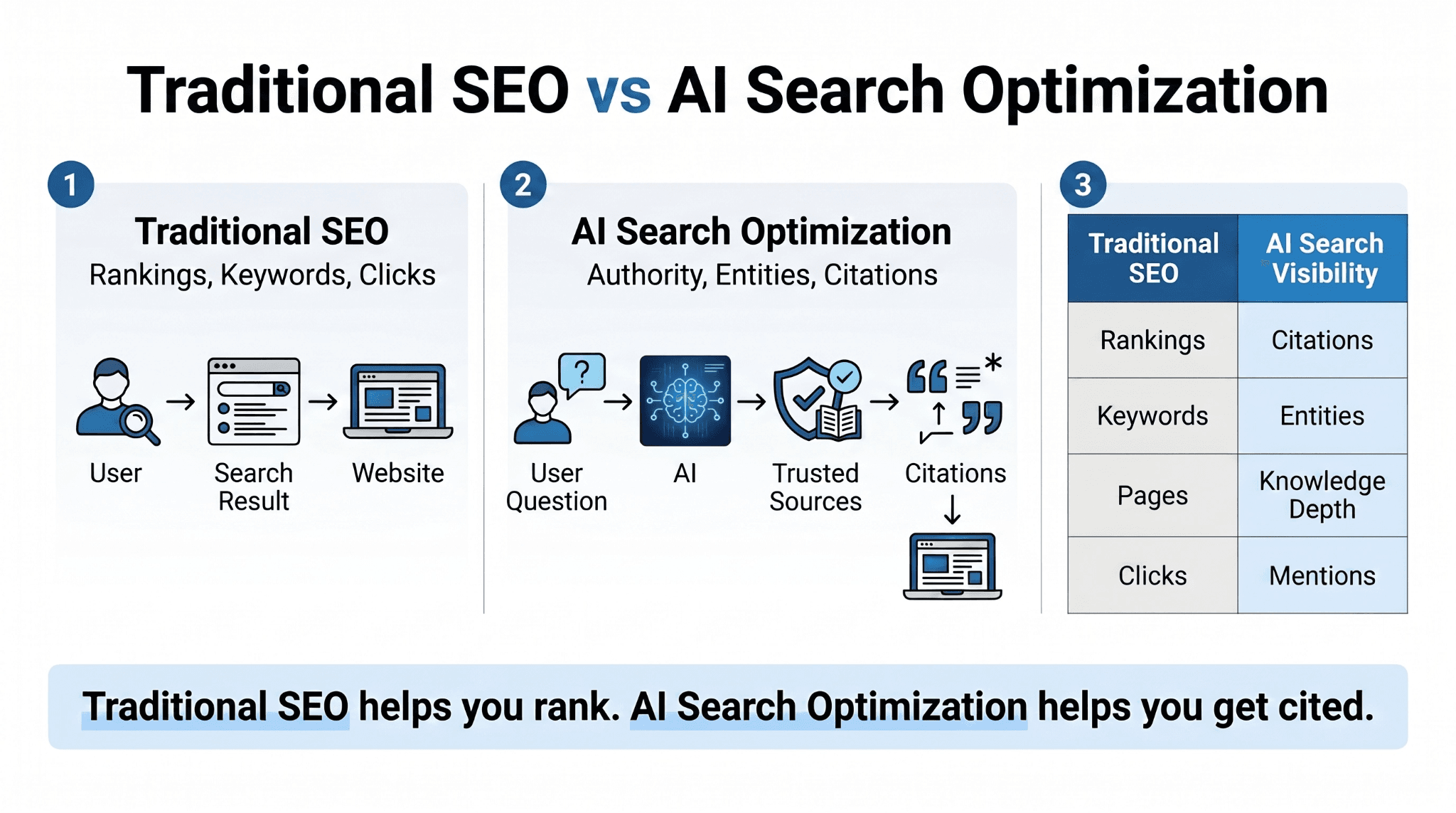
Traditional SEO is about ranking. AI search optimization for websites is about becoming a source AI systems consider safe to reference. Optimizing a website for AI search means building the infrastructure that makes your content both retrievable and citable, not just indexed.
Why Traditional SEO Alone Is No Longer Enough
The user journey through search has structurally changed. In 2024 and much of 2025, the path was linear. In 2026, a parallel path runs alongside it, and for many commercial queries, it runs ahead.
Traditional Search Journey: User → Search Result → Website
AI Search Journey: User → AI-Generated Answer → Cited Sources → Website
Optimizing a website for ChatGPT, Perplexity, and AI search visibility requires a different set of signals than ranking in a traditional SERP:
|
Traditional SEO |
AI Search Visibility |
|
Rankings |
Citations |
|
Keywords |
Entities |
|
Pages |
Knowledge depth |
|
Clicks |
Mentions |
|
SERPs |
AI-generated answers |
Brands cited in AI Overviews earn approximately 35% higher organic CTR and 91% higher paid CTR compared to uncited brands, according to Seer Interactive. Meanwhile, a 2026 report by Fuel Online found that 62% of enterprise brands were invisible to generative AI models, despite 94% investing heavily in traditional SEO.
Businesses that only optimize for rankings risk losing visibility inside the AI-generated answers where buying decisions now begin.
The Core Elements That Help AI Search Engines Understand Your Website
To optimize a website for AI search engines, content architecture matters as much as content itself. AI retrieval systems parse structure, extract entities, and evaluate trust signals before a human ever reads the output.
Clear Topic Authority
AI systems build associations between brands and subject domains based on content depth and consistency. A brand that has published 80 pieces of high-quality, well-cited content on a subject will earn citations faster than a brand with one piece, even if that single piece is excellent.
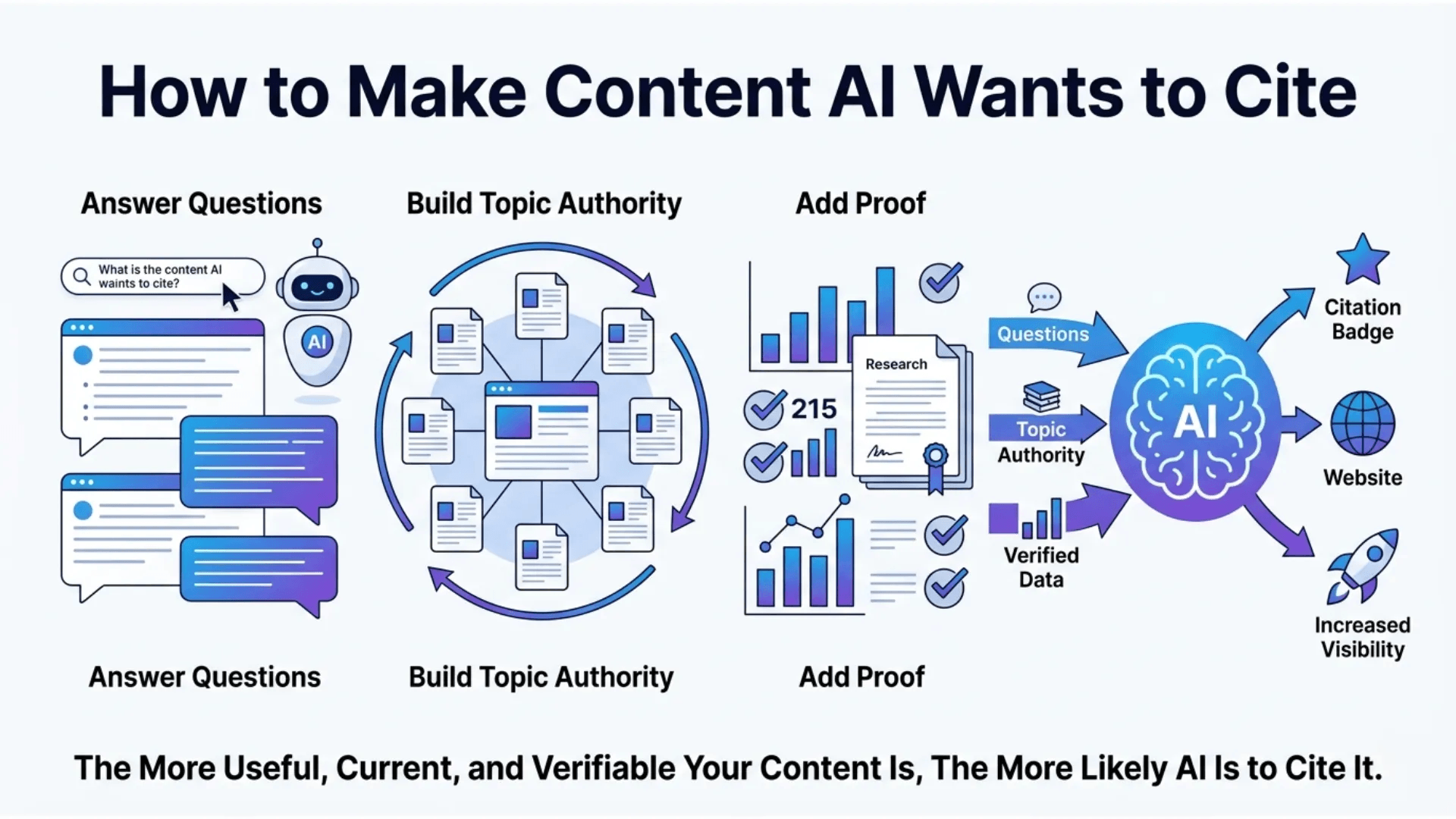
Topic authority is built through content clusters, interlinked articles covering a subject from multiple angles. AI search engine optimization for websites begins here: map your expertise, identify the questions your audience asks, and build comprehensive coverage around each one.
Structured Content Architecture
AI systems extract answers more reliably from pages with:
-
Clear H2 and H3 headings that mirror real user questions
-
FAQ sections with concise, direct answers
-
Schema markup, FAQ, Article, and Organization schema
-
Logical internal linking that connects related topics
Entity-Based Optimization
Optimize website content for AI search engines by treating your brand, products, services, and key personnel as named entities. When these appear consistently across your website, Google Business Profile, third-party publications, and social profiles, you become a more reliable entity for AI systems to cite.
Trust Signals
AI retrieval systems do not just evaluate what your content says. They evaluate whether your content comes from a source they can verify. Large language models reward pages tied to verifiable human credentials because those pages carry trust signals that machines can extract and cross-reference against other authoritative sources.
In practice, this means:
-
Named authors with verifiable expertise
-
Cited sources for every factual claim
-
External mentions on credible publications
-
Consistent brand presence across platforms
Agencies that help with optimizing websites for AI search consistently identify trust infrastructure, not content volume, as the primary gap in most business websites.
How to Optimize Website Content for AI Search Results
Moving from architecture into content strategy requires a different orientation than traditional SEO. How to optimize a website for AI search results is fundamentally a question of content design, not just production volume.
Write for Questions, Not Just Keywords
AI search systems are retrieval engines built to answer questions. Every major section of a page should be able to stand alone as a complete answer to a specific query, not build toward an answer across several paragraphs.
Build Comprehensive Topic Coverage
AI models treat content freshness and topical depth as key trust signals. A page that was accurate and well-structured in 2024 but has not been updated since is already losing citation ground to fresher, more current alternatives. AI systems actively deprioritize stale content when evaluating which sources to reference in a generated answer.
Optimizing a website for AI search requires a content maintenance discipline, not just a publishing calendar.
Use Statistics and Original Insights
Original research and data-rich content consistently outperform generic informational pages in AI citation rates. When AI systems generate an answer, they favor sources that contain specific, verifiable claims over sources that speak in generalities because concrete data reduces the risk of a hallucinated or inaccurate response.
Every factual claim should be attributed, every statistic sourced, and every insight specific. Vague content gives AI systems nothing concrete to extract and cite with confidence.
Where Businesses Are Getting AI Search Optimization Wrong
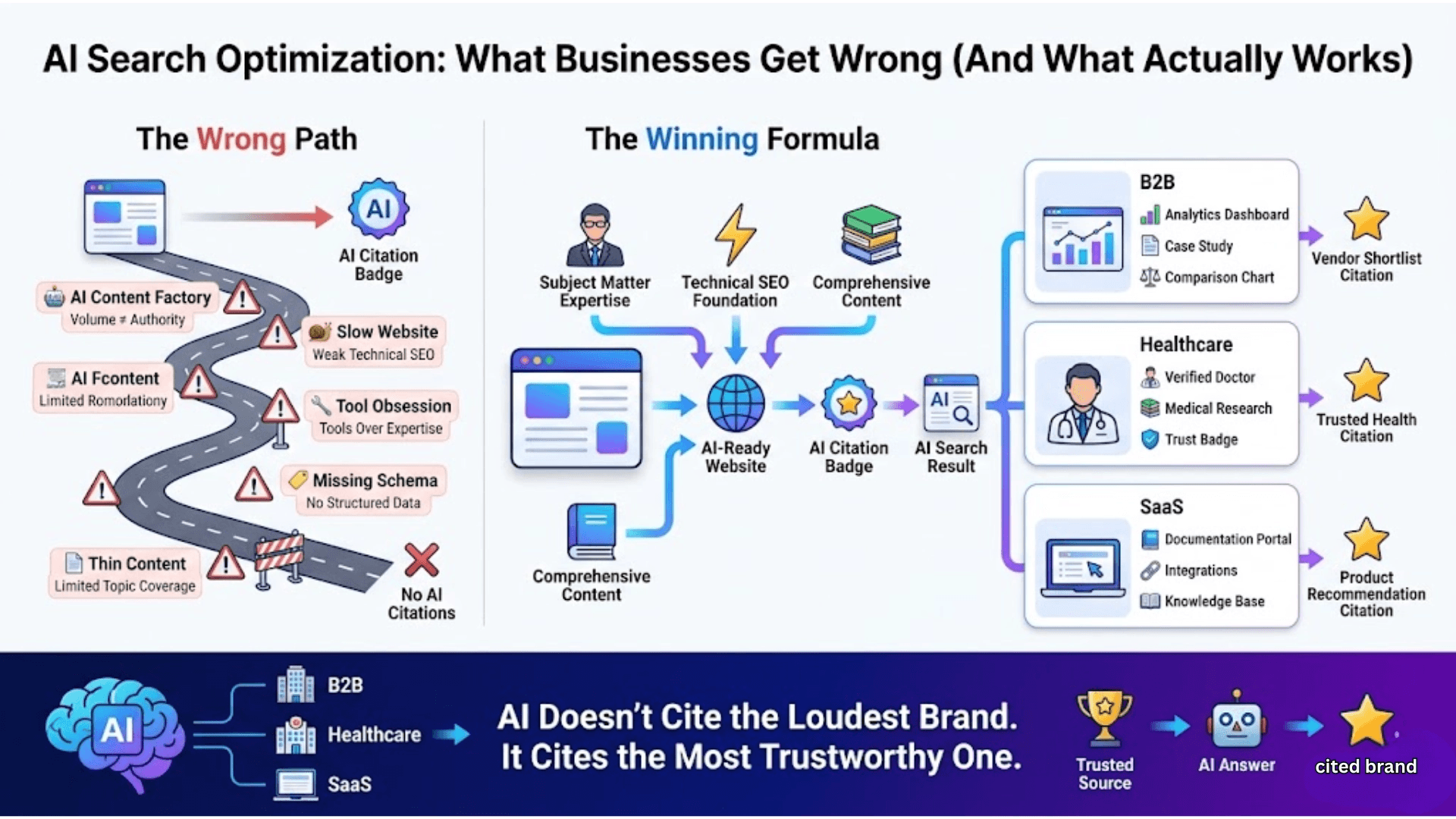
Most businesses are making the same errors, and each one compounds over time:
-
Publishing AI-generated content at scale. Volume without expertise does not build topical authority. AI amplifies expertise. It does not create it.
-
Ignoring Google SEO fundamentals. Page speed, crawlability, and core web vitals remain prerequisites. AI systems cannot cite pages they cannot access cleanly.
-
Chasing tools instead of authority. No tool substitutes for genuine subject matter depth. The AI search optimization for websites that produces durable results is built on real expertise, not optimized prompts.
-
Missing structured data. Schema markup is the primary mechanism through which AI systems classify content and associate it with the correct entities.
-
Thin content across key topic areas. AI systems evaluate the credibility of entire domains, not just individual pages. Shallow supporting content signals limited authority regardless of how strong a single page is.
Industry-Specific Applications of AI Search Optimization
The structural principles of AI search optimization apply universally. Implementation, however, varies meaningfully by industry.
How to Optimize B2B Websites for AI-Driven Search
B2B buyers now use AI search engines to shortlist vendors and validate expertise before any sales contact. How to optimize B2B websites for AI-driven search requires content that demonstrates operational depth:
-
Detailed case studies with measurable outcomes
-
Solution pages addressing specific use cases, not general categories
-
Comparison content that clearly articulates trade-offs
B2B websites that establish AI-retrievable expertise earn citations during the research phase, before a competitor has had any direct contact with the buyer.
AI Search Optimization for Medical Websites
Health queries trigger AI Overviews at the highest rate of any category, making verified author credentials, cited clinical sources, and compliance-conscious content structure the baseline, not a differentiator.
To optimize a medical website for AI search tools, E-E-A-T signals are non-negotiable: named clinician authors, institutional affiliations, cited clinical sources, and compliance-conscious content structure. AI search optimization for medical websites is not an SEO exercise. It is a trust infrastructure exercise. Medical websites that cannot demonstrate verifiable expertise will not earn citations regardless of traffic volume.
How SaaS Companies Can Improve AI Visibility
SaaS companies have a structural advantage: their documentation, use case libraries, and integration pages are exactly the type of structured, information-dense content AI retrieval systems prefer.
To optimize a SaaS website for generative AI search, treat your knowledge base as a primary AI visibility asset, not just a support function. Detailed integration documentation and product comparison content position your brand as the cited source when potential buyers query AI engines about solutions in your category.
Examples of AI-Driven Websites Optimized for Search Engines
The examples of AI-driven websites optimized for search engines that earn consistent citations share a recognizable set of structural traits regardless of industry or domain size.
Website A demonstrates strong topical authority through deep content clusters, original research with cited data, and named expert authors. Internal linking connects related topics into a coherent knowledge structure that AI systems can map.
Website B operates a dedicated knowledge hub, comprehensive guides, structured FAQ content, and schema markup across all informational pages, covering its subject domain at a depth that isolated blog posts cannot match.
Website C maintains detailed, regularly updated product and integration documentation. Each page is structured so that specific answers can be extracted cleanly without the full page needing to be read.
All three share one underlying logic: built to be understood by machines and trusted by humans simultaneously.
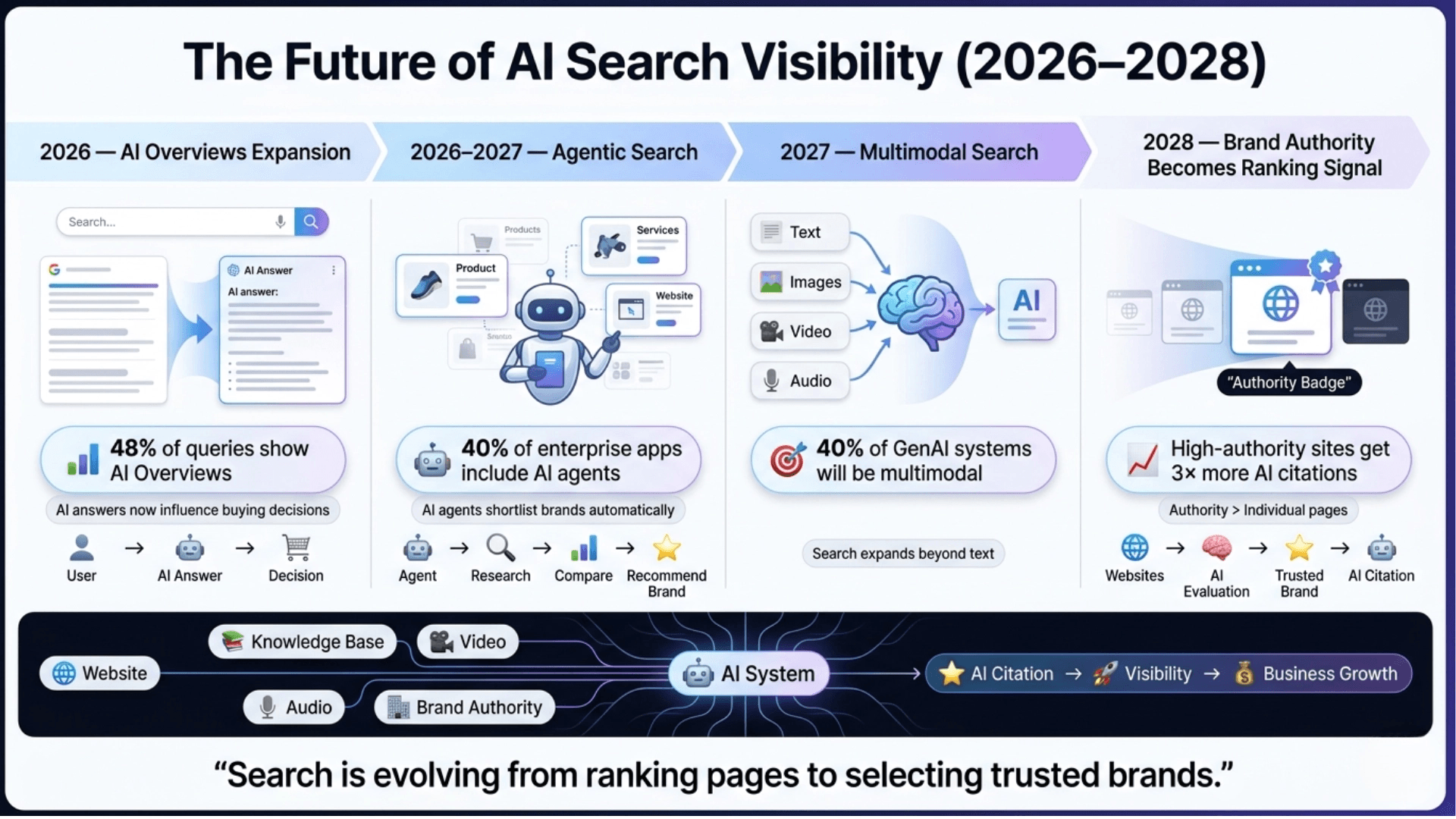
What AI Search Visibility Will Look Like Over the Next Three Years
AI Overviews Expansion
BrightEdge measured AI Overview presence at approximately 48% of tracked queries by February 2026, up from 31% a year earlier. The expansion into commercial and transactional queries is accelerating; AI-generated answers will increasingly influence purchase decisions, not just informational research.
Agentic Search
Gartner predicts 40% of enterprise applications will include integrated task-specific AI agents by the end of 2026, up from less than 5% in 2025. Brands without established AI visibility will be functionally absent from agentic research workflows.
Multimodal Search
Gartner predicts 40% of generative AI solutions will be multimodal, covering text, image, audio, and video, by 2027. Websites optimized only for text-based retrieval will need to expand their structured data and content formats.
Brand Authority as a Ranking Signal
Domain authority is the strongest predictor of AI citation probability, with high-traffic sites earning three times more AI citations than low-traffic ones, according to SE Ranking's study of 2.3 million pages. AI visibility will increasingly reward trusted entities over isolated pages.
What Business Leaders Are Asking About AI Search Visibility
AI search visibility is a relatively new operational concern, and the same foundational questions come up consistently. What they share is a common thread: this is not a content marketing problem. It is an infrastructure problem. Businesses that treat it as such are the ones building a durable competitive advantage.
What is the difference between SEO and AI search optimization?
Traditional SEO optimizes for ranked positions. AI search optimization positions your brand as a source AI systems cite when generating answers. Both matter in 2026, but they require different signals, structures, and measurement frameworks. WellsGroup engineers both as a connected system.
How long does it take to see results?
Building genuine topical authority and trust infrastructure takes three to six months of consistent execution. Quick fixes do not produce durable AI citations.
Does this apply to my industry?
Yes. Health queries trigger AI Overviews in over 60% of cases. B2B research increasingly begins with AI-generated vendor summaries. Logistics, SaaS, ecommerce, and professional services are all affected.
Can a small business compete against larger brands?
Focused expertise in a specific subject domain outperforms broad, shallow coverage at any domain size. Depth beats breadth every time.
How does WellsGroup approach AI search visibility?
WellsGroup engineers AI search visibility as a connected operational system, combining content architecture, entity optimization, trust signal infrastructure, and performance tracking into a unified layer. The goal is not content that might get cited. It is building the structural conditions under which citation becomes the predictable output.
Visibility Now Depends on More Than Rankings
AI search is not an SEO trend. It is an infrastructure shift in how businesses are discovered, evaluated, and chosen.
Visibility in 2026 is no longer determined by ranked position alone. It is determined by whether your brand has built the content depth, entity authority, and trust infrastructure that AI systems require to cite you confidently. Rankings remain important. But a business that ranks well and is invisible to AI search is operating with a significant and widening blind spot.
The businesses building those systems now are compounding a discovery advantage that becomes harder to close with each passing quarter.
The question is no longer whether AI will influence how customers find your business. The question is whether your website is prepared to be part of the answers they receive.