Digital PR Strategy: 7 Ways to Build Authority Links
Build stronger authority with seven proven digital PR strategies that earn quality backlinks, increase brand credibility, and improve AI search visibility.

A digital PR strategy is a structured system for earning backlinks, brand mentions, and media coverage through newsworthy content, rather than paid placement or manual link requests. Done well, it builds durable domain authority, strengthens visibility inside AI search engines, and produces links that keep compounding long after a campaign ends.
Most businesses still treat digital PR as an occasional project rather than an operating system. That distinction matters more in 2026, since search engines and AI answer tools now weigh earned coverage differently from self-published content, and the gap between brands treating digital PR as infrastructure versus a one-off campaign is widening.
If your current link-building efforts are inconsistent or hard to measure, book a free consultation with WellsGroup to architect a digital PR system built for repeatable authority growth.
What Is Digital PR?
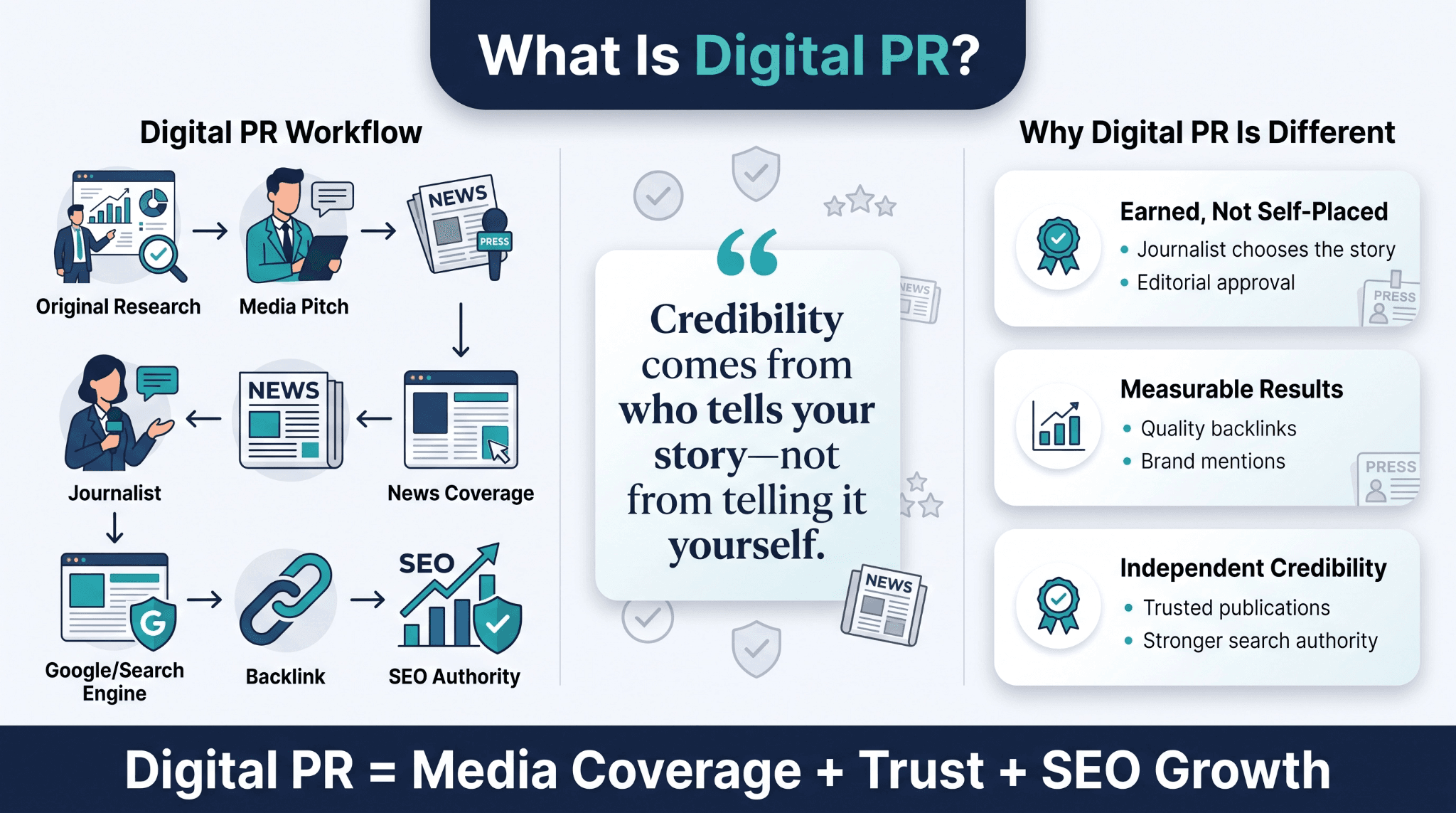
Digital PR is the practice of earning coverage, mentions, and backlinks from online publications and journalists, usually by pitching data, expert commentary, or original research rather than paying for placement.
Think of it this way. If you print your own flyer, people can ignore it because you made it yourself. If a respected teacher tells the class you did something impressive, people listen differently, because the credibility belongs to the messenger.
What sets digital PR apart from other link-building methods:
-
It is earned, not self-placed. Guest posts are written and placed by the brand itself. Digital PR links exist because a journalist decided the story was worth writing about.
-
It produces a measurable asset. Every placement should result in a backlink, a brand mention, or both, not just impressions.
-
It carries independent credibility. A search engine trusts a third-party citation more than content a brand publishes about itself.
Why Does Digital PR Matter for Building Authority Links?
Search engines do not treat every backlink equally. A link from a site with thin editorial standards carries little ranking value. A link earned through a journalist citing your data on an established news site signals genuine third-party credibility.
That distinction has only become more important in 2026:
-
Reporter Outreach's State of Link Building 2026 survey of 500 SEO professionals found that 34 percent ranked digital PR as their best-performing method, nearly double the 18 percent who ranked guest posting first.
-
The same survey found 76 percent of practitioners now pay at least $300 per placement, reflecting a market shifting toward quality over volume.
Directory links, low-quality guest posts, and reciprocal exchanges rarely survive an algorithm update because they were never based on genuine editorial trust. Digital PR links tend to hold their value because that trust signal is real.

What Are the Best Digital PR Strategies for Building Authority Links?
There is no single digital PR strategy that works in isolation. The strongest programs combine several tactics, using each one for a different purpose, whether that is speed, authority, or long-term relationship building with journalists.
The seven approaches below function as a system, where each tactic reinforces the others over time.
1. How Does Data-Driven PR Earn Authority Links?
Original research, surveys, and proprietary data remain the backbone of most digital PR campaigns because journalists need something new to report on. A logistics company publishing shipping delay data by region, for example, gives a reporter a reason to cite the source directly.
-
Ideal for: brands with access to internal or industry data that journalists cannot easily find elsewhere.
2. How Does Newsjacking Build Fast, Relevant Links?
Newsjacking means reacting quickly to a trending story with relevant expert commentary. Speed and relevance both matter, since reactive PR only works when the brand can genuinely add value to the story, not simply attach itself to a trend.
-
Ideal for: fast link acquisition, often within days, while a story is still live.
3. How Do Expert Commentary and Source Requests Build Links?
Positioning a company spokesperson to respond to journalists' source requests is one of the most consistent ways to earn quotable, linkable mentions. It depends on having a credible voice available whenever a relevant story breaks.
-
Ideal for: ongoing programs that do not rely on a single campaign asset.
4. How Does Digital PR Use Creative Campaigns to Attract Coverage?
Interactive tools, visual assets, and calculators built specifically to be newsworthy can attract coverage a standard blog post never would, because journalists have something to embed, screenshot, or link to directly.
-
Ideal for: a smaller number of high-impact placements, since production time is longer.
5. How Do Strategic Partnerships and Co-Branded Content Build Links?
Partnering with a complementary, non-competing brand to co-produce a report or study effectively doubles the outreach network, since both companies pitch the same asset to their own media contacts.
-
Ideal for: B2B and SaaS companies with high audience overlap but no direct product competition.
6. How Does Founder or Executive Visibility Support Digital PR?
Thought leadership from a founder or executive, placed through interviews, bylines, or expert roundups, signals a credible, named human perspective behind the brand. Each additional placement makes the executive a more attractive source for future stories.
-
Ideal for: compounding authority over time, not a one-time link boost.
7. How Do Digital PR Agencies Use Media Relationships to Secure Coverage?
Existing journalist relationships remain one of the few advantages that cannot be replicated quickly. A digital PR agency with established contacts can place a story faster than a brand pitching cold.
-
Ideal for: companies that need speed to coverage without years of relationship building.
Should You Hire a Digital PR Agency or Build an In-House Team?
This decision usually comes down to four factors:
-
Cost
-
Speed to first placement
-
Existing media relationships
-
How much does the program need to scale
An in-house team offers more control over messaging and timing. A digital PR agency offers faster access to established journalist relationships and campaign infrastructure that would otherwise take years to build internally.
|
Factor |
In-House Team |
Digital PR Agency |
|
Speed to first placement |
Slower, relationships take time to build |
Faster, existing media contacts |
|
Cost structure |
Fixed salary cost scales with headcount |
Retainer-based, scales with campaign volume |
|
Media relationships |
Built gradually over years |
Already established |
|
Best fit |
Companies with a dedicated in-house expert voice |
Companies needing consistent, scalable coverage |
Many growth-stage companies land on a hybrid model, using an in-house expert as the credible voice while a digital PR agency manages outreach and journalist relationships.
What Should You Look for in Digital PR Services?
Not all digital PR services operate at the same standard, and the difference shows up within the first two campaigns. A provider that reports on impressions alone is optimizing for the wrong metric.
Before committing to a budget, confirm the following with any digital PR agency under consideration:
-
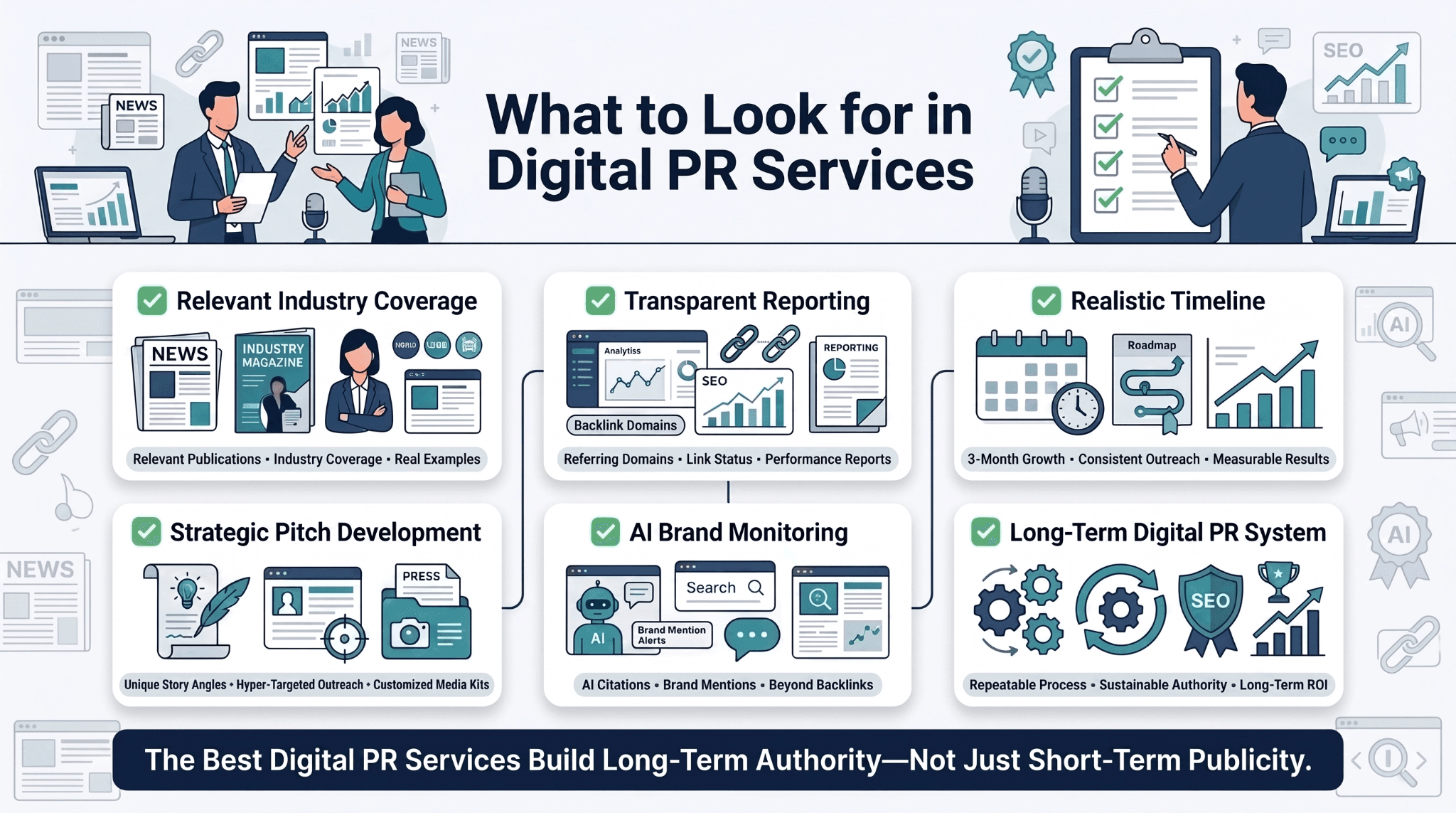
Ask for examples of past coverage in publications relevant to your industry, not just high-traffic sites in unrelated niches.
-
Request a clear reporting structure that tracks referring domains and link status, not just media mentions.
-
Confirm realistic timelines, since most digital PR efforts take around three months to produce measurable results.
-
Check whether the team tracks brand citations in AI search tools, not only traditional backlinks.
A provider that meets these standards tends to treat digital PR as a repeatable system rather than a one-time media push, which is the clearest signal of long-term value for the budget involved.
What Common Mistakes Weaken a Digital PR Strategy?
The most common mistakes tend to repeat across otherwise well-resourced campaigns:
-
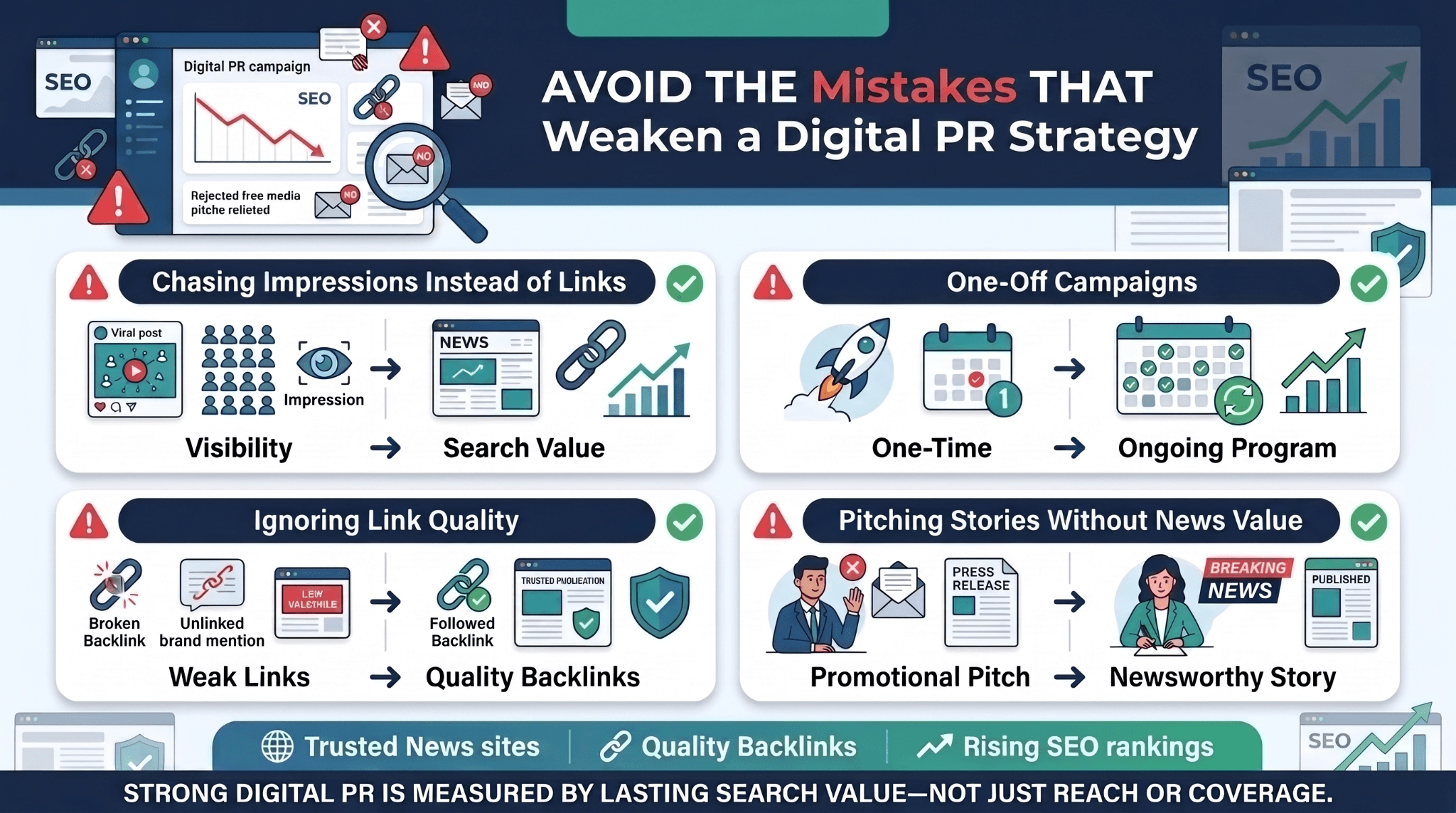
Chasing impressions instead of links. A story that reaches a large audience but produces no citation or backlink does little for search visibility.
-
Running one-off campaigns with no follow-up. Digital PR compounds when treated as an ongoing program, not a single push tied to a launch.
-
Ignoring link type differences. A followed link and a syndicated, unlinked mention do not carry the same ranking value.
-
Pitching stories with no real news value. Journalists reject pitches that read like a press release, and repeated irrelevant pitches damage future outreach.
Most of these mistakes share the same root cause: measuring digital PR by reach and coverage volume rather than by the durable search value each placement actually produces. Reviewing pitches and results against that standard before they go out prevents most of these issues from recurring.
What Do Readers Usually Want to Know About Digital PR?
A few questions come up in nearly every conversation about building a digital PR program. Here are direct answers to the ones asked most often.
Is digital PR the same as link building?
Not exactly. Link building is the broader goal of earning backlinks through any method. Digital PR is one approach, focused on earning coverage through journalism rather than directories or paid placement. We treat digital PR as one layer within a wider link acquisition system, not a standalone tactic.
How long does digital PR take to show results?
Most campaigns take around three months to produce measurable link and ranking movement. Data-driven and reactive campaigns tend to move faster, while creative or partnership-based campaigns take longer to plan. We structure our digital PR programs to deliver early wins through reactive PR while longer-term data campaigns build toward bigger placements.
How much do digital PR services cost?
Pricing varies by scope, but most teams now pay $300 or more per earned placement, with a meaningful share paying above $500. Our digital PR services are built around earned placements rather than flat retainers, so spend maps directly to the coverage a business actually receives.
Do digital PR links help with AI search visibility, not just Google rankings?
Brand mentions earned through digital PR are increasingly relevant to how AI search tools select sources, since these systems favor content already validated by independent publications. Tracking this is a standard part of how WellsGroup reports on every digital PR strategy it runs.
Should a small business invest in a digital PR strategy?
Yes, though the scale should match the business. A smaller company may start with expert commentary and reactive PR before investing in larger data-driven campaigns. We typically build programs this way, starting lean and scaling the strategy as results and budget allow.
Building a Digital PR Strategy That Lasts
A digital PR strategy works because it replaces manufactured links with earned trust, the kind search engines and AI systems cannot fake or automate. Every tactic covered here, from data-led stories to executive visibility, points to the same operating principle: coverage has to be genuinely worth writing about before it is worth linking to.
What separates a lasting program from a short-lived campaign usually comes down to three habits: treating digital PR as infrastructure rather than a one-time push tied to a single launch, measuring earned links and citations instead of impressions, and tracking visibility across AI search the same way as traditional rankings.
Brands that build this way keep compounding authority with every placement. Brands that treat digital PR as a campaign tend to start from zero each time they need visibility again. If you are ready to build a digital PR program that operates continuously rather than in bursts, get a proposal from WellsGroup to design and manage the system end to end.