Conversion Rate Optimization: 5 Fundamentals Driving 2026 Growth
Boost more conversions in 2026 with proven CRO fundamentals that reduce friction, improve user experience, and turn more website visitors into customers.

Conversion rate optimization is the structured process of increasing the percentage of website visitors who complete a desired action, such as a purchase or a form submission. In 2026, five fundamentals drive results: strategy, website experience, audits, testing tools, and e-commerce-specific execution, applied as one continuous system rather than a single project.
Most businesses treat conversion rate optimization as an occasional project, something to revisit after a redesign or a slow quarter. The five fundamentals below are built for a different approach, one where conversion performance is monitored and adjusted continuously, the same way uptime or security would be. If your team is ready to see where your funnel is actually losing revenue, get a proposal from WellsGroup.
What Is Conversion Rate Optimization?
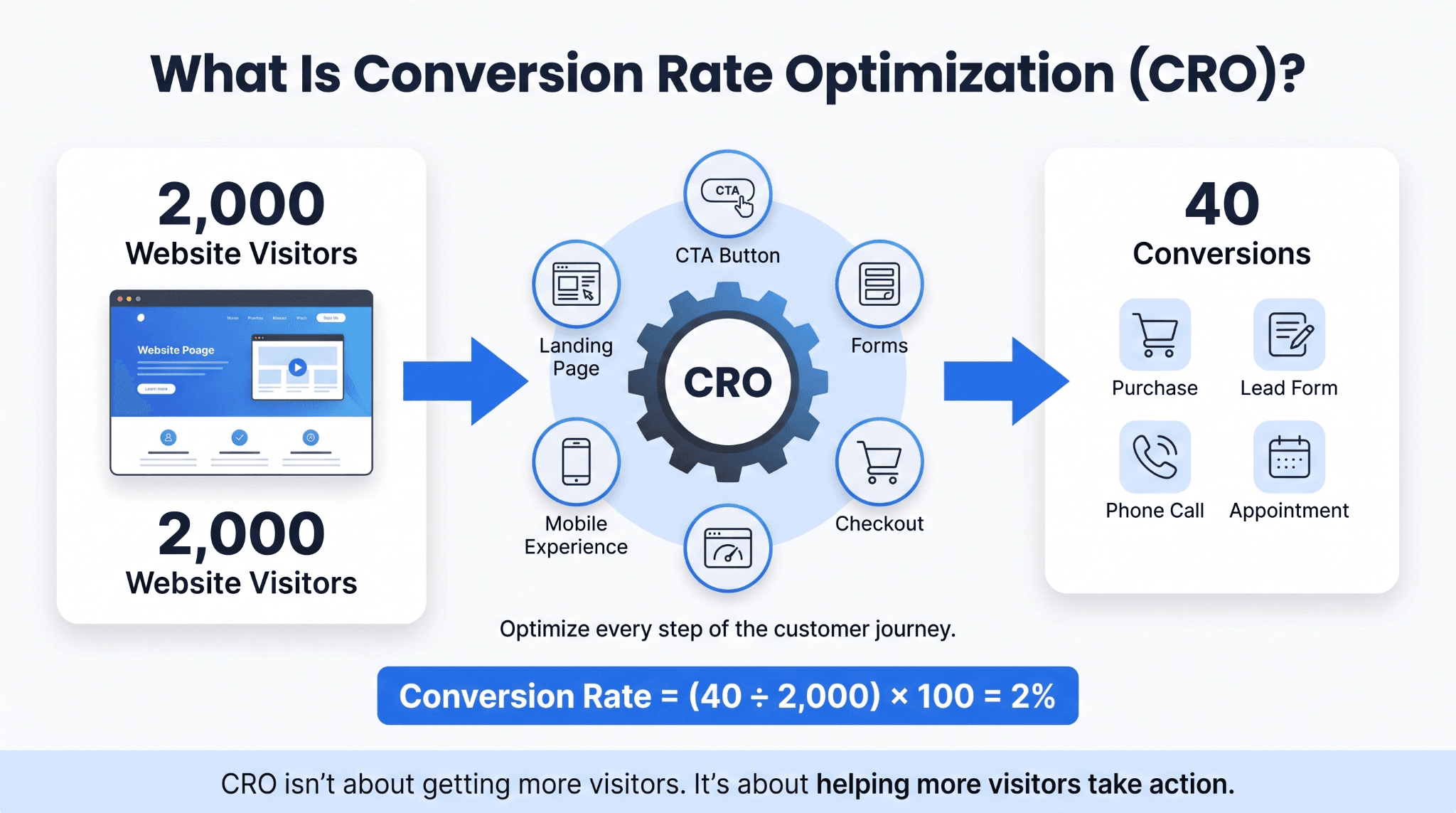
Conversion rate optimization, or CRO, is the practice of increasing the share of visitors who complete a defined action on a website.
The formula behind it is simple:
-
Conversion rate equals total conversions divided by total sessions, multiplied by 100
-
A page with 2,000 sessions and 40 completed purchases converts at 2 percent
That formula only measures an outcome. It says nothing about why a visitor converts or fails to, which is the actual work of conversion rate optimization. CRO is treated as an operational discipline, not a marketing tactic:
-
Every page, form, and checkout step is part of one system
-
That system either supports revenue or leaks it
-
The goal is infrastructure that runs continuously, not a project with an end date
Why Does Conversion Rate Optimization Matter for Business Growth in 2026?
Two forces are reshaping digital growth heading into 2026:
-
Cost. Paid acquisition across search and social keeps climbing, which makes every existing visitor more valuable than the next one that a business would have to buy.
-
Discovery. Mobile conversion rates are moving closer to desktop, and AI-powered search is changing how products get discovered in the first place.
For most businesses, buying more traffic is the default response to a growth plateau. Conversion rate optimization is the alternative. It treats the traffic a business already owns, whether from organic search, paid campaigns, or referral, as the primary growth lever.
This is why conversion rate optimization sits inside the same operational system as SEO, PPC, and AI search visibility rather than as a standalone service. A visitor who arrives through an AI Overview citation still needs a page that converts.
What Are the 5 Fundamentals of Conversion Rate Optimization?
Conversion rate optimization is not a technique applied once. It is five interlocking fundamentals that operate together, each addressing a different layer of the system, from the strategic decisions made before a single test runs to the execution details that show up on a live product page. The five sections below walk through each fundamental in the order a business would typically build them.
How Do You Build a Strong Conversion Rate Optimization Strategy?
A conversion rate optimization strategy starts with a decision most businesses skip: defining what actually counts as a conversion. Strong conversion rate optimization strategies separate two types of goals:
-
Macro conversions: the primary revenue action, such as a completed purchase or signed contract
-
Micro conversions: supporting steps like add to cart, trial signup, or email capture
Tracking both matters operationally. It tells a team where in the funnel a system is actually breaking, rather than optimizing a metric that looks better without moving revenue.
What Website Conversion Rate Optimization Practices Improve User Experience?
Website conversion rate optimization focuses on removing friction between intent and action. Three factors carry the most weight in 2026:
-
Load speed. According to page speed data reported by BloggersIdeas, Walmart found that every 100-millisecond improvement in page speed resulted in a 2 percent increase in conversions and a 1 percent lift in incremental revenue. At that scale, milliseconds compound into measurable revenue.
-
Mobile usability. If most of a site's traffic arrives on mobile but converts at a fraction of the desktop's rate, the gap usually traces back to checkout steps, form length, or layout shift, not product demand.
-
Navigational clarity. Visitors who cannot find the next step disengage before they ever reach a conversion point.
How Does a Conversion Rate Optimization Audit Identify Weak Points?
A conversion rate optimization audit is a structured review of analytics, session behavior, and funnel data used to locate exactly where visitors disengage. Unlike a general website review, an audit is diagnostic:
-
It isolates the step in the funnel losing the most value
-
It replaces guesswork with a ranked list of friction points
-
It orders those friction points by traffic volume and drop-off rate, so the highest-impact fix gets built first
Which Conversion Rate Optimization Tools Support Testing and Analysis?
Conversion rate optimization tools fall into three functional categories:
-
Analytics platforms that quantify what is happening
-
Behavioral tools, such as session recordings and heatmaps, that show why
-
Testing platforms that validate a fix before it rolls out sitewide
Choosing tools matters less than understanding sample size. Per research published by Convertibles, a business needs roughly 50,000 visitors per variant, or 100,000 total, to reach statistically significant A/B test results at a 2 percent baseline conversion rate. Lower-traffic sites should prioritize qualitative tools like session recordings over formal split testing, since underpowered tests produce false confidence rather than insight.
What Ecommerce Conversion Rate Optimization Best Practices Drive Sales?
Ecommerce conversion rate optimization concentrates on the two points where most revenue is lost: the product page and checkout.
-
Product pages need clear pricing, sufficient trust signals such as reviews, and fast image loading
-
Checkout needs the shortest possible number of fields and visible security signals near the payment entry
Per benchmark data reported by Propel Commerce, mobile converts at roughly 35 percent lower than desktop on the average Shopify store, and that gap widens at the top of the distribution. This makes mobile checkout the single highest-impact fix available to most online retailers in 2026.
Website conversion rate optimization looks different depending on whether it is treated as a project or as an operating system. The comparison below outlines the difference directly.
|
Traditional Approach |
Systems-Based Approach |
|
One-time redesign project |
Continuously monitored and adjusted system |
|
Tests run in isolated campaigns |
Tests run inside an ongoing operating cadence |
|
Success measured by clicks or launches |
Success measured by revenue per session |
|
Handoff ends at delivery |
Operation continues after deployment |
How Do You Run a Conversion Rate Optimization Audit Step by Step?
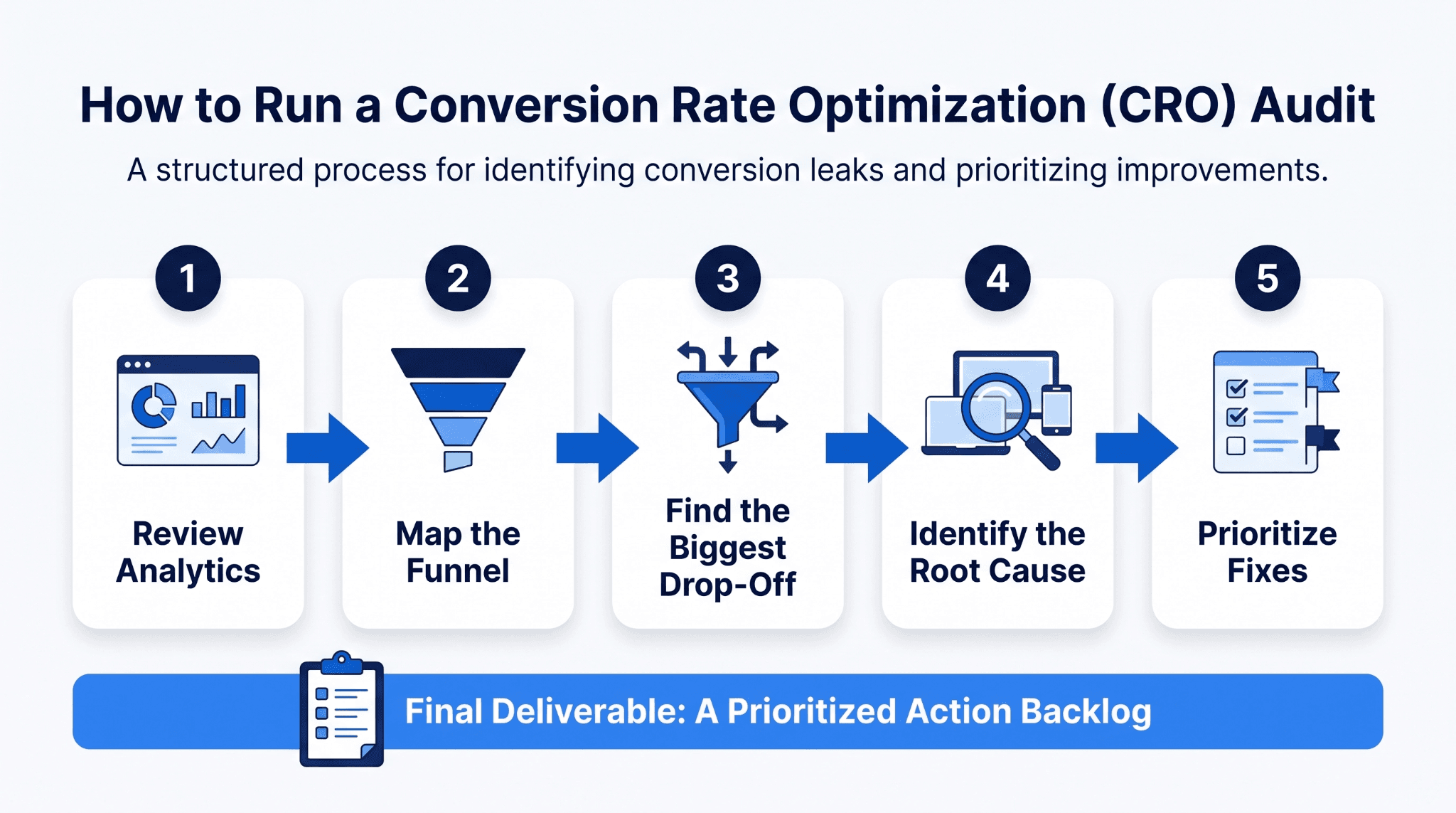
Running a conversion rate optimization audit follows a consistent sequence regardless of industry or platform. The process below reflects how WellsGroup structures audits across ecommerce, SaaS, and logistics clients:
-
Review analytics to establish baseline conversion rate, session volume, and traffic source mix
-
Map the funnel from the landing page to the final conversion, marking every required step
-
Identify the highest drop-off point using session data, not assumptions
-
Cross-reference drop-off points with device and traffic source to isolate the real cause
-
Prioritize fixes by combining traffic volume with ease of implementation
The output should be a ranked backlog, not a list of general recommendations. A ranked backlog tells a team exactly which fix to build first, based on the volume of traffic passing through that specific point in the funnel.
What Mistakes Reduce the Success of Conversion Rate Optimization Efforts?
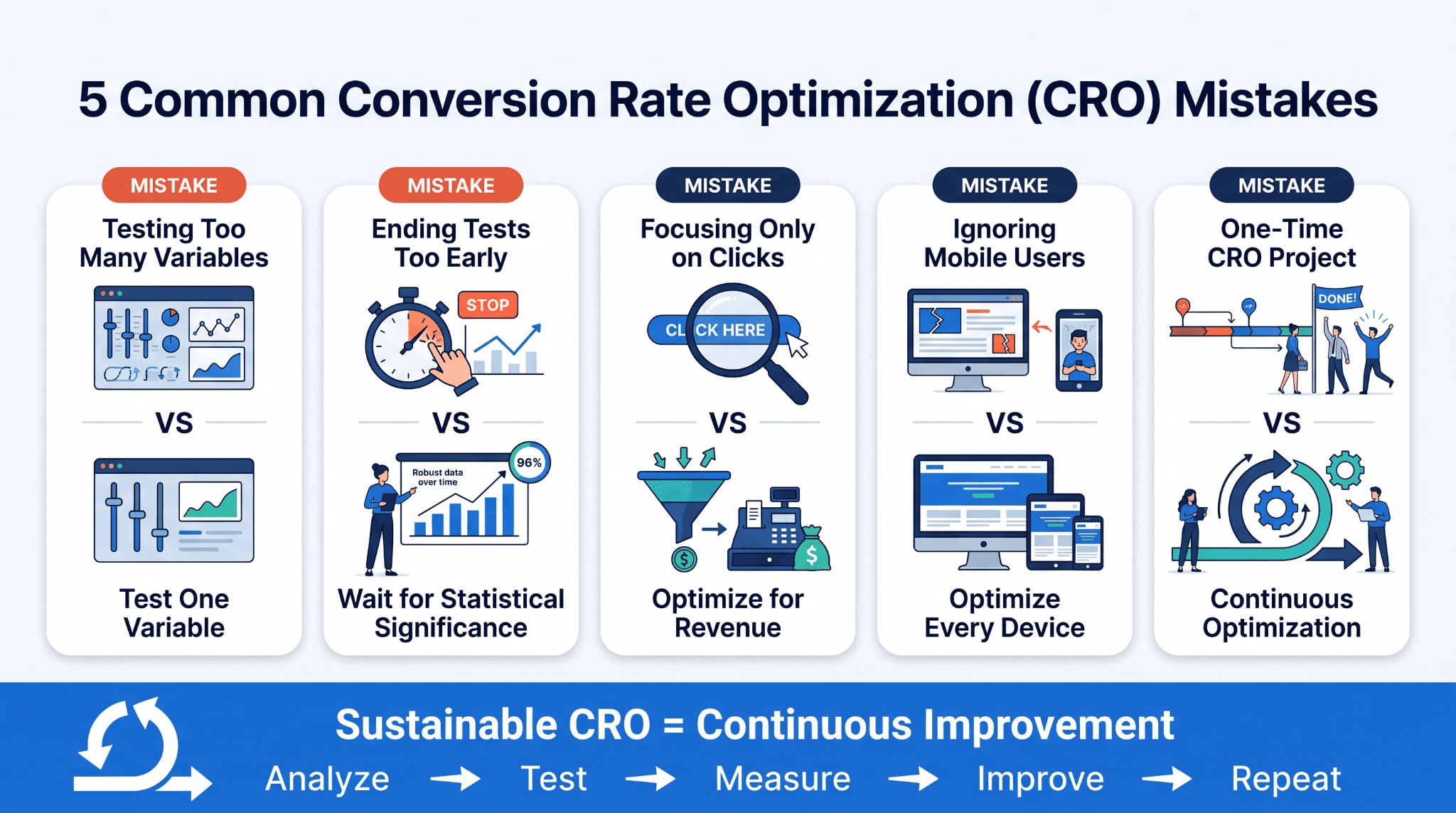
Most failed conversion rate optimization efforts fail for operational reasons, not creative ones. The most common mistakes include:
-
Testing multiple variables at once, which makes it impossible to isolate which change caused a result
-
Ending tests before reaching statistical significance, which produces false positives
-
Optimizing for clicks or form starts instead of completed revenue actions
-
Treating mobile as a smaller version of desktop instead of a distinct experience
-
Running conversion rate optimization strategies as isolated sprints instead of a continuous operating process
That last point is the most consequential. A single successful test does not compound if the underlying system reverts once the campaign ends. Sustainable conversion rate optimization strategies are built as ongoing operations, not seasonal initiatives.
What Readers Want to Know About Conversion Rate Optimization
The questions below come up consistently across search behavior and buyer conversations, regardless of industry. Each answer is kept short and direct, since these are the moments when a reader wants a clear takeaway rather than another framework.
What is a good conversion rate?
There is no single answer, since it varies by industry, traffic source, and device. As a reference point, most ecommerce sites convert between 1.4 percent and 3 percent, with top performers reaching 3.2 percent or higher, which is the range we target when auditing a client's funnel.
How do you calculate conversion rate?
Conversion rate equals total conversions divided by total sessions, multiplied by 100. It is a simple formula on paper, but getting an accurate, decision-ready number usually requires the kind of tracking setup WellsGroup builds into every client's analytics stack.
What is the difference between conversion rate optimization and SEO?
SEO increases the volume and relevance of traffic arriving at a website, while CRO increases the percentage of that traffic that converts. We treat them as one connected system rather than separate services, since visibility without conversion leaves revenue on the table.
How long does it take to see results from conversion rate optimization?
Directional signals can surface within two to three weeks, while statistically valid results often take four to eight weeks, depending on traffic. We structure every engagement around this timeline so clients see an early signal without mistaking noise for a real result.
What tools do I need to start a conversion rate optimization audit?
At a minimum, an audit needs an analytics platform, a behavioral tool like session recording, and a testing platform once traffic supports it. WellsGroup selects and configures this stack as part of every audit, so clients are not left guessing which tools are worth paying for.
What's the biggest mistake businesses make with conversion rate optimization?
Treating it as a single project instead of an operating system. This is exactly the gap we were built to close, since a redesign that lifts conversions once will not hold that lift without a team monitoring and adjusting the system afterward.
Turning Conversion Insights Into Sustainable Growth
The five fundamentals covered here point to the same conclusion: conversion rate optimization performs best as infrastructure, not as a campaign. A strategy that defines the right conversion, a website built to remove friction, a recurring audit process, the right testing tools, and e-commerce-specific execution only compound when they operate together, continuously, inside one system.
This is the operational model built for founders, operations leaders, and marketing teams who need conversion performance that survives beyond a single quarter. Rather than delivering a redesign and moving to the next client, WellsGroup remains accountable for how that system performs after launch.
If your current conversion rate optimization strategies are running as isolated projects rather than a connected system, book a free consultation to see where the highest-impact fix in your funnel actually is.