AI in Business Operations Is Redefining How Modern Companies Operate
Learn how AI is streamlining operations, reducing costs, improving forecasting, and helping businesses build lasting competitive advantages in 2026.

A logistics manager at a regional freight company used to spend three hours every morning reading dispatch reports, cross-referencing delivery windows, and flagging exceptions manually. Today, an AI layer inside his operations stack surfaces the same analysis in under ten minutes. That is the operational baseline for businesses that have made the structural shift.
AI in business operations has moved well past the experimental stage. According to McKinsey's 2025 State of AI report, 78% of organizations now use AI in at least one business function, up from 55% in 2023. In supply chain management alone, 61% of respondents report cost reductions from AI deployment.
This article breaks down where the measurable gains are coming from, where businesses are still getting it wrong, and what the landscape looks like through 2026 and beyond.
What "AI in Business Operations" Actually Means Today
Most people hear "AI" and think of consumer products. Operational AI is different. It sits inside business workflows, running continuously in the background, driving scheduling, compliance, forecasting, and infrastructure decisions.
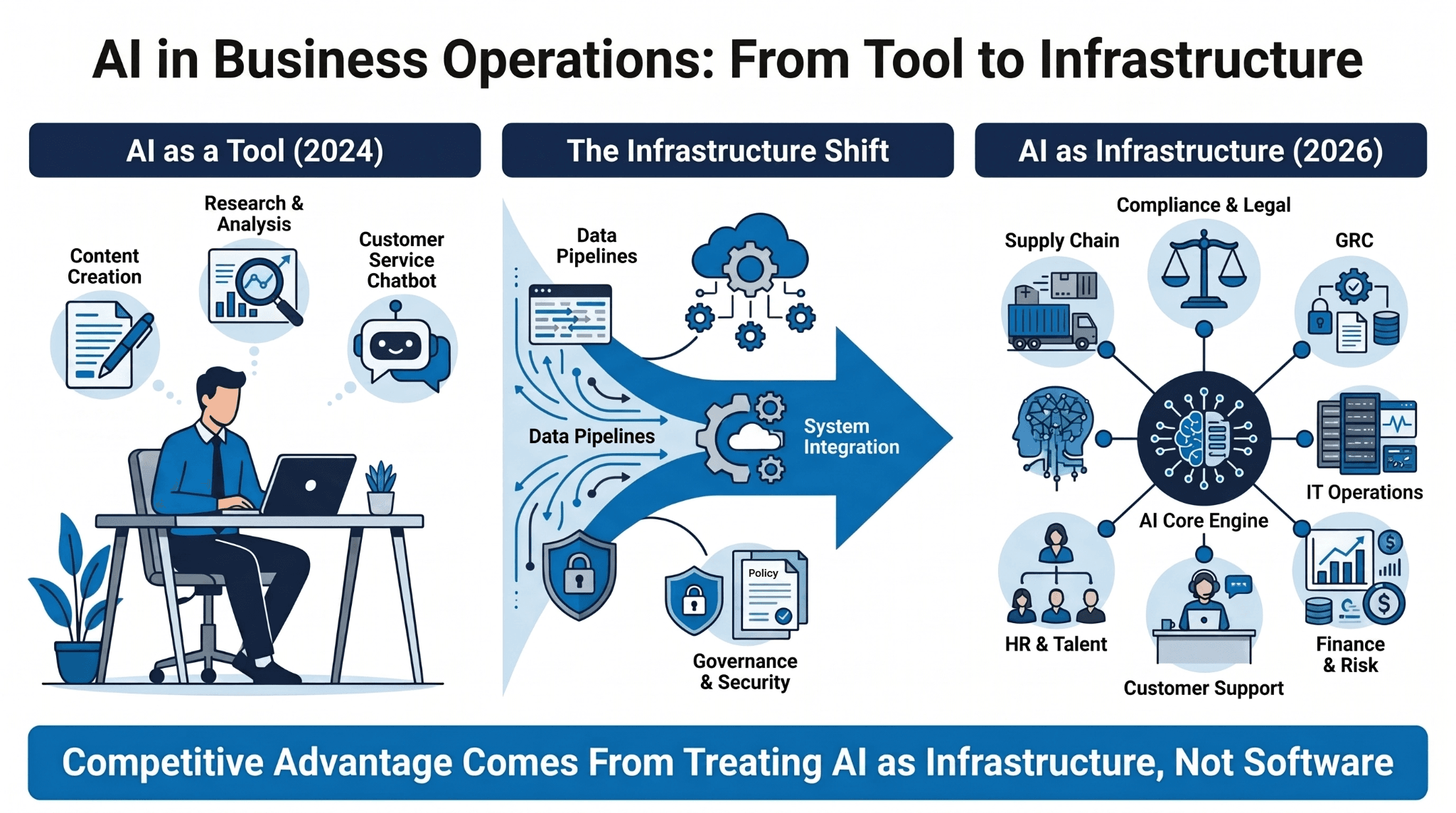
The critical distinction is between AI as a tool and AI as infrastructure. A tool is something your team reaches for occasionally. Infrastructure is what your business runs on around the clock. Most companies in 2024 were using AI as a tool. The businesses building real competitive advantage in 2026 are treating it as infrastructure.
Using AI in business operations today means it is active across:
-
Supply chain demand forecasting and inventory optimization
-
Document processing and compliance checks
-
IT infrastructure monitoring and anomaly detection
-
HR screening and employee onboarding automation
-
Customer support triage and routing
-
Financial reconciliation and real-time reporting
The shift from tool to infrastructure is architectural. It requires clean data pipelines, defined output ownership, and system-wide integration rather than isolated deployments.
The Core Areas Where AI in Business Operations Is Making the Biggest Difference
The real operational gains from AI are not spread evenly. They concentrate in high-volume workflow categories where pattern recognition and automation compound over time.
How Generative AI Is Rewriting Back-Office Work
Generative AI in business operations is cutting documentation time by hours each week, freeing teams for higher-judgment work. The back-office bottleneck has never been people working slowly. It has been the endless volume of low-complexity, high-repetition documentation.
Generative AI handles that volume directly, including:
-
RFP drafting and vendor communication templates
-
Invoice reconciliation notes and billing dispute summaries
-
Performance review templates and HR policy documentation
-
Regulatory filing summaries and compliance updates
Gartner confirmed that by 2026, more than 80% of enterprises will have used generative AI APIs or deployed generative AI-enabled applications in production, up from less than 5% in 2023. That prediction is now a present reality.
The operational gain is throughput, not headcount reduction. The bottleneck shifts from document production to judgment and approval, which is precisely where human expertise belongs.
AI and Machine Learning in Predictive Operations
AI and machine learning applications in business operations are not interchangeable terms. Machine learning reads patterns in historical data and generates predictions. Generative AI creates content and communication. Conflating the two leads to misapplied deployments and unmet expectations.
Machine learning is where predictive operations live. Here is what that shift looks like in practice:
|
Traditional Operations |
ML-Driven Operations |
|
Scheduled maintenance regardless of the equipment state |
Predictive maintenance triggered by sensor anomaly patterns |
|
Demand planning based on last quarter's numbers |
Demand sensing using real-time market and weather signals |
|
Manual churn identification after cancellation signals |
Predictive models flagging at-risk accounts 60 to 90 days early |
|
IT outage response after systems fail |
Anomaly detection before user-facing impact occurs |
McKinsey research confirms that AI-based predictive maintenance generates roughly a 10% reduction in annual maintenance costs and up to a 25% reduction in unplanned downtime. In environments where downtime equals direct revenue loss, that is a structural advantage, not a marginal one.
The Real Benefits: What the Numbers Say
The benefits of AI in business operations are well-documented, but they only materialize when AI is matched to specific workflow problems rather than deployed broadly.
The McKinsey Global Institute estimates AI can deliver cost reductions of up to 40% across sectors by automating tasks and improving efficiency. The results concentrate in specific functions: supply chain and inventory management saw a 61% cost reduction rate among adopters, and service operations saw 58%.
Consistently supported benefits across research include:
-
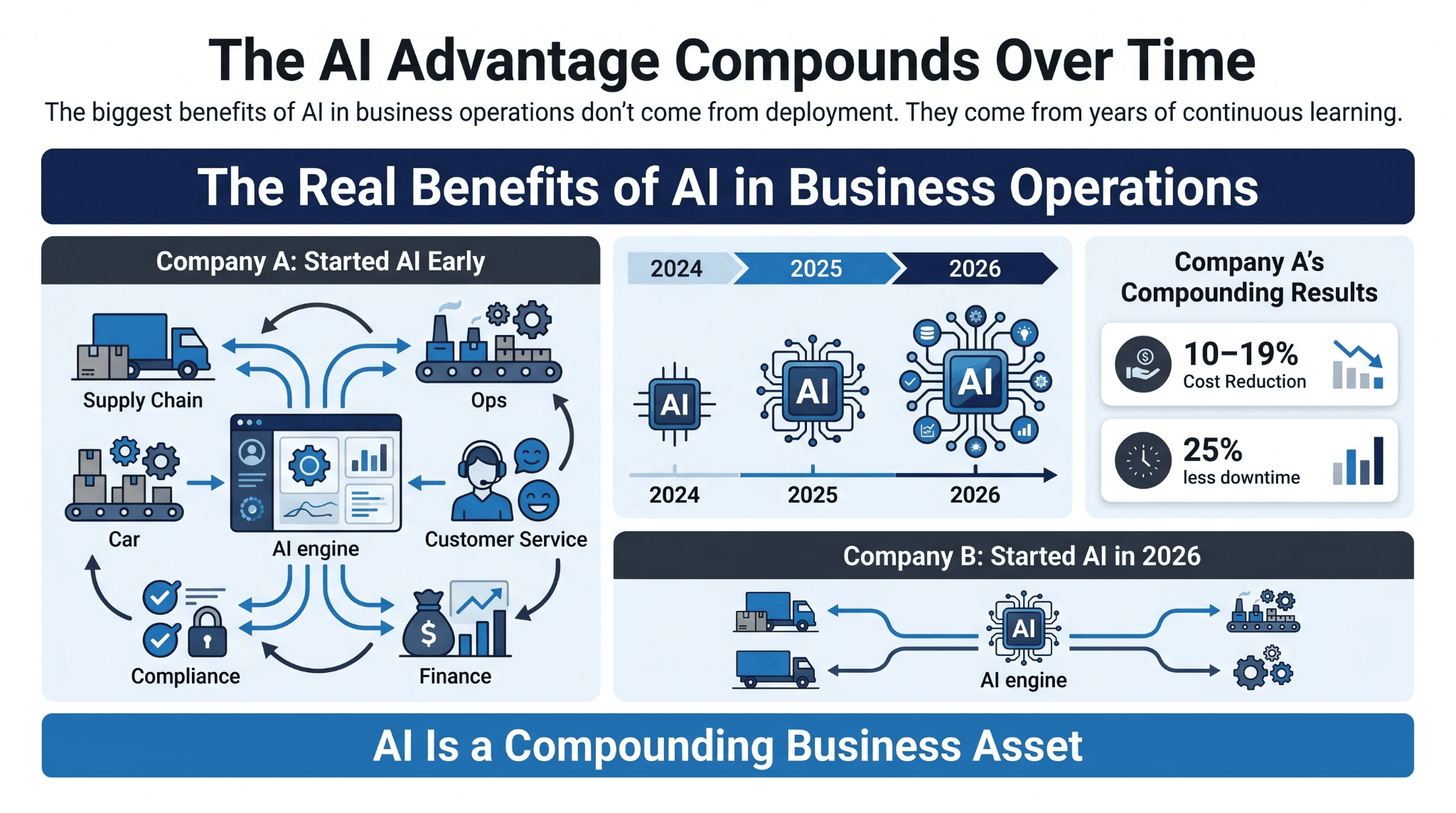
Cost reductions of 10% to 19% in supply chain functions
-
Up to 25% reduction in unplanned equipment downtime through predictive maintenance
-
Faster customer onboarding through AI-powered routing and triage
-
Lower error rates in document-heavy compliance processes
-
Earlier detection of supply chain disruption signals
AI applications in business operations compound because the systems learn. A predictive model running for three years is substantially more accurate than one running for six months. Businesses that delayed building these systems in 2024 and 2025 are not catching up in 2026 with a single deployment. They are starting a process their competitors already have years of learning behind.
Where Businesses Are Getting It Wrong
Most AI implementation failures are not technology failures. They are integration and expectation failures.
For AI to truly reshape operational workflows in business, the underlying workflows need to be documented, measurable, and understood before automation touches them. That is what most organizations skip.
The most common mistakes follow a predictable pattern:
-
Deploying AI before cleaning and governing data pipelines
-
Having no defined ownership of AI outputs and errors
-
Treating AI as a cost-cutter first rather than a throughput improvement
-
Skipping workforce training, leading to adoption resistance
-
Choosing broad generic tools over workflow-specific deployments
MIT's Project NANDA, analyzing over 300 publicly disclosed AI initiatives, found that only about 5% of pilots reached production with measurable value. Gartner adds that 60% of AI projects lacking AI-ready data will be abandoned through 2026, and 73% of failed projects had no agreed definition of success before they started.
AI amplifies existing process quality. A broken intake workflow, when automated, becomes a faster broken intake workflow. Fix the process first. Then automate.

Industry-Specific Operational Applications
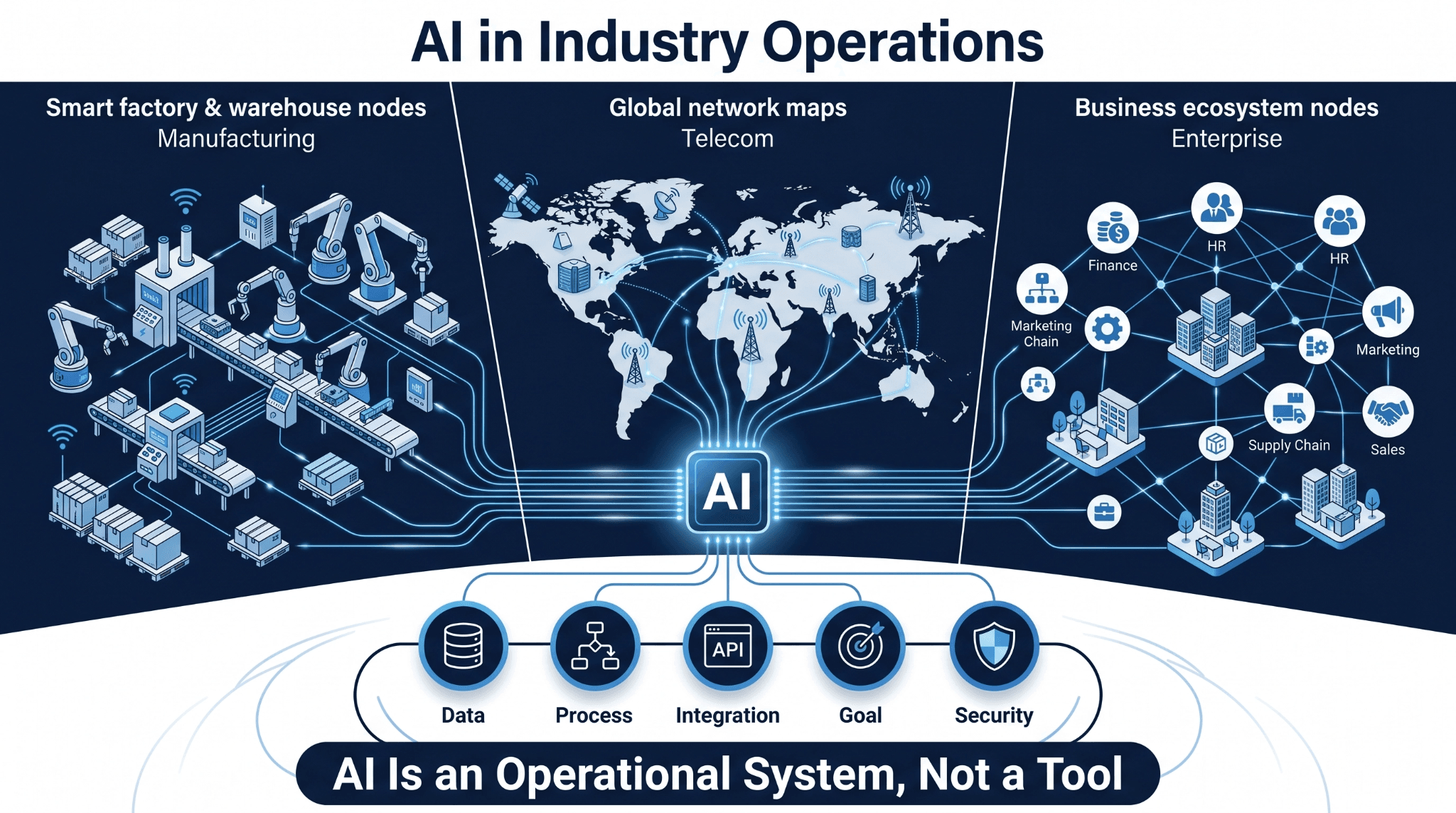
The operational gains from AI vary by context, but the architectural principles are consistent. High-volume, real-time, pattern-heavy environments see the clearest and fastest returns.
AI Applications for Operational Reliability in Manufacturing and Logistics
AI applications for operational reliability in businesses like manufacturing and logistics are running production lines and delivery networks right now, not in pilot environments.
Active AI deployments in these sectors include:
-
Sensor-based equipment health monitoring that flags anomalies before mechanical failure
-
Dynamic scheduling that adjusts production sequences in response to supply chain signals
-
Supplier risk scoring that surfaces vendor reliability issues before they cascade
-
Automated quality inspection through computer vision
DHL's warehouse automation systems have produced a 35% productivity increase and order accuracy approaching 99.7%. Their 2025 AI agent deployment for appointment scheduling, transport status calls, and warehouse coordination already targets hundreds of thousands of emails and millions of voice minutes annually.
The principle behind those results is orchestration. AI is not running isolated tasks. It is coordinating across the supply chain so that a shift in demand is sensed immediately and adjusts picking priorities, dispatch scheduling, and last-mile routing as a connected system.
How CSPs Are Using AI in Customer and Business Operations
AI in CSP customer and business operations addresses a specific challenge: delivering uninterrupted service to millions of users while managing network complexity that no human team can monitor at scale. Telecoms and internet providers adopted operational AI early for exactly this reason, and their model transfers to any organization managing real-time service delivery at volume.
CSP operational AI applications now in production include:
-
Network anomaly detection identifies service degradation before customers are affected
-
Automated complaint routing based on issue type and resolution probability
-
Predictive churn models surfacing at-risk accounts 60 to 90 days before cancellation
-
Billing dispute automation resolving standard categories without human intervention
-
Field engineer scheduling optimization reduces travel time and improves first-visit resolution
What AI Is Essential in Modern Business Operations Actually Requires
When people say AI is essential in modern business operations, the real meaning is this: the competitive gap between businesses that have integrated it structurally and those that have not is now measurable and growing.
Readiness is not binary. Most businesses are partially ready. The question is where to start.
Here is what operational AI readiness looks like across five dimensions:
|
Readiness Dimension |
What It Looks Like in Practice |
|
Data Governance |
Clean, labeled, consistently structured data with defined ownership |
|
Process Documentation |
Workflows mapped to inputs, outputs, and decision points before automation |
|
Integration Architecture |
Systems that can receive AI outputs and act on them without manual handoff |
|
Outcome Definition |
Specific, measurable success criteria agreed before any pilot begins |
|
Ownership Structure |
Named accountability for AI outputs, errors, and continuous improvement |
Organizations that deploy AI without these foundations do not fail because of the AI. They fail because the AI makes the absence of these foundations visible and faster.
What Is Coming: AI Trends in Business Operations for the Next Three Years
The next 36 months of operational AI are already visible in current deployment patterns. Five directions are clear.
Agentic AI as an Execution Layer
Gartner predicts 40% of enterprise applications will include task-specific AI agents by the end of 2026, up from less than 5% in 2025. These systems plan and act autonomously across connected business systems. By 2029, 70% of enterprises are expected to deploy agentic AI as part of IT infrastructure operations.
AI Ops Platforms
Dedicated platforms for managing AI model performance inside live operations are entering mainstream deployment, monitoring model drift and accuracy degradation without manual oversight for every update.
Vertical AI Models
General-purpose models are giving way to domain-trained alternatives built for legal, medical, logistics, and financial environments. Where accuracy is non-negotiable, vertical AI is becoming the default choice.
AI Governance Layers
With the EU AI Act in force and regional regulations accelerating, compliance infrastructure built directly into AI pipelines is now an operational requirement.
Human-AI Learning Structures
New roles centered on AI oversight, output validation, and escalation management are emerging, requiring domain expertise combined with AI literacy.
AI applications in business operations will continue to compound in depth and specificity. Businesses building governance and integration infrastructure now will hold a structural accuracy advantage that generic tooling cannot close.
What Operators Are Asking About AI
The most common questions we hear from founders and operations leaders come down to the same core concerns: where to start, what actually works, and what to avoid.
What are the most practical uses of AI in business operations today?
Supply chain forecasting, compliance automation, predictive maintenance, and customer support triage are where the clearest ROI lives right now. These are high-volume, pattern-based workflows where AI compounds quickly. At WellsGroup, these are also the workflows we map first during system discovery, because the gains are measurable and fast.
How does generative AI differ from other types of AI used in business?
Generative AI creates content, including reports, contracts, and summaries. Machine learning reads historical patterns and generates predictions. They serve different operational purposes and work best when deployed together inside a unified architecture, which is exactly how WellsGroup integrates them across client systems.
What does a business need before implementing AI in its operations?
Clean data pipelines, documented workflows, integration architecture, defined success metrics, and named output ownership. Without these, AI accelerates existing process failures rather than eliminating them. WellsGroup starts every engagement with a system discovery audit precisely because this foundation determines everything that follows.
Which industries benefit most from AI in operational workflows?
Manufacturing, logistics, financial services, and communication service providers have the most documented track records. The architectural principles transfer directly to SaaS, marketplace, and education businesses. If your operation involves real-time data at volume, the ROI case for operational AI is strong regardless of industry.
What are the biggest risks of using AI in day-to-day business operations?
Undefined output ownership, poor data quality, generic tool selection, and treating deployment as a finish line rather than a continuous system. The businesses that avoid these risks are the ones that approach AI as an operational discipline, not a one-time project. That is the operator model WellsGroup was built around.
Is Your Business Ready to Make This Shift?
AI in business operations is not primarily a technology decision. It is an infrastructure decision. The organizations generating real competitive advantage are not the ones with the most sophisticated models. They are the ones who built the data foundations, process discipline, and integration architecture to make AI outputs actionable.
The question is not whether AI will change your operations. It already is. The question is whether you are directing that change or absorbing its effects.
Start with one process. Make sure the workflow is documented, the success metric is clear, and the data is clean. Measure it. Then build.